Learn about the mega forces driving a global economic transformation of the energy system and how you can capitalize on this momentum.

To reach a different BlackRock site directly, please update your user type.
The iShares Global Clean Energy ETF seeks to track an index of global companies involved in clean energy. The fund offers a way to pursue long-term growth in renewable energy.
As part of its investment objective this fund seeks to track an index that applies the following business involvement screens: controversial weapons, small arms, military contracting, tobacco, thermal coal, oil sands, shale energy and arctic oil and gas exploration. The business involvement screens are based on revenue or percentage of revenue thresholds for certain categories and categorical exclusions for others. Please read the definition for each screen here.
This information must be preceded or accompanied by a current prospectus. For standardized performance, please see the Performance section.
Holdings are subject to change.
The values shown for “market value,” “weight,” and “notional value” (the “calculated values”) are based off of a price provided by a third-party pricing vendor for the portfolio holding and do not reflect the impact of systematic fair valuation (“the vendor price”). The vendor price is not necessarily the price at which the Fund values the portfolio holding for the purposes of determining its net asset value (the “valuation price”). Holdings data shown reflects the investment book of record, which may differ from the accounting book of record used for the purposes of determining the Net Assets of the Fund. Notional value represents the portfolio's exposures based on the economic value of investments and options are delta-adjusted. Additionally, where applicable, foreign currency exchange rates with respect to the portfolio holdings denominated in non-U.S. currencies for the valuation price will be generally determined as of the close of business on the New York Stock Exchange, whereas for the vendor price will be generally determined as of 4 p.m. London. The calculated values may have been different if the valuation price were to have been used to calculate such values. The vendor price is as of the most recent date for which a price is available and may not necessarily be as of the date shown above.
Please see the “Determination of Net Asset Value” section of each Fund’s prospectus for additional information on the Fund’s valuation policies and procedures.
“Quantity” represents the number of shares, units or contracts of the corresponding security, as applicable per security type.
| Renewable Electricity | 27.33% |
| Heavy Electrical Equipment | 18.54% |
| Semiconductors | 15.88% |
| Electrical Components & Equipment | 13.90% |
| Electric Utilities | 13.42% |
| Semiconductor Equipment | 7.85% |
| Oil & Gas Refining & Marketing & Transportation | 1.71% |
| Independent Power Producers & Energy Traders | 0.54% |
| Cash and/or Derivatives | 0.41% |
| Steel | 0.26% |
| Industrial Machinery & Supplies & Components | 0.14% |
Allocations are subject to change.
| 1y | 3y | 5y | 10y | Incept. | |
|---|---|---|---|---|---|
Total Return (%) | 58.45 | 5.34 | -1.27 | 10.72 | -3.06 |
Market Price (%) | 57.94 | 5.23 | -1.37 | 10.63 | -3.07 |
Benchmark (%) | 59.25 | 5.46 | -1.15 | 10.71 | -3.66 |
After Tax Pre-Liq. (%) | 58.04 | 5.02 | -1.55 | 10.30 | -3.53 |
After Tax Post-Liq. (%) | 34.79 | 4.07 | -0.99 | 8.76 | -2.33 |
The performance quoted represents past performance and does not guarantee future results. Investment return and principal value of an investment will fluctuate so that an investor's shares, when sold or redeemed, may be worth more or less than the original cost. Current performance may be lower or higher than the performance quoted.
The ETF total return may appear to diverge from the return of its benchmark. This may be due to the use of systematic fair value. Click here for more information
The Hypothetical Growth of $10,000 chart reflects a hypothetical $10,000 investment and assumes reinvestment of dividends and capital gains. Fund expenses, including management fees and other expenses were deducted.
The performance quoted represents past performance and does not guarantee future results. Investment return and principal value of an investment will fluctuate so that an investor’s shares, when sold or redeemed, may be worth more or less than the original cost. Current performance may be lower or higher than the performance quoted, and numbers may reflect small variances due to rounding. Standardized performance and performance data current to the most recent month end may be found in the Performance section.
| Jun 15, 2026 | Jun 15, 2026 | Jun 18, 2026 | $0.056063 | $0.056063 | $0.000000 | $0.000000 | $0.000000 |
| Dec 16, 2025 | Dec 16, 2025 | Dec 19, 2025 | $0.128205 | $0.128205 | $0.000000 | $0.000000 | $0.000000 |
| Jun 16, 2025 | Jun 16, 2025 | Jun 20, 2025 | $0.139649 | $0.139649 | $0.000000 | $0.000000 | $0.000000 |
| Dec 17, 2024 | Dec 17, 2024 | Dec 20, 2024 | $0.114179 | $0.114179 | $0.000000 | $0.000000 | $0.000000 |
| Jun 11, 2024 | Jun 11, 2024 | Jun 17, 2024 | $0.095878 | $0.095878 | $0.000000 | $0.000000 | $0.000000 |
| Dec 21, 2023 | Dec 20, 2023 | Dec 27, 2023 | $0.122752 | $0.122752 | $0.000000 | $0.000000 | $0.000000 |
| Jun 08, 2023 | Jun 07, 2023 | Jun 13, 2023 | $0.124629 | $0.124629 | $0.000000 | $0.000000 | $0.000000 |
| Dec 14, 2022 | Dec 13, 2022 | Dec 19, 2022 | $0.036360 | $0.036360 | $0.000000 | $0.000000 | $0.000000 |
| Jun 10, 2022 | Jun 09, 2022 | Jun 15, 2022 | $0.140342 | $0.140342 | $0.000000 | $0.000000 | $0.000000 |
| Dec 31, 2021 | Dec 30, 2021 | Jan 05, 2022 | $0.012314 | $0.012314 | $0.000000 | $0.000000 | $0.000000 |
The amounts shown above are as of the current prospectus, but may not include extraordinary expenses incurred by the Fund over the past fiscal year. Amounts are rounded to the nearest basis point, which in some cases may be "0.00".
Sustainability Characteristics provide investors with specific non-traditional metrics. Alongside other metrics and information, these enable investors to evaluate funds on certain environmental, social and governance characteristics. Sustainability Characteristics do not provide an indication of current or future performance nor do they represent the potential risk and reward profile of a fund. They are provided for transparency and for information purposes only. Sustainability Characteristics should not be considered solely or in isolation, but instead are one type of information that investors may wish to consider when assessing a fund. Learn more
Review the MSCI methodologies behind Sustainability Characteristics using the links below.
To address climate change, many of the world's major countries have signed the Paris Agreement. The temperature goal of the Paris Agreement is to limit global warming to well below 2°C above pre-industrial levels, and ideally 1.5 °C, which will help us avoid the most severe impacts of climate change.
What is the ITR metric?
The ITR metric is used to provide an indication of alignment to the temperature goal of the Paris Agreement for a company or a portfolio. ITR employs open source 1.55° C decarbonization pathways derived from the Network of Central Banks and Supervisors for Greening the Financial System (NGFS). These pathways can be regional and sector specific and set a net zero target of 2050, in line with GFANZ (Glasgow Financial Alliance for Net Zero) industry standards. We make use of this feature for all GHG scopes. This enhanced ITR model was implemented by MSCI on February 19, 2024.
How is the ITR metric calculated?
The ITR metric is calculated by looking at the current emissions intensity of companies within the fund's portfolio as well as the potential for those companies to reduce its emissions over time. If emissions in the global economy followed the same trend as the emissions of companies within the fund's portfolio, global temperatures would ultimately rise within this band.
Note, only corporate issuers are covered within the calculation. A summary explanation of MSCI’s methodology and assumptions for its ITR metric can be found here.
Because the ITR metric is calculated in part by considering the potential for a company within the fund’s portfolio to reduce its emissions over time, it is forward-looking and prone to limitations. As a result, BlackRock publishes MSCI’s ITR metric for its funds in temperature range bands. The bands help to underscore the underlying uncertainty in the calculations and the variability of the metric.
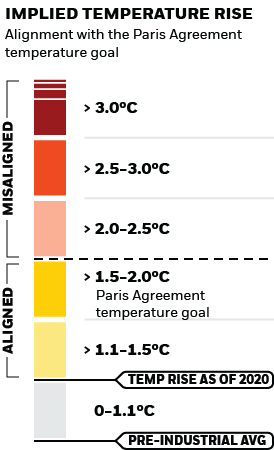
What are the key assumptions and limitations of the ITR metric?
This forward-looking metric is calculated based on a model, which is dependent upon multiple assumptions. Also, there are limitations with the data inputs to the model. Importantly, an ITR metric may vary meaningfully across data providers for a variety of reasons due to methodological choices (e.g., differences in time horizons, the scope(s) of emissions included and portfolio aggregation calculations).
There is not a universally accepted way to calculate an ITR. There is not a universally agreed upon set of inputs for the calculation. At present, availability of input data varies across asset classes and markets. To the extent that data becomes more readily available and more accurate over time, we expect that ITR metric methodologies will evolve and may result in different outputs. Funds may change bands as methodologies evolve. Where data is not available, and / or if data changes, the estimation methods vary, particularly those related to a company’s future emissions.
The ITR metric estimates a fund’s alignment with the Paris Agreement temperature goal based on a credibility assessment of stated decarbonization targets. However, there is no guarantee that these estimates will be reached. The ITR metric is not a real time estimate and may change over time, therefore it is prone to variance and may not always reflect a current estimate.
The ITR metric is not an indication or estimate of a fund’s performance or risk. Investors should not rely on this metric when making an investment decision and instead should refer to a fund’s prospectus and governing documents. This estimate and the associated information is not intended as a recommendation to invest in any fund, nor is it intended to indicate any correlation between a fund’s ITR metric and its future investment performance.
All data is from MSCI ESG Fund Ratings as of Aug 21, 2026, based on holdings as of Jul 31, 2026. As such, the fund’s sustainable characteristics may differ from MSCI ESG Fund Ratings from time to time.
To be included in MSCI ESG Fund Ratings, 65% (or 50% for bond funds and money market funds) of the fund’s gross weight must come from securities with ESG coverage by MSCI ESG Research (certain cash positions and other asset types deemed not relevant for ESG analysis by MSCI are removed prior to calculating a fund’s gross weight; the absolute values of short positions are included but treated as uncovered), the fund’s holdings date must be less than one year old, and the fund must have at least ten securities.
Business Involvement metrics can help investors gain a more comprehensive view of specific activities in which a fund may be exposed through its investments.
Business Involvement metrics are not indicative of a fund’s investment objective, and, unless otherwise stated in fund documentation and included within a fund’s investment objective, do not change a fund’s investment objective or constrain the fund’s investable universe. For more information regarding a fund's investment strategy, please see the fund's prospectus.
Review the MSCI methodology behind the Business Involvement metrics, using links below.
BlackRock business involvement exposures as shown above for Thermal Coal and Oil Sands are calculated and reported for companies that generate more than 5% of revenue from thermal coal or oil sands as defined by MSCI ESG Research. For the exposure to companies that generate any revenue from thermal coal or oil sands (at a 0% revenue threshold), as defined by MSCI ESG Research, it is as follows: Thermal Coal 0.00% and for Oil Sands 0.00%.
Business Involvement metrics are calculated by BlackRock using data from MSCI ESG Research which provides a profile of each company’s specific business involvement. BlackRock leverages this data to provide a summed up view across holdings and translates it to a fund's market value exposure to the listed Business Involvement areas above.
While BlackRock calculates the business involvement metrics based on data from MSCI ESG Research, the fund seeks to replicate the performance of an index not provided by MSCI. As a result, MSCI may take a different view on the business involvement exposure of a fund’s underlying holdings than the fund’s index provider. The fund’s index provider may also implement business involvement screens with a similar exposure as the business involvement metrics but apply a different methodology. Consequently, the business involvement metrics may indicate exposure to a category that is subject to an exclusionary screen by the fund’s index methodology.
Business Involvement metrics are designed only to identify companies where MSCI has conducted research and identified as having involvement in the covered activity. As a result, it is possible there is additional involvement in these covered activities where MSCI does not have coverage. This information should not be used to produce comprehensive lists of companies without involvement. Business Involvement metrics are only displayed if at least 1% of the fund’s gross weight includes securities covered by MSCI ESG Research.
This fund does not seek to follow a sustainable, impact or ESG investment strategy. For more information regarding the fund's investment strategy, please see the fund's prospectus or, as applicable, shareholder report.
Carefully consider the Funds' investment objectives, risk factors, and charges and expenses before investing. This and other information can be found in the Funds' prospectuses or, if available, the summary prospectuses, which may be obtained by visiting the iShares Fund and BlackRock Fund prospectus pages. Read the prospectus carefully before investing.
Investing involves risk, including possible loss of principal.
If the Fund invests in any underlying fund, certain portfolio information, including sustainability characteristics and business-involvement metrics, provided for the Fund may include information (on a look-through basis) of such underlying fund, to the extent available.
International investing involves risks, including risks related to foreign currency, limited liquidity, less government regulation and the possibility of substantial volatility due to adverse political, economic or other developments. These risks often are heightened for investments in emerging/developing markets or in concentrations of single countries.
Funds that concentrate investments in specific industries, sectors, markets or asset classes may underperform or be more volatile than other industries, sectors, markets or asset classes and the general securities market.
Shares of ETFs are bought and sold at market price (not NAV) and are not individually redeemed from the fund. Any applicable brokerage commissions will reduce returns. Beginning August 10, 2020, market price returns for BlackRock and iShares ETFs are calculated using the closing price and account for distributions from the fund. Prior to August 10, 2020, market price returns for BlackRock and iShares ETFs were calculated using the midpoint price and accounted for distributions from the fund. The midpoint is the average of the bid/ask prices at 4:00 PM ET (when NAV is normally determined for most ETFs). The returns shown do not represent the returns you would receive if you traded shares at other times.
Index returns are for illustrative purposes only. Index performance returns do not reflect any management fees or expenses. Returns for net indices generally assume the reinvestment of dividends after the deduction of the maximum withholding tax in each country applicable to non-residents of the country as determined by the index provider. Such indices use withholding tax rates that are often at a higher rate than the rates to which the Fund is subject in each country, including for countries where the Fund is not subject to withholding taxes. When this is the case, index performance will be lower than if the index used the Fund’s applicable withholding tax rates, if any. Indexes are unmanaged and one cannot invest directly in an index. Past performance does not guarantee future results.
After-tax returns are calculated using the historical highest individual federal marginal income tax rates and do not reflect the impact of state and local taxes. Actual after-tax returns depend on the investor's tax situation and may differ from those shown. The after-tax returns shown are not relevant to investors who hold their fund shares through tax-deferred arrangements such as 401(k) plans or individual retirement accounts.
Certain sectors and markets perform exceptionally well based on current market conditions and iShares and BlackRock Funds can benefit from that performance. Achieving such exceptional returns involves the risk of volatility and investors should not expect that such results will be repeated.
Distribution Yield and 12m Trailing Yield results may have period over period volatility due to factors including tax considerations such as treatment of passive foreign investment companies (PFICs), treatment of defaulted bonds or excise tax requirements; exceptional corporate actions; seasonality of dividends from underlying holdings; significant fluctuations in fund shares outstanding; or fund capital gain distributions.
The Funds are distributed by BlackRock Investments, LLC (together with its affiliates, “BlackRock”).
Although BlackRock shall obtain data from sources that BlackRock considers reliable, all data contained herein is provided “as is” and BlackRock makes no representation or warranty of any kind, either express or implied, with respect to such data, the timeliness thereof, the results to be obtained by the use thereof or any other matter. BlackRock expressly disclaims any and all implied warranties, including without limitation, warranties of originality, accuracy, completeness, timeliness, non-infringement, merchantability and fitness for a particular purpose.
BlackRock provides compensation in connection with obtaining or using third-party ratings and rankings.
The iShares Funds are not sponsored, endorsed, issued, sold or promoted by Bloomberg, BlackRock Index Services, LLC, Cboe Global Indices, LLC, Cohen & Steers, European Public Real Estate Association (“EPRA® ”), FTSE International Limited (“FTSE”), ICE Data Indices, LLC, NSE Indices Ltd, JPMorgan, JPX Group, London Stock Exchange Group (“LSEG”), MSCI Inc., Markit Indices Limited, Morningstar, Inc., Nasdaq, Inc., National Association of Real Estate Investment Trusts (“NAREIT”), Nikkei, Inc., Russell, S&P Dow Jones Indices LLC or STOXX Ltd. None of these companies make any representation regarding the advisability of investing in the Funds. With the exception of BlackRock Index Services, LLC, who is an affiliate, BlackRock Investments, LLC is not affiliated with the companies listed above.
Neither FTSE, LSEG, nor NAREIT makes any warranty regarding the FTSE Nareit Equity REITS Index, FTSE Nareit All Residential Capped Index or FTSE Nareit All Mortgage Capped Index. Neither FTSE, EPRA, LSEG, nor NAREIT makes any warranty regarding the FTSE EPRA Nareit Developed ex-U.S. Index, FTSE EPRA Nareit Developed Green Target Index or FTSE EPRA Nareit Global REITs Index. “FTSE®” is a trademark of London Stock Exchange Group companies and is used by FTSE under license.
For funds with an investment objective that include the integration of ESG criteria, there may be corporate actions or other situations that may cause the fund or index to passively hold securities that may not comply with ESG criteria. Please refer to the fund’s prospectus for more information. The screening applied by the fund's index provider may include revenue thresholds set by the index provider. The information displayed on this website may not include all of the screens that apply to the relevant index or the relevant fund. These screens are described in more detail in the fund’s prospectus, other fund documents, and the relevant index methodology document.
Review the MSCI methodology behind the Sustainability Characteristics and Business Involvement metrics: 1ESG Fund Ratings; 2Index Carbon Footprint Metrics; 3Business Involvement Screening Research; 4ESG Screened Index Methodology; 5ESG Controversies; 6MSCI Implied Temperature Rise
Certain information contained herein (the “Information”) has been provided by MSCI ESG Research LLC, a RIA under the Investment Advisers Act of 1940, and may include data from its affiliates (including MSCI Inc. and its subsidiaries (“MSCI”)), or third party suppliers (each an “Information Provider”), and it may not be reproduced or redisseminated in whole or in part without prior written permission. The Information has not been submitted to, nor received approval from, the US SEC or any other regulatory body. The Information may not be used to create any derivative works, or in connection with, nor does it constitute, an offer to buy or sell, or a promotion or recommendation of, any security, financial instrument or product or trading strategy, nor should it be taken as an indication or guarantee of any future performance, analysis, forecast or prediction. Some funds may be based on or linked to MSCI indexes, and MSCI may be compensated based on the fund’s assets under management or other measures. MSCI has established an information barrier between equity index research and certain Information. None of the Information in and of itself can be used to determine which securities to buy or sell or when to buy or sell them. The Information is provided “as is” and the user of the Information assumes the entire risk of any use it may make or permit to be made of the Information. Neither MSCI ESG Research nor any Information Party makes any representations or express or implied warranties (which are expressly disclaimed), nor shall they incur liability for any errors or omissions in the Information, or for any damages related thereto. The foregoing shall not exclude or limit any liability that may not by applicable law be excluded or limited.
© 2026 BlackRock, Inc. BLACKROCK, BLACKROCK SOLUTIONS, BUILD ON BLACKROCK, ALADDIN, iSHARES, iBONDS, FACTORSELECT, iTHINKING, iSHARES CONNECT, FUND FRENZY, LIFEPATH, SO WHAT DO I DO WITH MY MONEY, INVESTING FOR A NEW WORLD, BUILT FOR THESE TIMES, the iShares Core Graphic, CoRI and the CoRI logo are trademarks of BlackRock, Inc., or its subsidiaries in the United States and elsewhere. All other marks are the property of their respective owners.
MKTG0626-5629118-EXP0627