MARKET INSIGHTS

Weekly market commentary

Upping developed stocks strategically

Market take

Weekly video_20260518

Devan Nathwani

Portfolio Strategist

BlackRock Investment Institute

Header:

CAPITAL AT RISK. MARKETING MATERIAL.

Opening frame: What’s driving markets? Market take

Camera frame

Title slide: Upgrading developed equities

Mega forces are reshaping portfolio opportunities over a strategic horizon of five years or more. Their latest manifestation shifts where we take growth risk.

1: Multiple possible outcomes

Markets are being pulled in different directions by competing mega forces, namely AI and geopolitical fragmentation. AI is driving stocks higher, but we can’t say for sure what mega force will dominate over the long term. That’s why our capital market assumptions – for professional investors only – anchors to multiple plausible scenarios.

In one, AI could drive a productivity boom that supports growth, earnings and equity valuations. In another, geopolitical fragmentation fuels stagflationary pressure, resulting in weaker equity valuations as investors demand more compensation for taking growth risk. Our starting point represents our latest thinking of how these mega forces will evolve.

2. Strong earnings boost developed market stocks

Earnings momentum for developed market stocks looks strong. Only three quarters since 1988 have seen bigger jumps in expected 24-month U.S. equity earnings than we’ve seen for each of the past two quarters.

AI’s impact is also cutting across asset class labels, as the tech sector is now a larger share of the MSCI Emerging Markets index than for the S&P 500. The granular impact of mega forces underpins our developed equity upgrade and existing emerging equity overweight on a strategic horizon of five years or more.

3. Total portfolio implications

Our upgrade of developed equities means reducing exposure to fixed income. We like high yield in fixed income, but don’t build portfolios in asset class silos. So we downgrade high yield on a strategic horizon because we prefer to take growth risk through equities. We reduce developed market government bonds to underweight and continue to prefer inflation-linked government bonds. Why? We prefer to hold less duration risk at the total portfolio level and see inflation being more persistent than markets expect.

Outro: Here’s our Market take

Solid momentum in earnings growth leads us to upgrade developed market equities over a longer-term horizon. We adjust for that by downgrading high yield credit.

Closing frame: Read details: blackrock.com/weekly-commentary

Moving overweight

AI-driven earnings upgrades lead us to upgrade DM equities on a strategic basis. We downgrade high yield as we prefer taking growth risk through stocks.

Market backdrop

AI optimism and policy caution drove markets last week: the S&P 500 hit record highs on strong earnings, while bond yields rose as Fed cut expectations faded.

Week ahead

European and Japanese data this week should show whether high energy costs and supply disruptions are feeding into inflation and production hiccups.

Stocks are rallying on strong AI earnings expectations, offsetting jitters over inflation pressures from geographical fragmentation such as the Middle East supply shock. That could change in the near term, but we look beyond this in our strategic views when we see these mega forces - big, structural trends - in action. We upgrade developed market stocks to overweight and downgrade high yield to neutral as we shift where we take growth risk on a horizon of five years or more.

Download full commentary (PDF)

Paragraph-2,Paragraph-3,Image-1,Paragraph-4
Paragraph-5,Advance Static Table-1,Paragraph-6,Advance Static Table-2,Paragraph-7,Advance Static Table-3,Paragraph-8,Advance Static Table-4

Multiple outcomes
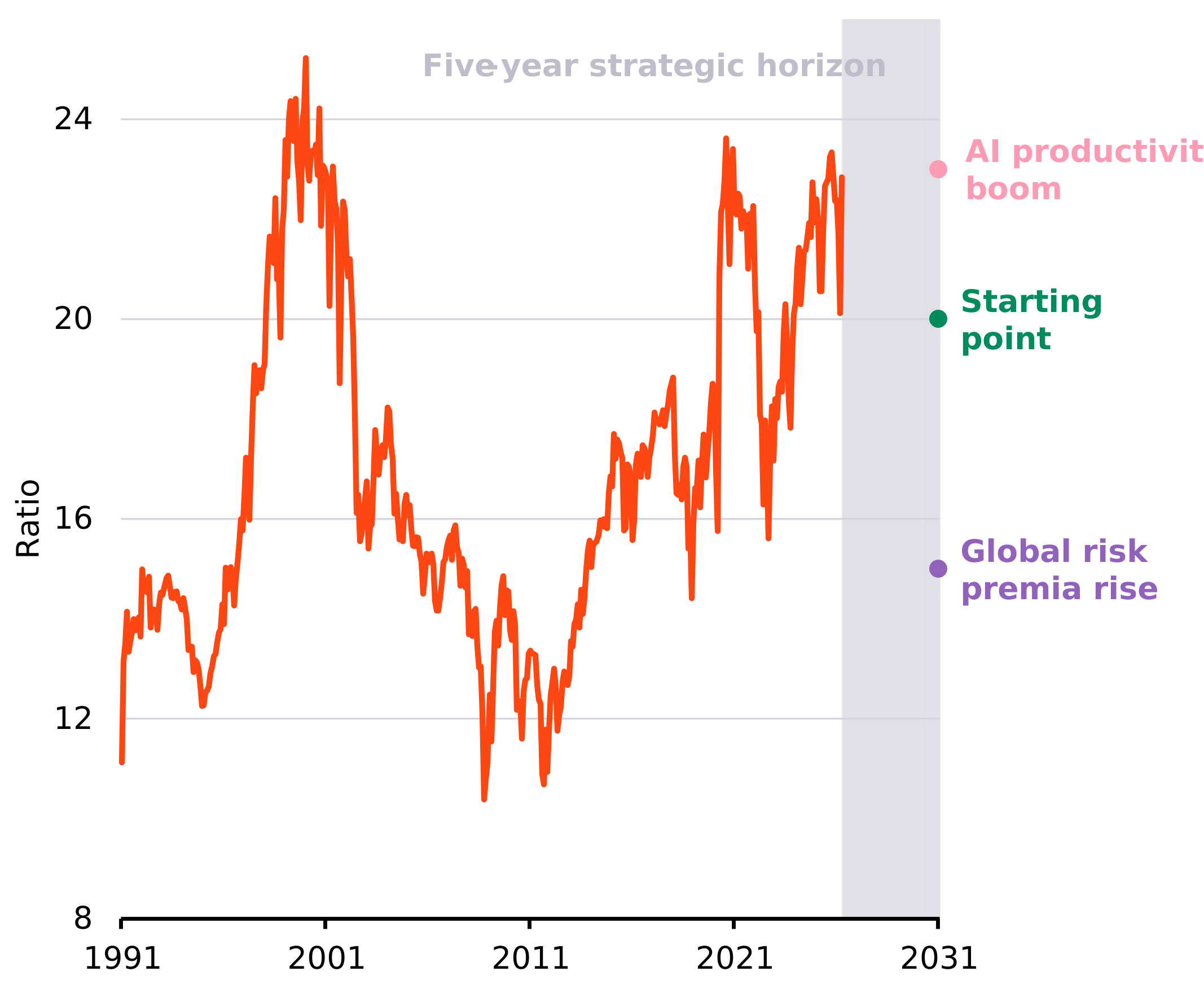
U.S. equity 12-month forward price-earnings ratio, 1991-2031

This chart shows how mega forces like AI and geopolitical fragmentation could shape different outcomes for forward earnings over a strategic horizon of five years or longer.

Forward –looking estimates may not come to pass. Past performance is not a reliable indicator of current or future results. Source: BlackRock Investment Institute, with data from Robert Shiller, (Yale University), May 2026. Note: The line shows the forward price-earnings ratio of U.S. equities, the markers indicate future estimates of the ratio across various scenarios.

Markets are being pulled in different directions by competing mega forces. AI is driving stocks higher today, but we cannot say which force will dominate in the long run. That’s why our capital market assumptions (for professional investors only) are built on multiple scenarios that imply fundamentally different macro paths. Our starting point (the green dot) reflects our latest thinking, and the gap between outcomes shows how mega forces could affect outcomes over a five-year period. In one, AI drives a productivity boom that could sustain stronger growth and earnings, justifying higher equity valuations over the strategic horizon, as the chart’s pink dot shows. In another, geopolitical fragmentation fuels stagflationary pressures that push global risk premia higher as investors demand greater compensation for uncertainty. This would lower equity valuations, as the purple dot shows.

For now, AI-driven earnings momentum looks strong: Upgrades to MSCI U.S. 2026 and 2027 earnings expectations in the past two quarters rank in the top five since 1988. And it’s broadening: The gap between expected “magnificent seven” earnings growth and the rest of the S&P 500 in 2027 has narrowed to 3 percentage points, down from 31% in 2024. Leadership is also broadening across regions and sectors, as AI reshapes markets beyond asset classes. The technology sector is a larger share of the MSCI EM Index than it is of the S&P 500, reflecting Taiwan’s and South Korea’s key role in the AI supply chain. All this underpins our DM equities upgrade and existing EM equities overweight on a long-term horizon. We view these not as broad market exposures but through sectors and regions. Within DM equities, we favor technology, AI-adopters such as health care and energy sectors tied to the AI buildout and rising power demand. We also favor EM tied to AI supply chains, including Taiwan and South Korea. We see India stocks benefiting from the demographic mega force: a growing workforce.

A holistic portfolio approach

To fund the DM equities upgrade, we reduce our fixed income exposure in our strategic portfolios. Within this segment, we like high yield as it offers attractive income with less duration, or sensitivity to interest rate swings, than investment grade credit. But we don’t build portfolios in asset class silos. Similar to a total portfolio approach, we prefer taking growth risk in equities, leading us to downgrade high yield to neutral. The reason: Investors can participate in equity upside rather than be capped by coupon income. We also downgrade DM government bonds to underweight, leaving our long-term portfolios with less duration risk than our benchmark. We overweight inflation-linked bonds as we expect inflation to be more persistent than markets currently price over a strategic horizon of five years or more.

The clash of mega forces across asset classes this year reinforces the need for a dynamic, scenario-based approach to navigate uncertain outcomes. We see the industry increasingly recognizing this shift through greater focus on total portfolio approaches that cut through asset class labels. A prime example is investing in infrastructure. We think infrastructure can do well under all our scenarios as it has historically been resilient in periods of market stress. Most investors can up their holdings materially, depending on their tolerance for illiquidity risk, or the risk of being unable to sell an investment quickly.

Our bottom line

We upgrade DM equities on a strategic basis due to AI-driven earnings momentum strength. We downgrade high yield to neutral as we prefer to take growth risk in equities but still like it for income in a fixed income context.

Market backdrop

The S&P 500 last week notched another record high as investors kept their focus on strong AI-driven earnings before slipping on Friday. U.S. Treasury yields jumped to around 4.56% as investors scaled back expectations for Federal Reserve rate cuts while oil prices remained well above pre-conflict level amid ongoing supply disruptions caused by the Middle East conflict. Brent crude remained near $105, more than 40% above pre-conflict levels.

This week’s focus is on inflation data from the UK and Japan, along with early signals on global production. Japan CPI will likely show how higher energy costs tied to the Middle East conflict are feeding into price pressures, while flash PMIs will indicate whether supply disruptions and rising costs are starting to weigh on activity.

Week ahead

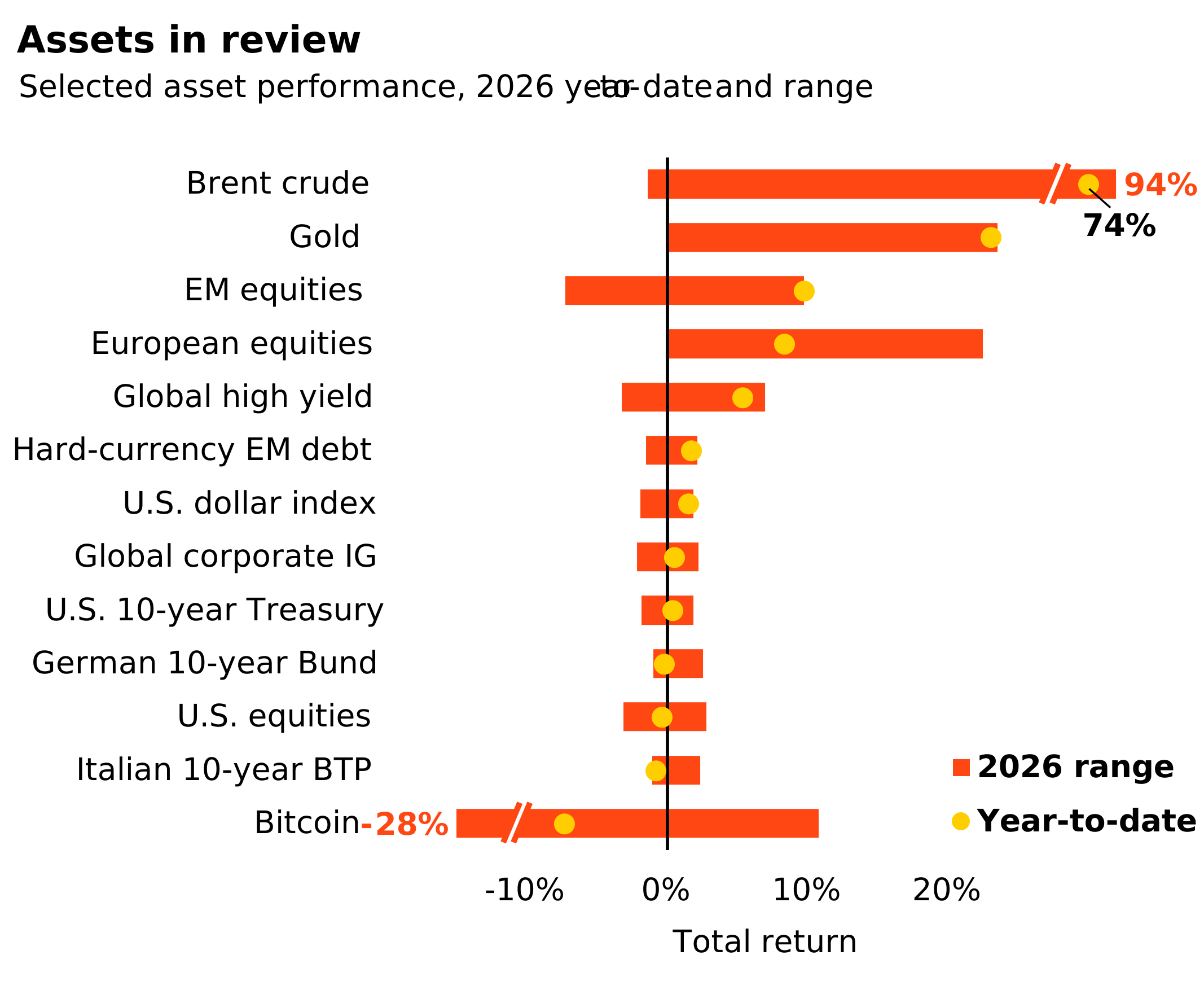
The chart shows that brent crude is the best-performing asset year-to-date, while bitcoin is the worst.

Past performance is not a reliable indicator of current or future results. Indexes are unmanaged and do not account for fees. It is not possible to invest directly in an index. Sources: BlackRock Investment Institute, with data from LSEG Datastream as of May 14, 2026. Notes: The two ends of the bars show the lowest and highest res at any point year to date, and the dots represent current year-to-date res. Emerging market (EM), high yield and global corporate investment grade (IG) res are denominated in U.S. dollars, and the rest in local currencies. Indexes or prices used are: spot Brent crude, ICE U.S. Dollar Index (DXY), spot gold, spot bitcoin, MSCI Emerging Markets Index, MSCI Europe Index, LSEG Datastream 10-year benchmark government bond index (U.S., Germany and Italy), Bloomberg Global High Yield Index, J.P. Morgan EMBI Index, Bloomberg Global Corporate Index and MSCI USA Index.

May 19

Euro area trade balance; China Loan Prime Rate

May 20

UK CPI and PPI; Japan trade balance

May 21

Global Flash PMIs; euro area consumer confidence

May 22

Japan CPI

Read our past weekly market commentaries here.

Big calls

Our highest conviction views on six- to 12-month (tactical) and over five-year (strategic) horizons, May 2026

  Reasons
Tactical  
Favor AI beneficiaries We favor infrastructure and equipment supporting the AI buildout such as semiconductors, power and data centers. We think they stand to benefit no matter AI’s eventual winners or losers. We see the AI boom lifting U.S. corporate earnings. underpinning our U.S. equity overweight.
Selected international exposures We like hard-currency EM debt on economic resilience, disciplined fiscal and monetary policy and a high ratio of commodities exporters. We’re also overweight EM equities, preferring commodity exporters and AI beneficiaries. In Europe, we favor equity sectors like infrastructure.
Evolving diversifiers We suggest looking for “plan B” portfolio hedges such as thematic opportunities related to the AI built-out and search for energy security. Long-term U.S. Treasuries no longer provide a buffer against equity market declines, and gold also has shown to be an ineffective diversifier.
Strategic  
Portfolio construction We favor a scenario-based approach as AI winners and losers emerge. We lean on private markets and hedge funds for idiosyncratic returns and to anchor portfolios in mega forces.
Infrastructure equity and private credit We find infrastructure equity valuations attractive as geopolitical fragmentation and the AI build-out underpin structural demand. We still like private credit but see an increase in dispersion of returns. This highlights the importance of manager selection.
Beyond market cap benchmarks We get granular in public markets. We favor DM government bonds outside the U.S. Within equities, we favor EM over DM – and get selective in both. In EM, we like India because it sits at the intersection of mega forces. In DM, we like Japan amid inflation and corporate reforms.

Note: Views are from a U.S. dollar perspective, May 2026. This material represents an assessment of the market environment at a specific time and is not intended to be a forecast of future events or a guarantee of future results. This information should not be relied upon by the reader as research or investment advice regarding any particular funds, strategy or security.

Tactical granular views table

Six- to 12-month tactical views on selected assets vs. broad global asset classes by level of conviction, May 2026

Legend Granular

We have lengthened our tactical investment horizon back to six to 12 months. The table below reflects this and, importantly, leaves aside the opportunity for alpha, or the potential to generate above-benchmark returns – especially at a time of heightened volatility.

Granular views

Six- to 12-month tactical views on selected assets vs. broad global asset classes by level of conviction, May 2026

Past performance is not a reliable indicator of current or future results. It is not possible to invest directly in an index. Note: Views are from a U.S. dollar perspective. This material represents an assessment of the market environment at a specific time and is not intended to be a forecast or guarantee of future results. This information should not be relied upon as investment advice regarding any particular fund, strategy or security.

Euro-denominated tactical granular views

Six to 12-month tactical views on selected assets vs. broad global asset classes by level of conviction, May 2026

Legend Granular

We have lengthened our tactical investment horizon back to six to 12 months. The table below reflects this and, importantly, leaves aside the opportunity for alpha, or the potential to generate above-benchmark returns – especially at a time of heightened volatility.

Past performance is not a reliable indicator of current or future results. It is not possible to invest directly in an index. Note: Views are from a euro perspective, May 2026. This material represents an assessment of the market environment at a specific time and is not intended to be a forecast or guarantee of future results. This information should not be relied upon as investment advice regarding any particular fund, strategy or security.

On the go?

Stay informed on our latest weekly Market take. Listen wherever you get your podcasts.
podcast banner
Meet the authors
Jean Boivin
Head – BlackRock Investment Institute
Wei Li
Global Chief Investment Strategist – BlackRock Investment Institute
Vivek Paul
Global Head of Portfolio Research – BlackRock Investment Institute
Devan Nathwani
Portfolio Strategist – BlackRock Investment Institute
Sally Du
Co-Portfolio Manager - BlackRock Fundamental Equities