Five reasons to consider closed-end funds in your portfolio

Closed-end funds (“CEFs”) are exchange-traded investment companies that can play an important role in a diversified portfolio by offering investors the potential for generating income and capital growth. Over time, CEFs have evolved to include a variety of asset classes and investment strategies to accommodate the objectives and risk tolerance of a wide range of investors.

Five reasons to consider closed-end funds in your portfolio

1) Potential for attractive and regular distributions1
2) Seek to generate higher income and returns
3) Ability to buy funds at discounted valuations
4) Reduce cash drag and selling pressure from investor redemption
5) Intra‑day liquidity through exchange‑traded pricing

1) Potential for attractive and consistent distributions

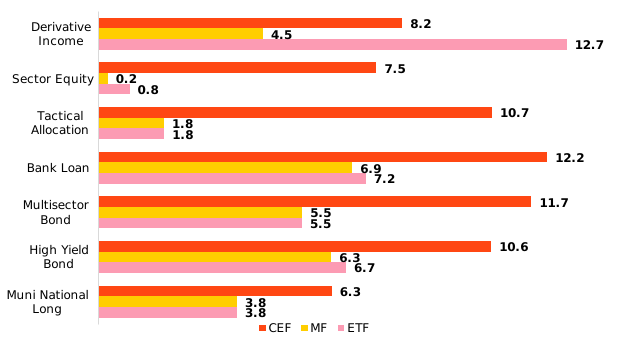
Most CEFs, including all BlackRock funds, pay monthly distributions.1 In many cases, CEF distribution rates exceed those of other investment vehicles such as open-end mutual funds and ETFs (Exhibit 1). Additionally, CEFs typically pay level distributions, seeking to provide consistency and stability of cash flow each month. Investors generally have the option of receiving distributions in cash or having their distributions reinvested. While distribution rates may be attractive, it is important to note that distributions may be derived from various sources, including return of capital.1

By automatically reinvesting dividends, investors purchase additional CEF shares on an ongoing basis. Because CEF distributions are paid out of NAV, and CEFs may trade at a discount to NAV, reinvesting distributions may allow investors to purchase additional shares at a price below the fund's net asset value — effectively acquiring more than a dollar of net assets for each dollar reinvested.2

Exhibit 1: CEFs have generally delivered higher distribution rates than other investment vehicles such as open-end mutual funds (MFs) and exchange traded funds (ETFs)3,4

Distribution rates of CEF, MF and ETF

Source: Morningstar data as of 5/31/2026. Past performance is not a guarantee of future results.

2) Seek to generate higher income and returns

The efficient structure of a CEF (referenced in the section above) also provides greater flexibility in the types of securities and investment strategies that portfolio managers can utilize, such as employing leverage to potentially enhance income and investing in private markets in seeking to generate higher returns.

Leverage is a strategy that can be employed by CEFs in an effort to enhance both distributable income and total returns. By borrowing at short-term interest rates, or issuing preferred stock, and investing the proceeds in higher-yielding securities, leverage seeks to capture the spread between the fund's borrowing costs and the return on its investments. This may include profiting from the shape of the yield curve as well as investing in spread assets such as corporate or securitized bonds.

Although there are several potential benefits of using leverage, investors should consider the potential for increased risk and volatility prior to investing in a leveraged CEF. Leverage can magnify both gains and losses, and may not be effective in all market environments. For example, in a declining rate environment, the cost of leverage may decrease, which can support investment income.

Illiquidity premium: CEFs provide access to unique investment opportunities that can offer potentially higher income and returns by harvesting the illiquidity premium. The illiquidity premium refers to the incremental return that an investor may receive for owning an asset that cannot easily be sold.

3) Ability to buy funds at discounted valuations

At any given point in time, a CEF’s share price may be above or below its NAV (value of investments), which is referred to as the CEF trading at a premium (market price is above NAV), or discount (market price is below NAV). Premiums or discounts are the result of a number of factors including, but not limited to, market and investor sentiment, fund specific characteristics, and/or manager and firm recognition.

While there may be instances where purchasing a fund at a premium is warranted based on its distribution rate and returns, BlackRock believes that it may be advantageous to purchase a fund when it is trading at a discount to its NAV, since each dollar invested purchases more than a dollar of net assets. If the discount begins to narrow, investors may also have greater potential for capital appreciation.

One way to evaluate whether a CEF's current discount represents a potential buying opportunity is the z-statistic (z-stat or z-score), which is a a measure of how far a fund's current discount is from its historical average, expressed in standard deviations. A negative z-stat suggests the fund is trading at a wider discount than usual, which may signal relative value. For example, a 1-year z-stat of -2.0 means the fund's current discount is 2 standard deviations wider than its average over the past year. Exhibit 2 summarizes z-stats across CEF asset classes over 1-, 3-, and 5-year periods.

Exhibit 2: Z-statistics by CEF asset class suggest many categories are trading at wider-than-average discounts5
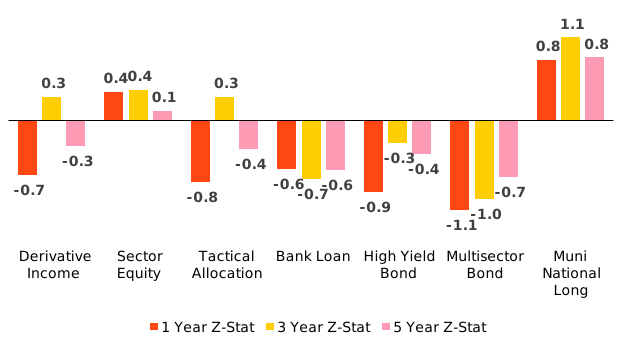
Statistics of CEF for 1, 3, and 5 years

Source: Morningstar data as of 5/31/2026. Past performance is not a guarantee of future results.

4) Reduce cash drag and forced sales driven by investor flows

A CEF's shares trade on a stock exchange and are usually not subject to inflows and outflows like open-end mutual funds and ETFs. This means that portfolio managers seek to remain fully invested and do not have to keep cash on hand (or sell securities, potentially at inopportune times) to meet redemptions. This generally stable asset base also allows portfolio managers to seek to lock in attractive yields and coupons over time, which aims to support more consistent distributions. In contrast, open-end funds and ETFs experiencing outflows may be forced to sell higher-yielding positions or see those attractive coupons diluted by new inflows at lower prevailing rates.

5) Intra‑day liquidity through exchange‑traded pricing

CEFs are typically listed on a major exchange such as the New York Stock Exchange like stocks and ETFs.6 This provides the benefit of liquidity and the convenience of being able to track an investment with its assigned ticker symbol throughout the day.

Key Terms

  • Net asset value / NAV: The per‑share value of the fund’s underlying assets (assets minus liabilities).
  • Market price: The price at which closed‑end fund shares trade on an exchange, determined by investor supply and demand and which may differ from NAV.
  • Discount/Premium: Market price below/above NAV.
  • Total return: Share price change plus distributions received.
  • Leverage: Borrowing/issuing senior securities to increase investment exposure; magnifies gains and losses.
  • Illiquid securities: Investments that may not have an active secondary market, and cannot easily be converted to cash at fair market value.