MARKET INSIGHTS

Weekly market commentary

Staying positive on emerging markets

Market take

Weekly video_20260209

Axel Christensen

Chief Investment Strategist for Latin America,

BlackRock Investment Institute

Opening frame: What’s driving markets? Market take

Camera frame

We think emerging markets can deliver again after a stellar 2025. They’re supported by an upbeat macro outlook, with stable inflation and disciplined policy. But we stay selective, focusing on mega forces driving returns.

Title slide: Staying positive on emerging markets

1: Emerging markets off to the races

The MSCI emerging markets index notched a 9% gain last month – well above the 2.2% gain in its developed markets counterpart. Performance has broadened out beyond the AI theme, but we still see significant dispersion. South Korea, for example, has surged 21%, while India is still lagging. That means an active approach is key, in our view.

2: Mega forces driving EM returns

We see several broad factors driving emerging market returns. Solid global growth gives emerging market economies a stable backdrop even with sections of episodic, policy-driven volatility. Potential rate cuts as the inflation outlook improves are also supportive. And easing trade uncertainty could encourage further capital inflows and firmer currencies.

In addition to these macro factors, mega forces like AI are also helping drive returns. Emerging markets are key to the AI buildout. South Korea and Taiwan – leaders in manufacturing AI hardware – stand to benefit as the U.S. hyperscalers spend even more on AI than expected. And the industrial metals needed to power the technology are largely located in emerging market regions. Supply chain constraints could push up commodity prices – another potential boost.

3: Leaning into emerging markets

We are overweight hard currency emerging market debt.

Elections this year could lead to currency volatility – a reason we prefer hard currency debt to local currency. We also like high yield emerging market issuers, and think increased dispersion could create opportunities for active returns.

On the equities side, we favor markets benefiting from even more AI capex. We favor leaders in China’s new economy: AI, automation and low-carbon energy. And we see rewiring global supply chains and stronger commodity prices benefiting Mexico, Brazil and Vietnam.

Outro: Here’s our Market take

We see the bullish themes that drove emerging market outperformance in 2025 still playing out – though we think selectivity is key as dispersion rises. We prefer emerging market hard currency debt and stay selective in emerging market equities, preferring stocks that benefit from mega forces like AI.

Closing frame: Read details: blackrock.com/weekly-commentary
Building on a solid start

We think emerging market (EM) assets can build on a solid start after a strong 2025. We prefer EM hard currency debt and are selective in EM equities.

Market backdrop

The S&P 500 fell slightly but rebounded from lows driven by a global selloff. We think recent moves are evidence of the power and scope of the AI mega force.

Week ahead

Fresh U.S. inflation and jobs data this week should clarify whether January’s price pressures fade and if the labor market’s “no hiring, no firing” stasis holds.

Emerging market (EM) stocks and bonds are off to a strong start to the year following a stellar 2025. We think returns can deliver again: an upbeat global macro outlook with stable inflation and disciplined policy should be supportive, in our view, though selectivity is key. We focus on mega forces driving returns in EM stocks – notably in AI across tech hardware in Asia and commodity-linked shares in Latin America. We stay overweight EM assets and prefer hard currency debt.

Download full commentary (PDF)

Paragraph-2,Paragraph-3,Image-1,Paragraph-4
Paragraph-5,Advance Static Table-1,Paragraph-6,Advance Static Table-2,Paragraph-7,Advance Static Table-3,Paragraph-8,Advance Static Table-4

Off to the races?
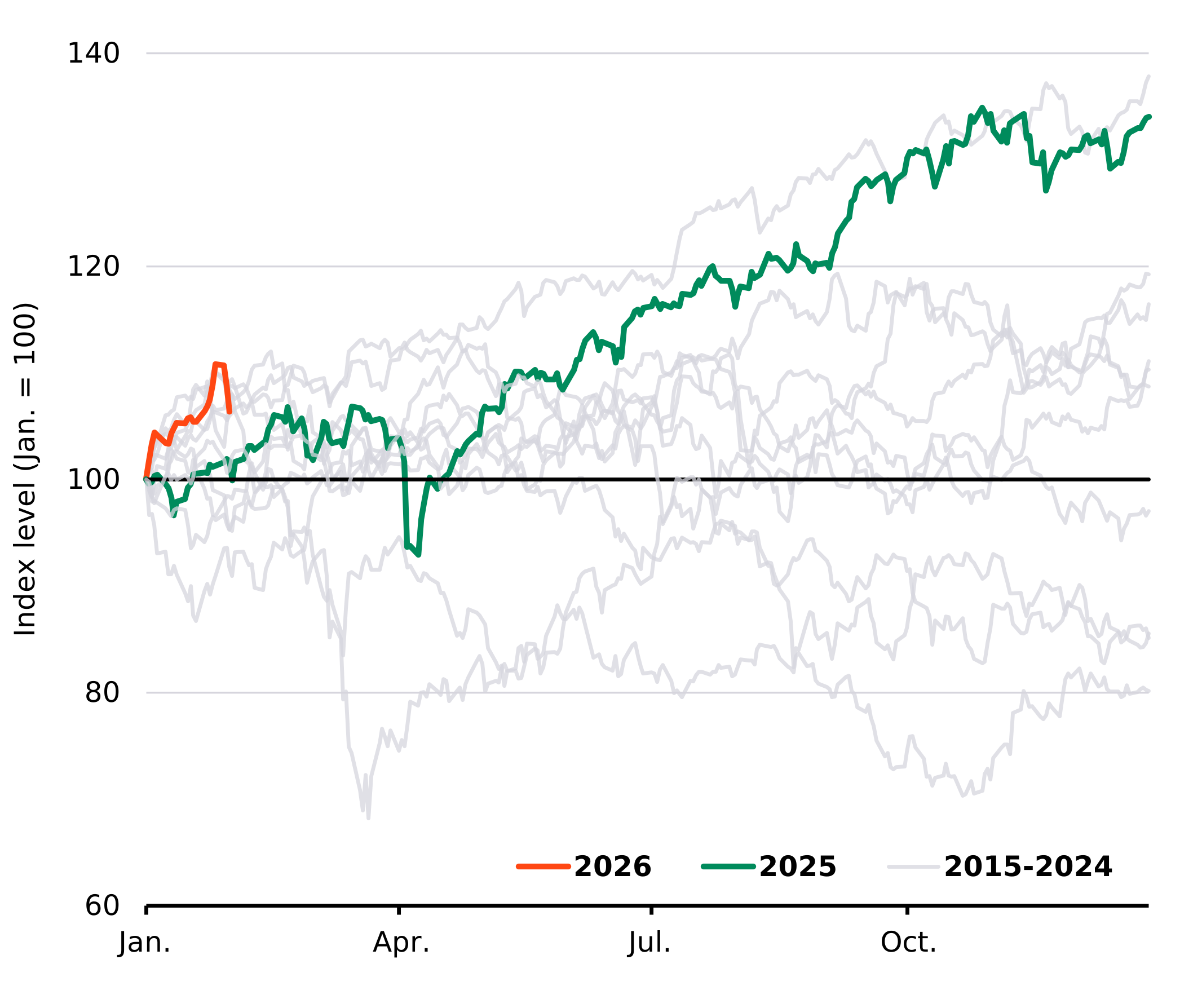
MSCI Emerging Markets index performance, 2015-2026

The chart shows that emerging market equities are off to a strong start in 2026 and had a very strong 2025, outpacing recent years.

Past performance is no guarantee of future results. It is not possible to invest in an index. Indexes are unmanaged and performance does not account for fees. Source: BlackRock Investment Institute, MSCI, with data from LSEG Datastream. Note: The chart shows the annual performance of the MSCI EM$ index through the calendar year from 2015 to 2026.

EM equities strength has carried over to 2026: the MSCI Emerging Markets index notched a nearly 9% gain last month, its best January clip since 2012 and one of its largest monthly gains in recent years, easily beating the 2.2% gain in developed market stocks. See the chart. 2025’s outperformance was led by tech and the AI theme. While EM stock strength has broadened out, dispersion and the impact of mega forces like AI are still evident. South Korean stocks have surged more than 20% after last year’s big gains, while India is still lagging even with the recent U.S. trade deal. We think such differentiation among EM rewards an active approach and being selective. We expect both EM stocks and bonds to be supported by resilient – if steady – global economic growth and a stable to softer U.S. dollar.

Solid global growth is one of the broader drivers we see supporting EM returns, along with both major and EM central banks – including the Federal Reserve thanks to a softer labor market – leaning toward rate cuts. This provides a stable macro backdrop for EM economies, even with episodic, policy-driven volatility. Immutable economic laws – such as supply chains can’t be rewired overnight – are easing policy uncertainty on trade and should support a risk-on stance in EM, encouraging further capital inflows and firmer currencies. Investor appetite for EM remains strong: 2025 was a record year for inflows, with EM debt and equity ETPs drawing $152 billion and $103 billion, according to BlackRock and Markit data.

In emerging markets, mega forces trump traditional macro

We are also seeing mega forces trump the traditional macro in EM. The AI theme has broadened out to markets like South Korea and Taiwan over the past year, with their strength in manufacturing AI hardware – especially semiconductors – driving gains. The big increase in AI capital spending plans announced by the U.S. mega cap tech “hyperscalers” should be another positive, in our view. EM is key to the AI buildout from industrial metals to manufacturing supply chains: the industrial metals such as copper needed to power the technology’s buildout are largely located in EM countries. We also see persistent supply constraints pushing up commodity prices, another potential boost for EM – especially Latin America. Demographics are also a strength for countries like India as major economies struggle with aging populations.

We lean into EM with our overweight to hard currency EM debt. Improved fiscal policy in some large EM countries stands in contrast to our theme of leveraging up happening in DM. We also like high yield EM issuers and see heightened dispersion forging opportunities for active returns. Elections this year and the potential for currency volatility, such as in Brazil, is another reason we favor EM hard currency bonds over local currency. In EM equities, markets benefiting from even more AI capex stand out. We favor leaders in China’s new economy – AI, automation and renewable energy. We also see the rewiring of global supply chains benefiting Mexico, Brazil and Vietnam, while stronger commodity prices are a boon to Latin America.

Our bottom line

We see bullish themes that drove EM outperformance in 2025 still playing out – though we favor selectivity as dispersion rises. We prefer EM hard currency debt and stay selective in EM equities, favoring mega force beneficiaries.

Market backdrop

The S&P 500 dipped on a global tech stock selloff tied to concerns about AI disruption and investment, though stocks trimmed losses into the weekend. The tech-heavy Nasdaq shed 2% as software shares were hard hit on concerns about Anthropic’s new AI tools hurting business models. We think this shows markets reacting to AI as a real economic disruptor that will sort winners and losers - not a speculative narrative. Gold prices bounced after their slide from all-time highs.

This week provides a cleaner read on U.S. inflation and jobs growth after data in previous months was distorted by last year’s government shutdown. We’re watching whether early‑year price pressures will be contained after strong core inflation in January. The jobs report for January will shed light on whether the “no hiring, no firing” stasis in jobs persists. If so, and inflation proves little changed, we see the Fed leaving rates unchanged at its next meeting.

Week ahead

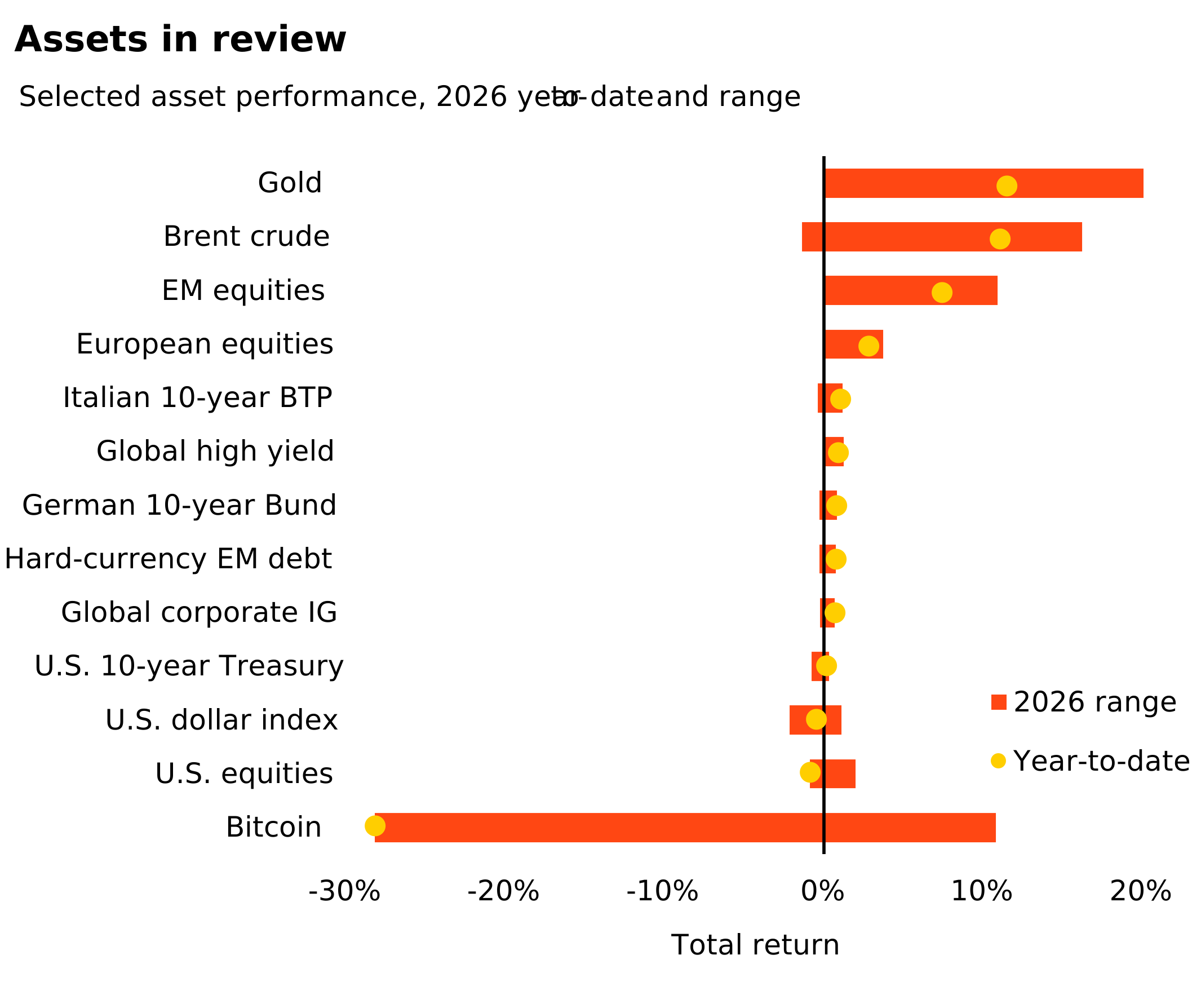
The chart shows that emerging markets (EM) equities are carrying over last year's outperformance to 2026: the MSCI Emerging Markets index outpaced its developed markets counterpart in January.

Past performance is not a reliable indicator of current or future results. Indexes are unmanaged and do not account for fees. It is not possible to invest directly in an index. Sources: BlackRock Investment Institute, with data from LSEG Datastream as of February 5, 2026. Notes: The two ends of the bars show the lowest and highest returns at any point year to date, and the dots represent current year-to-date returns. Emerging market (EM), high yield and global corporate investment grade (IG) returns are denominated in U.S. dollars, and the rest in local currencies. Indexes or prices used are: spot Brent crude, ICE U.S. Dollar Index (DXY), spot gold, spot bitcoin, MSCI Emerging Markets Index, MSCI Europe Index, LSEG Datastream 10-year benchmark government bond index (U.S., Germany and Italy), Bloomberg Global High Yield Index, J.P. Morgan EMBI Index, Bloomberg Global Corporate Index and MSCI USA Index.

Feb. 10-17

China total social financing

Feb. 11

U.S payrolls

Feb. 12

UK GDP

Feb. 13

U.S. CPI, euro area trade balance

Read our past weekly market commentaries here.


Big calls

Our highest conviction views on six- to 12-month (tactical) and over five-year (strategic) horizons, February 2026

  Reasons
Tactical  
Still favor AI We see the AI theme supported by strong earnings, resilient profit margins and healthy balance sheets at large listed tech companies. Continued Fed easing into 2026 and reduced policy uncertainty underpin our overweight to U.S. equities.
Select international exposures We like Japanese equities on strong nominal growth and corporate governance reforms. We stay selective in European equities, favoring financials, utilities and healthcare. In fixed income, we prefer EM due to improved economic resilience and disciplined fiscal and monetary policy.
Evolving diversifiers We suggest looking for a “plan B” portfolio hedge as long-dated U.S. Treasuries no longer provide portfolio ballast – and to mind potential sentiment shifts. We like gold as a tactical play with idiosyncratic drivers but don’t see it as a long-term portfolio hedge.
Strategic  
Portfolio construction We favor a scenario-based approach as AI winners and losers emerge. We lean on private markets and hedge funds for idiosyncratic return and to anchor portfolios in mega forces.
Infrastructure equity and private credit We find infrastructure equity valuations attractive and mega forces underpinning structural demand. We still like private credit but see dispersion ahead – highlighting the importance of manager selection.
Beyond market-cap benchmarks We get granular in public markets. We favor DM government bonds outside the U.S. Within equities, we favor EM over DM yet get selective in both. In EM, we like India which sits at the intersection of mega forces. In DM, we like Japan as mild inflation and corporate reforms brighten the outlook.

Note: Views are from a U.S. dollar perspective, February 2026. This material represents an assessment of the market environment at a specific time and is not intended to be a forecast of future events or a guarantee of future results. This information should not be relied upon by the reader as research or investment advice regarding any particular funds, strategy or security.

Tactical granular views

Six- to 12-month tactical views on selected assets vs. broad global asset classes by level of conviction, February 2026

Legend Granular

We have lengthened our tactical investment horizon back to six to 12 months. The table below reflects this and, importantly, leaves aside the opportunity for alpha, or the potential to generate above-benchmark returns – especially at a time of heightened volatility.

Past performance is not a reliable indicator of current or future results. It is not possible to invest directly in an index. Note: Views are from a U.S. dollar perspective. This material represents an assessment of the market environment at a specific time and is not intended to be a forecast or guarantee of future results. This information should not be relied upon as investment advice regarding any particular fund, strategy or security.

Euro-denominated tactical granular views

Six to 12-month tactical views on selected assets vs. broad global asset classes by level of conviction, February 2026

Legend Granular

We have lengthened our tactical investment horizon back to six to 12 months. The table below reflects this and, importantly, leaves aside the opportunity for alpha, or the potential to generate above-benchmark returns – especially at a time of heightened volatility.

Past performance is not a reliable indicator of current or future results. It is not possible to invest directly in an index. Note: Views are from a euro perspective, February 2026. This material represents an assessment of the market environment at a specific time and is not intended to be a forecast or guarantee of future results. This information should not be relied upon as investment advice regarding any particular fund, strategy or security.

On the go?

Stay informed on our latest weekly Market take. Listen wherever you get your podcasts.
podcast banner
Meet the authors
Jean Boivin
Head – BlackRock Investment Institute
Wei Li
Global Chief Investment Strategist – BlackRock Investment Institute
Axel Christensen
Chief Investment Strategist for Latin America — BlackRock Investment Institute
Ehsan Khoman
Economist — BlackRock Investment Institute