Financing implications for the muni market
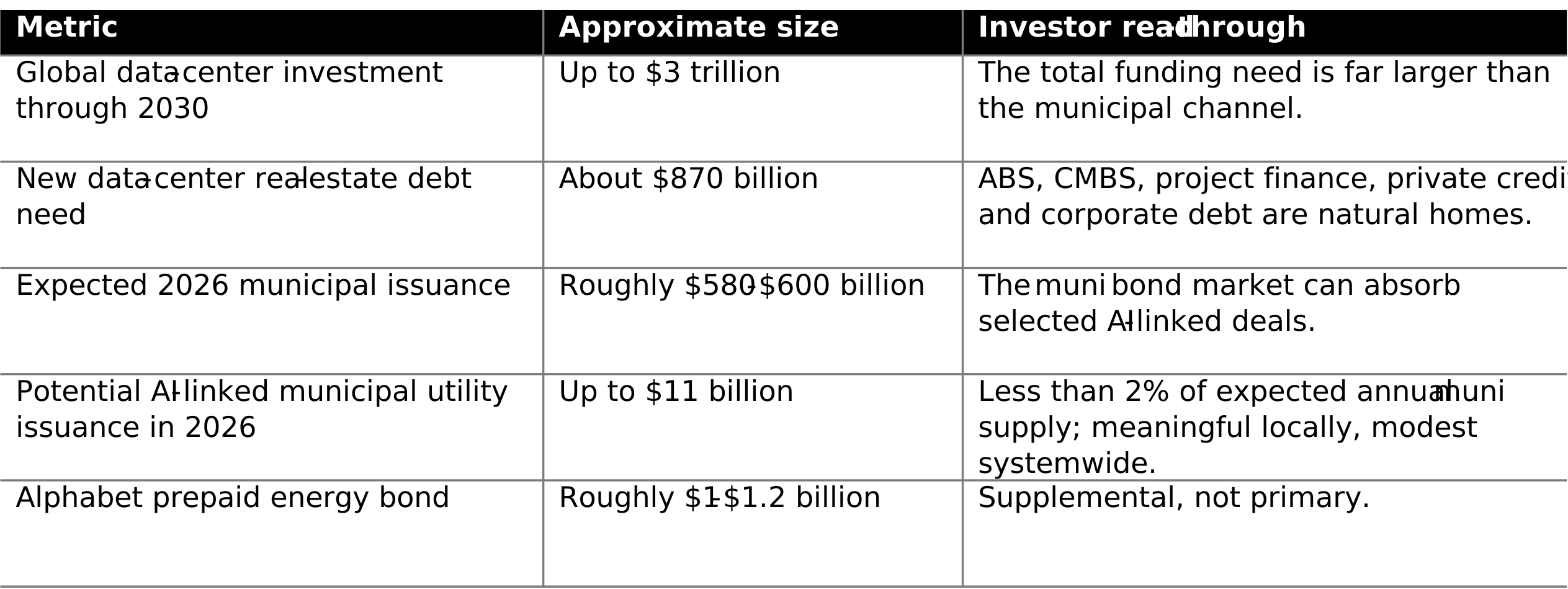
The municipal market is likely to play a targeted role in financing data center growth. Municipal bonds are best suited to long-lived, essential assets that serve a broader system, including substations, public power upgrades, transmission and distribution networks, water and wastewater capacity, and grid resilience projects. They are less suited to tenant-specific technology that can become obsolete quickly. Compute hardware, for example, may turn over in three to five years, while municipal debt often amortizes over 20 to 30 years. That mismatch makes private capital structures with meaningful equity support a more natural fit.
Tax treatment may further narrow the opportunity set. Long-term agreements that reserve capacity for a single private user can raise private-use concerns, potentially shifting the financing into taxable municipal debt or private markets.
Prepaid power and capacity-style structures may still become more common where a public power provider can lock in lower long-term energy costs and a strong corporate counterparty supports repayment. Alphabet’s transaction is a useful example, but these deals are complex, tax-sensitive and limited in scale.
Beyond the municipal market, AI data center infrastructure is already financed through ABS, CMBS, project finance, private credit, taxable corporate debt and equity. Moody’s has noted that developers and landlords will need to raise substantial capital across these channels. In our view, municipal bonds can address selected infrastructure needs, but most of the capital required for AI-related development will come from outside the tax-exempt market.
Prepaid energy bonds are a limited option
Alphabet’s 2026 municipal market debut brought the topic into sharper focus. The California Community Choice Financing Authority issued a $1.2 billion prepaid-energy transaction for Pioneer Community Energy, with Alphabet identified as the recipient of a senior unsecured loan funded from the bond proceeds. The deal supported a long-term clean-power prepayment and marked the first known prepaid-energy transaction involving a major U.S. technology company.
Given its unique structure, the transaction was well received by municipal investors. Bloomberg reported a surge in demand, tighter secondary-market spreads, and heavy trading in the 2035 maturity following pricing. The response reinforces that municipal bonds can finance select power-procurement transactions, but the largest AI data center financings will continue to rely on non-municipal capital markets.
Private capital provides scale
At roughly $27 billion, the 2-gigawatt Hyperion data center project in Louisiana illustrates the practical limits of the municipal market. Meta and funds managed by Blue Owl formed a joint venture to develop and own the campus in Richland Parish, with Blue Owl holding an 80% interest and Meta retaining 20%. Meta contributed the land and construction-in-progress, while Blue Owl provided approximately $7 billion in cash, financed in part through private debt placed with PIMCO and other institutional investors.
Projects of this magnitude are too large to be absorbed entirely by the municipal market and will instead rely on hyperscaler cash flow, taxable debt, securitizations, project finance, private credit and equity to fund the core development. Municipal bonds are more likely to play a complementary role, financing power, water and other shared local infrastructure.
Credit considerations for the muni market
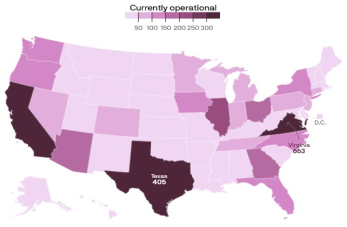
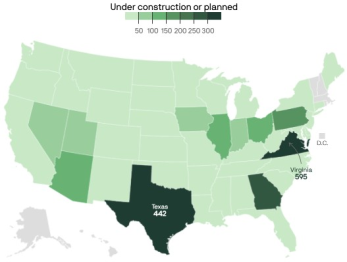
Credit risk is best assessed at the issuer level and will heavily depend on how each project is structured. Data centers can stress local credit profiles through electricity demand, water usage, land-use conflict, tax-incentive leakage and affordability concerns. The risk is greatest when governments or utilities commit capital before firm contracts are in place or allow data center costs to be absorbed by existing taxpayers or ratepayers. Most states offer tax incentives to attract data centers. Virginia alone offered over $1 billion in tax incentives between 2023 and 2025.
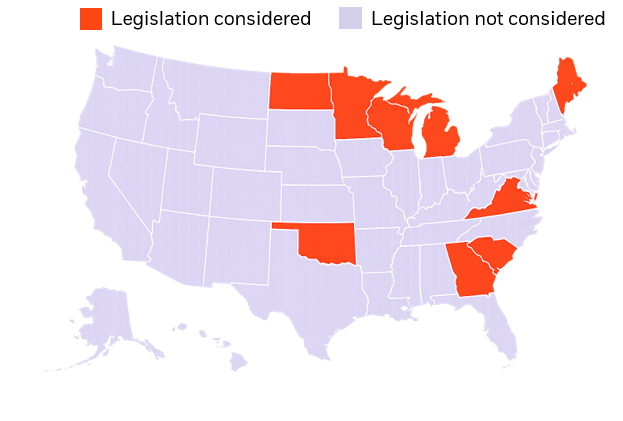
These risks can be mitigated through dedicated data center tariffs, minimum payment requirements, upfront capital contributions, termination fees, parent guarantees, and project-specific cost sharing. Moratoria and tighter development review may also give governments time to evaluate infrastructure needs, incentive packages, and rate structures before committing public resources.
Who pays? The key muni credit variable
The strongest municipal structures make the hyperscaler responsible for incremental costs through upfront contributions, dedicated tariffs, take-or-pay or minimum-charge contracts, termination payments and parent guarantees. These provisions reduce the risk that data-center-specific assets become stranded or that legacy customers subsidize private load.
Federal policy is also beginning to reflect these concerns. The 2026 Ratepayer Protection Pledge calls on major hyperscalers and AI companies to secure the power needed for their data centers and fund the related transmission and distribution upgrades. It also contemplates separate rate structures and minimum-payment obligations, even when contracted power is not fully used. The pledge is a policy signal, not a bond covenant. Investors should focus on the enforceable protections contained in service agreements and financing documents.
Data Center Pushback