Multi-asset income

BlackRock Dynamic High Income Fund

A globally diversified income fund that seeks to deliver reliable, high income by investing flexibly across equities, fixed income, and beyond.

In today’s environment, it can be challenging for investors to find sources of consistent high income. But investors willing to broaden their scope can still find opportunities.

The BlackRock Dynamic High Income Fund is a global multi-asset strategy that aims to provide investors with the potential for high income and positive total return. The Fund achieves this outcome by investing across stocks, bonds and “complementary income asset classes”. Complementary asset classes are often more difficult to access for retail investors and are less commonly found in existing income strategies. Their lower correlation to traditional income sources can help to complement what investors already own. 

Complementary asset classes can be complicated. Investing in them requires expertise and flexibility. Our team has the flexibility to dynamically adapt the Fund’s asset allocation, adjusting the portfolio based on current market opportunities and conditions. 

With the right amount of risk management, complementary asset classes can offer compelling opportunities to investors today. The BlackRock Dynamic High Income Fund seeks to deliver a compelling combination of high income, capital appreciation, and diversification, and is exactly what investors should be looking for today.

Where can investors find high income today?

Traditional income sources alone may no longer be sufficient to deliver consistent high income. Discover how the BlackRock Dynamic High Income Fund leverages complementary income sources to uncover new income opportunities while managing risk.

Why invest in the BlackRock Dynamic High Income Fund?

Percent icon

Access high income opportunities

Harness consistent high income across a full range of income assets and across market environments, while staying positioned to benefit when markets rise.
Low volatility

Turn volatility into income potential

Actively seek higher income through multiple complementary income sources during periods of increased market volatility.
Choice icon

Flexibility to adapt as markets evolve

Invests flexibly across more than 10 asset classes to build a diversified global income portfolio that adapts as markets change .

1. Access high income opportunities

The Fund invests across a wide range of income assets — from traditional sources to complementary opportunities — allowing it to go where the best income potential lies. Today, that means focusing on the areas of the market offering the most compelling returns.

Asset class yields (%)1
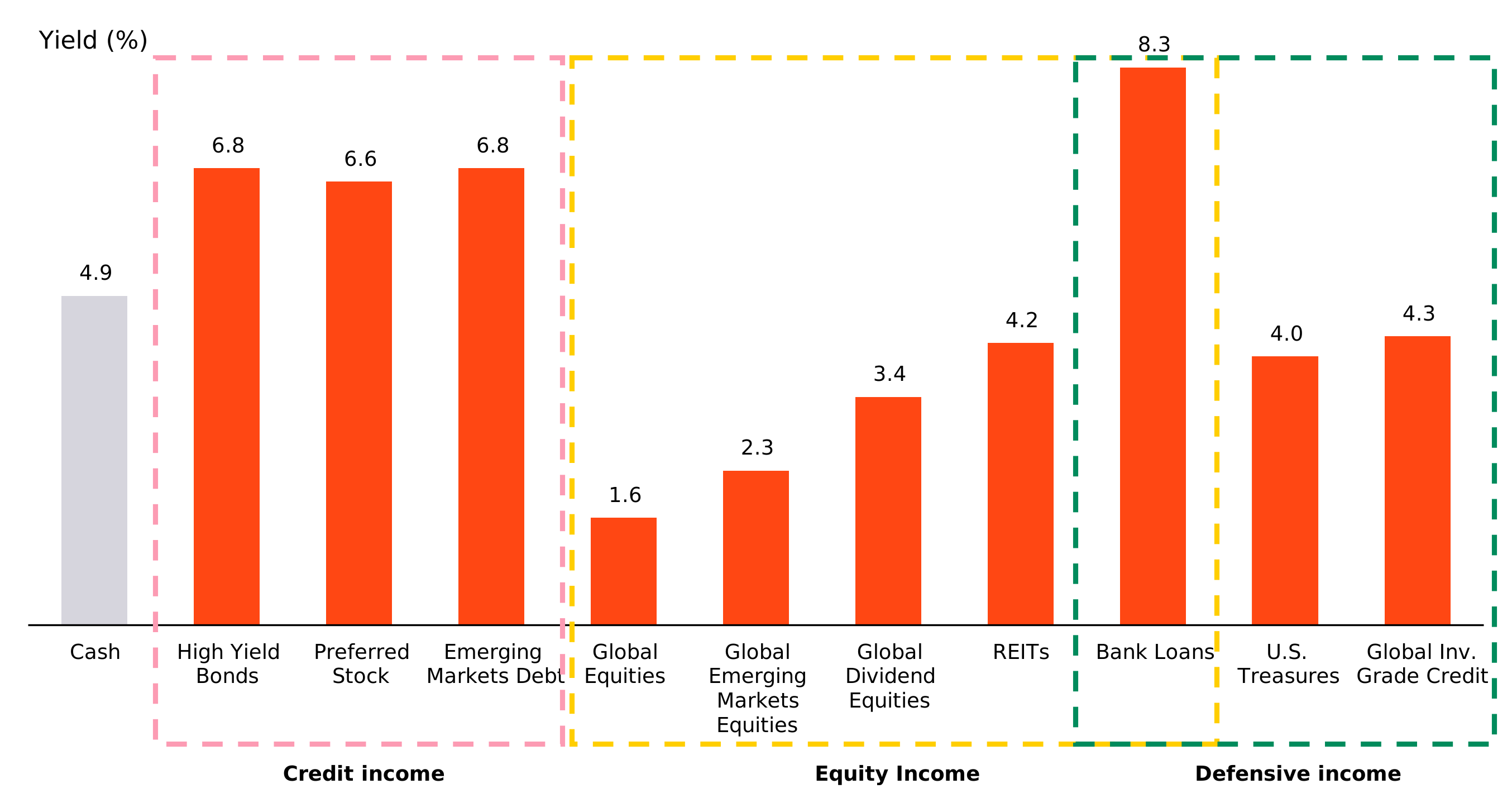
Taps into a full range of markets to generate high income

2. Turn volatility into income potential

Periods of market volatility may create attractive opportunities across a broader range of income assets, such as floating rate loans, which may offer higher yields and the potential for capital growth. The Fund's active approach allows it to tap into these opportunities to pursue higher income and returns, even when conditions are uncertain.

3. Flexibility to adapt as markets evolve

Investing across 10+ income asset classes and over 1,000 stocks and bonds around the world,² the Fund is designed to help investors stay resilient through changing markets and ready to act on new opportunities.

It also draws on the knowledge of more than 10 dedicated BlackRock investment teams, each focused on selecting the individual stocks and bonds best positioned for the road ahead.

Diversify further with complementary income sources

The Fund invests in complementary income asset classes such as covered calls, floating rate loans and real assets. These asset classes have the potential to deliver higher yields and capital appreciation, and their low correlation3 to more traditional asset classes may provide meaningful diversification to your portfolio.

A covered call strategy is commonly used to generate additional income in a portfolio. It is achieved by holding a stock position and selling or “writing” a call option on that same stock.

A call option is a contract that gives the buyer the right to buy a stock at a pre-arranged price, or the strike price, on or before the option expiration date, depending on the terms of the contract. On the other side of the contract, the seller of a call option is required to sell the stock at the strike price if the buyer wishes to exercise the option. In return, the seller receives a payment or a premium upfront from the buyer of the call option. 

Let’s look at an example. Say we bought shares of XYZ Company at $100. While we like its long-term prospects, we feel the stock won’t appreciate sharply in the near term. How can we still generate a return in the meantime? This is where a covered call strategy may add value. By selling a call option worth $2 at a strike price of $105, we earn the $2 premium from selling the call option today, but one of these scenarios is going to play out before the option expiration date::

a) XYZ stock trades above $105. The buyer of our call option will exercise it, meaning we need to sell our stock to the buyer at $105. In this case, we still get to keep the $2 option premium but we lose out on any capital appreciation beyond $105.

b) XYZ stock trades between $100 to $105. The call option expires worthless. Because the stock did not trade above the strike price of $105, the buyer did not exercise the option, we get to retain ownership of the stock, earn the $2 in option premium and capture the full upside of the stock.

c) XYZ stock trades below $100 at maturity. The call option expires worthless. Because we own the stock, we would incur a loss that equals the stock price decline less the income earned from the premium. In other words, the option premium can provide some protection against modest stock price declines.

While it is important to be aware of the risks involved, a covered call strategy can help investors achieve additional income in a portfolio and provide some downside protection from stock price movement.

Video Playlist

A covered call strategy is commonly used to generate additional income in a portfolio. It is achieved by holding a stock position and selling or “writing” a call option on that same stock.

A call option is a contract that gives the buyer the right to buy a stock at a pre-arranged price, or the strike price, on or before the option expiration date, depending on the terms of the contract. On the other side of the contract, the seller of a call option is required to sell the stock at the strike price if the buyer wishes to exercise the option. In return, the seller receives a payment or a premium upfront from the buyer of the call option. 

Let’s look at an example. Say we bought shares of XYZ Company at $100. While we like its long-term prospects, we feel the stock won’t appreciate sharply in the near term. How can we still generate a return in the meantime? This is where a covered call strategy may add value. By selling a call option worth $2 at a strike price of $105, we earn the $2 premium from selling the call option today, but one of these scenarios is going to play out before the option expiration date::

a) XYZ stock trades above $105. The buyer of our call option will exercise it, meaning we need to sell our stock to the buyer at $105. In this case, we still get to keep the $2 option premium but we lose out on any capital appreciation beyond $105.

b) XYZ stock trades between $100 to $105. The call option expires worthless. Because the stock did not trade above the strike price of $105, the buyer did not exercise the option, we get to retain ownership of the stock, earn the $2 in option premium and capture the full upside of the stock.

c) XYZ stock trades below $100 at maturity. The call option expires worthless. Because we own the stock, we would incur a loss that equals the stock price decline less the income earned from the premium. In other words, the option premium can provide some protection against modest stock price declines.

While it is important to be aware of the risks involved, a covered call strategy can help investors achieve additional income in a portfolio and provide some downside protection from stock price movement.