Rethink cash and income with bond ETFs

Key takeaways

  • 01

    Cash and income opportunities are both evolving.

    Returns of cash may change quickly if interest rates move lower, while higher yields can come with different types of risk.

  • 02

    A strong foundation matters more as choices grow.

    As investment options expand, balancing income, risk and flexibility becomes more important.

  • 03

    Bond ETFs can help support that foundation.

    By offering diversified income, broad market exposure and flexibility, bond ETFs can help investors adapt as conditions evolve.

Put cash to work

Cash has played an important role in helping investors navigate uncertainty. With higher rates, it has offered a source of income while keeping capital readily accessible. 

But one key feature of cash is that its returns can change quickly. As interest rates move lower, the income from cash tends to adjust downward relatively fast.

At the same time, staying in cash may mean missing other sources of potential income or return in a changing market. 

Today, as the chart shows, many bonds are offering higher yields than cash. This highlights the potential income trade-off of staying fully in cash. 
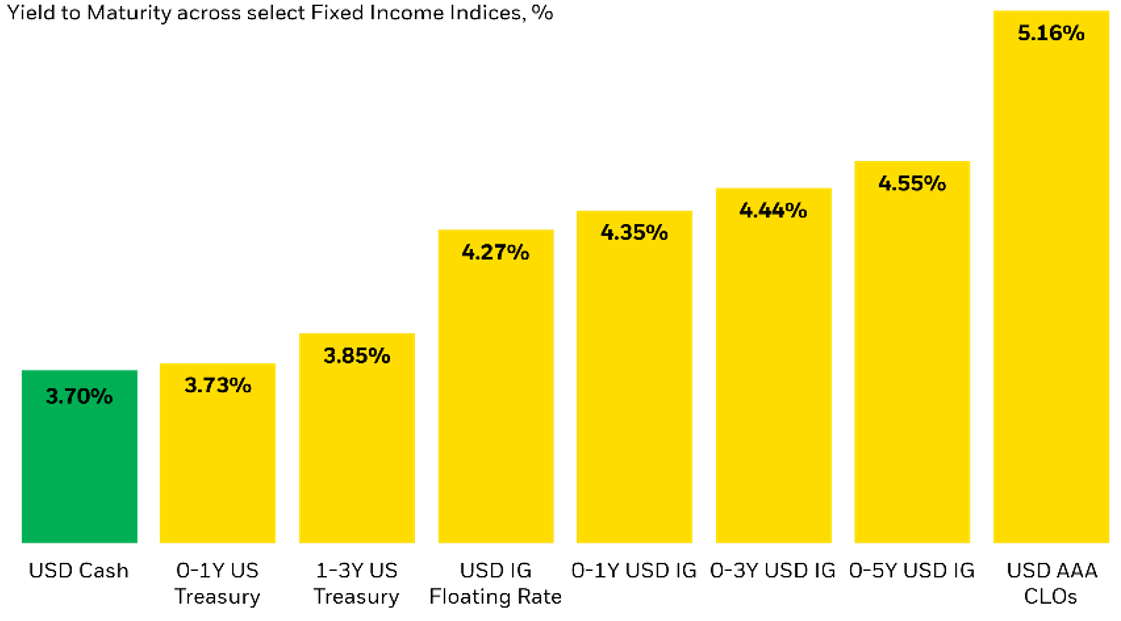
How cash compares with today’s bond yields

Chart: How cash compares with today’s bond yields

Source: BlackRock, Bloomberg as of 31 March 2026. USD Cash based on ICE 0-3 Month US Treasury Bill Index, 0-1Y US Treasury based on ICE Short US Treasury Securities Index, 1-3Y US Treasury based on ICE US Treasury 1-3 Year Bond Index, USD IG Floating Rate based on Bloomberg US Floating Rate Note <5 Years Index, 0-1Y USD IG based on Markit iBoxx USD Liquid Investment Grade Ultrashort Index, 0-3Y USD IG based on Bloomberg MSCI US Corporate 0-3 ESG SRI Index, 0-5Y USD IG based on Markit iBoxx USD Liquid Investment Grade 0-5 Index, USD AAA CLOs based on JP Morgan CLOIE AAA Index. 

Index performance is for illustrative purposes only. Index performance does not reflect any management fees or expenses. Indexes are unmanaged and one cannot invest directly in an index. Performance data represents past performance and does not guarantee future results. 

Improve income

Not all income is equal. Investors can generate income through stocks, bonds, and options overlays, each with different drivers and risks. Bonds typically sit toward the lower risk end of the income spectrum compared to stocks, as they generally provide regular and fixed income payments in the form of bond coupons. 

Within bonds, the opportunity set has also broadened. Today's bond ETFs can provide access to a wider range of opportunities, helping investors move beyond core bonds, such as pure government debt and corporate bonds, to manage risk and seek higher yield. 

This broader toolkit can support a more balanced income approach. Investors may benefit from combining core bonds and 'plus' sectors, such as high-yield credit, securitized assets and emerging market debt. 

At the same time, bond ETFs themselves continue to evolve. Recent innovations have brought more choice for investors, including active and outcome ETFs that can help target specific goals, such as higher quality income or enhanced income potential. 

Cash vs bonds

Caption:

A simple way to think about the trade-off

Cash Bonds 
Income today Steady, linked to short-term rates Often higher, varies by type of bond 
When rates fall Income typically resets quickly Income continues + potential price gains 
Risk level Low price volatility Varies depending on duration and credit quality 
Flexibility High Varies (individual bonds vs bond ETFs) 

For illustration only. 

Where do bond ETFs fit in today?

Investing is becoming more sophisticated, but it doesn't have to become more complicated. Many investors are trying to balance three key things at once: earning income, managing risk, and staying flexible enough to adapt as markets change. 

If you’re holding cash, it may feel safe and stable — but the trade-off is becoming more important. Cash can offer certainty today, but it may limit your ability to earn higher income over time. 

Moving beyond cash can open more income opportunities, but higher yields are only part of the picture. It’s just as important to understand where that income comes from and the risks behind it. 

Investment options are also becoming more complex. Beyond traditional investments, there are now many options — from thematic strategies to private markets. With more choices comes a greater need for a strong, dependable core. 

Bond ETFs offer one way to help fill that gap — providing income, diversification, and flexibility in a single investment, making it easier to build a more balanced portfolio. 

Why choose iShares?

  • 01

    Access

    Invest your way. iShares offers the world’s broadest range of bond ETFs. Choose from over 400 bond ETFs globally to suit your goals, whether you want income, diversification, or a place to invest cash.1

  • 02

    Quality

    Invest with confidence. iShares bond ETFs are supported by BlackRock’s investment expertise, combining decades of experience with detailed research and disciplined portfolio management.2

  • 03

    Value

    Keep more of what you earn. iShares bond ETFs cost less than active mutual funds on average. Low costs, efficient trading and scale help reduce the overall cost of investing.3