

Education
Skip to content
Welcome to the BlackRock site for intermediaries
Before you proceed, please take a moment to review and accept the following Terms and Conditions.
The information contained on this website is intended strictly for Sophisticated Clients as defined under the Capital Market Authority rules and regulations.
The information contained on this website is being made available on the basis that the recipient acknowledges and understands:
- any product/service related literature contained on this website is not subject to any form of regulation or approval by the CMA or any other relevant licensing authority or governmental agency in the Kingdom of Saudi Arabia;
- the information contained on this website does not constitute or form any offer or recommendation to issue or sell, or any solicitation of any offer to subscribe for or purchase, any securities, investment products and/or services in the Kingdom of Saudi Arabia and accordingly should not be construed as such;
- the information contained on this website is for information purposes only and is not intended for and should not be distributed to, or relied upon by, members of the public;
- the information contained on this website may contain statements that are not purely historical in nature but are ‘forward looking statements, including amongst other things, projections forecasts or estimates of income. These forward-looking statements are based on certain assumption, some of which are described in other documents or materials.
This website and the information it contains is not directed at residents of any country where it is prohibited by law or regulations from making the information available. It is not intended for access or any use that would be contrary to local law or regulation.
The CMA has no responsibility for reviewing or verifying any Prospectus or other documents contained on this website.
Whilst great care has been taken to ensure that the information contained on this website is accurate, no responsibility can be accepted for any errors, mistakes or omissions or for any action taken in reliance thereon.
You may only reproduce, circulate and use any information contained on this website with the express consent of BlackRock Saudi Arabia.
BlackRock Saudi Arabia is authorised and regulated by the Capital Market Authority, license no. 18-192-30.
BlackRock Saudi Arabia is located at Laysen Valley, Building 7976 Salim Ibn Abi Bakr Shaikan St West Umm Al Hamam District, 2223, Riyadh 12329, Saudi Arabia.
I CONFIRM THAT I AM A SOPHISTICATED INVESTOR, HAVE READ THE IMPORTANT INFORMATION AND WISH TO PROCEED

Inside alternatives
Introduction to Private Real Estate
Hello, I’m Thomas Mueller-Borja, Global Co-Head for Real Estate at BlackRock.
Our work in private real estate is helping us power the future for our communities – the ways we live and work – in 3 key ways:
Firstly, private real estate addresses today’s needs for critical infrastructure, including i) social; ii) industrial and iii) digital infrastructure. We get to develop buildings i) for everyday people by providing housing; ii) for small businesses by providing supply chains and production facilities; and iii) for hyperscalers and larger corporates by providing data centers that power the future.
Secondly, as a private real estate investor, I get to improve the built environment by anticipating tomorrow’s tenants’ needs. This means making living, working and entertainment spaces more enjoyable and more connected for a lasting positive impact on body, mind and soul.
And thirdly, the long-term nature of private real estate allows us to build lasting partnerships with the communities and clients who entrust us with their land and capital. Together we are able to deliver on their long-term investment goals.
Tune in as Thomas Mueller-Borja, Global Co-Head for Real Estate, shares three ways our work in private real estate is helping us power the future of our communities.
Key Takeaways
Capital at risk. The value of investments and the income from them can fall as well as rise and are not guaranteed. Investors may not get back the amount originally invested.
- Real estate offers multiple ways to invest, including direct ownership, public real estate investment trusts (REITs) and private funds.
- Private real estate spans a wide potential risk/return range.
- Real estate may enhance portfolios through potential income, inflation sensitivity and diversification.
How does private real estate work?
While real estate can be accessed through public markets, another way to access real estate is through unlisted, private real estate. Private real estate involves the acquisition of property outside of publicly, listed real estate and can operate at both the individual and institutional level. Often for institutional private real estate owners, acquisitions are funded using a mix of direct capital investment and property‑level debt, similar to how an individual buys a home with a mortgage. The debt is usually non‑recourse, meaning it is secured only against the property itself and not against the broader balance sheet of the owner. Assets are largely held in special purpose vehicles which are standalone legal entities created solely to own a specific asset and are domiciled in tax-friendly jurisdictions.
Exhibit 1: Ways to access real estate
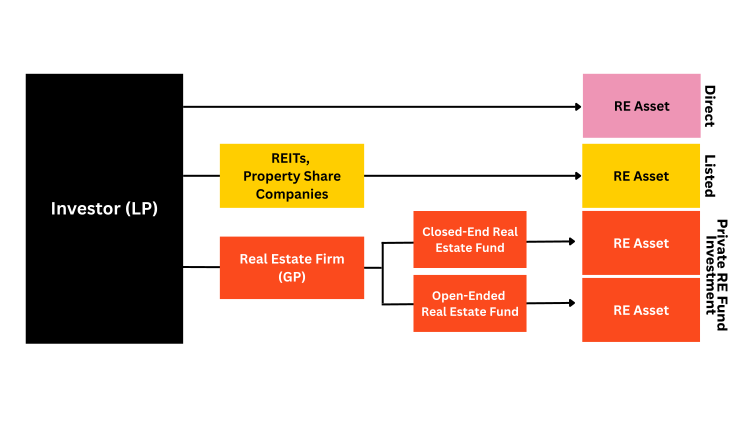
For illustrative purposes only.
Accessing private real estate
Within private real estate investing, assets can be held in closed-end or open-ended funds, depending on the nature of the underlying investment. Private real estate investments are often categorized into four main categories (see Exhibit 2), each with various potential levels of risk and return, private real estate can also be accessed through distressed or debt strategies.
Exhibit 2: The four main strategies of private real estate investing
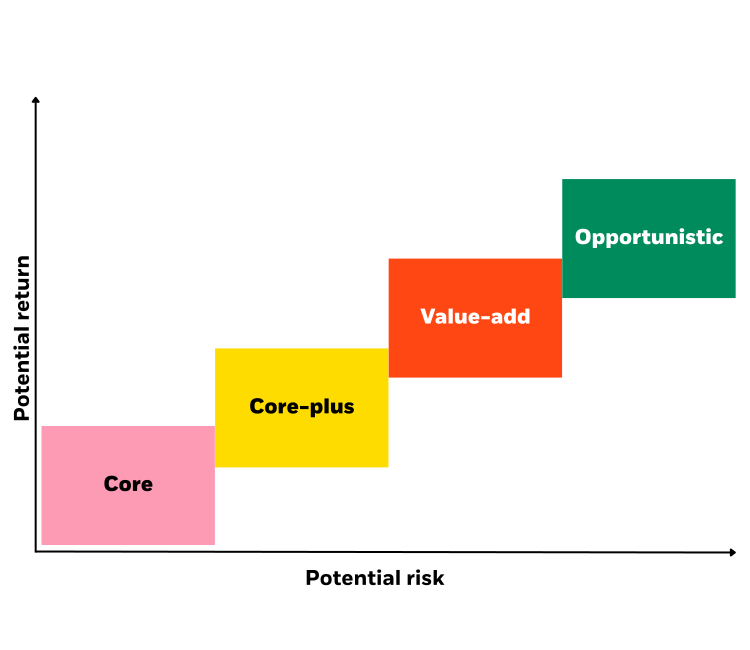
This is for illustrative purposes only and does not represent actual performance or specific investments. The strategies shown are generalized and their characteristics may vary.
- Core
Core investment strategies generally focus on high-quality buildings that are fully leased, multi-tenant properties in well-established, diversified metropolitan areas. Typically core strategies have long hold periods and, as a result, are commonly seen in open-ended funds.
Example: A stabilized, high-quality property in a major metropolitan area. - Core-plus
Core-plus strategies also invest in core properties that may require improvements such as renovations, repositioning or re-leasing. This is considered a potential moderate risk/ return strategy and may require a modest amount of leverage.
Example: A stabilized, undermanaged, multifamily property in a metropolitan area with potential for operational improvement. - Value-added
Value added strategies buy lower quality properties with the intent to make improvements and sell the asset for a gain. This could be buildings that exhibit management operation problems or buildings that require physical improvements. Because the holding period on these investments is typically between 3-10 years, value-add investments are often seen in closed-end funds and require a high amount of leverage.
Example: A 50-year-old multi-family property requiring renovation, where following improvements may support repositioning and potential changes in tenant profile, rental income and asset value. - Opportunistic
Opportunistic investments require substantial redevelopment of existing properties, construction of new developments, or investment in raw land/niche property sectors. Opportunistic investments are typically held in close end funds and have a high amount of leverage embedded into the investment.
Example: Purchase of land and construction of a new office building.
Distressed and debt real estate strategies that can encompass similar potential risk and return profiles to any of the above.
- Distressed: A building priced at a discount due to problems with the building, building management, or tenants.
- Debt: This tends to have a greater focus on income relative to real estate equity investments, depending on structure and risk profiles. Similar to corporate credit, investments may include senior debt and mezzanine or subordinated debt, which differ in their priority of repayment.
Why consider investing in private real estate?
Private real estate seeks to offer several compelling benefits for investors, including income generation, inflation sensitivity, and diversification. Properties may generate monthly or quarterly income, and the level of potential income is commonly assessed using the capitalization rate (or cap rate), which is calculated by dividing a property’s net operating income by its value. Even during economic downturns, some real estate investments may continue to generate rental income as tenants may have multi-year lease agreements in place. In addition, real estate may serve as an inflation hedge, as property values and rental income tend to rise with inflation; housing rents are a component of CPI, and many tenancy contracts include inflation-linked rent increases. Finally, real estate may provide diversification benefits, offering investors exposure to a wide range of strategies, property types, and geographic markets within a single asset class.
What are the risks of investing in private real estate?
Private real estate investments are subject to several key risks, including market and macro sensitivity, leverage and capital risk, and operational and asset‑specific considerations. Property values and cash flows can be highly sensitive to economic conditions, interest rates, and local supply‑and‑demand dynamics, which may pressure valuations and refinancing outcomes. The use of leverage can further amplify both gains and losses, increasing exposure to income shortfalls, covenant breaches, or defaults during periods of market stress. In addition, returns depend heavily on effective property management and asset‑level factors such as tenant quality, occupancy rates, maintenance requirements, and regulatory or environmental considerations.
Sign up for the private markets quarterly newsletter
Get timely updates on private markets with curated insights from BlackRock. By subscribing, you’ll receive market updates, product launches, thought leadership, and webinars designed to keep you informed.
Please try again

Explore more
About us
Insights
Education
-
Education
Themes

© 2026 BlackRock, Inc. All rights reserved.
MKTG0526-5458194-EXP0527