
Filter list by keyword
Show More
Show Less
to
of
Total
Sorry, no data available.
3067 / 9067
iShares Hang Seng TECH ETF
-
Fees as stated in the prospectus
Management Fee: 0.25%
IMPORTANT: Investment involves risk, including the loss of principal. Investors should refer to the Prospectus and Key Facts Statement of the iShares Hang Seng TECH ETF (the “ETF”) for details, including the risk factors. If you are in any doubt, you should consult your stockbroker, bank manager, solicitor, accountant or other financial adviser for independent financial advice. Investors should not base investment decisions on this marketing material alone. Investors should note:
• The ETF aims to provide investment results that, before fees and expenses, closely correspond to the performance of the Hang Seng TECH Index (net total return version) (the “Underlying Index”).
• The ETF is subject to tracking error risk, which is the risk that its performance may not track that of the underlying index exactly. The underlying Index is a new index and the ETF may be riskier than other exchange traded funds tracking more established indices with longer operating history.
• The ETF’s investments are concentrated in in companies with a technology theme from across the Greater China region listed in Hong Kong. The value of the ETF may be more volatile than that of a fund having a more diverse portfolio of investments or global / regional scope.
• The ETF’s base currency is in HKD but has units traded in USD (in addition to HKD). Investors may be subject to additional costs or losses associated with foreign currency fluctuations between the base currency and the USD trading currency when trading units in the secondary market.
• If there is a suspension of the inter-counter transfer of units between the counters and/or any limitation on the level of services provided by brokers and CCASS participants, Unitholders will only be able to trade their units in one counter. The market price of units traded in each counter may deviate significantly.
• Termination of the market making arrangement may lead to risk of liquidity in the market for the units being adversely affected if there is no or only one market maker for the units on any counter. The units of the ETF are traded on the SEHK. The trading price of the units is subject to market factors and may trade at a substantial premium or discount to the ETF’s NAV.
• The Manager may at its discretion pay distributions out of capital, or effectively out of capital, of the ETF. Payment of distributions out of capital or effectively out of capital amounts to a return or withdrawal of part of an investor’s original investment or from any capital gains attributable to that original investment. Any such distributions may result in an immediate reduction of the NAV per unit.
• The Fund may use derivatives for hedging and for investment purposes. However, usage for investment purposes will not be extensive. The Fund may suffer losses from its derivatives usage.
• The ETF is subject to securities lending transactions risks. In particular, the borrower may fail to return the securities in a timely manner and the value of the collateral may fall below the value of the securities lent out.
• The ETF aims to provide investment results that, before fees and expenses, closely correspond to the performance of the Hang Seng TECH Index (net total return version) (the “Underlying Index”).
• The ETF is subject to tracking error risk, which is the risk that its performance may not track that of the underlying index exactly. The underlying Index is a new index and the ETF may be riskier than other exchange traded funds tracking more established indices with longer operating history.
• The ETF’s investments are concentrated in in companies with a technology theme from across the Greater China region listed in Hong Kong. The value of the ETF may be more volatile than that of a fund having a more diverse portfolio of investments or global / regional scope.
• The ETF’s base currency is in HKD but has units traded in USD (in addition to HKD). Investors may be subject to additional costs or losses associated with foreign currency fluctuations between the base currency and the USD trading currency when trading units in the secondary market.
• If there is a suspension of the inter-counter transfer of units between the counters and/or any limitation on the level of services provided by brokers and CCASS participants, Unitholders will only be able to trade their units in one counter. The market price of units traded in each counter may deviate significantly.
• Termination of the market making arrangement may lead to risk of liquidity in the market for the units being adversely affected if there is no or only one market maker for the units on any counter. The units of the ETF are traded on the SEHK. The trading price of the units is subject to market factors and may trade at a substantial premium or discount to the ETF’s NAV.
• The Manager may at its discretion pay distributions out of capital, or effectively out of capital, of the ETF. Payment of distributions out of capital or effectively out of capital amounts to a return or withdrawal of part of an investor’s original investment or from any capital gains attributable to that original investment. Any such distributions may result in an immediate reduction of the NAV per unit.
• The Fund may use derivatives for hedging and for investment purposes. However, usage for investment purposes will not be extensive. The Fund may suffer losses from its derivatives usage.
• The ETF is subject to securities lending transactions risks. In particular, the borrower may fail to return the securities in a timely manner and the value of the collateral may fall below the value of the securities lent out.
Overview
Estimated NAV per unit is indicative and for reference purposes only. It is calculated, disseminated on a delayed basis and displayed on this website by ICE Data Services. The estimated NAV per unit for each trading currency other than the Base Currency is calculated using the estimated Net Asset Value per Unit in the Base Currency multiplied by the real time exchange rate provided by ICE Data Services for each such trading currency. The near real time estimated NAV per unit is updated at 15-second intervals during trading hours of the Stock Exchange of Hong Kong.

Performance
Performance
Chart
Performance chart data not available for display.
Distributions
| Record Date | Ex-Date | Payable Date |
|---|
-
Returns
During this period performance was achieved under circumstances that no longer apply
| 2016 | 2017 | 2018 | 2019 | 2020 | 2021 | 2022 | 2023 | 2024 | 2025 | |
|---|---|---|---|---|---|---|---|---|---|---|
| Total Return (%) | -32.64 | -26.89 | -8.54 | 19.48 | 24.34 | |||||
| Benchmark (%) | -32.47 | -26.67 | -8.26 | 19.89 | 24.68 |
Past performance is not a guide to future performance. Investors may not get back the full amount invested.
If the share class of the fund has been launched for less than 5 years, please refer to the fund factsheet for the performance information calculated from the launch date to the end of launch year.
Performance is calculated based on the calendar year end, NAV-to-NAV with dividend reinvested.
These figures show by how much the Share Class of the Fund increased or decreased in value during the calendar year being shown. Performance is calculated in the relevant Share Class currency, including ongoing charges and taxes and excluding subscription and redemption fees, if applicable.
Where no past performance is shown there was insufficient data available in that calendar year to provide performance.
Please refer to the Key Facts section on the right for the inception date of the Fund and the Share Class.
If the share class of the fund has been launched for less than 5 years, please refer to the fund factsheet for the performance information calculated from the launch date to the end of launch year.
Performance is calculated based on the calendar year end, NAV-to-NAV with dividend reinvested.
These figures show by how much the Share Class of the Fund increased or decreased in value during the calendar year being shown. Performance is calculated in the relevant Share Class currency, including ongoing charges and taxes and excluding subscription and redemption fees, if applicable.
Where no past performance is shown there was insufficient data available in that calendar year to provide performance.
Please refer to the Key Facts section on the right for the inception date of the Fund and the Share Class.
| 1y | 3y | 5y | 10y | Incept. | |
|---|---|---|---|---|---|
| Total Return (%) | -33.74 | 3.51 | -6.44 | - | -8.23 |
| Benchmark (%) | -33.58 | 3.80 | -6.17 | - | -7.96 |
| YTD | 1m | 3m | 6m | 1y | 3y | 5y | 10y | Incept. | |
|---|---|---|---|---|---|---|---|---|---|
| Total Return (%) | -22.34 | -7.89 | -4.72 | -7.88 | -33.74 | 10.89 | -28.32 | - | -40.50 |
| Benchmark (%) | -22.21 | -7.89 | -4.69 | -7.78 | -33.58 | 11.84 | -27.27 | - | -39.41 |
Past performance is not a guide to future performance and should not be the sole factor of consideration when selecting a product.The price of the investments may go up or down and the investor may not get back the amount invested.
Source: BlackRock. Performance data is displayed on a Net Asset Value basis, net of fees. Brokerage or transaction fees will apply.
Key Facts
Key Facts
Net Assets of Fund
as of 06-Oct-2026
HKD 12,924,314,068
Exchange
Hong Kong Stock Exchange
Asset Class
Equity
Index Ticker
HSTECHN
Management Fee
0.25%
Distribution Frequency
Semi-Annually
Bloomberg Ticker
3067 HK
SFC-authorised ESG fund
No
Fund Inception
14-Sept-2020
Base Currency
Hong Kong Dollar
Benchmark Index
Hang Seng TECH Net Total Return Index (HKD)
Shares Outstanding
as of 06-Oct-2026
1,449,150,000
ISIN
HK0000651213
Domicile
Hong Kong
For premium / discount information, please refer to the pricing & exchange table below.
Portfolio Characteristics
Portfolio Characteristics
Number of Holdings
as of 06-Oct-2026
30
12M Trailing Distribution
as of 05-Oct-2026
0.68%
3y Beta
as of 30-Sept-2026
0.999
P/B Ratio
as of 05-Oct-2026
2.09
Benchmark Level
as of 06-Oct-2026
HKD 4,752.38
Standard Deviation (3y)
as of 30-Sept-2026
32.19%
P/E Ratio
as of 05-Oct-2026
17.11
Ratings
Holdings
Holdings
| Ticker | Name | Sector | Asset Class | Market Value | Weight (%) | Notional Value | Shares | CUSIP | ISIN | SEDOL | Price | Location | Exchange | Currency | FX Rate | Market Currency |
|---|
Holdings are subject to change.
Exposure Breakdowns
Exposure Breakdowns
as of 05-Oct-2026
% of Weight
As a percentage of NAV of the Fund. Based on Global Industry Classification Standard (GICS). Please note this data excludes underlying investments of any exchange traded funds that may be invested by the Fund. Allocations are subject to change. Due to rounding, the total may not be equal to 100%.
Participating Dealers
Participating Dealers
ABN Amro Clearing Bank N.V
BNP PARIBAS Securities Services
China Merchants Securities (HK) Co., Limited
Haitong International Securities Group Limited
J.P. Morgan Broking (Hong Kong) Limited
Mirae Asset Securities (HK) Limited
Morgan Stanley Hong Kong Securities Limited
Barclays Bank PLC
Citigroup Global Markets Asia Limited
Goldman Sachs (Asia) Securities Limited
The Hongkong and Shanghai Banking Corporation Limited
Korea Investment & Securities Asia Limited
Merrill Lynch Far East Limited
UBS Securities Hong Kong Limited
Exchange
Exchange
| Ticker | Exchange | Currency | Listing Date | Premium Discount | Premium Discount As Of | NAV | NAV $ Change | NAV % Change | Price As Of | NAV As Of | Closing Price | Closing Price $ Change | Closing Price % Change | FX to Base Ccy | 20d Avg Volume | Exchange Volume | Bloomberg Ticker | Bloomberg IOPV | Bloomberg INAV | Bloomberg Shares Out. | SEDOL | ISIN | RIC | Trading Board Lot |
|---|---|---|---|---|---|---|---|---|---|---|---|---|---|---|---|---|---|---|---|---|---|---|---|---|
| 3067 | XHKG | Hong Kong Dollar | 17-Sept-2020 | -0.21 | 06-Oct-2026 | 8.92 | 0.08 | 0.94 | 06-Oct-2026 | 06-Oct-2026 | 8.90 | 0.09 | 1.02 | - | 15,201,713.00 | 19,443,114.00 | 3067 HK | 3067NAV | 3067IV | 3067SHO | BMW44P6 | HK0000651213 | 3067.HK | 100.00 |
| 9067 | XHKG | U.S. Dollar | 17-Sept-2020 | 0.32 | 06-Oct-2026 | 1.14 | 0.01 | 0.92 | 06-Oct-2026 | 06-Oct-2026 | 1.14 | -0.03 | -2.56 | 0.12743 | 239,617.00 | 358,700.00 | 9067 HK | 9067NAV | 9067IV | 9067SHO | BV5H046 | HK0000651213 | 9067.HK | 100.00 |
Sustainability Characteristics
Sustainability Characteristics
Sustainability Characteristics provide investors with specific non-traditional metrics. Alongside other metrics and information, these enable investors to evaluate funds on certain environmental, social and governance characteristics. Sustainability Characteristics do not provide an indication of current or future performance nor do they represent the potential risk and reward profile of a fund. They are provided for transparency and for information purposes only. Sustainability Characteristics should not be considered solely or in isolation, but instead are one type of information that investors may wish to consider when assessing a fund.
The metrics are not indicative of how or whether ESG factors will be integrated into a fund. Unless otherwise stated in fund documentation and included within a fund’s investment objective, the metrics do not change a fund’s investment objective or constrain the fund’s investable universe, and there is no indication that an ESG or Impact focused investment strategy or exclusionary screens will be adopted by a fund. For more information regarding a fund's investment strategy, please see the fund's prospectus.
Review the MSCI methodologies behind Sustainability Characteristics.
MSCI ESG Fund Rating (AAA-CCC)
as of 18-Sept-2026
AA
MSCI ESG Quality Score (0-10)
as of 18-Sept-2026
7.34
Fund Lipper Global Classification
as of 18-Sept-2026
Equity Sector Information Technology
MSCI Weighted Average Carbon Intensity (Tons CO2E/$M SALES)
as of 18-Sept-2026
64.54
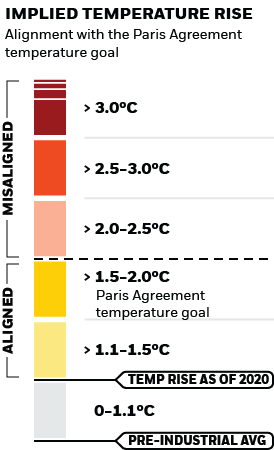
MSCI Implied Temperature Rise (0-3.0+ °C)
as of 18-Sept-2026
> 2.5° - 3.0° C
MSCI ESG % Coverage
as of 18-Sept-2026
90.00
MSCI ESG Quality Score - Peer Percentile
as of 18-Sept-2026
87.98
Funds in Peer Group
as of 18-Sept-2026
1,456
MSCI Weighted Average Carbon Intensity % Coverage
as of 18-Sept-2026
97.43
MSCI Implied Temperature Rise % Coverage
as of 18-Sept-2026
97.43
What is the Implied Temperature Rise (ITR) metric? Learn what the metric means, how it is calculated, and about the assumptions and limitations for this forward-looking climate-related metric.
To address climate change, many of the world's major countries have signed the Paris Agreement. The temperature goal of the Paris Agreement is to limit global warming to well below 2°C above pre-industrial levels, and ideally 1.5 °C, which will help us avoid the most severe impacts of climate change.
What is the ITR metric?
The ITR metric is used to provide an indication of alignment to the temperature goal of the Paris Agreement for a company or a portfolio. ITR employs open source 1.55° C decarbonization pathways derived from the Network of Central Banks and Supervisors for Greening the Financial System (NGFS). These pathways can be regional and sector specific and set a net zero target of 2050, in line with GFANZ (Glasgow Financial Alliance for Net Zero) industry standards. We make use of this feature for all GHG scopes. This enhanced ITR model was implemented by MSCI on February 19, 2024.
How is the ITR metric calculated?
The ITR metric is calculated by looking at the current emissions intensity of companies within the fund's portfolio as well as the potential for those companies to reduce its emissions over time. If emissions in the global economy followed the same trend as the emissions of companies within the fund's portfolio, global temperatures would ultimately rise within this band.
Note, only corporate issuers are covered within the calculation. A summary explanation of MSCI’s methodology and assumptions for its ITR metric can be found here.
Because the ITR metric is calculated in part by considering the potential for a company within the fund’s portfolio to reduce its emissions over time, it is forward-looking and prone to limitations. As a result, BlackRock publishes MSCI’s ITR metric for its funds in temperature range bands. The bands help to underscore the underlying uncertainty in the calculations and the variability of the metric.
What are the key assumptions and limitations of the ITR metric?
This forward-looking metric is calculated based on a model, which is dependent upon multiple assumptions. Also, there are limitations with the data inputs to the model. Importantly, an ITR metric may vary meaningfully across data providers for a variety of reasons due to methodological choices (e.g., differences in time horizons, the scope(s) of emissions included and portfolio aggregation calculations).
There is not a universally accepted way to calculate an ITR. There is not a universally agreed upon set of inputs for the calculation. At present, availability of input data varies across asset classes and markets. To the extent that data becomes more readily available and more accurate over time, we expect that ITR metric methodologies will evolve and may result in different outputs. Funds may change bands as methodologies evolve. Where data is not available, and / or if data changes, the estimation methods vary, particularly those related to a company’s future emissions.
The ITR metric estimates a fund’s alignment with the Paris Agreement temperature goal based on a credibility assessment of stated decarbonization targets. However, there is no guarantee that these estimates will be reached. The ITR metric is not a real time estimate and may change over time, therefore it is prone to variance and may not always reflect a current estimate.
The ITR metric is not an indication or estimate of a fund’s performance or risk. Investors should not rely on this metric when making an investment decision and instead should refer to a fund’s prospectus and governing documents. This estimate and the associated information is not intended as a recommendation to invest in any fund, nor is it intended to indicate any correlation between a fund’s ITR metric and its future investment performance.
All data is from MSCI ESG Fund Ratings as of 18-Sept-2026, based on holdings as of 31-Aug-2026. As such, the fund’s sustainable characteristics may differ from MSCI ESG Fund Ratings from time to time.
To be included in MSCI ESG Fund Ratings, 65% (or 50% for bond funds and money market funds) of the fund’s gross weight must come from securities with ESG coverage by MSCI ESG Research (certain cash positions and other asset types deemed not relevant for ESG analysis by MSCI are removed prior to calculating a fund’s gross weight; the absolute values of short positions are included but treated as uncovered), the fund’s holdings date must be less than one year old, and the fund must have at least ten securities.
Business Involvement
Business Involvement
Business Involvement metrics can help investors gain a more comprehensive view of specific activities in which a fund may be exposed through its investments.
Business Involvement metrics are not indicative of a fund’s investment objective, and, unless otherwise stated in fund documentation and included within a fund’s investment objective, do not change a fund’s investment objective or constrain the fund’s investable universe, and there is no indication that an ESG or Impact focused investment strategy or exclusionary screens will be adopted by a fund. For more information regarding a fund's investment strategy, please see the fund's prospectus.
Review the MSCI methodology behind the Business Involvement metrics, using links below.
MSCI - Controversial Weapons
as of 05-Oct-2026
0.00%
MSCI - Nuclear Weapons
as of 05-Oct-2026
0.00%
MSCI - Civilian Firearms
as of 05-Oct-2026
0.00%
MSCI - Tobacco
as of 05-Oct-2026
0.00%
MSCI - UN Global Compact Violators
as of 05-Oct-2026
0.00%
MSCI - Thermal Coal
as of 05-Oct-2026
0.00%
MSCI - Oil Sands
as of 05-Oct-2026
0.00%
Business Involvement Coverage
as of 05-Oct-2026
100.00%
Percentage of Fund not covered
as of 05-Oct-2026
0.00%
BlackRock business involvement exposures as shown above for Thermal Coal and Oil Sands are calculated and reported for companies that generate more than 5% of revenue from thermal coal or oil sands as defined by MSCI ESG Research. For the exposure to companies that generate any revenue from thermal coal or oil sands (at a 0% revenue threshold), as defined by MSCI ESG Research, it is as follows: Thermal Coal 0.00% and for Oil Sands 0.00%.
Business Involvement metrics are calculated by BlackRock using data from MSCI ESG Research which provides a profile of each company’s specific business involvement. BlackRock leverages this data to provide a summed up view across holdings and translates it to a fund's market value exposure to the listed Business Involvement areas above.
Business Involvement metrics are designed only to identify companies where MSCI has conducted research and identified as having involvement in the covered activity. As a result, it is possible there is additional involvement in these covered activities where MSCI does not have coverage. This information should not be used to produce comprehensive lists of companies without involvement. Business Involvement metrics are only displayed if at least 1% of the fund’s gross weight includes securities covered by MSCI ESG Research.
