A powerful economic restart is underway in the US – with Europe and emerging markets (EMs) set to follow. At the same time our new nominal theme has been playing out, with a hefty jump in inflation expectations but a more muted rise in nominal yields. Against this backdrop, we reiterate our pro-risk stance and refine our tactical views in response to adjustments in market pricing and valuations.
Chart of the week
US GDP estimates, global financial crisis and Covid-19 shock
Forward looking estimates may not come to pass. Sources: BlackRock Investment Institute, Federal Reserve, and Reuters News, with data from Haver Analytics, April 2021. The charts show the level and estimates of US GDP over time for the global financial crisis (GFC) and the Covid-19 shock. Both series are rebased to 100 for the year prior to the shock – 2007 and 2019. Estimates are from the Fed’s Federal Open Markets Committee’s Summary of Economic Projections published through 2008 on the left and 2020-21 on the right. The level of GDP is derived from the FOMC’s forecasts of GDP growth from the fourth quarter of the prior year to the fourth quarter of the current year. Early estimates are as of Jan 2008 for GFC (June 2020 for Covid); later estimates as of Nov. 2008 (Mar. 2021 for Covid).
We are at an uncertain juncture in markets. Investors are grappling with how to interpret unusual growth dynamics and new central bank frameworks. On the first, US activity looks set to restart strongly this year, powered by pent-up demand across income cohorts and sky-high excess savings. Growth forecasts have been catching up, as the chart above shows, but the magnitude of the restart may still be underappreciated. This is in stark contrast to the repeat growth disappointments seen after the global financial crisis – and reflects the different nature of this shock. We see it as more akin to a natural disaster followed by a rapid “restart” – rather than a traditional business cycle recession followed by a “recovery.” This is why a year ago we warned against extrapolating too much from the steep decline in activity. Now the same is true – but in reverse. US growth will likely peak over the summer but the eye-popping data will be transient: the more activity is restarted now, the less there will be to restart later. We see the rest of the world following the US and reopening as vaccine rollouts pick up pace.
The second dynamic investors are grappling with is new central bank frameworks. Our new nominal theme helps us navigate this environment. The Federal Reserve is building credibility in its new framework and has set a high bar to change its easy policy stance, even in face of higher realised inflation. This has yet to be fully digested by markets, in our view. We see markets still underestimating the potential for the Fed to achieve above-target inflation in the medium term as it looks to make up for persistent undershoots in the past. This is why we think the direction of travel for yields is higher. But we believe the overall adjustment will be much more muted than one would have expected in the past based on growth dynamics – and much adjustment has already taken place.
As a result of these two key dynamics, we maintain our pro-risk tactical view. We remain overweight equities, neutral credit and underweight government bonds on a tactical basis. Yet we have tweaked some of our tactical views given significant moves in market pricing. For example, 10-year Treasury yields have more than tripled from last year’s lows around 0.5%. This leaves less room for further rises in yields on a tactical horizon, in our view. US inflation expectations also have come a long way since we moved to an overweight in US Treasury Protected Securities (TIPS) early last year. As a result, we are trimming our tactical underweight to US Treasuries and closing our overweight in TIPS – even as we see room for yields to push higher and inflationary pressures to build further in the medium term. In a world starved for income, we have upgraded EM local currency debt on attractive valuations and the prospect of a stable dollar as the restart broadens, prefer high yield over investment grade credit and see opportunities in private markets. Within equities we express our pro-cyclical stance through overweights to EM and US small caps as beneficiaries of the vaccine-led restart.
Bottom line: The broadening restart – coupled with our belief that this will not translate into significantly higher rates – underpins our pro-risk stance. Risks remain, however, on the tactical horizon. One is a market overreaction to exceptional growth data in the months ahead. We may see bouts of volatility as markets test the Fed’s resolve to stay “behind the curve” on inflation. Any temporary spikes in rates may challenge EM assets in particular, but we advocate staying invested and looking through any turbulence as our “new nominal” plays out. Want to know more? BII’s Global Outlook (GO) meeting on April 27 is a chance to hear from us directly and ask questions. Contact your BlackRock relationship manager for details.
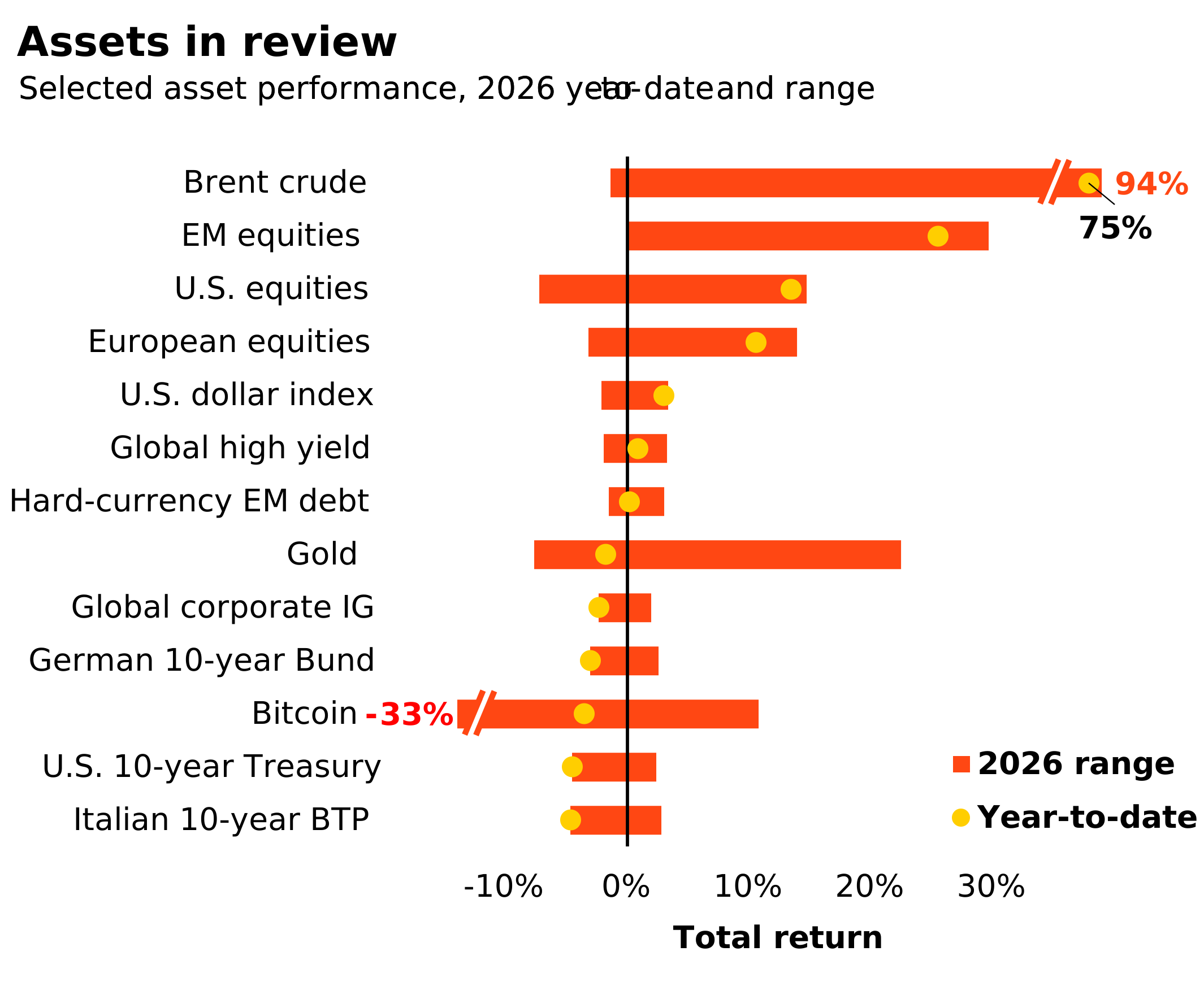
Assets in review
Selected asset performance in the past 12 months
Past performance is not a reliable indicator of current or future results. Indexes are unmanaged and do not account for fees. It is not possible to invest directly in an index. Sources: BlackRock Investment Institute, with data from Refinitiv Datastream as of April 22, 2021. Notes: The two ends of the bars show the lowest and highest returns at any point this year to date, and the dots represent current year-to-date returns. Emerging market (EM), high yield and global corporate investment grade (IG) returns are denominated in US dollars, and the rest in local currencies. Indexes or prices used are, in descending order: spot Brent crude, MSCI USA Index, MSCI Europe Index, MSCI Emerging Markets Index, the ICE US Dollar Index (DXY), Bank of America Merrill Lynch Global High Yield Index, Refinitiv Datastream Italy 10-year benchmark government bond index,, Refinitiv Datastream Germany 10-year benchmark government bond index, Bank of America Merrill Lynch Global Broad Corporate Index, J.P. Morgan EMBI index, Refinitiv Datastream US 10-year benchmark government bond index and spot gold.
A decline in US Treasury yields and strong corporate earnings are providing some support to equities. Some 87% of S&P 500 companies have beaten estimates for the first quarter, with just under one-fifth having reported, Refinitiv data showed as of Thursday. The five largest S&P 500 companies report this week. The Bank of Canada last week said it would start to taper down its asset purchases, becoming the first major central bank to signal an exit from quantitative easing. This comes ahead of a Federal Reserve policy meeting where the central bank is likely to reiterate its desire to stay “behind the curve.”
Week ahead
April. 27- Bank of Japan policy decision
April. 28- US FOMC policy decision; President Biden address to joint session of Congress
April. 29- US GDP (advance)
April. 30- Japan and China manufacturing PMIs; euro area preliminary GDP
The FOMC policy meeting will be in focus this week. Our new nominal theme that nominal yields will be less sensitive to expectations for higher inflation was confirmed by the Fed in the last policy meeting, a clear reaffirmation of its commitment to be well “behind the curve” on inflation. Elsewhere, US President Joe Biden is expected to make the case in an address to Congress for a more than $2 trillion infrastructure package as well as accompanying tax reforms that would partly fund it.
Strategic (long-term) and tactical (6-12 month) views on broad asset classes, April 2021

| Asset | Strategic view | Tactical view | |
| Equities | ![]() |
![]() |
|
| We are overweight equities on a strategic horizon. We see a better outlook for earnings amid moderate valuations. Incorporating climate change in our expected returns brightens the appeal of developed market equities given the large weights of sectors such as tech and healthcare in benchmark indexes. Tactically, we stay overweight equities as we expect the restart to re-accelerate and interest rates to stay low. We tilt toward cyclicality and maintain a bias for quality. | |||
| Credit | ![]() |
![]() |
||
| We are underweight credit on a strategic basis as valuations are rich and we prefer to take risk in equities. On a tactical horizon, credit, especially investment grade, has come under pressure from tightening spreads, but we still like high yield for income. | ||||
| Govt Bonds | ![]() |
![]() |
|
| We are strategically underweight nominal government bonds as their ability to act as portfolio ballasts are diminished with yields near lower bounds and rising debt levels may eventually pose risks to the low-rate regime. This is part of why we underweight government debt strategically. We prefer inflation-linked bonds as we see risks of higher inflation in the medium term. We are underweight duration on a tactical basis as we anticipate gradual increases in nominal yields supported by the economic restart. | |||
| Cash | ![]() |
![]() |
||
| We use cash to fund overweight in equities. Holding some cash makes sense, in our view, as a buffer against supply shocks driving both stocks and bonds lower. | ||||
| Private markets | ![]() |
![]() |
|
| We believe non-traditional return streams, including private credit, have the potential to add value and diversification. Our neutral view is based on a starting allocation that is much larger than what most qualified investors hold. Many institutional investors remain underinvested in private markets as they overestimate liquidity risks, in our view. Private markets are a complex asset class not suitable for all investors. | |||
Notes: Views are from a U.S. dollar perspective, April 2021. This material represents an assessment of the market environment at a specific time and is not intended to be a forecast of future events or a guarantee of future results. This information should not be relied upon by the reader as research or investment advice regarding any particular funds, strategy or security.
Our granular views indicate how we think individual assets will perform against broad asset classes. We indicate different levels of conviction.
Six to 12-month tactical views on selected assets vs. broad global asset classes by level of conviction, April 2021

Equities
| Asset | Tactical view | ||
| United States | ![]() |
||
| We are overweight U.S. equities. We see the tech and healthcare sectors offering exposure to structural growth trends, and U.S. small caps geared to an expected cyclical upswing in 2021. | |||
| Europe |
![]() |
|
| We are neutral European equities. We believe the broad economic restart later in the year will help narrow the performance gap between this market and the rest of the world. | ||
| Japan |
![]() |
![]() |
|
| We are underweight Japanese equities. Other Asian economies may be greater beneficiaries of a more predictable US trade policy under a Biden administration. A stronger yen amid potential US dollar weakness may weigh on Japanese exporters. | |||
| Emerging markets | ![]() |
|
| We are overweight EM equities. We see them as principal beneficiaries of a vaccine-led global economic upswing in 2021. Other positives: our expectation of a flat to weaker US dollar and more stable trade policy under a Biden administration. | ||
| Asia ex-Japan | ![]() |
|
| We are overweight Asia ex-Japan equities. Many Asian countries have been more effective at containing the virus – and are further ahead in the economic restart. We see the region’s tech orientation allowing it to benefit from structural growth trends. | ||
| UK | ![]() |
|
| We are overweight UK equities. The removal of uncertainty over a Brexit deal should see the risk premium on UK assets attached to that outcome erode. We also see UK large-caps as a relatively attractive play on the global cyclical recovery as it has lagged peers. | ||
| Momentum | ![]() |
|
| We keep momentum at neutral. The factor has become more exposed to cyclicality, could face challenges in the near term as a resurgence in Covid-19 cases and a slow start to the vaccination efforts create potential for choppy markets. | ||
| Value |
![]() |
![]() |
|
| We are neutral on value despite recent underperformance. The factor could benefit from an accelerated restart, but we believe that many of the cheapest companies – across a range of sectors – face structural challenges. | |||
| Minimum volatility | ![]() |
|
| We turn neutral min vol. Our regional and sectoral preferences warrant a higher exposure to the factor. Min vol’s underperformance has brought valuations to more reasonable levels in our view. | ||
| Quality |
![]() |
![]() |
|
| We are overweight quality. We like tech companies with structural tailwinds and see companies with strong balance sheets and cash flows as resilient against a range of outcomes in the pandemic and economy. | |||
| Size |
![]() |
![]() |
|
| We are overweight the US size factor. We see small- and mid-cap US companies as a key place where exposure to cyclicality may be rewarded amid a vaccine-led recovery. | |||
Fixed income
| Asset | Tactical view | ||
| US Treasuries | ![]() |
||
| We trim our underweight to U.S. Treasuries by one notch following the sharp move up in yields in response to the accelerated economic restart. We prefer to stay underweight as we expect short-term rates will stay anchored near zero. | |||
| Treasury Inflation-Protected Securities | ![]() |
|
| We turn neutral TIPS following the sharp rise in inflation expectations since late year. Further increases seem unlikely in the near-term. We still see inflation pressures building over the medium term due to structural reasons. | ||
| German bunds |
![]() |
|
| We are neutral on bunds. We see the balance of risks shifting back in favor of more monetary policy easing from the European Central Bank as the regional economic rebound shows signs of flagging. | ||
| Euro area peripherals | ![]() |
|
| We are neutral euro peripheral bond markets. Yields have rallied to near record lows and spreads have narrowed. The ECB supports the market but it is not price-agnostic - its purchases have eased as spreads have narrowed. | ||
| Global investment grade | ![]() |
|
| We are underweight investment grade credit. We see little room for further yield spread compression and favor more cyclical exposures such as high yield and Asia fixed income. | ||
| Global high yield |
![]() |
|
| We are moderately overweight global high yield. Spreads have narrowed significantly, but we believe the asset class remains an attractive source of income in a yield-starved world. | ||
| Emerging market - hard currency | ![]() |
|
| We are neutral hard-currency EM debt. We expect it to gain support from the vaccine-led global restart and more predictable US trade policies. | ||
| Emerging market - local currency | ![]() |
|
| We upgrade EM local debt to overweight as its year-to-date underperformance has left valuations more appealing, particularly if U.S. Treasury yields and the U.S. dollar stabilize. We see limited contagion to broader EM from selected country-specific volatility. | ||
| Asia fixed income |
![]() |
|
| We are overweight Asia fixed income. We see the asset class as attractively valued. Asian countries have done better in containing the virus and are further ahead in the economic restart. | ||
Past performance is not a reliable indicator of current or future results. It is not possible to invest directly in an index. Note: Views are from a US dollar perspective. This material represents an assessment of the market environment at a specific time and is not intended to be a forecast or guarantee of future results. This information should not be relied upon as investment advice regarding any particular fund, strategy or security.
Read details about our investment themes and more in our 2021 Global outlook.
We see the US and UK leading the developed world’s economic restart, powered by pent-up demand and sky-high excess savings. The huge growth spurt will be transitory, in our view. This is because a restart is not a recovery: the more activity restarts now, the less there will be to restart later.
Covid-19 has accelerated geopolitical transformations such as a bipolar US-China world order and a rewiring of global supply chains, placing greater weight on resilience.
The pandemic has added fuel to pre-existing structural trends such as an increased focus on sustainability, rising inequality within and across nations, and the dominance of e-commerce at the expense of traditional retail.
This material is for distribution to Professional Clients (as defined by the Financial Conduct Authority or MiFID Rules) and Qualified Investors only and should not be relied upon by any other persons.
Issued by BlackRock Investment Management (UK) Limited, authorised and regulated by the Financial Conduct Authority. Registered office: 12 Throgmorton Avenue, London, EC2N 2DL. Tel: 020 7743 3000. Registered in England No. 2020394. For your protection telephone calls are usually recorded. BlackRock is a trading name of BlackRock Investment Management (UK) Limited.
Past performance is not a reliable indicator of current or future results and should not be the sole factor of consideration when selecting a product or strategy.
Capital at risk. The value of investments and the income from them can fall as well as rise and is not guaranteed. You may not get back the amount originally invested. Changes in the rates of exchange between currencies may cause the value of investments to diminish or increase. Fluctuation may be particularly marked in the case of a higher volatility fund and the value of an investment may fall suddenly and substantially. Levels and basis of taxation may change from time to time.
Any research in this document has been procured and may have been acted on by BlackRock for its own purpose. The results of such research are being made available only incidentally. The views expressed do not constitute investment or any other advice and are subject to change. They do not necessarily reflect the views of any company in the BlackRock Group or any part thereof and no assurances are made as to their accuracy.
This document is for information purposes only and does not constitute an offer or invitation to anyone to invest in any BlackRock funds and has not been prepared in connection with any such offer.
© 2019 BlackRock, Inc. All Rights reserved. BLACKROCK, BLACKROCK SOLUTIONS, iSHARES, BUILD ON BLACKROCK and SO WHAT DO I DO WITH MY MONEY logo are registered and unregistered trademarks of BlackRock, Inc. or its subsidiaries in the United States and elsewhere. All other trademarks are those of their respective owners.