A supercharged AI mega force
Weekly video_20260420
Natalie Gill
Senior Portfolio Strategist
BlackRock Investment Institute
Header:
CAPITAL AT RISK. MARKETING MATERIAL.
Opening frame: What’s driving markets? Market take
Camera frame
Since we last took stock of the AI mega force in our 2026 Global Outlook, several shifts have increased our conviction that it’s even more powerful now. And some of those shifts give the US a competitive edge on AI.
Title slide: A supercharged mega force
Since we last took stock of the AI mega force in our 2026 Global Outlook, several shifts have increased our conviction that it’s even more powerful now. And some of those shifts give the US a competitive edge on AI.
1. AI spending accelerates
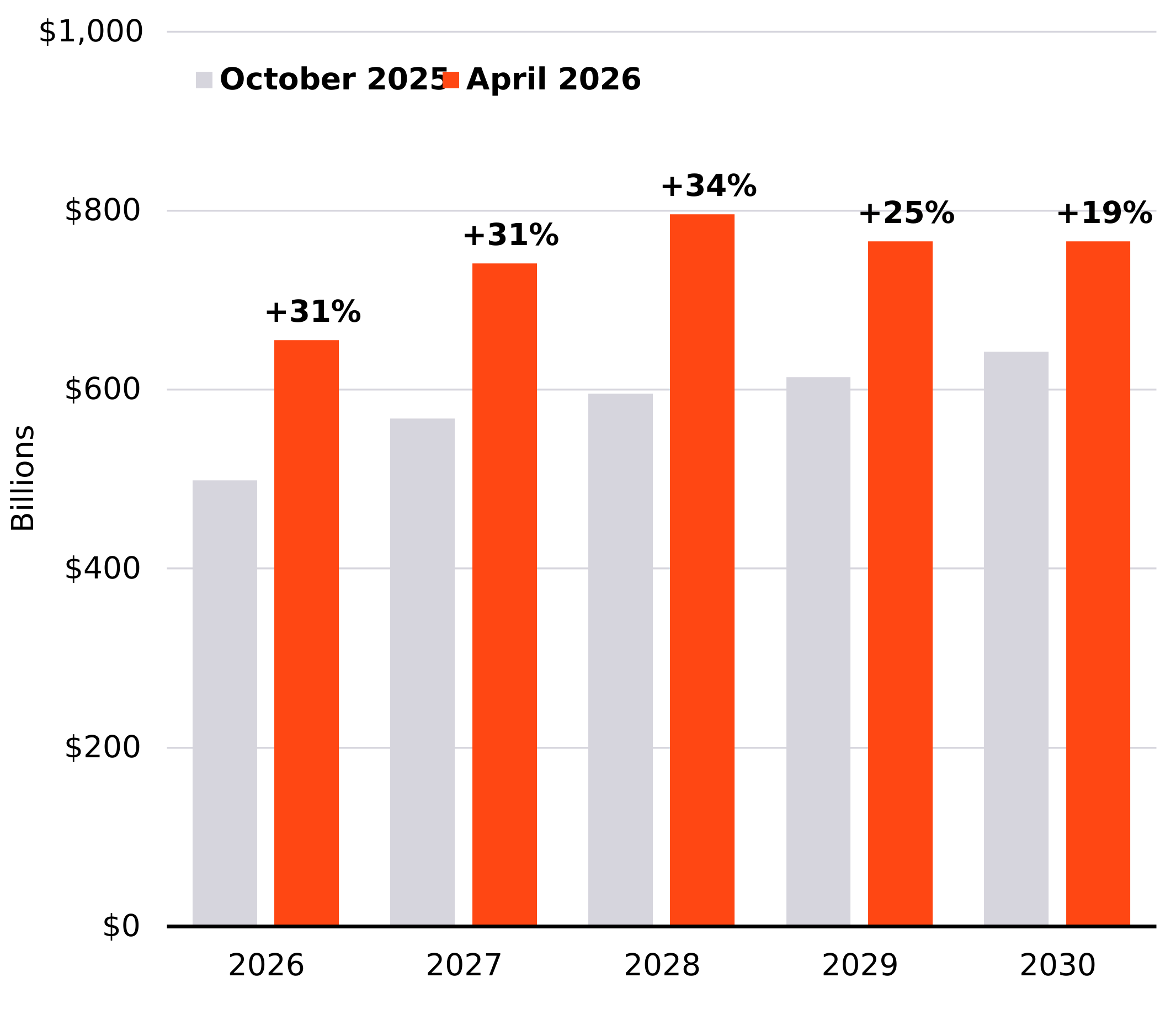
Spending for the AI buildout – already historic – is accelerating even faster than expected, especially for the 'hyperscalers' or mega cap tech companies leading the buildout. Just since October, their capital expenditure estimates out to 2030 are up 25%.
2. Energy and political constraints
In our outlook, we laid out three constraining forces on the buildout: physical, political and financial.
Firstly, physical. The spike in gas prices since the start of the Middle East conflict enhances the US and China’s AI edge. Data centers in Europe and other parts of Asia rely on grids powered by Middle East gas. China relies on such grids only minimally and the US is a net energy exporter.
3. Financing and market implications
The back-loaded revenue gains from the massive AI spend has seen companies take on more debt. Funding from private markets has also played a role. Some major IPOs for companies like OpenAI and Anthropic could test appetite in equity markets. But bond issuance from 'hyperscaler' tech companies has been well-absorbed. That depth of capital markets in the US is another advantage in the AI theme.
Outro: Here’s our Market take
We stay overweight to US and EM stocks after last week’s upgrade. We see larger-than-expected investment supercharging the AI mega force and focus on its beneficiaries.
Closing frame: Read details: blackrock.com/weekly-commentary
We view AI as a supercharged mega force as buildout spending is rising from already-historic levels, supporting our overweight to US and EM stocks.
Oil fell as Iran pledged to open the Strait of Hormuz during the Lebanon ceasefire. Both the S&P 500 and the Nasdaq hit new record highs.
We watch global flash PMIs for signs of any growth drag, supply chain disruptions and price pressures from the Middle East conflict.
US-Iran talks to end the Middle East conflict have boosted stocks to new record highs. Tech has helped drive the gains – and what’s becoming clearer is the building strength of the AI theme. Our conviction in the AI transformation grows as we see broad gains in revenues and already-historic capital spending even as US tech valuations are back on par with the overall market. This reinforces our US equity overweight and preference for AI thematic opportunities.
Even bigger spending
Hyperscaler capital spending consensus estimates, 2026-30
Source: BlackRock Investment Institute with data from Bloomberg, April 2026. Note: Bars show the evolution of hyperscaler capex estimates over the last six months. Hyperscalers include Google, Meta, Microsoft, Amazon and Oracle.
Equity markets have rebounded on hopes for a resolution to the Middle East conflict, with the S&P 500 hitting a new record high. Tech stocks and the AI theme have led the gains, with the US tech sector up 11% so far this month. We are seeing broad improvements in the drivers of the AI theme across capital spending and revenues after a notable drop in valuations. First, we had already expected the fastest capital spending buildout in history as we laid out in our 2026 Global Outlook – and consensus expectations have only risen since then, with “hyperscaler” mega cap tech companies’ estimates for 2026 to 2030 up over 25% since October. See the chart. Second, we are seeing rapid revenue gains for some AI model builders. And third, US tech valuations are now in line with the broader S&P 500 even as tech earnings expectations have risen sharply, as we noted last week.
In our 2026 Outlook, we identified three potential constraints on the AI buildout: power, politics and financing. The energy constraint is front and center and is starting to bind – but we have seen some improvements. “Behind the meter” power generation solutions – which generate power without a grid connection, help avoid potential delays from connecting to the grid and can limit impacts on local electricity prices – are set to move from being a marginal source to powering about 25-30% of new US data centers in coming years, our compilation of equipment company estimates and Sightline Climate Data show. Yet supply disruptions from the Middle East conflict have caused a sharp spike in natural gas prices – a key source for powering AI data centers. The impact is regional in nature: Europe and larger Asian economies feel the disruptions more, while the US is a net exporter with much lower prices. We think this, combined with “behind the meter” solutions, gives the US an edge on AI. China’s diversified energy mix and nuclear and renewable energy leadership means it is also less affected.
Watching political constraints
On the US political front, anti-AI data center sentiment is rising and creating pressures that could constrain the AI buildout. Maine’s legislature passed a temporary ban on large new data centers – a first among states in a new trend. At least 12 other states are looking to pause further AI data center building. We are monitoring the impact of these potential restrictions and their scale heading into US elections later this year.
The AI buildout financing has played out as we explained in our Outlook’s leveraging up theme. Demand for bonds from hyperscalers has been strong, with an Amazon sale seeing demand quadruple the total amount sold. We view this leverage as necessary to get over the hump between front-loaded investment and backloaded revenues – and think it’s healthy so far. Upcoming new listings of key AI model builders and players will test this financing in equity markets. The rapid revenue gains of some model builders should be supportive, such as Claude model-maker Anthropic reporting a tripling of revenue to over $30 billion since the end of 2025. The depth of US capital markets is another edge in the AI transformation.
Our bottom line
We stay overweight to US and EM stocks, and see the AI mega force accelerating. Recent developments including energy disruptions reinforce the US edge in AI. We also like AI thematic opportunities in power and infrastructure.
Market backdrop
Oil prices fell as Iran declared that the Strait of Hormuz would be open throughout the 10-day Lebanon ceasefire, ending the week at about $90. Both the S&P 500 and the Nasdaq hit record highs, with the latter posting its longest winning streak since 1992. Solid US corporate earnings and a potential peace deal could buoy them further, in our view. US 10-year Treasury yields dipped to 4.25%, but are still up more than 20 basis points since the conflict began.
We watch global flash PMIs for signs of any drag on growth from the supply chain disruptions tied to the Middle East conflict. We also watch Japan’s CPI and PPI to see if the Bank of Japan can look through conflict-driven cost pressures and stay on track to achieve 2% inflation by the end of 2027. UK unemployment hovers around its post-pandemic peak, so next week’s unemployment and inflation data – the first since the conflict began – will highlight the Bank of England’s inflation-growth trade-off.
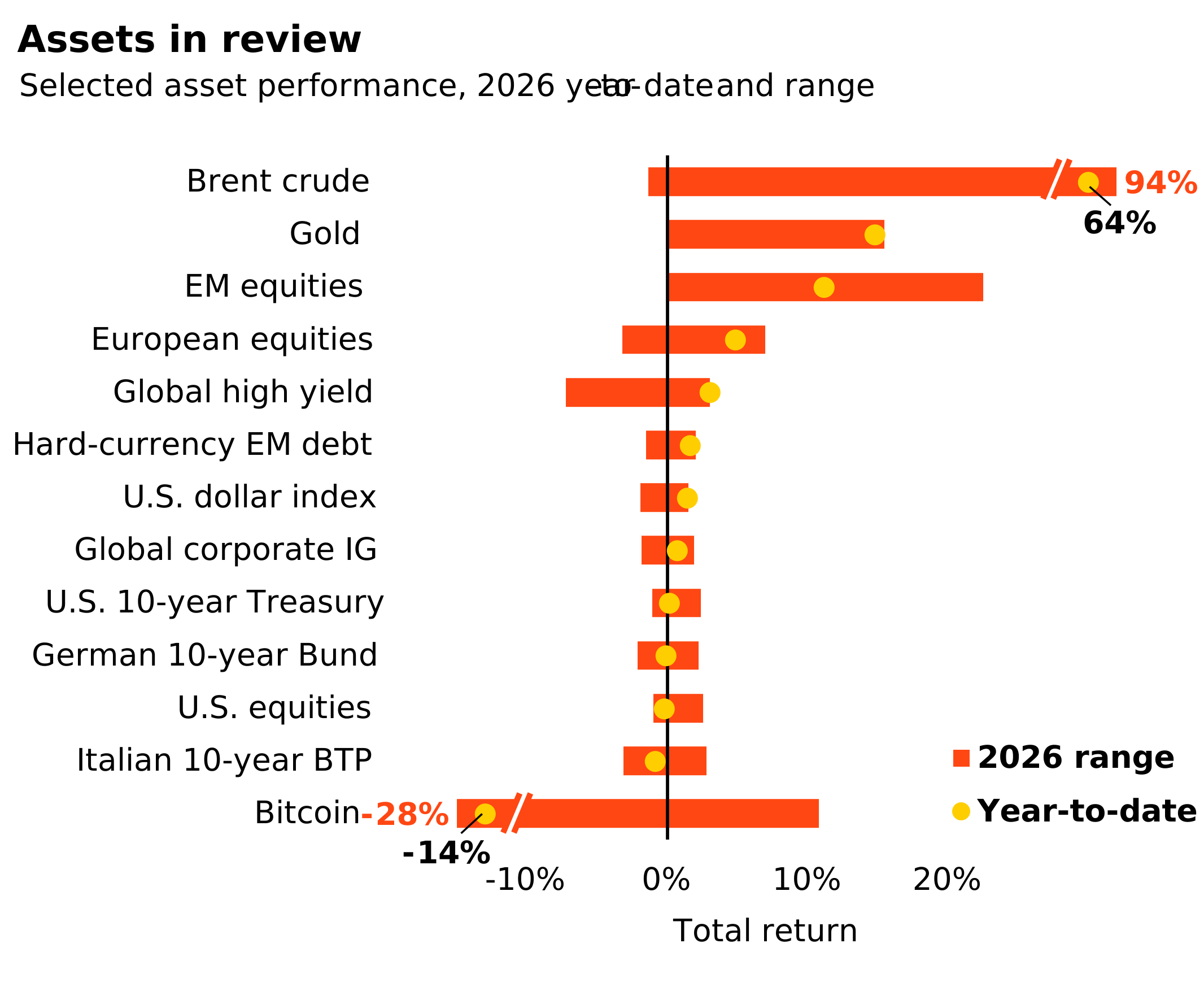
Week ahead
Past performance is not a reliable indicator of current or future results. Indexes are unmanaged and do not account for fees. It is not possible to invest directly in an index. Sources: BlackRock Investment Institute, with data from LSEG Datastream as of April 16, 2026. Notes: The two ends of the bars show the lowest and highest res at any point year to date, and the dots represent current year-to-date res. Emerging market (EM), high yield and global corporate investment grade (IG) res are denominated in US dollars, and the rest in local currencies. Indexes or prices used are: spot Brent crude, ICE US Dollar Index (DXY), spot gold, spot bitcoin, MSCI Emerging Markets Index, MSCI Europe Index, LSEG Datastream 10-year benchmark government bond index (US, Germany and Italy), Bloomberg Global High Yield Index, J.P. Morgan EMBI Index, Bloomberg Global Corporate Index and MSCI USA Index.
UK unemployment
UK CPI; Japan trade balance
Global flash PMIs
Japan CPI and PPI
Read our past weekly commentaries here.
Big calls
Our highest conviction views on six- to 12-month (tactical) and over five-year (strategic) horizons, April 2026
| Reasons | ||
|---|---|---|
| Tactical | ||
| Favor AI beneficiaries | We favor infrastructure and equipment supporting the AI buildout – like semiconductors, power and data center assets – that we think stand to benefit no matter the winners or losers. We see the AI theme lifting US earnings, underpinning our US equity overweight. | |
| Select international exposures | We like hard-currency EM debt on economic resilience, disciplined fiscal and monetary policy and a high ratio of commodities exporters. We like EM equities too, preferring commodity exporters and AI beneficiaries. In Europe, we favor equity sectors like infrastructure. | |
| Evolving diversifiers | We suggest looking for a “plan B” portfolio hedge as long-term US Treasuries no longer provide portfolio ballast. We like gold as a tactical play with idiosyncratic drivers, but we think it has become more unreliable as the diversification mirage grows. | |
| Strategic | ||
| Portfolio construction | We favor a scenario-based approach as AI winners and losers emerge. We lean on private markets and hedge funds for idiosyncratic return and to anchor portfolios in mega forces. | |
| Infrastructure equity and private credit | We find infrastructure equity valuations attractive and mega forces underpinning structural demand. We still like private credit but see dispersion ahead – highlighting the importance of manager selection. | |
| Beyond market cap benchmarks | We get granular in public markets. We favor DM government bonds outside the US Within equities, we favor EM over DM yet get selective in both. In EM, we like India which sits at the intersection of mega forces. In DM, we like Japan as mild inflation and corporate reforms brighten the outlook. | |
Note: Views are from a US dollar perspective, April 2026. This material represents an assessment of the market environment at a specific time and is not intended to be a forecast of future events or a guarantee of future results. This information should not be relied upon by the reader as research or investment advice regarding any particular funds, strategy or security.
Tactical granular views
Six- to 12-month tactical views on selected assets vs. broad global asset classes by level of conviction, April 2026

We have lengthened our tactical investment horizon back to six to 12 months. The table below reflects this and, importantly, leaves aside the opportunity for alpha, or the potential to generate above-benchmark returns – especially at a time of heightened volatility.
| Asset | Tactical view | Commentary | ||||
|---|---|---|---|---|---|---|
| Developed markets | ||||||
| United States | We are overweight. Contained damage to global growth from the Mideast conflict and strong earnings expectations – particularly in tech – keep us risk-on. | |||||
| Europe | We are neutral. We are neutral. Europe’s high exposure to the energy shock from the Mideast conflict makes it vulnerable to higher inflation and lower growth. | |||||
| UK | We are neutral. Valuations remain attractive relative to the US, but we see few near-term catalysts to trigger a shift. | |||||
| Japan | We are neutral. Japan’s exposure to imported energy may erode strong equity gains powered by healthy corporate balance sheets and governance reforms. | |||||
| Emerging markets (EM) | We are overweight yet stay selective. We favor Asian countries that manufacture critical AI components and Latin American energy and commodity exporters. | |||||
| China | We are neutral. Trade relations with the US have steadied, but property stress and an aging population still constrain the macro outlook. Relatively resilient activity limits near-term policy urgency. We like sectors like AI, automation and power generation. | |||||
| Fixed income | ||||||
| Short US Treasuries | We are neutral. Shorter-term bonds are relatively attractive as the market has woken up to persistent inflation and higher rates. | |||||
| Long US Treasuries | We are underweight. Yields already faced upward pressure from rising term premia, as investors demand more compensation for the risk of holding long-term debt. The recent energy price shock compounds this by aggravating pre-existing inflationary pressures. | |||||
| Global inflation-linked bonds | We are neutral. We think inflation will settle above pre-pandemic levels, but markets may not price this in the near term as growth cools. | |||||
| Euro area government bonds | We go neutral short-term European government bonds. The market has repriced the ECB policy path more in line with our view. We think increased German bond issuance to finance its fiscal stimulus package is already largely reflected in the current level of 10-year yields. | |||||
| UK Gilts | We are neutral. The recent budget aims to shore up market confidence through fiscal consolidation. But deferred borrowing cuts could bring back gilt market volatility. | |||||
| Japanese government bonds | We are underweight. Rate hikes, higher global term premium and heavy bond issuance will likely drive yields up further. | |||||
| China government bonds | We are neutral. China bonds offer stability and diversification but developed market yields are higher and investor sentiment shifting towards equities limits upside. | |||||
| US agency MBS | We are overweight. Agency MBS offer higher income than Treasuries with similar risk and may offer more diversification amid fiscal and inflationary pressures. | |||||
| Short-term IG credit | We are neutral. Corporate strength means spreads are low, but they could widen if issuance increases and investors rotate into US Treasuries as the Fed cuts. | |||||
| Long-term IG credit | We are underweight. We prefer short-term bonds less exposed to interest rate risk over long-term bonds. | |||||
| Global high yield | We are neutral. High yield offers more attractive carry and shorter duration, but we think dispersion between higher and weaker issuers will increase. | |||||
| Asia credit | We are neutral. Overall yields are attractive and fundamentals are solid, but spreads are tight. | |||||
| Emerging hard currency | We are overweight. EM hard-currency indexes lean towards Latin American commodity exporters such as Brazil that stand to benefit as Mideast supply plummets. | |||||
| Emerging local currency | We are neutral. The US dollar has been strengthening as a safe-haven currency in the wake of the Middle East conflict. This could reverse year-to-date gains driven by a falling USD. | |||||
Past performance is not a reliable indicator of current or future results. It is not possible to invest directly in an index. Note: Views are from a US dollar perspective. This material represents an assessment of the market environment at a specific time and is not intended to be a forecast or guarantee of future results. This information should not be relied upon as investment advice regarding any particular fund, strategy or security.
Euro-denominated tactical granular views
Six to 12-month tactical views on selected assets vs. broad global asset classes by level of conviction, April 2026

| Asset | Tactical view | Commentary | ||
|---|---|---|---|---|
| Equities | ||||
| Europe ex UK | We are neutral. We would need to see more business-friendly policy and deeper capital markets for recent outperformance to continue and to justify a broad overweight. We stay selective, favoring financials, utilities and healthcare. | |||
| Germany | We are neutral. Increased spending on defense and infrastructure could boost the corporate sector. But valuations rose significantly in 2025 and 2026 earnings revisions for other countries are outpacing Germany. | |||
| France | We are neutral. Political uncertainty could continue to drag corporate earnings behind peer markets. Yet some major French firms are shielded from domestic weakness, as foreign activity accounts for most of their revenues and operations. | |||
| Italy | We are neutral. Valuations are supportive relative to peers. Yet we think the growth and earnings outperformance that characterized 2022-2023 is unlikely to persist as fiscal consolidation continues and the impact of prior stimulus peters out. | |||
| Spain | We are overweight. Valuations and earnings growth are supportive relative to peers. Financials, utilities and infrastructure stocks stand to gain from a strong economic backdrop and advancements in AI. High exposure to fast-growing areas like emerging markets is also supportive. | |||
| Netherlands | We are neutral. Technology and semiconductors feature heavily in the Dutch stock market, but that’s offset by other sectors seeing less favorable valuations and a weaker earnings outlook than European peers. | |||
| Switzerland | We are neutral. Valuations have improved, but the earnings outlook is weaker than other European markets. If global risk appetite stays strong, the index’s tilt to stable, less volatile sectors may weigh on performance. | |||
| UK | We are neutral. Valuations remain attractive relative to the U.S., but we see few near-term catalysts to trigger a shift. | |||
| Fixed income | ||||
| Euro area government bonds | We go neutral short-term European government bonds. The market has repriced the ECB policy path more in line with our view. We think increased German bond issuance to finance its fiscal stimulus package is already largely reflected in the current level of 10-year yields. | |||
| German bunds | We are neutral. Potential fiscal stimulus and bond issuance could push yields up, but we think market pricing reflects this possibility. Market expectations for near-term policy rates are also aligned with our view. | |||
| French OATs | We are neutral. France faces continued challenges from elevated political uncertainty, high budget deficits and slow structural reforms, but these risks already seem priced into OATs and we don’t expect a worsening from here. | |||
| Italian BTPs | We are neutral. The spread over German bunds looks tight given its large budget deficits and growing public debt. Domestic factors remain supportive, with growth holding up relative to the rest of the euro area and Italian households showing solid demand to hold BTPs at higher yields. Domestic political pushback likely prevents defense spending from rising to levels that would resurface fiscal stability concerns. | |||
| UK gilts | We are neutral. Gilt yields are off their highs, but we expect more market attention on long-term yields through the government’s November budget, given the difficulty it has had implementing spending cuts. | |||
| Swiss government bonds | We are neutral. Markets are expecting policy rates to return to negative territory, which we deem unlikely. | |||
| European inflation-protected securities | We are neutral. We see higher medium-term inflation, but inflation expectations are firmly anchored. Cooling inflation and uncertain growth may matter more near term. | |||
| European investment grade | We are neutral on European investment grade credit, favoring short- to medium-term paper for quality income. We prefer European investment grade over the US Quality-adjusted spreads have tightened significantly relative to the US, but they remain wider, and we see potential for further convergence. | |||
| European high yield | We are overweight. The income potential is attractive, and we prefer European high yield for its more appealing valuations, higher quality and less sensitivity to interest rate swings compared with the US Spreads adequately compensate for the risk of a potential rise in defaults, in our view. | |||
Past performance is not a reliable indicator of current or future results. It is not possible to invest directly in an index. Note: Views are from a euro perspective, April 2026. This material represents an assessment of the market environment at a specific time and is not intended to be a forecast or guarantee of future results. This information should not be relied upon as investment advice regarding any particular fund, strategy or security.
Meet the authors
This material is for distribution to Professional Clients (as defined by the Financial Conduct Authority or MiFID Rules) and Qualified Investors only and should not be relied upon by any other persons.
Issued by BlackRock Investment Management (UK) Limited, authorised and regulated by the Financial Conduct Authority. Registered office: 12 Throgmorton Avenue, London, EC2N 2DL. Tel: 020 7743 3000. Registered in England No. 2020394. For your protection telephone calls are usually recorded. BlackRock is a trading name of BlackRock Investment Management (UK) Limited.
Past performance is not a reliable indicator of current or future results and should not be the sole factor of consideration when selecting a product or strategy.
Capital at risk. The value of investments and the income from them can fall as well as rise and is not guaranteed. You may not get back the amount originally invested. Changes in the rates of exchange between currencies may cause the value of investments to diminish or increase. Fluctuation may be particularly marked in the case of a higher volatility fund and the value of an investment may fall suddenly and substantially. Levels and basis of taxation may change from time to time.
Any research in this document has been procured and may have been acted on by BlackRock for its own purpose. The results of such research are being made available only incidentally. The views expressed do not constitute investment or any other advice and are subject to change. They do not necessarily reflect the views of any company in the BlackRock Group or any part thereof and no assurances are made as to their accuracy.
This document is for information purposes only and does not constitute an offer or invitation to anyone to invest in any BlackRock funds and has not been prepared in connection with any such offer.
© 2026 BlackRock, Inc. All Rights reserved. BLACKROCK, BLACKROCK SOLUTIONS, iSHARES, BUILD ON BLACKROCK and SO WHAT DO I DO WITH MY MONEY logo are registered and unregistered trademarks of BlackRock, Inc. or its subsidiaries in the United States and elsewhere. All other trademarks are those of their respective owners.