Skip to content

Welcome to the BlackRock site for wealth managers
Before you proceed, please take a moment to review and accept the following Terms and Conditions.
This section includes investor type descriptions for professional clients and market counterparties.
Professional client
A Professional Client is either: (i) a ‘deemed’ professional client; (ii) serviced-based professional client; or (iii) an assessed professional Client
(i) Deemed Professional Client
A person is a “deemed” professional client if the person is:
- a supranational organisation whose members are either countries, central banks or national monetary authorities
• a government, government agency, central bank or other national monetary authority of any country or jurisdiction
• a public authority or state investment body
• an Authorised Market Institution, Regulated Exchange or regulated clearing house
• a Regulated Financial Institution or the management company of a regulated pension fund;
• a Collective Investment Fund or a regulated pension fund;
• a corporate body whose shares are listed or admitted to trading on any exchange of an IOCSO member country
• trustee of a trust which has, or had during the previous 12 months, assets of at least $10 million;
• a Single Family Office licensed under the Single Family Office Regulations
• a person classified as a ‘large undertaking’ who meetstwoof the following criteria (i) a balance sheet total of at least $20 million; (ii) a net annual turnover of at least $40 million or (iii) own funds or called up capital of at least $2 million
(ii) Service-based Professional Clients
A person is a ‘serviced-based’ professional client if
- the services provided to the client is in relation to the provision of credit including arranging and/or advising on credit
• the services provided to the client relates to corporate structuring and financing such as advice relating to an acquisition, disposal, structuring, restructuring, financing or refinancing of a corporation or other legal entity i.e. takeovers, mergers and capital raising
(iii) Assessed-based Professional Clients
Assessed-based professional clients can be either (i) individuals; or (ii) undertakings
Individuals
An individual (and associated joint account holders) would be classified as an ‘assessed-based professional client’ if:
- the individual (and primary account holder, if relevant) has net assets of at least $1 million; and
• the individual is, or has been, an employee of an authorised firm or a regulated financial institution in the past two years; or
• the individual can provide evidence which demonstrates that they have sufficient knowledge and experience of relevant markets, products and associated risks
Where there is a joint account in place, the secondary account holder must obtain confirmation in writing that investment decisions relating to the joint account are made for or on behalf of the secondary account holder
Undertakings
Undertakings, which are generally not individuals, would be classified as ‘assessed-based’ professional clients if it:
- has own funds or called up capital of at least $1 million; and
• can evidence that they have sufficient knowledge and experience of relevant markets, products and associated risks
Market counterparties
A Market Counterparty is any person who is either:
- authorised firm;
• regulated financial institution; or
• professional client


Inside alternatives
Portfolio Construction with Alternatives
Hi, I’m Rafael Iborra, BlackRock’s Head of Model Portfolio Solutions, International.
Portfolio construction is about making clear choices - balancing risk and return over time, with each part of the portfolio playing a defined role. Here are three things to consider as private markets become a more important part of that conversation.
First, private markets introduce differentiated return drivers.
Unlike public equities and bonds, returns are shaped by long term capital, active ownership, and less liquid assets. This leads to different performance patterns and greater dispersion - creating opportunities that behave differently across market cycles.
Second, they expand the opportunity set beyond public markets.
Private investments provide access to companies, sectors, and value creation levers that aren’t available in public markets, giving investors new ways to pursue growth, income, and diversification.
Third, when integrated thoughtfully, private markets can strengthen portfolio outcomes.
Alongside public markets, they can improve diversification, support more stable outcomes over time, and help align portfolios with long term objectives – in turn contributing to more resilient portfolios and enhanced return potential.
Hear from Rafael Iborra, BlackRock’s Head of Model Portfolio Solutions, as he shares three key themes on thoughtfully incorporating alternatives into portfolios.
Key takeaways
Capital at risk. The value of investments and the income from them can fall as well as rise and are not guaranteed. Investors may not get back the amount originally invested.
- As capital markets evolve, the opportunity to add private market assets to traditional portfolios also grows.
- Private market investments have historically enhanced portfolio returns by offering unique opportunities as well as characteristics that complement public exposures.
- One strategy for incorporating private markets into portfolios takes the traditional 60/40 allocation to a “modernized” 50/30/20 framework.
New thinking for a new marketplace
Traditional diversified portfolios are typically anchored to broad public benchmarks. While public indexes are transparent, there are limitations from a portfolio construction perspective:
- Equity indexes are market-capitalization weighted and, as such, concentrate exposure in the largest companies and sectors.
- Bond indexes are weighted by issuer and can expose portfolios to unintended duration and credit concentration.
This means a traditional 60% equity/40% bond (60/40) portfolio can be structurally overexposed to two primary return drivers: equity beta and bond duration.
However, a wider range of investors are gaining access to a broader range of capital markets, and this translates to greater opportunity to potentially enhance portfolio outcomes by targeting new sources of risk and return.
A place for private markets
Private markets are becoming critical exposures for those looking to access a broader set of portfolio building blocks, particularly as the proportion of opportunities shift from public to private markets.
While the number of public companies has been shrinking in recent decades, the number of private companies is on the rise. In the U.S., the number of large private companies (those with 100+ employees) has grown by 46% over the past 30 years, while the number of public companies has fallen by 24%.1 The trend is not isolated to the U.S., as research shows the number of listed companies has declined across many developed economies.
Companies are also increasingly seeking private funding, with just 25% of the leveraged loan market funded by banks in 2024 compared to 72% 30 years earlier.2
Taken together, this illustrates that modern capital formation extends beyond public exchanges, creating a larger role for private markets and allowing portfolios to participate more fully in an evolving and expanding investment landscape.
The private markets toolkit
Private equity and private credit are two of the most common private market exposures. Both have delivered higher returns than traditional asset classes over the past decade, as shown in the chart below.
An opportunity for enhanced returns: Ten-year average annual returns as of year-end 2024
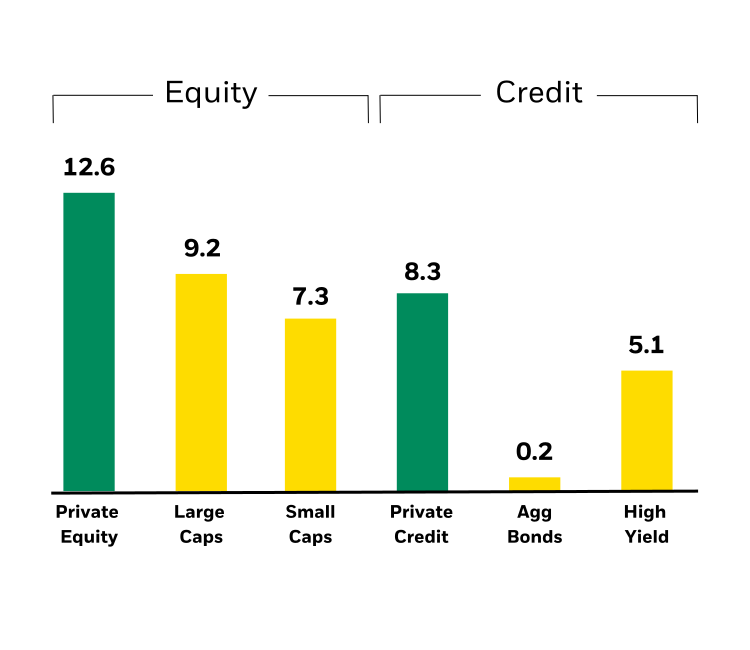
Source: Bloomberg, MPI, measuring returns from 12/31/14 through 12/31/24. “Private Equity” represented by the Preqin Private Equity Index as of 9/30/24. “Large Caps” represented by the MSCI ACWI NR Index, “Small Caps” represented by the MSCI ACWI Small Cap NR. “Private Credit” refers to the Preqin Private Debt Index, “Agg Bonds” refers to the Bloomberg Global Aggregate TR Index, and “High Yield” refers to the ICE BofA US High Yield TR Index. Past performance does not guarantee or indicate future results. Index performance is shown for illustrative purposes only. It is not possible to invest directly in an index.
Real estate and infrastructure are two other popular private asset classes. Their role in portfolios is often to provide a mix of potential capital appreciation and income, as well as an inflation hedge given that they are real assets with tangible economic value.
Returns in private markets are driven by different structural factors than public markets, which can make them compelling complements in a diversified portfolio:
- Illiquidity of underlying assets often offers a premium which can help offset potential over-indexing to more liquid structures (and associated sacrifice of return potential).
- Periodic valuation rather than continuous pricing can mean less transparency, but potentially less sensitivity to headline-related market volatility.
- Wider dispersion of outcomes across managers, making manager selection a potential differentiator.
- Varying capital commitment structures or hold periods, which also means more choice for managing around investment time horizons and goals.
From 60/40 to 50/30/20
The “optimal” allocation to private markets will depend on the individual investor’s goals and risk tolerance. For example, is the investor seeking long-term growth or income, and are they sensitive to tax considerations?
While the decision can be decidedly individual, today’s market landscape does challenge the continued applicability of a traditional 60/40 portfolio. It may mean that the definition of ‘diversification’ needs to evolve along with the investing backdrop.
A 50/30/20 framework provides one way to reflect today’s broader opportunity set:
- 50% public equities
- 30% public, fixed income
- 20% alternatives, including private markets and liquid alternatives
Effectively, this model suggests that equity exposure is moderated from 60% to 50% and fixed income is reduced from 40% to 30%, opening a 20% opportunity to add other diversified return drivers.
The funding of this new allocation will have a meaningful impact on a portfolio’s risk/return profile. Many of our BlackRock Portfolio Constructors suggest a like-for-like funding strategy wherever possible: funding strategies with equity-like risk profiles from equities and bond-like risk profiles from bonds.
Sourcing higher-risk allocations from bond sleeves can increase portfolio risk, while sourcing lower-risk allocations from stock sleeves could decrease risk and potentially also impact expected returns.
Stepping into private markets
Modern capital markets extend well beyond traditional public equity and investment-grade bond benchmarks. Private markets offer access to unique opportunities that can complement positions in traditional assets.
According to a recent BlackRock survey, wealth professionals expect allocations to private markets to increase significantly by 2030, with over 70% of wealth investors projected to allocate between 5–20% of their portfolios. This compares with today, where around two‑thirds of wealth investors are believed to allocate just 0–5% to private markets.3
Whether working toward a 20% allocation or another level better suited to client needs, we offer a four-step framework for thinking about and incorporating a private markets strategy:
1. Choose private market exposures
Select alternative asset classes that further portfolio objectives.
2. Determine your allocation
Decide the size of your allocation, based on risk/return assumptions and liquidity budget.
3. Choose the right investment
Pick the right vehicle to access your target exposures.
4. Fund from “like” asset classes
Source from traditional asset classes based on risk, return and correlations to equity.
Sign up for the private markets quarterly newsletter
Get timely updates on private markets with curated insights from BlackRock. By subscribing, you’ll receive market updates, product launches, thought leadership, and webinars designed to keep you informed.
Please try again

Explore more
Products
Themes
ETFs & Indexing
Insights

© 2026 BlackRock, Inc. All rights reserved.
1. Source: U.S. Census Bureau – Statistics of U.S. Businesses, The World Bank World Federation of Exchange Databases as of December 2023. Represents the latest data available.
2. Source: S&P LCD, Pitchbook LCD as of March 31, 2024.
3. The survey was conducted at BlackRock’s Private Markets Wealth Summit in London on 27 March 2025, with 70 wealth professionals from 17 countries across.
Europe and the Middle East. “Wealth investors” here are respondents’ clients. There is no guarantee that any forecasts made will come to pass. For illustrative purposes only.
MKTG0526-5467940-EXP0527