Skip to content

Welcome to the BlackRock site for wealth managers
Before you proceed, please take a moment to review and accept the following Terms and Conditions.
This section includes investor type descriptions for professional clients and market counterparties.
Professional client
A Professional Client is either: (i) a ‘deemed’ professional client; (ii) serviced-based professional client; or (iii) an assessed professional Client
(i) Deemed Professional Client
A person is a “deemed” professional client if the person is:
- a supranational organisation whose members are either countries, central banks or national monetary authorities
• a government, government agency, central bank or other national monetary authority of any country or jurisdiction
• a public authority or state investment body
• an Authorised Market Institution, Regulated Exchange or regulated clearing house
• a Regulated Financial Institution or the management company of a regulated pension fund;
• a Collective Investment Fund or a regulated pension fund;
• a corporate body whose shares are listed or admitted to trading on any exchange of an IOCSO member country
• trustee of a trust which has, or had during the previous 12 months, assets of at least $10 million;
• a Single Family Office licensed under the Single Family Office Regulations
• a person classified as a ‘large undertaking’ who meetstwoof the following criteria (i) a balance sheet total of at least $20 million; (ii) a net annual turnover of at least $40 million or (iii) own funds or called up capital of at least $2 million
(ii) Service-based Professional Clients
A person is a ‘serviced-based’ professional client if
- the services provided to the client is in relation to the provision of credit including arranging and/or advising on credit
• the services provided to the client relates to corporate structuring and financing such as advice relating to an acquisition, disposal, structuring, restructuring, financing or refinancing of a corporation or other legal entity i.e. takeovers, mergers and capital raising
(iii) Assessed-based Professional Clients
Assessed-based professional clients can be either (i) individuals; or (ii) undertakings
Individuals
An individual (and associated joint account holders) would be classified as an ‘assessed-based professional client’ if:
- the individual (and primary account holder, if relevant) has net assets of at least $1 million; and
• the individual is, or has been, an employee of an authorised firm or a regulated financial institution in the past two years; or
• the individual can provide evidence which demonstrates that they have sufficient knowledge and experience of relevant markets, products and associated risks
Where there is a joint account in place, the secondary account holder must obtain confirmation in writing that investment decisions relating to the joint account are made for or on behalf of the secondary account holder
Undertakings
Undertakings, which are generally not individuals, would be classified as ‘assessed-based’ professional clients if it:
- has own funds or called up capital of at least $1 million; and
• can evidence that they have sufficient knowledge and experience of relevant markets, products and associated risks
Market counterparties
A Market Counterparty is any person who is either:
- authorised firm;
• regulated financial institution; or
• professional client


Resilience reshapes the GCC’s U.S.$2.1 trillion investment cycle
Conflict has increased the value to Gulf Cooperation Council (GCC) economies of keeping energy and trade flows moving reliably. Disruption to key shipping routes, from the Strait of Hormuz to the gateways of the Red Sea, has underlined the region's reliance on a handful of maritime chokepoints for its energy exports and trade. Route disruption can blunt the benefit of higher oil prices, putting a premium on alternative routes, continuity infrastructure and financial buffers.
As we argued in our May Global Insights, the shock marks a structural inflection point for the region, widening dispersion and pulling capital inward. The result is a more selective investment cycle, shifting the emphasis from scale toward strategic efficiency. Existing projects are being reassessed, resilience infrastructure is being accelerated, and urban, digital and industrial investment is being re-underwritten as sequencing, financing and required returns change.
Capital shifts toward resilience
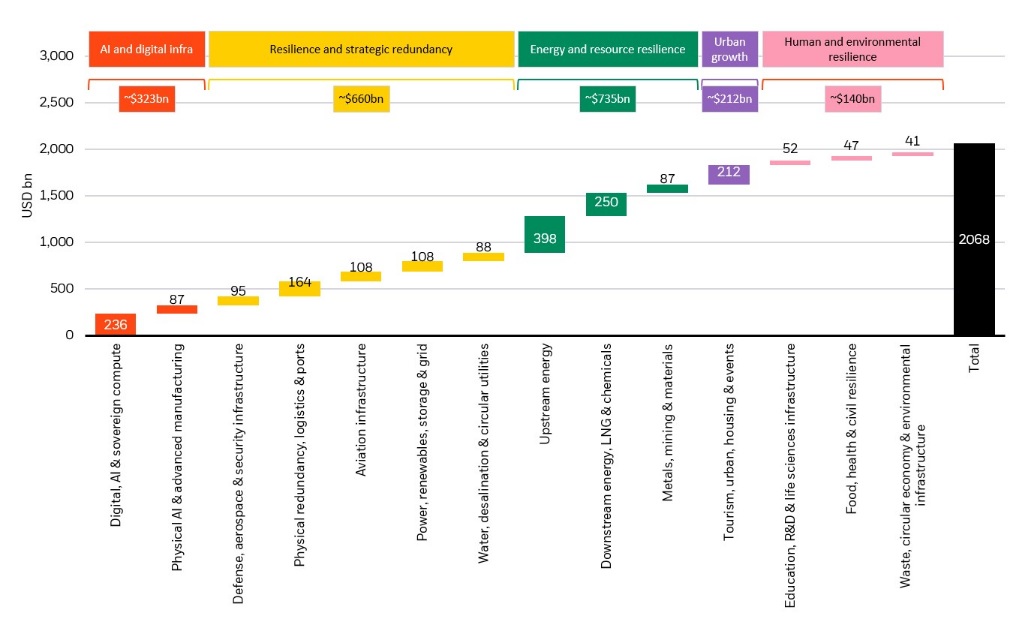
Our central estimate for GCC strategic capex through 2030 is U.S.$2.1 trillion, within a range of U.S.$1.6-2.5 trillion. See the chart. Much of this investment predates the conflict. What has changed is how capital is being prioritized across five interconnected areas. These are not rigid categories, as enabling systems such as power, water and logistics support several parts of the investment cycle. More than 80% of our estimated capex lies outside upstream oil and gas, spanning energy infrastructure, industry, digital and social assets, a far broader opportunity than a bet on oil.
Two areas account for roughly two-thirds of estimated capex. Energy, resources and industry, the largest at roughly U.S.$735 billion, includes major investment in gas, downstream industries and mining. Saudi Arabia's Jafurah gas program and the UAE's Ruwais industrial base are examples.
Strategic redundancy, at roughly U.S.$660 billion, is the part of the existing pipeline most affected by the conflict. It spans export routes, ports, and power and water projects whose priority and sequencing, and in some cases financing, have shifted as the value of reducing dependence on any single route or system has risen. Saudi Arabia's East-West corridor and Oman's open-ocean ports illustrate the value of that optionality.
The remaining three broaden the cycle. Digital infrastructure, at roughly U.S.$323 billion, extends beyond AI to the power, grids and cooling that enable it. Selective urban growth, at roughly U.S.$212 billion, is increasingly tied to fixed-deadline events such as Expo 2030 Riyadh. Human and environmental resilience, at roughly U.S.$140 billion, covers healthcare, food, water and waste.
Resilience redraws the GCC's investment map
Estimated GCC strategic capex by area through 2030, U.S.$ billion
Source: BlackRock Investment Institute estimates, based on company disclosures; national development strategies and budgets; GCC sovereign wealth funds, national oil companies and government-related entities; GCC central banks, national statistical authorities and GCC-Stat; MEED; LSEG Datastream; S&P Global Market Intelligence; IEA; OPEC; IRENA; World Bank; IMF; and relevant national energy, infrastructure, utility, digital, industrial and tourism authorities. Note: Estimates represent cumulative strategic investment envelopes over 2026–2030 and combine announced, awarded, advanced and capacity-implied investment. Figures include public, sovereign, state-owned-enterprise, public-private-partnership and private-sector capital and should not be interpreted as government-budget expenditure forecasts.
Dispersion widens across the GCC
The U.S.$2.1 trillion estimated capital spending masks significant differences across GCC markets. Saudi Arabia has the deepest pipeline and the largest absolute opportunity, but also the greatest execution, financing and sequencing risks, so projects backed by sovereign priority, secured funding or contracted demand should be better placed. The UAE offers one of the most direct public-market expressions of the theme, in our view. Route optionality supports resilient trade and investment flows, while listed banks, utilities, logistics and digital infrastructure give relatively direct channels for capital spending to translate into earnings and cash flow. Valuation and the timing of real estate and tourism normalization nevertheless remain important. Oman is smaller in scale, but open-ocean access through Duqm and Salalah supports selective logistics and industrial opportunities. Qatar, Kuwait and Bahrain offer narrower exposures that call for greater selectivity around corridor dependence, issuance and fiscal repair.
Own the capex transmission
For investors, the opportunity lies less in the headline capex number than in identifying where spending becomes financeable, contractually protected and cash-generative. Higher oil prices did not automatically lift earnings or government revenues during the conflict when routes were impaired. As disruption ebbs, markets should increasingly reward funding, contract awards, execution and cash conversion, even as a geographic risk premium persists.
In equities, the clearest listed exposure is concentrated among the enablers of the cycle: project-finance banks, utilities and grids, ports and logistics, engineering firms, digital infrastructure and healthcare. The UAE offers greater normalization potential, while Saudi Arabia provides exposure to a deeper pipeline. Listed GCC markets are light on pure-play AI, so investors are more likely to access the buildout through the enabling stack of utilities, grids, EPC contractors, telecoms and data centers. In credit, route optionality, external buffers, valuation and supply matter more than headline ratings. UAE and Oman exposures look better placed, while heavier issuance and slower fiscal repair could weigh on Qatar and Kuwait spreads. Private markets offer the most direct asset-level exposure. The planned Saudi and UAE pipeline alone is around U.S.$3 trillion, with roughly U.S.$700 billion already committed. Sovereign anchors, public-private partnerships and asset monetization create a multi-year role for infrastructure equity and private credit across power, water, digital, logistics and healthcare.
Bottom line
The GCC's next investment cycle will increasingly be judged by the resilience and productivity created by ongoing spending. Conflict has raised the value of redundancy, energy security, digital sovereignty and infrastructure, but not every strategically important project will reward investors. Open-ended development and low-margin construction remain more exposed to delays, cost inflation and leverage. Returns are more likely to accrue to the enablers of the cycle and to assets backed by regulated, contracted or clearly visible demand. That makes selectivity critical across public and private markets and calls for looking beyond traditional asset-class labels, as we set out in our Midyear Outlook. The investment lens should start with where capex can translate into durable earnings and cash flow, then identify the form of exposure that captures those returns most effectively.
Authors

Ehsan Khoman
Economist — BlackRock Investment Institute

Ben Powell
Chief Investment Strategist for the Middle East and APAC — BlackRock Investment Institute
Explore more
Products
Themes
ETFs & Indexing
Insights

© 2026 BlackRock, Inc. All rights reserved.
BII0826-M-5868840-EXP0827