Skip to content

Welcome to the BlackRock site for professional investors
Before you proceed, please take a moment to review and accept the following Terms and Conditions.
This site is designed for Professional Investors resident in South Africa. We define "Professional Investors" as those who have the appropriate expertise and knowledge e.g. asset managers, distributors and financial intermediaries. You should not use this site if you do not fall within this category.


Building for growth: Unlocking the power of infrastructure assets
The modernization of our infrastructure is essential to fostering a growing and equitable economy. Institutions are tuning into what we believe is a generational opportunity, not only for the potential portfolio benefits listed below, but as a powerful way to invest in the trends that will shape the future of our economy.
Capital at risk. The value of investments and the income from them can fall as well as rise and are not guaranteed. Investors may not get back the amount originally invested.
Portfolio positioning



Infrastructure as a potential inflation hedge
Living with inflation

The figures shown relate to past performance. Past performance is not a reliable indicator of current or future results.
Source: Bloomberg, Barclays. EDHEC for Infrastructure equity; NCREIF for Global Real Estate; MSCI for Global Equities; and BBG Barclays Global Aggregate Index TR for Global fixed income, as of May 22, 2023 (annual data since 2001). The charts are based on an illustrative US economic scenario. Past performance is not indicative of future results. You cannot invest directly in an unmanaged index. High growth periods are when U.S. GDP > 2.5% and Low growth periods are when U.S. GDP < 2.5%. High inflation periods are when U.S. CPI > 2.5%.
Staying ahead of inflation with infrastructure assets
Infrastructure is a unique asset class with characteristics that can provide resilience in the current rising rate and high inflationary macroeconomic environment.
Historical infrastructure outperforms during high inflationary times
The returns of private infrastructure companies tracked in the EDHEC 300 index increased by 23% through low growth and high inflation scenarios.
Explicit linkages to inflation
Infrastructure assets have long-term revenues that are often contracted or regulated in nature, with examples including power purchase agreements (“PPAs”) or take-or-pay contracts.
Building more resilient portfolios
A dedicated infrastructure position, held as part of a broadly diversified long-term portfolio, has the potential to increase both the efficiency and durability of the portfolio’s returns.
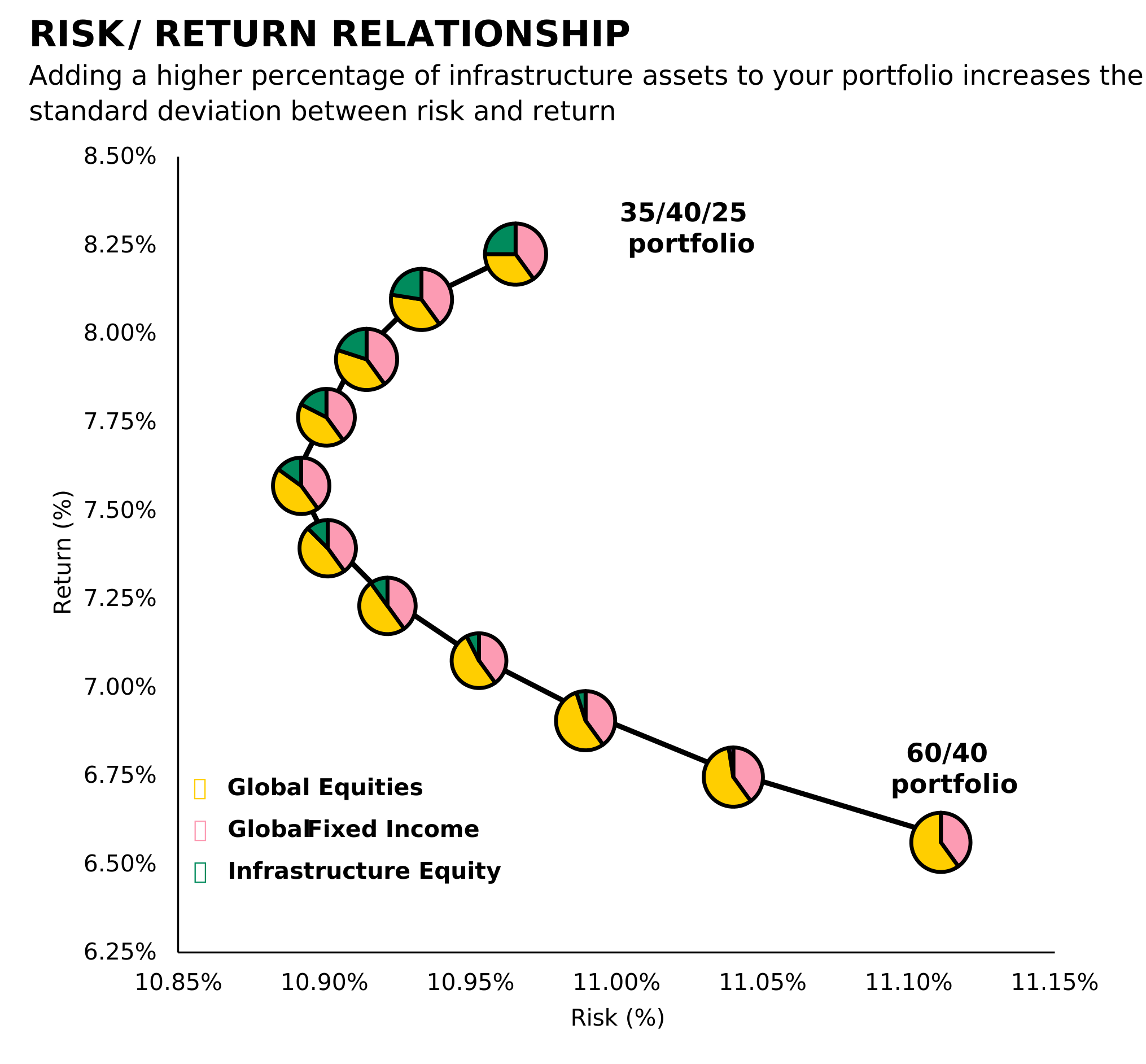
BlackRock, May 22, 2023, based on BlackRock's Capital Market Assumptions. Expected Returns are net of fees and expenses and calculated using a model fee equal to 0.30%, which represents the highest advisory fees charged for an institutional client. Expected returns also reflect reinvestment of dividends, capital gains, and interest but do not reflect the deduction of taxes. Had that expense been deducted, performance would have been lower. There is no guarantee that the capital market assumptions will be achieved, and actual risk and returns could be significantly higher or lower than shown. Hypothetical portfolios and risks shown are for illustrative discussion purposes only and no representation is being made that any account, product or strategy will or is likely to achieve results similar to those shown. Expected risk is calculated using the expected volatility assumptions. Expected risk is defined as annual expected volatility and is calculated using data derived from portfolio asset class mappings, using the Aladdin portfolio risk model. This proprietary multi-factor model can be applied across multiple asset classes to analyze the impact of different characteristics of securities on their behaviors in the marketplace. In analyzing risk factors, the Aladdin portfolio risk model attempts to capture and monitor these attributes that can influence the risk/return behavior of a particular security/asset. See "Capital Market and Modeling Assumptions". Past performance is not a guarantee or reliable indicator of future results.
Equity and fixed income relationship
The Great Moderation saw long-term bonds work as a cushion against risk asset selloffs. We think this era is over and strategic infrastructure allocations can help make portfolios more resilient.
Low correlation to other asset classes
Infrastructure equity exhibits low correlation to traditional asset classes due to its idiosyncratic characteristics.
Diversification benefits
Our research finds that adding infrastructure to a traditional 60/40 portfolio, could increase returns while diversifying risk. The optimal portfolio allocation has a 35% exposure to infrastructure.
Infrastructure in action
Infrastructure investments impact on the world
Infrastructure investments offer institutions the opportunity to invest in the building blocks of our economy and support the transition to a more technology-driven world. We believe BlackRock’s global reach, experience and sourcing prowess provide the foundations of an investment platform investors can build on with confidence.

Insights
More articles loaded. Use Shift+Tab keys to browse.
Total articles:
Have a question? Contact the team
Please try again

Explore more
Products
Themes
ETFs & Indexing
Insights

© 2026 BlackRock, Inc. All rights reserved.
MKTG0526-5456616-EXP0527