INVESTING 101

Beginner’s Guide to Investing: Start Your Journey Now

Daniel Prince, CFA Mar 02, 2026

INVESTING: A BEGINNER’S GUIDE

Investing involves buying assets that you believe will become more valuable in the future. But it’s not without risk - there’s always the chance you could lose some or all the money you started with.

No matter where you are in your financial journey or what your goals may be, one timeless principle tends to hold true: The sooner you start investing and the longer you stay invested, the more chance you have of meeting your investing goals.

Here’s a primer on how you can start thinking about your investing journey:

  • Define your financial goals
  • Define your risk tolerance
  • Evaluate what types of investments could help you meet investment goals
  • Set up your investment portfolio

DEFINE YOUR FINANCIAL GOALS

Identifying clear financial goals is crucial when embarking on your investment journey. Are you investing for retirement, buying a new home, funding your children’s education, or aiming to grow your wealth? Even when pursuing multiple goals at once, focusing on specific, individual goals may help you determine how to invest.

DETERMINE YOUR RISK TOLERANCE

Your ability to tolerate risk can help be determined by two key factors:

  • Willingness to take risk: This refers to how well you can stomach market volatility. Do market gyrations cause you emotional angst?
  • Ability to take risk: This refers to your financial capacity to take risk and is based on time horizon and liquidity needs.

Shorter-term goals (e.g. vacations, emergency funds) may require a more conservative investing approach, with a focus on safety and preservation of capital. Consider high quality bonds, such as short-term investment-grade bonds, which typically carry a lower risk of default and exhibit less volatility compared to riskier assets.

Medium-term goals (e.g. down payment on a home, college education) typically allow for a higher tolerance for investment risk. With more time to recover from market fluctuations, allocating a portion to equities could help your investments grow more than investing in bonds alone.

Long-term goals (e.g. retirement or estate planning) can span decades, allowing you to consider investments with higher potential risk and return profiles. Examples include less liquid assets such as real estate that require longer holding periods.

Importantly, the further away you are from your financial goal, the more time you have in the market to grow your assets and recover from any near-term losses, typically allowing for a greater risk tolerance.
HOW ETFs MAY SIMPLIFY YOUR STRATEGY

If you’ve ever felt overwhelmed by building a portfolio from scratch, there’s a simple way. All‑in‑one ETFs, also called Asset Allocation ETFs, bundle a mix of stocks and bonds into a single ETF. Think of them as ready‑made portfolios that save investors from the hassle of picking individual investments.

These ETFs are designed to serve as the basic building blocks of an investment portfolio and exist for investors with conservative, moderate, or aggressive risk targets. For example, XEQT offers all-equity exposure with diversification across Canada, the U.S., and international markets in one ETF. Explore the full suite here.

XEQT and other iShares All‑in‑One ETFs are professionally managed and rebalanced as needed, to keep your portfolio aligned with its target allocation. All of this comes at a low management fee - just 0.17% annually, helping you keep more of what you earn.1

INVESTING IS A JOURNEY: ADJUST OVER TIME

Just like your preferred living situations changes over time — say, moving from a lively city apartment to a quieter home in the suburbs — your investment portfolio should evolve too. That downtown apartment might have been perfect in your twenties, but it’s not ideal when you’re thinking about space for a growing family or a backyard for weekend barbecues.

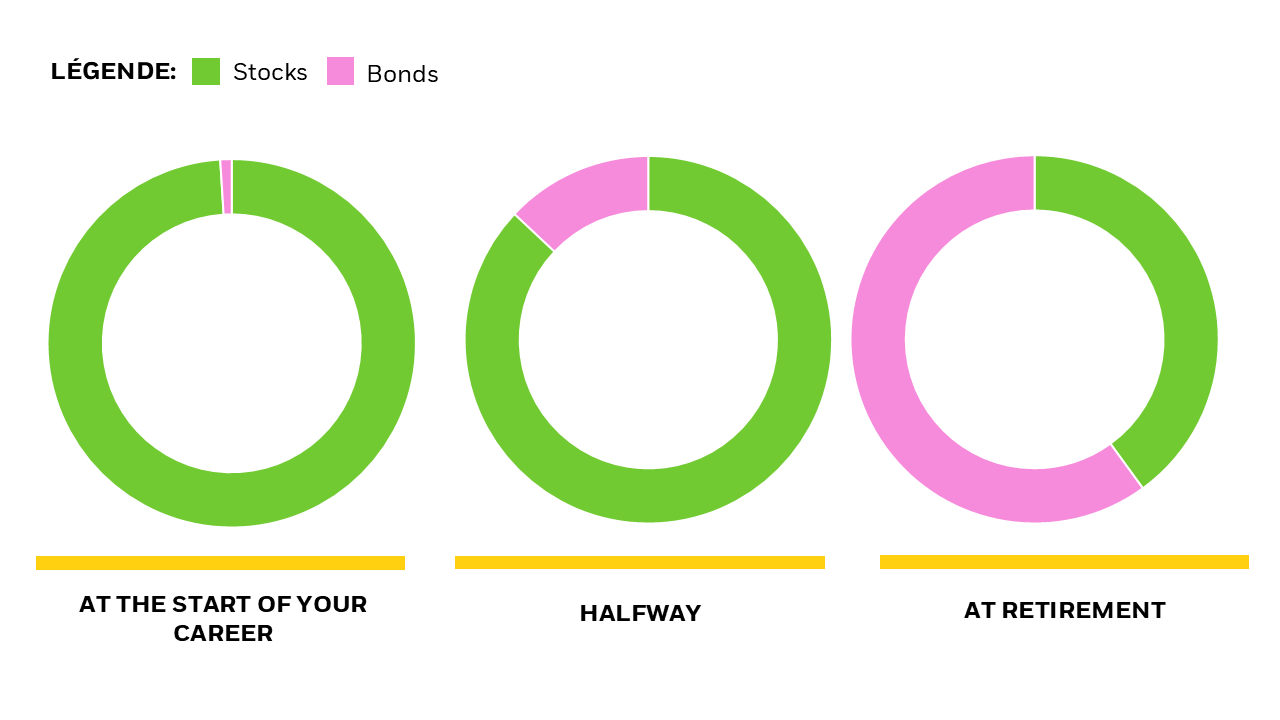
In the same way, investors with longer time horizons, such as younger investors saving for retirement, often have the flexibility to take on more risk and may favour stocks for their growth potential. But as life progresses and retirement approaches, priorities shift. Stability, income, and preservation of wealth become more important — making safer assets like bonds and cash a more likely fit. Your portfolio, like your living situation, should match where you are in your investment journey.

Example of an asset allocation adjusts over time

This example illustrates how target stock/bond allocations may change as a person’s life stage evolves.

Chart description: This example illustrates how target stock/bond allocations may change as a person’s life stage evolves. This visual is for illustrative purposes only and does not constitute investment advice.


WHERE TO INVEST: LOCATION MATTERS

With your plan in place, it’s time to put it into action — like packing for a trip. You’ve chosen your destination (investment goals) and what to pack (asset allocation). Now, it’s about picking the right bags: your investment accounts.

There are three main types:

  • Tax deferred accounts (e.g., Registered Retirement Savings Plan (RRSPs)). Think of these like checked baggage, which meets you at your destination. You contribute pre-tax dollars, defer taxes until retirement, and potentially pay a lower rate later. Deferring taxes allows more money to stay invested and compound over time.
  • Tax free accounts (e.g., Tax-Free Savings Account (TFSAs) ) are also like checked bags, but with extra perks, like spinner wheels that help you get around more easily. These are funded with after-tax dollars but grow tax-free. You don’t get a tax benefit up front, but you potentially save more in the future. These accounts can be especially valuable if you expect to be in a higher tax bracket in retirement.
  • Non-registered investment accounts are akin to carry-on bags, which are accessible, but involve a little extra hassle in lugging them around. But the benefit is access — or, in this case, no age restrictions on withdrawals.

Many investors may benefit from using all three to maximize flexibility. RRSPs and TFSAs have annual contribution limits.2 If you’ve maxed out tax-advantaged accounts, taxable accounts are a great way to keep your money working.

CONCLUSION

Building a strong investment plan starts with clarity: define your goals and understand your risk tolerance. As life changes, revisit your portfolio to ensure it still aligns with your objectives. Tools like ETFs can help simplify diversification and keep your strategy on track. Remember, investing is a long-term journey — start early, stay disciplined, and adjust as your circumstances evolve.

Photo of Daniel Prince, CFA

Daniel Prince, CFA

U.S. Head of iShares Product

Kaitlin Arciaga

iShares Product Strategist

Contributor

Aaron Task

Content Specialist

Contributor