Exploring Bitcoin and Gold for Portfolio Diversification

Oct 10, 2025

KEY TAKEAWAYS

  • Gold and bitcoin spot ETFs have seen $44.4B and $23.6Bin net flows year-to-date respectively.1
  • As volatility rises and stock-bond correlations remain elevated, investors are seeking unique assets to help diversify portfolios.
  • Gold and bitcoin are gaining traction — not only as portfolio diversifiers, but also as potential global monetary alternatives and potential hedges against long-run inflation.

DE-DOLLARIZATION & DIVERSIFICATION

The current market environment is shaped by economic and geopolitical uncertainty, which continues to drive persistent inflation and weigh on global growth. Trade policy is further exacerbating the theme of geopolitical fragmentation, weakening foreign demand for U.S. assets and putting downward pressure on the U.S. dollar, which is down nearly 10% YTD vs. other major currencies.2

The dollar’s status as the world’s reserve currency has come under renewed scrutiny this year amid the trade turmoil. Global central banks are diversifying beyond the dollar3, leading to a rise in other currency reserves, gold holdings and consideration for emerging assets like bitcoin.

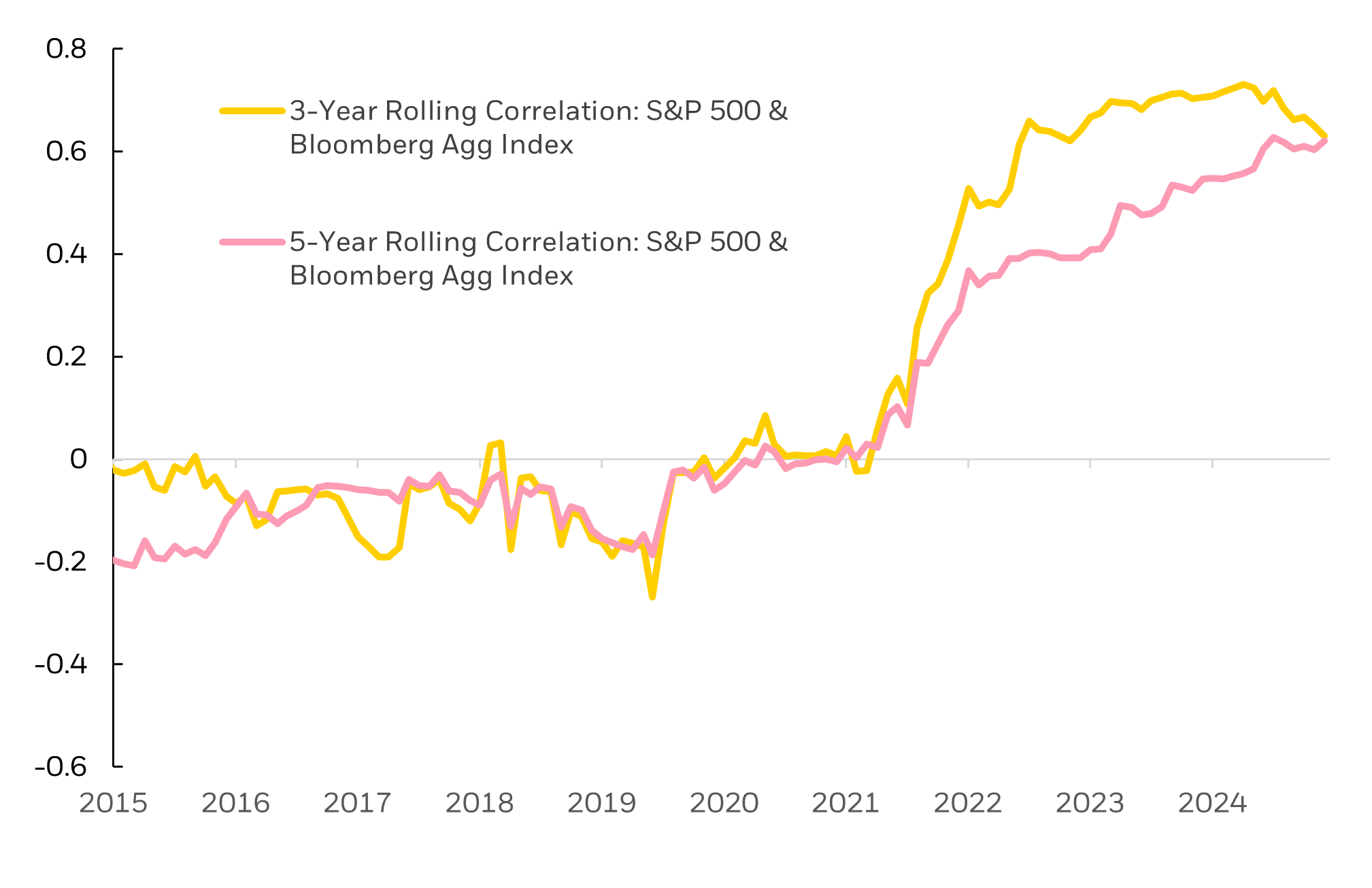
From individuals to the biggest institutions, investors are increasingly considering alternative assets like gold and bitcoin — assets that can offer added diversification in their portfolios amid heightened uncertainty. This is of paramount importance as the diversification benefits historically captured by traditional 60/40 portfolios have started to break down. As illustrated below, stock-bond correlations sit near historic highs, meaning long-duration bonds may not provide their historic function as a hedge against equity drawdowns.

Equity–Bond correlation is above historical norms

Rolling 3-year and 5-year correlation of the monthly returns of stocks and bonds

Source: Bloomberg, BlackRock, calculations as of 9/16/2025.
Chart description: Rolling 3-year and 5-year correlation of the monthly returns of stocks and bonds, denoted by the S&P 500 TR Index and the Bloomberg US Aggregate bond index. Sourced from Bloomberg, data is from November 2004 through September 2025. Correlation refers to the statistical relationship between the price movements of two or more assets, securities, or financial variables.


A NEW GOLD STANDARD FOR DIVERSIFICATION

Gold has long been viewed as a safe-haven asset, and its scarcity and historical relevance have allowed gold to appreciate over time, serving as a long-term hedge against inflation.

In recent years, bitcoin has increasingly entered the conversation as a potential tool for navigating some of these same risk vectors. Its appeal stems from being global, digitally native, decentralized, and fixed in supply. Bitcoin has a hard-coded maximum supply of 21 million units, with new issuance halving every four years.4 Bitcoin’s programmatic issuance schedule sits in contrast to fiat currencies, which can be more easily debased by the issuing government.

While bitcoin has a much shorter track record than gold and remains more volatile, its digitally native nature provides certain advantages in the 21st century, allowing for low-cost, near-instantaneous global transfers of value. Its historical price appreciation has been partly reflective of its potential to be adopted as a global store of value alongside gold.

Treasuries vs. Gold vs. Bitcoin

Caption:

Table detailing the properties of global monetary alternatives, U.S. treasuries and gold, in their comparison with bitcoin.

U.S. TreasuriesGoldBitcoin
Supply5UnfixedSemi-fixedFixed
Volatility6LowMediumHigh
Length of track record7MediumLongShort
GovernanceCentralizedDecentralizedDecentralized
Cost to move8LowHighLow
Cost to store8LowHighLow
Market cap9$27T$24T$2.1T

Source: BlackRock internal analysis, as of June 2025. 10-year U.S. Treasuries represented as bonds bought through a broker-dealer/bank and held at a custodian; gold represented as physical gold bars held at a bank or in self-custody in a physical vault; bitcoin represented as crypto assets held at a third-party exchange or in a self-custody wallet.

Past performance does not guarantee future results. Index performance is for illustrative purposes only. Index performance does not reflect any management fees, transaction costs or expenses. Indexes are unmanaged and one cannot invest directly in an index Certain sectors and markets perform exceptionally well based on current market conditions and iShares and BIackRock Funds can benefit from that performance. Achieving such exceptional returns involves the risk of volatility and investors should not expect that such results will be repeated. Index performance does not represent actual Fund performance.

ETFs have made it easier than ever for investors to gain exposure to assets like gold and bitcoin. These vehicles offer efficient and cost-effective access — alleviating many of the complexities of direct ownership:

Convenience:

  • Gold: Prior to ETF adoption, investors largely managed gold exposure through direct ownership like gold bars or jewelry, or more sophisticated investors might use derivatives such as futures contracts. But owning gold directly can present liquidity and custody challenges, as buying, selling, and storing physical gold can be cumbersome and expensive. For example, storing gold bars might require buying a safe or renting a safety deposit box at a local bank. And selling one’s gold bars might require going to a dealer who could charge a wider spread relative to the current market prices. Gold ETFs like CAD-hedged iShares Gold Bullion ETF (CGL) and currency non-hedged iShares Gold Bullion ETF (CGL.C) store their gold bars in high security vault facilities of The Royal Canadian Mint for safekeeping.
  • Bitcoin: Establishing a robust bitcoin custody arrangement can be operationally challenging as it requires investors to either secure, store, and manage their individual private keys, which can be thought of as the password that authorizes the movement of associated bitcoin, or engage an institutional-grade custodian. Without deep technical knowledge or robust processes, investors have at many times throughout bitcoin’s history suffered substantial losses.

    The iShares Bitcoin ETF (IBIT and IBIT.U) is an example of a spot bitcoin ETF. Its underlying utilizes an institutional-grade segregated cold storage vault custody solution, meaning private keys are generated and stored in secure, offline facilities. This is done through Coinbase Prime10, the world’s largest institutional digital asset custodian — so investors don’t need to manage their own wallets or keys. 

Efficient access:

  • Gold: Gold ETFs like CGL and CGL.C allow investors efficient access to the changes in gold prices within an ETF wrapper that can be owned within their traditional brokerage accounts. The market for gold ETFs is deeply liquid, with millions of shares exchanging hands daily. These market dynamics provide for low bid-ask spreads, resulting in low trading costs for investors.
  • Bitcoin: Spot bitcoin ETFs like IBIT and IBIT.U allow investors to gain exposure to the price movements of bitcoin in the convenience of the ETF wrapper. IBIT’s underlying has solidified itself as one of the most frequently traded ETFs in secondary market activity.11 This trading activity on traditional exchanges provides for high liquidity and low bid-ask spreads, significantly reducing transaction costs for investors versus what many face when trying to trade bitcoin directly on crypto exchanges. Through an ETF like IBIT, investors can gain exposure to bitcoin through traditional brokerage accounts, creating a bridge between traditional finance and cryptocurrency.

CONCLUSION

The operational convenience of bitcoin and gold ETFs coupled with rising uncertainty in global markets has driven investor demand for bitcoin and gold ETFs, which have seen $23.6 billion and $44.4 billion in new assets year to date.1 iShares ETFs have driven a significant share of net flows, taking in $9.7 billion in net gold ETF flows and $23.0 billion in net bitcoin ETF flows.12 This surge in flows reflects investors seeking out these assets through the convenience of the ETF wrapper. As uncertainty persists, bitcoin and gold will continue to be seen as strategic tools for diversification and as a potential long-run store of value.

Photo: Jay Jacobs

Jay Jacobs

U.S. Head of Thematic and Active ETFs at BlackRock

Brendan Easter

Thematic Strategist

Contributor

FEATURED FUNDS