
Income through market cycles
Markets can turn quickly, but the power of income endures. Making income a core part of your portfolio may help support returns and keep you progressing toward your financial goals through every market cycle.
Why income
-
01
Keep earning, even when markets don’t
Regular income from bonds and dividends may add to your overall return, even when markets move around.
-
02
Turn small payouts into big progress
Reinvesting income may turn regular payouts into meaningful long-term growth through compounding.
-
03
A buffer when markets get bumpy
Quality income assets may help soften the impact of market swings, so your portfolio keeps moving forward.
Income-focused investing has traditionally been associated with retirees.
But today, Australians at different stages of life are also considering strategies that aim to generate income from their portfolios — not just long-term growth.
Why? We believe there are several reasons.
Regular portfolio distributions may help with unexpected costs, like a car repair or replacing a flat tire.
They may help smooth cash flow for people with variable income from contracting, freelancing, sole trading or running a small business.
And for some investors, income can make investment outcomes feel more tangible along the way.
But whether you’re building wealth, preparing for retirement or already drawing an income, diversification still matters.
Using a small number of ETFs may help blend income and growth opportunities from different sources and diversify the investing experience.
A few areas investors may consider include:
Putting surplus cash to work:
Short-duration Australian government or semi-government bond ETFs may help investors earn income on cash they don’t need for day-to-day expenses or emergency savings. These funds can have lower interest-rate sensitivity than longer-duration bond exposures.
Balancing growth and income:
Options-based or defined-outcome strategies may seek to generate income while maintaining some exposure to share market growth, helping investors as they pursue growth in their assets while producing cash flow.
Seeking dividend income from shares:
Dividend-focused ETFs can provide exposure to companies that aim to return profits to shareholders. In Australia, dividends may also come with franking credits, depending on the company and the investor’s tax circumstances.
Broadening fixed income exposure:
Active fixed income ETFs may look across different parts of the bond market to seek higher income and diversification.
We believe income investing today is not a single-product solution. It can be a whole-portfolio approach, drawing income from multiple sources or balancing income with growth potential, to help investors work towards their financial goals.
Income investing explained
Watch BlackRock's Melissa Vincent explore income investing, including how Australian's are supplementing cash flow, the potential role of income-focused ETFs, and how they can help investors access diversified sources of income within a broader portfolio.
What is income investing?
Income investing is an approach focused on generating regular income through assets such as bonds, dividend-paying equities, and multi-asset income strategies. Rather than relying solely on capital growth, income investing seeks returns through interest payments and dividends over time.
Income strategies can help investors:
• Support portfolio cash flow needs
• Diversify sources of return
• Help manage market volatility
• Complement growth allocations
• Build more resilient portfolios
Income opportunities can be found across:
• Government bonds
• Investment grade credit
• High yield bonds
• Dividend-paying equities
• Infrastructure and real assets
Why now for income investing
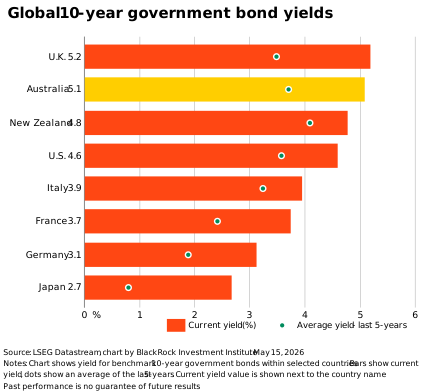
After years of low yields, changing market conditions have created new income opportunities across fixed income markets. This is particularly the case in Australia, where 10-year government bond yields are now some of the highest in the world.
At the same time, investors are increasingly looking to diversify beyond traditional cash holdings and concentrated income sources. More than 1 in 4 Australians say higher returns have motivated them to invest beyond cash, while around 20% are investing with the goal of generating an income outside work.1
Income investing may help provide stability during periods of market volatility by generating regular income even when asset prices fluctuate. Bonds and dividend-paying equities may help smooth portfolio returns, reduce reliance on market timing, and support investors in staying invested through different market conditions.
Income investing insights
18%
of Australians are investing to generate an income outside work*
44%
of Australian investors want to invest in an income ETF in the next 12 months*
36%
of Australian ETF investors currently hold an income ETF*
*iShares ETF Insights Report 2026
Income investing isn’t just for retirees anymore
Australians are thinking about income earlier. The iShares ETF Insights Report shows that people in their 30s and 40s are increasingly focused on generating income while they are still working. With inflation having outpaced wage growth by around 0.5% a year on average since 2020, many are exploring ways to supplement cash flow and build greater financial flexibility.2
That shift is already reflected in ETF use: more than one in three ETF investors (37%) use income ETFs, while Australians aged 25–44 are the most likely to say they are looking to generate regular income outside work. For many, it is about more than extra cash today—it is about gaining greater control over their financial future, creating the option to work less and considering alternatives to cash savings.3
Income ETF solutions
FeaturedFunds-1
FeaturedFunds-2
FeaturedFunds-3
FeaturedFunds-4
