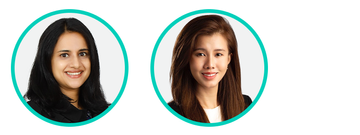
[KATE HILL]
To your eldest, you should have said, “Blue Horseshoe loves Anacott Steel.” That's what you should have said. That's what he should have been wandering around saying.
[MEERA JESSA]
Kate and Kamiya, I am so excited to have you join us today. It's not often you get two powerhouse women in a room to talk about trading in a world where typically you don't see women, quite frankly. Before we get started, Kate, I hear that you are a passionate gardener and that you attend the RHS Chelsea Flower Show every year. I have lived in London or did live in London for 25 years, and I have never been. Please, can you give me a little bit of an inside scoop on what goes on over there?
[KATE HILL]
I'm not sure it's an inside scoop. So, that flower show is the jewel in the crown of the RHS. It's an event that brings the absolute best of what's on offer in terms of garden design and planting. It's a fascinating construction process, and it's just a fun thing to go to if you're interested in that sort of thing—shows you, I guess, the art of the possible, and there's always something new and different there, even though I’ve been going the hundreds of years.
[MEERA JESSA]
As you think about gardening and having to understand sort of seasonal cycles and soil conditions, weather patterns, it's not that dissimilar to what you do in the trading world, right? You need to interpret market trends, shifting sentiment, you look at economic data, you need to manage your risk, right. They need to do that as gardeners too, and adjust when conditions change as well. And today if we think about the market, there is so much going on. And really, Kate and Kamya, for both of you, how do we break this all down and understand the moment that we're in? And maybe I'll start with you Kamya, break it down for me—what is going on right now?
[KAMYA SOMASUNDARAM]
Information overload.
That's actually how I would characterize it. And the decisions that we make will greatly shape whether we use that information to our benefit or to our detriment. If you look at history over the last hundreds of years, or even if you take recent history over the last 25 years, when you look at major events that were catastrophic in nature, they all talk about one commonality, which is data fragmentation in silos.
The fact that organizations are unable to share relevant information or don't even know what is relevant, has been a common pattern amongst these events. I think about that a lot in the world of trading where there is a plethora of information, but if we don't have the right architecture, we don't have the right plumbing, the right channels to take that information, manipulate it, understand what it means, and then share it with others who need to know. That could really change the trajectory of whether we use data to our benefit, or we use data to our detriment.
[MEERA JESSA]
Kate, how about you? How would you describe this moment that we're in right now?
[KATE HILL]
So, this moment that we're in right now, in some respects, is very different to what's gone before, but also is exactly the same. What I mean by that is you’re at a point in time where you're on the precipice or in the process of introducing new technology in the form of AI, etc., and much the same as if you go as far back as the Industrial Revolution or before then, that will always have a very significant impact depending on how it's adopted and deployed.
But what I would say to Kamya’s point is that our ability to leverage that new technology in the world of trading is entirely dependent on our data infrastructure. It only kind of works as well as what you feed it. So, I think we're at an important turning point. A very exciting one. But in some respects, it's not that different to what's gone before.
[MEERA JESSA]
If you think about how you started your career and where we are now and your statement around “it's different but it's exactly the same” is, I guess you could describe it as an oxymoron in some regards. What has surprised you the most as you look at what you've seen in the industry and market structure throughout the course of your career?
[KATE HILL]
That's a tricky one, because I think I've been doing this now for coming up 30 years. That's a long time. So, when I started in markets, we weren't even using email. And I guess over the course of that 30 years, the constant is change and how technology always finds its way into financial markets in one way or the other.
When I think back to the early days in FX, our order board at that time was a whiteboard with a marker pen. Any of the banks listening to this will have a bit of a giggle about that, because that's just not obviously sustainable or scalable, but that was considered the best technology at the time.
So, if you assume that the only certainty is change, the way that you look at technology and the way you deploy it leaves you open to new ideas and new ways of thinking, right? Especially if you've started in the era of pretty close to pen and paper.
[MEERA JESSA]
You're also forgetting a very important technological instrument we had in the past called a squawk box.
[KATE HILL]
From a squawk box perspective, shouting’s quicker than typing. One of the downsides of technology is sometimes you change market structure to a point where it's less fun. And the noise, I remember when I walked into the Citibank trading room in 1994, the noise of that place was just exciting and fascinating, and bells, whistles, alarms, people shouting at each other. But obviously as technology progresses, you end up losing some of that noise, which is a bit of a shame, but it's a different type of fun.
[MEERA JESSA]
So, if we think about that noise and the sort of shouty trader, and when anyone thinks about trading, everyone thinks of the coats, the open outcry and the sort of shouty world. And today, that noise still exists. It just exists in a different medium. So, Kamya, when you think about that different medium, how is technology really addressing the market in the moment we're in right now?
[KAMYA SOMASUNDARAM]
I'll go on a little segue, because as overhearing you and Kate talk about sort of how that industry has changed is making me giggle because, as you know, yesterday we had a Halloween event in the office. And I brought my two-year-old in and I dressed him up as Gordon Gekko from Wall Street.
[MEERA JESSA]
Which is a great costume, by the way.
[KAMYA SOMASUNDARAM]
And he had exactly what you guys are describing. He had the suspenders, hair slicked back, and we made a little dummy phone for him. And this is sort of like the sign that you are getting old is, I was like, how many people are actually going to know who Gordon Gekko is? So, I had a name tag with Gordon Gekko.
And as we walked the floors, the younger generation immediately like “Oh my God, is he a finance bro?” And I was like, well, yes, actually, I guess Gordon Gekko is the original finance bro. The noise, I think to your point, Meera, comes in a very different way. Yes, the trading floors are no longer noisy in an obvious way, but they're really noisy in terms of the input of data that we're getting.
Going back again to that point, like how do you clean up that data? How do you make sense of that data? That is what you and I, for example, spend our lives doing today is how do we create the toolkits and the frameworks that help our very important clients, like Kate, manage that noise, manage that data, manage the intricacies that come with that.
So, like that's how I think about noise today. And I also think that the noise comes from the lack of ecosystem development. So, the markets that do it really very well are the markets where individual players in that ecosystem have decided and come to the conclusion that you cannot solve these problems alone. And I think this is why in the world of financial markets, we see so many consortiums, we see so many industry bodies.
It's really important to have that. But I think we all know that that plays a really important role in bringing structure. And we need that. The structure that we align to, that we collectively agree, allows us to make sense of the noise and take progress in a collective fashion.
[MEERA JESSA]
That makes a lot of sense. If we could double click a little bit more into the ecosystem development that you just talked about. Let's use an industry as an example, right? Or a particular asset class like FX, foreign exchange. How do you take that concept of ecosystem development and apply it to something like FX? Or how does that industry evolve, like FX is mostly today electronically traded, right? Talk me through that evolution.
[KAMYA SOMASUNDARAM]
So, I think one of the simple things that exists is the market participants agreeing to a technology framework. We talk a lot about something called FIX in trading. What is FIX? It's a language with standards and protocols that we have all agreed to. And we hold hands together and they exist, and it's pervasive through what we would call essentially public securities and public markets.
That is one very simple manifesto, and that is how Aladdin, for example, communicates to a network of hundreds of participants, broker dealers, venues, trading platforms. But in the absence of all of us agreeing to speak the same language, we either spend and waste a lot of time in translation. And that is where the errors happen. Or we just don't progress.
[MEERA JESSA]
And Kate, as a practitioner who is part of this ecosystem, what's your experience as someone who sits on the trading floor and has to make these decisions every day?
[KATE HILL]
So, I think we're talking about the noise and the shouting and the stopping. What we used to call that is the concept of “dealer’s ear”. So, from a bank or trading environment, it mattered how close you were sat next to the spot desk. It mattered how close you were to other sales teams selling other products, etc. so you are absorbing what's going on around you.
When you electronify that world, you still want to do the same thing and to Kamya’s point, that’s where the data collection, distribution, etc. becomes so important. And speaking the same language is really important, whether you're on the buy or sell side. But what I would say, kind of thinking about how we might look at that in the future, it's also looking at data in terms of what you don't know.
So, every time you get a data set, you're kind of looking almost for confirmation bias, if that makes sense. The interesting thing about getting your data structure right is to find something that you didn't know. It could be anything. It could be day dependent. It could be a particular price action post payrolls. It could be no end of different things.
But unless, I suppose you're in a situation where you have a data set that can be mined and explored by someone that doesn't have bias already. I mean, after 30 years, I'm pretty sure I know my own biases, but that's the really interesting next leg for how we think about pre-trade analysis, whether it's FX or any other asset class, and how we do a better job of analyzing our performance post-trade.
[MEERA JESSA]
So, proximity matters. Speaking the same language is important. And we need to find out what you don't know, right? When we look today at signals for trading and we've talked a lot about data and there's a lot of language processing around parsing this data and analyzing it in real time, you see it through information you get from Twitter or news articles. I even read somewhere that hedge funds are relying on alternative data, things like satellite imagery and shipping traffic. It's unfathomable, right? Like ten years ago, we wouldn't be talking about this. This is all to generate different trading ideas. So, there's a plethora of data that we need to make sense of. We're now doing more electronically, so people aren't really speaking to each other that much.
Kamya, you talked about information overload. So, when you look at all this data that's out there and these innovative ways to gather information to learn what you don't know, how do you actually make sense of this to enable faster and smarter trading decisions?
[KAMYA SOMASUNDARAM]
I think this ultimately boils down to do you have the right talent in the right seats? And I think that is the critical unlock as we think about how we grow the space. We need more data scientists. We need more researchers. We need people with the skill set that can understand and parse that data. But we also need a balance. We need the 30 years of experience where you can understand what that means for the output you're looking for. That's how we figure out what the data means. I mean, yes, there's incredible value in alternative data sets, but if you don't know what that alternative data set is supposed to tell you and you don't have an intuition about that, that data is meaningless.
[KATE HILL]
You also need to think about why—what are you trying to achieve? I completely agree with you in terms of the skill set for today is very different from what's gone before, but there's a difference between the “are looking for high-frequency trading to generate alpha”, a different beast to a real money manager like Aviva Investors that’s mostly concentrating on trying to get the absolute best result for their clients in that particular point in time for a trade.
But we need to understand what are we trying to achieve, because it has to have an end game. It has to have a result. It has to have a notable performance impact necessarily. And I think these high-frequency trading model, a bank or a hedge fund is very different from how asset managers would use data and pre- and post-trade analysis.
[MEERA JESSA]
So, I want to just touch on the talent comment that Kamya made. We're in a world now where AI is increasingly embedded into our lives, let alone our day-to-day work. What does that mean for talent and in particular for the role of a trader today? How would you think about that Kate?
[KATE HILL]
The application of technology generally and AI, those are two different things. So, for example, when I think about how the market structure has changed through time, there's definitely a set of asset classes and execution protocols that lend themselves to what I would describe as low touch execution. That's the rules-based, automated, and preferably zero touch execution methodology where you can use technology to get your clients a fab result, but where you also gain efficiency.
When you think about AI, you're thinking about—right, so if I was a high frequency trader, how would I create a price-making, deep learning type machine, just for want of a better word. Or within the asset management industry, how do I use tools, AI tools to mine research, to mine data, to make me more efficient, to come up with better decisions?
I think those are two different things, and I think it's always about the so what? I'm very conscious that there are lots of ways in which we could use AI, but we still need to think about what's the outcome that we're trying to achieve. For our part, we've been using rules-based execution, I think now coming up a decade, so that's not new news to us. So, the next leg is what do we want to achieve with AI rather than AI for the sake of AI?
[MEERA JESSA]
So, Kamya, in your world, in where you sit in the industry, and Kate describing the “so what?”—how do you develop the right AI tools to deliver on the “so what?”
[KAMYA SOMASUNDARAM]
What’s very interesting is just even in the last five years, because we're in this moment of turn of the century change with AI, the problems we need to solve have gotten so complex. The person or persons that we are trying to solve for it now wear so many different hats. I would say 5 or 6 years ago, the type of questions that we were fielding, the pain points we were fielding were about “this screen is not showing me things in these 15 different ways”, and now it is a little bit of that, but there is a burgeoning community of individuals saying “I need that in the form of an API. I need that to speak to this.”, and it is less about the screens they see and more about the software behind it. And I think that that means now when we think about AI, it is both how do we react and how do we pre-empt.
And one of the problems that we have is, it is very hard now to curate a solution that fits the needs of a client holistically, because a client now wears so many different hats. Some of them want to see the data visualized in a certain way. Some of them want to see that just as components. This is where the unlock I think AI will bring is incredible. The ability to be able to query the database and have the output come out in the form that you want it to be. Customization at scale is exactly what we talk about now all the time, and I think this is where I am very excited about what AI can bring.
[MEERA JESSA]
I think the output and how people want to interact with it is really important, as you are saying Kamya, but it's also what you put into it, otherwise it's garbage in, garbage out. I'm going to ask you a bit of a fun question here. Trading is, even in our conversation just now, it's full of jargon. And I think we've tried to stay away from it. I'm going to give you the exam question of how would you describe trading to your kids? Why don't you go first, Kate?
[KATE HILL]
That is a very good question. My son is 16 and I don't know how, but he seems to be interested in this field.
[MEERA JESSA]
He's got a great role model.
[KATE HILL]
Thank you very much. I'm quite keen to make sure that he, I guess, understands the people side of it. So, we talk about trading and traders almost as beings in their own right, that it's a very singular existence. And I think for me, the important thing to emphasize is that it doesn't really matter which element of trading that you want to be in, whether it's buy-side sell-side, whatever, you're actually still going to be working as part of a small team, right? So, it's more about having those interpersonal skills, that confidence, that communication, etc. So, that's one thing that I've spoken to him a lot.
In terms of financial markets, I guess I'm speaking to him a lot about basic macroeconomics, really, which is the starting point of that. And really expose him, my job now, yes, of course, it's about driving solutions for clients, but a lot of it is being a good people manager. That's a very important part of my role. So, I don't really spend a lot of time on the actual trading elements, but more on, I suppose, the required softer skills around it.
[MEERA JESSA]
That's actually a really interesting take, because that is not what you would expect to hear from someone on the trading floor. I like that a lot. Kamya, what would you say to your boys?
[KAMYA SOMASUNDARAM]
Okay. My boys are two and one. So, apart from giving them one liners like “buy low, sell high” and “money never sleeps” and mommy never sleeps either.
[KATE HILL]
To your eldest, you should have said, “Blue, Blue Horseshoe loves Anacott Steel.” That's what you should have said. That's what he should have been wandering around saying.
[MEERA JESSA]
So, we've talked a lot about the past. We've talked about the present. We've talked a little bit about the future as well. I would say a lot about the future. What excites you about the future the most? Let's start with you, Kamya.
[KAMYA SOMASUNDARAM]
I'm a little bit of a credit junkie. That's where I think my subject matter expertise is. It's the part of the market that I find fascinating. I think it has a lot of character. That's why I love it. But one of the things that really excites me is when we think about the world of trading, investment, asset management, we followed a life cycle that has been very standard for many, many years.
With AI, with technology, I think the lines have already started to blur a lot. And one of the things I love spending time talking about with my teams, with my colleagues, with professionals, is this concept of “shift left”, which is the idea that you can create portfolios instantly that have a view all the way to the end of the lifecycle on how you can very efficiently trade, get out the door, minimize how long things stay in the blotter, essentially like turbocharge the speed at which you do this at a significantly lower level of risk.
That is what excites me, and I think that that's going to allow people to do a little bit more of what they typically use to do and do a lot less of something that they spend time on. And I do think that it will change dramatically in the next 2 to 3 years.
[MEERA JESSA]
I love that, “shift left”. How about you, Kate?
[KATE HILL]
So, I'm less excited about the speed of that process and more excited about the quality of the decision making. I already think from the asset management community, in fixed income especially, what you actually have is a holy trinity between portfolio managers, analysts and traders. And when the communication between those three distinct groups works well, then you're really talking about moving the dial on customer outcomes.
So, I think that already exists. I agree with Kamya, the pace of change this time, even though we've been here before, with the introduction of new tech, even though the introduction of technology is the same, the rate of change could be parabolic. I think we have to leave that as an open possibility. So, I think what most excites me is that the union of those three functions becomes stronger, much more effective, and works at, I suppose, as I say, not faster, but better quality outcome in terms of decision making.
I guess more generally for a five year time horizon, I don't know what I don't know, but I do feel that we're on the precipice of quite significant market structural change. We've talked about getting a data house in order in order to leverage AI. There's also a regulatory construct underlying all of this. I think we see that in demand for the shortening of settlement cycles. We see that in the introduction of digital assets, tokenization, etc.
All of that, though, is essentially bolted on to an infrastructure, a market structure which is older than me. And when we think about financial markets and our ability to leverage all of that new tech, it's only going to be as good as the strength of our foundations. And I think for the first time, probably in my career, this degree of change actually will force some really fundamental changes to market structure.
The adoption of tech is largely optional. The application of reg is never optional. So, if those two things coincide, then I think that could create a market structure that looks very different to the one that we've enjoyed for the last 30 years.
[MEERA JESSA]
Last question for you both. What's never done for you?
[KAMYA SOMASUNDARAM]
So, I am from Singapore and I miss going home. I love going home. But as everyone knows, the path to getting from here to Singapore is a 19-hour flight. How great would it be if I could get from here to there in a significantly shorter amount of time? And yes, we've had iterations of this with the Concorde that came and went and all of that, but it just still baffles me that where we are today, that is something that takes so long.
Maybe there's a trend because again, I seem to be very focused on speed and efficiency. And so there is a bias here. But to me it's what's never done before. It's just there feels to be a bit of a lag in that where air travel has stood, has stayed still for many, many years now.
[MEERA JESSA]
I like that. How about you, Kate?
[KATE HILL]
I've tried to think about this answer, and I've tried to sort of give you something sensible, but the one that immediately springs to mind is my washing.
[MEERA JESSA]
I love it.
[KAMYA SOMASUNDARAM]
By the way, that was my second one. I'm very excited to hear what Kate has to say.
[KATE HILL]
I agree with you on the travel, but I suppose from a market perspective, what's never done is the theme of what we've really been talking about is change. It’s never finishing. Every day is different. You can never assume that what you did yesterday to get a great result is going to get the same result today. So, I think it's an ongoing process. It's a constant cycle of evaluation, trying to understand what's today in this environment right here, right now. What's the right thing to do? So, that's the never done bit for me.
[MEERA JESSA]
Kate, Kamya, thank you so much for joining me today. It was an absolute pleasure. This was so much fun.
[KAMYA SOMASUNDARAM]
Thank you.
[KATE HILL]
Thanks very much for having me. It's been fun. Thank you.