BLACKROCK INVESTMENT INSTITUTE
Mega forces: An investment opportunity
Mega forces are big, structural changes that affect investing now - and far in the future. This creates major opportunities - and risks - for investors.
BLACKROCK SUSTAINABILITY
Please read this page before proceeding as it explains certain restrictions imposed by law on the distribution of this information and the jurisdictions in which our products and services are authorised to be offered or sold.
By entering this site, you are agreeing that you have reviewed and agreed to the terms contained herein, including any legal or regulatory restrictions, and have consented to the collection, use and disclosure of your personal data as set out in the Privacy section referred to below.
By confirming below, you also acknowledge that you:
(i) have read this important information;
(ii) agree your access to this website is subject to the disclaimer, risk warnings and other information set out herein; and
(iii) are the relevant sophistication level and/or type of audience intended for your respective country or jurisdiction identified below.
The information contained on this website (this “Website”) (including without limitation the information, functions and documents posted herein (together, the “Contents”) is made available for informational purposes only.
No Offer
The Contents have been prepared without regard to the investment objectives, financial situation, or means of any person or entity, and the Website is not soliciting any action based upon them.
This material should not be construed as investment advice or a recommendation or an offer or solicitation to buy or sell securities and does not constitute an offer or solicitation in any jurisdiction where or to any persons to whom it would be unauthorized or unlawful to do so.
Access Subject to Local Restrictions
The Website is intended for the following audiences in each respective country or region: In the U.S.: public distribution. In Canada: public distribution. In the UK and outside the EEA: professional clients (as defined by the Financial Conduct Authority or MiFID Rules) and qualified investors only and should not be relied upon by any other persons. In the EEA, professional clients, qualified clients, and qualified investors. For qualified investors in Switzerland, qualified investors as defined in the Swiss Collective Investment Schemes Act of 23 June 2006, as amended. In DIFC: 'Professional Clients’ and no other person should rely upon the information contained within it. In Singapore, public distribution. In Hong Kong, public distribution. In South Korea, Qualified Professional Investors (as defined in the Financial Investment Services and Capital Market Act and its sub-regulations). In Taiwan, Professional Investors. In Japan, Professional Investors only (Professional Investor is defined in Financial Instruments and Exchange Act). In Australia, public distribution. In China, this may not be distributed to individuals resident in the People's Republic of China ("PRC", for such purposes, excluding Hong Kong, Macau and Taiwan) or entities registered in the PRC unless such parties have received all the required PRC government approvals to participate in any investment or receive any investment advisory or investment management services. For Other APAC Countries, Institutional Investors only (or professional/sophisticated /qualified investors, as such term may apply in local jurisdictions). In Latin America, institutional investors and financial intermediaries only (not for public distribution).In Latin America, no securities regulator within Latin America has confirmed the accuracy of any information contained herein. The provision of investment management and investment advisory services is a regulated activity in Mexico thus is subject to strict rules. For more information on the Investment Advisory Services offered by BlackRock Mexico please refer to the Investment Services Guide available at www.blackrock.com/mx.
This Contents are not intended for, or directed to, persons in any countries or jurisdictions that are not enumerated above, or to an audience other than as specified above.
This Website has not been, and will not be submitted to become, approved/verified by, or registered with, any relevant government authorities under the local laws. This Website is not intended for and should not be accessed by persons located or resident in any jurisdiction where (by reason of that person's nationality, domicile, residence or otherwise) the publication or availability of this Website is prohibited or contrary to local law or regulation or would subject any BlackRock entity to any registration or licensing requirements in such jurisdiction.
It is your responsibility to be aware of, to obtain all relevant regulatory approvals, licenses, verifications and/or registrations under, and to observe all applicable laws and regulations of any relevant jurisdiction in connection with your access. If you are unsure about the meaning of any of the information provided, please consult your financial or other professional adviser.
No Warranty
The Contents are published in good faith but no advice, representation or warranty, express or implied, is made by BlackRock or by any person as to its adequacy, accuracy, completeness, reasonableness or that it is fit for your particular purpose, and it should not be relied on as such. The Contents do not purport to be complete and is subject to change. You acknowledge that certain information contained in this Website supplied by third parties may be incorrect or incomplete, and such information is provided on an "AS IS" basis. We reserve the right to change, modify, add, or delete, any content and the terms of use of this Website without notice. Users are advised to periodically review the contents of this Website to be familiar with any modifications. The Website has not made, and expressly disclaims, any representations with respect to any forward-looking statements. By their nature, forward-looking statements are subject to numerous assumptions, risks and uncertainties because they relate to events and depend on circumstances that may or may not occur in the future.
No information on this Website constitutes business, financial, investment, trading, tax, legal, regulatory, accounting or any other advice. If you are unsure about the meaning of any information provided, please consult your financial or other professional adviser.
No Liability
BlackRock shall have no liability for any loss or damage arising in connection with this Website or out of the use, inability to use or reliance on the Contents by any person, including without limitation, any loss of profit or any other damage, direct or consequential, regardless of whether they arise from contractual or tort (including negligence) or whether BlackRock has foreseen such possibility, except where such exclusion or limitation contravenes the applicable law.
You may leave this Website when you access certain links on this Website. BlackRock has not examined any of these websites and does not assume any responsibility for the contents of such websites nor the services, products or items offered through such websites.
Intellectual Property Rights
Copyright, trademark and other forms of proprietary rights protect the Contents of this Website. All Contents are owned or controlled by BlackRock or the party credited as the provider of the Content. Except as expressly provided herein, nothing in this Website should be considered as granting any licence or right under any copyright, patent or trademark or other intellectual property rights of BlackRock or any third party.
This Website is for your personal use. As a user, you must not sell, copy, publish, distribute, transfer, modify, display, reproduce, and/or create any derivative works from the information or software on this Website. You must not redeliver any of the pages, text, images, or content of this Website using "framing" or similar technology. Systematic retrieval of content from this Website to create or compile, directly or indirectly, a collection, compilation, database or directory (whether through robots, spiders, automatic devices or manual processes) or creating links to this Website is strictly prohibited. You acknowledge that you have no right to use the content of this Website in any other manner.
Additional Information
Investment involves risks. Past performance is not a guide to future performance. The value of investments and the income from them can fall as well as rise and is not guaranteed. You may not get back the amount originally invested. Changes in the rates of exchange between currencies may cause the value of investments to diminish or increase.
Privacy
Your name, email address and other personal details will be processed in accordance with BlackRock’s Privacy Policy for your specific country which you may read by accessing our website at https://www.blackrock.com.
Please note that you are required to read and accept the terms of our Privacy Policy before you are able to access our websites.
Once you have confirmed that you agree to the legal information herein, and the Privacy Policy – by indicating your consent – we will place a cookie on your computer to recognise you and prevent this page from reappearing should you access this site, or other BlackRock sites, on future occasions. The cookie will expire after six months, or sooner should there be a material change to this important information.

Market take
Weekly video_20260202
Vivek Paul
Global Head of Portfolio Research, BlackRock Investment Institute
Opening frame: What’s driving markets? Market take
Camera frame
Title slide: Tapping infrastructure’s potential
Last week’s corporate earnings from mega cap tech companies showed massive investments in AI are ongoing. Beyond mega cap tech, we see a clear beneficiary: infrastructure. Most investors could increase their exposure, in our view.
1: A valuation discount
Corporate earnings in the fourth quarter show capital spending behind the AI buildout rolling on. This is a boon for infrastructure, which has been typically viewed as defensive.
Beyond the AI buildout, other mega forces, such as the low-carbon transition, support long-term demand.
But valuations do not yet reflect this. On an enterprise-value-to-EBITDA basis, publicly listed infrastructure equities trade at a steep discount to their long-term averages. Private infrastructure trades closer to long-term averages, unlike private equity. That helps make infrastructure our preferred growth private asset.
2: Tapping infrastructure exposure
Infrastructure is diverse. It spans transport, energy, telecommunications, and water and waste management. And investors can access it through both debt and equity vehicles in public and private markets.
Yet most investors, including large institutions that typically dominate illiquid investments, are under-allocated. Our analysis shows that a typical U.S. corporate pension with risk comparable to a 70/30 equity-bond split has infrastructure-like exposure of just 4 to 5%.
We think adding infrastructure holdings is particularly helpful in an inflationary environment like today, where investors need income sources whose value won’t erode over time. Infrastructure cash flows are often supported by regulation and long-term contracts that adjust with inflation. This offers predictable income over the lifespan of investments.
3: Common risks
Two risks are commonly cited for infrastructure. First, an AI burst could choke demand for data center and energy infrastructure – though we think this is unlikely. Strong legal protections in infrastructure contracts help mitigate these risks.
Second, higher real rates could push up the expected return threshold for infrastructure. We think this risk is the greater of the two and reflects structural forces like large government deficits and heavy bond issuance.
Outro: Here’s our Market take
We like opportunities in infrastructure. Mega forces like AI are driving long-term demand, and valuations don’t yet reflect that. We think most investors can increase their exposure.
Closing frame: Read details: blackrock.com/weekly-commentary
Most investors could increase their infrastructure exposure, we think. It benefits from multiple mega forces yet currently trades at a discount.
Stocks ended unchanged, masking big intraday moves triggered by jitters over AI investment. We see this as a reshuffling of winners, not the AI trade’s end.
U.S. jobs data this week could give some clarity on the Fed’s rate path. We see the nomination of Kevin Warsh as Fed chair easing pressure on the U.S. dollar.
The latest earnings from mega cap tech are still showing massive spending on AI, even amid market volatility and dispersion. We see a clear beneficiary: infrastructure. Most investors could increase their exposure to this diverse asset class, in our view. Beyond the AI buildout, multiple mega forces support long-term demand. Valuations look low to fair versus history. And cash flows that often adjust with rising prices can help hedge inflation risk.
A valuation discount
Listed infrastructure vs MSCI World valuations, 2010-2025
Past performance is no guarantee of future results. Source: BlackRock Investment Institute, with data from MSCI, FTSE, November 2025. Note: The chart compares the ratio of enterprise value to earnings before interest, tax, depreciation and amortisation for listed infrastructure and global equities. Positive values mean listed infrastructure is valued at a premium vs. global equities, negative values indicate a discount. The lines show the average relative valuation and the ±2 standard deviation from that average. Index proxies: FTSE World Core Infrastructure 50/50 and MSCI World.
Infrastructure, traditionally viewed as a stodgy defensive sector, is now at the center of interlocking mega forces. Geopolitical fragmentation is leading governments to emphasize energy security. Population growth in emerging markets requires upgrading urban infrastructure. Nuclear and renewable power for the low-carbon transition often need more up-front investment than traditional energy sources. Yet valuations, weighed down as interest rates have climbed, do not reflect this growth potential. Listed infrastructure equities trade at nearly 20% below their long-term average on enterprise-value-to-EBITDA multiples – below levels at the financial crisis and similar to the COVID shock. See the chart. Private infrastructure assets trade closer to long-term averages, we believe, but lets investors tap a much wider universe of assets.
Investors can tap infrastructure through a wide range of sectors and exposures. It spans transport, energy, telecom and digital networks and water and waste management, and can be accessed through debt and equity in both listed and private markets. Yet most investors are under-allocated, even the large institutions that historically dominate illiquid asset investing. Analysis from our recent paper (for professional investors only) shows that a typical U.S. corporate pension with similar risk to a 70/30 equity-bond split has infrastructure-like exposure of about 4 to 5% through equity and credit holdings such as utilities. Why so little? Infrastructure lacks the familiarity of mainstream stocks and bonds, and its long investing horizons has made it the purview of select institutional investors. Yet our analysis shows that corporate pension funds can more than double their current levels of exposure for increased portfolio efficiency: greater return for similar overall risk.
Infrastructure holdings are particularly helpful when supply chain constraints stoke inflation and mega forces cloud the long-term outlook. Growth is solid right now, but inflation is getting “stickier,” as Federal Reserve Chair Jerome Powell said after holding policy rates steady last week. Investors need income sources that have a low risk of eroding in such an environment. Infrastructure’s cash flows are often supported by regulation or long-term contracts that adjust with inflation, offering predictable income. We especially like infrastructure equity among private growth assets on a five-year-plus horizon.
What are the risks? First: an AI bust chokes data center and energy infrastructure demand. We see this as overblown for the sector. The reason: strong legal protections. Companies pay for space even if they don’t use it; early lease terminations are limited; and tenants front any increases in energy costs. Second: the risk of rising real rates raising the return bar for infrastructure assets. This risk has been front and center recently, with a rapid rise in the term premium pressuring the U.S. dollar and Treasuries as global investors rethink U.S. exposure. We see the nomination of Kevin Warsh as Federal Reserve chair mitigating the risk for now thanks to his financial crisis experience and likely focus on preventing global spillovers.
We like infrastructure. Mega forces like AI are driving long-term demand, but valuations don’t yet reflect that. We think most investors can allocate more and particularly favor infrastructure equity among private growth assets.
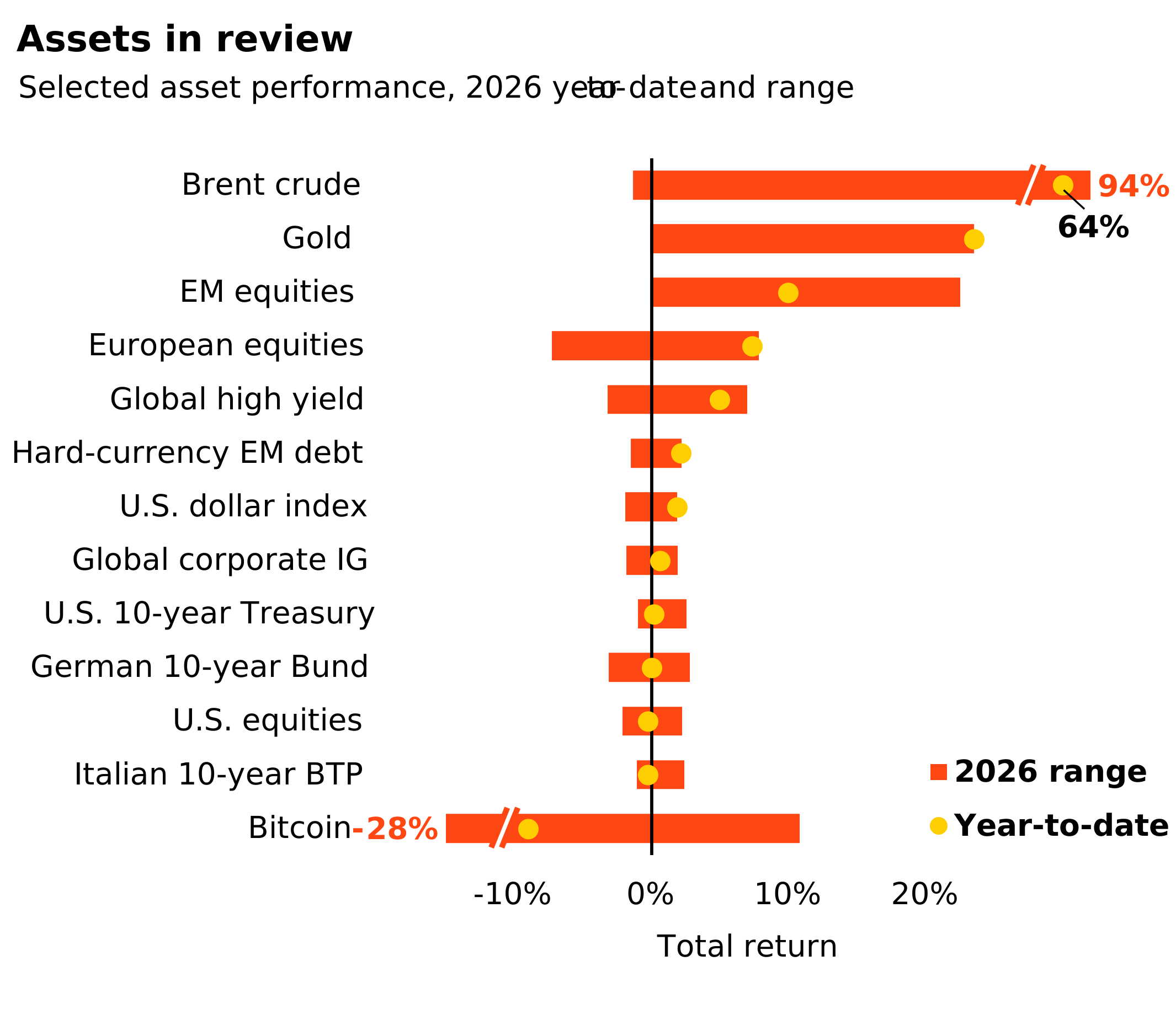
Stocks were little changed on the week, even as the S&P 500 notched a 1.7% intra-day decline last Thursday on jitters over AI investment. We see the latter as a reshuffling of winners, not as backlash against the AI trade. The U.S. dollar plumbed four-year lows, then perked up on news of the Warsh nomination. Precious metals that had become perceived safe havens during the term premium shock saw their biggest losses since the 1980s.
We look to U.S. jobs data for a cleaner read on the labor market. A “no hiring, no firing” stasis let the Fed trim rates last year, but wage pressures could limit cuts in 2026. The bigger question: How would Fed chair nominee Kevin Warsh navigate pressure to cut rates? Given Warsh’s financial crisis experience, we think he will focus on preventing global market spillovers. We see this supporting the U.S. dollar and easing the risk of spikes in long-term yields.
Past performance is not a reliable indicator of current or future results. Indexes are unmanaged and do not account for fees. It is not possible to invest directly in an index. Sources: BlackRock Investment Institute, with data from LSEG Datastream as of January 29, 2026. Notes: The two ends of the bars show the lowest and highest returns at any point year to date, and the dots represent current year-to-date returns. Emerging market (EM), high yield and global corporate investment grade (IG) returns are denominated in U.S. dollars, and the rest in local currencies. Indexes or prices used are: spot Brent crude, ICE U.S. Dollar Index (DXY), spot gold, spot bitcoin, MSCI Emerging Markets Index, MSCI Europe Index, LSEG Datastream 10-year benchmark government bond index (U.S., Germany and Italy), Bloomberg Global High Yield Index, J.P. Morgan EMBI Index, Bloomberg Global Corporate Index and MSCI USA Index.
U.S. job openings and labor turnover
Euro area inflation
ECB, BoE policy rate decisions
U.S. payrolls, University of Michigan consumer sentiment
Read our past weekly market commentaries here.
Our highest conviction views on six- to 12-month (tactical) and over five-year (strategic) horizons, February 2026
| Reasons | ||
|---|---|---|
| Tactical | ||
| Still favor AI | We see the AI theme supported by strong earnings, resilient profit margins and healthy balance sheets at large listed tech companies. Continued Fed easing into 2026 and reduced policy uncertainty underpin our overweight to U.S. equities. | |
| Select international exposures | We like Japanese equities on strong nominal growth and corporate governance reforms. We stay selective in European equities, favoring financials, utilities and healthcare. In fixed income, we prefer EM due to improved economic resilience and disciplined fiscal and monetary policy. | |
| Evolving diversifiers | We suggest looking for a “plan B” portfolio hedge as long-dated U.S. Treasuries no longer provide portfolio ballast – and to mind potential sentiment shifts. We like gold as a tactical play with idiosyncratic drivers but don’t see it as a long-term portfolio hedge. | |
| Strategic | ||
| Portfolio construction | We favor a scenario-based approach as AI winners and losers emerge. We lean on private markets and hedge funds for idiosyncratic return and to anchor portfolios in mega forces. | |
| Infrastructure equity and private credit | We find infrastructure equity valuations attractive and mega forces underpinning structural demand. We still like private credit but see dispersion ahead – highlighting the importance of manager selection. | |
| Beyond market-cap benchmarks | We get granular in public markets. We favor DM government bonds outside the U.S. Within equities, we favor EM over DM yet get selective in both. In EM, we like India which sits at the intersection of mega forces. In DM, we like Japan as mild inflation and corporate reforms brighten the outlook. | |
Note: Views are from a U.S. dollar perspective, February 2026. This material represents an assessment of the market environment at a specific time and is not intended to be a forecast of future events or a guarantee of future results. This information should not be relied upon by the reader as research or investment advice regarding any particular funds, strategy or security.
Six- to 12-month tactical views on selected assets vs. broad global asset classes by level of conviction, February 2026

We have lengthened our tactical investment horizon back to six to 12 months. The table below reflects this and, importantly, leaves aside the opportunity for alpha, or the potential to generate above-benchmark returns – especially at a time of heightened volatility.
| Asset | Tactical view | Commentary | ||||
|---|---|---|---|---|---|---|
| Equities | ||||||
| United States | We are overweight. Strong corporate earnings, driven in part by the AI theme, are supported by a favorable macro backdrop: continued Federal Reserve easing, broad economic optimism and less policy uncertainty, particularly on the trade front. | |||||
| Europe | We are neutral. We would need to see more business-friendly policy and deeper capital markets for recent outperformance to continue and to justify a broad overweight. We stay selective, favoring financials, utilities and healthcare. | |||||
| UK | We are neutral. Valuations remain attractive relative to the U.S., but we see few near-term catalysts to trigger a shift. | |||||
| Japan | We are overweight. Strong nominal GDP, healthy corporate capex and governance reforms – such as the decline of cross-shareholdings – all support equities. | |||||
| Emerging markets (EM) | We are neutral. Economic resilience has improved, yet selectivity is key. We see opportunities across EM linked to AI and the energy transition and see the rewiring of supply chains benefiting countries like Mexico, Brazil and Vietnam. | |||||
| China | We are neutral. Trade relations with the U.S. have steadied, but property stress and an aging population still constrain the macro outlook. Relatively resilient activity limits near-term policy urgency. We like sectors like AI, automation and power generation. We still favor China tech within our neutral view. | |||||
| Fixed income | ||||||
| Short U.S. Treasuries | We are neutral. We see other assets offering more compelling returns as short-end yields have fallen alongside the U.S. policy rate. | |||||
| Long U.S. Treasuries | We are underweight. We see high debt servicing costs and price-sensitive domestic buyers pushing up on term premium. Yet we see risks to this view: lower inflation and better tax revenues could push down yields near term. | |||||
| Global inflation-linked bonds | We are neutral. We think inflation will settle above pre-pandemic levels, but markets may not price this in the near-term as growth cools. | |||||
| Euro area government bonds | We are neutral. We agree with market forecasts of ECB policy and think current prices largely reflect increased German bond issuance to finance its fiscal stimulus package. We prefer government bonds outside Germany. | |||||
| UK gilts | We are neutral. The recent budget aims to shore up market confidence through fiscal consolidation. But deferred borrowing cuts could bring back gilt market volatility. | |||||
| Japanese government bonds | We are underweight. Rate hikes, higher global term premium and heavy bond issuance will likely drive yields up further. | |||||
| China government bonds | We are neutral. China bonds offer stability and diversification but developed market yields are higher and investor sentiment shifting towards equities limits upside. | |||||
| U.S. agency MBS | We are overweight. Agency MBS offer higher income than Treasuries with similar risk, and may offer more diversification amid fiscal and inflationary pressures. | |||||
| Short-term IG credit | We are neutral. Corporate strength means spreads are low, but they could widen if issuance increases and investors rotate into U.S. Treasuries as the Fed cuts. | |||||
| Long-term IG credit | We are underweight. We prefer short-term bonds less exposed to interest rate risk over long-term bonds. | |||||
| Global high yield | We are neutral. High yield offers more attractive carry in an environment where growth is holding up – but we think dispersion between higher and weaker issuers will increase. | |||||
| Asia credit | We are neutral. Overall yields are attractive and fundamentals are solid, but spreads are tight. | |||||
| Emerging hard currency | We are overweight. A weaker U.S. dollar, lower U.S. rates and effective EM fiscal and monetary policy have improved economic resilience. We prefer high yield bonds. | |||||
| Emerging local currency | We are neutral. A weaker U.S. dollar has boosted local currency EM debt, but it’s unclear if this weakening will persist. | |||||
Past performance is not a reliable indicator of current or future results. It is not possible to invest directly in an index. Note: Views are from a U.S. dollar perspective. This material represents an assessment of the market environment at a specific time and is not intended to be a forecast or guarantee of future results. This information should not be relied upon as investment advice regarding any particular fund, strategy or security.
Six to 12-month tactical views on selected assets vs. broad global asset classes by level of conviction, February 2026

We have lengthened our tactical investment horizon back to six to 12 months. The table below reflects this and, importantly, leaves aside the opportunity for alpha, or the potential to generate above-benchmark returns – especially at a time of heightened volatility.
| Asset | Tactical view | Commentary | ||
|---|---|---|---|---|
| Equities | ||||
| Europe ex UK | We are neutral. We would need to see more business-friendly policy and deeper capital markets for recent outperformance to continue and to justify a broad overweight. We stay selective, favoring financials, utilities and healthcare. | |||
| Germany | We are neutral. Increased spending on defense and infrastructure could boost the corporate sector. But valuations rose significantly in 2025 and 2026 earnings revisions for other countries are outpacing Germany. | |||
| France | We are neutral. Political uncertainty could continue to drag corporate earnings behind peer markets. Yet some major French firms are shielded from domestic weakness, as foreign activity accounts for most of their revenues and operations. | |||
| Italy | We are neutral. Valuations are supportive relative to peers. Yet we think the growth and earnings outperformance that characterized 2022-2023 is unlikely to persist as fiscal consolidation continues and the impact of prior stimulus peters out. | |||
| Spain | We are overweight. Valuations and earnings growth are supportive relative to peers. Financials, utilities and infrastructure stocks stand to gain from a strong economic backdrop and advancements in AI. High exposure to fast-growing areas like emerging markets is also supportive. | |||
| Netherlands | We are neutral. Technology and semiconductors feature heavily in the Dutch stock market, but that’s offset by other sectors seeing less favorable valuations and a weaker earnings outlook than European peers. | |||
| Switzerland | We are neutral. Valuations have improved, but the earnings outlook is weaker than other European markets. If global risk appetite stays strong, the index’s tilt to stable, less volatile sectors may weigh on performance. | |||
| UK | We are neutral. Valuations remain attractive relative to the U.S., but we see few near-term catalysts to trigger a shift. | |||
| Fixed income | ||||
| Euro area government bonds | We are neutral. We agree with market forecasts of ECB policy and think current prices largely reflect increased German bond issuance to finance its fiscal stimulus package. We prefer government bonds outside Germany. | |||
| German bunds | We are neutral. Markets have largely priced in fiscal stimulus and bond issuance, and expectations for policy rates align with our view. | |||
| French OATs | We are neutral. Political uncertainty, high budget deficits and slow structural reforms could stoke volatility, but current spreads incorporate these risks and we don’t expect a worsening from here. | |||
| Italian BTPs | We are neutral. Demand from Italian households is strong at current yield levels. Spreads tightened in line with its sovereign credit upgrade, but a persistently high debt-to-GDP levels means they likely won’t tighten further. | |||
| UK gilts | We are neutral. The recent budget aims to shore up market confidence through fiscal consolidation. But deferred borrowing cuts could bring back gilt market volatility. | |||
| Swiss government bonds | We are neutral. We don’t think the Swiss National Bank will slash policy rates to below zero, as markets expect. | |||
| European inflation-protected securities | We are neutral. Our medium-term inflation expectations align with those implied in current market pricing. | |||
| European investment grade | We are neutral. We favor short- to medium-term debt and Europe over the U.S. An intense re-leveraging cycle to support the AI buildout could put upward pressure on U.S. spreads, making Europe relatively more attractive. | |||
| European high yield | We are overweight. Spreads hover near historic lows, but credit losses have been limited in this cycle and better economic growth in 2026 could reduce them further. | |||
Past performance is not a reliable indicator of current or future results. It is not possible to invest directly in an index. Note: Views are from a euro perspective, February 2026. This material represents an assessment of the market environment at a specific time and is not intended to be a forecast or guarantee of future results. This information should not be relied upon as investment advice regarding any particular fund, strategy or security.