Skip to content

Welcome to the BlackRock site for Qualified Clients and Sophisticated Investors.
Before you proceed, please take a moment to review and accept the following Terms and Conditions.
The information and material on this website, including any offering document, is intended to be used for information purposes only. None of the information constitutes an offer to the public of securities or fund units under any applicable legislation (including but not limited to the Israeli Securities Law, 1968 and the Israeli Joint Investment Trust Law, 1994), or an offer to sell, or a solicitation or an offer to purchase, any financial instruments, including but not limited to the investment products.
The Qualified Client/Sophisticated Investor section of this website and its content is restricted to “Qualified Clients”/Sophisticated Investors” (as defined below) only and is not intended for retail or private investors who are not “Qualified Clients” or “Sophisticated Investors”.
For the purposes of these terms, references to a "Qualified Client" mean a qualified client pursuant to the First Schedule to the Israeli Regulation of Investment Advice, Investment Marketing and Investment Portfolio Management Law, 1995 (“the Investment Advice Law”), while reference to “Sophisticated Investors” mean a qualified investor pursuant to the Israeli Securities Law, 1968 (the "Securities Law”).
By clicking below, you confirm and consent to meet the definition of Qualified Client/Sophisticated Investor, to have the relevant knowledge and experience to receive the detailed information and documents about BlackRock and iShares products and to fall within one of the following categories:
Qualified Client:
- a joint investment trust fund or a Fund Manager
- a management company or a provident fund as defined in the Control of Provident Funds Law
- a licensed insurance company
- an underwriter qualified in accordance with Section 56 (c) of the Securities Law investing for its own account
- a licensed banking corporation and auxiliary body corporate, as defined by Israeli Banking (Licensing) Law 1981, other than a joint service company
- a licensee under the Investment Advice Law
- a member of the Tel Aviv Stock Exchange
- an entity which is wholly owned by an entity which falls within this list;
- an unlicensed corporation (other than an entity that incorporated in order to obtain services) whose equity capital exceeds NIS 50 million
- A corporation incorporated abroad, with characteristics of activity similar to those of a corporation named in this list
Sophisticated Investor:
- A mutual fund or a company that manages a fund
- a licensed provident fund
- a venture capital fund1
- a licensed management company that manages a provident fund
- a licensed insurance company
- A corporation with 50 million ILS equity
- an underwriter qualified in accordance with Section 56 (c) of the Securities Law investing for its own account
- a licensed banking corporation or auxiliary corporation as defined by Israeli Banking (Licensing) Law 1981 which intends to invest for its own account or for entities which fall within this list
- a licensed portfolio management company investing for its own account or for entities which fall within this list
- a licensed investment advising company or investment marketing company as defined in the Investment Advice Law investing for its own account
- a member of the Tel Aviv Stock Exchange investing for its own account or for entities which fall within this list
- an entity which is wholly owned by an entity which falls within this list;
In accessing the website as a Qualified Client or Sophisticated Investor you will be undertaking, warranting and representing to the BlackRock Group that you are a Qualified Client or Sophisticated Investor, as applicable. Please note that BlackRock will be acting in reliance upon your undertaking, warranty and representation.
As a matter of general policy, BlackRock will not conduct regulated investment activities with any person as a result of their receiving information from the website, unless agreed otherwise with a Qualified Client or Sophisticated Investor. Anyone who is not a Qualified Client or a Sophisticated Investor should not access the Website.
You understand and consent that due to your classification as a Sophisticated Investor, the protections granted to investors under the Securities Law will not be available for you. For example, you may be offered and sold investments that are not regulated or supervised by the ISA, that are not subject to any disclosure obligations (accordingly, there might be no available information with respect to thereto), and that are not permitted to be publicly offered in Israel) and consent thereto. Furthermore, you understand and consent that even if any information provided by BlackRock was considered "Investment Marketing" (without derogating from the fact that it should not be treated as such), BlackRock would not be required to comply with the following requirements of the Investment Advice Law, due to your classification as a Qualified Clients: (1) ensuring the compatibility of service to the needs of client; (2) engaging in a written agreement with the client, the content of which is as described in section 13 of the Investment Advice Law; (3) providing the client with appropriate disclosure regarding all matters that are material to a proposed transaction or to the advice given; (4) a prohibition on preferring certain Securities or other Financial Assets; (5) providing disclosure about "extraordinary risks" entailed in a transaction (and obtaining the client's approval of such transactions, if applicable); (6) a prohibition on making Portfolio Management fees conditional upon profits or number of transactions; (7) maintaining records of advisory/discretionary actions. Based on all of the above, you confirm that you are aware of the consequences of being classified as a Qualified Client and a Sophisticated Investor, including the consequences listed above, request and consent to be classified as a Qualified Client and a Sophisticated Investor.
By accessing this website, you consent to receive information on this website in English, unless you inform us otherwise.
Please note that the Privacy Policy includes important information on the use of cookies on our website, to which you agree by clicking above.
Legal Information
None of the material within this website is intended to be relied upon as a forecast, research or investment advice, and is not a recommendation, offer or solicitation to buy or sell any securities or financial product or to adopt any investment strategy. Any opinions expressed may change as subsequent conditions vary. The information and opinions contained in this material are derived from proprietary and non-proprietary sources deemed by BlackRock to be reliable, are not necessarily all-inclusive and are not guaranteed as to accuracy. Any investments named within this material may not necessarily be held in any accounts managed by BlackRock. Reliance upon information in this material is at the sole discretion of the reader. Past performance is no guarantee of future.
BlackRock Investment Management (UK) Limited is not licensed as, a portfolio manager, investment adviser or investment manager under the Investment Marketing and Investment Portfolio Management Law- 1995 (the "Advice Law") or any other applicable law, nor does it carry insurance as required thereunder. BlackRock Investment Management (UK) Limited is not, and will not be providing any investment advice, investment marketing or portfolio management services to the Investor. BlackRock and the Funds managed by BlackRock are not subject to the laws and supervision that apply to mutual funds in Israel.
BlackRock benefits from investments made by investors in Israel in the products mentioned in this website, as well as in other products managed by third parties with whom BlackRock is involved in a business contract. In particular, BlackRock manages the foreign funds mentioned in this website, and therefore benefits from investments of Israeli investors in them (inter alia, by charging a "management fee" as specified in the prospectus and in the Annex to the prospectuses of such funds). Therefore, BlackRock has a "Connection" to such products, a personal interest in their sale, and might prefer such products over other products. Accordingly, any advice BlackRock provides, is considered, for the purpose of the Investment Advice Law, as Investment Marketing (and not Investment Advising). The complete and updated information regarding the names of such asset managers to the products of which BlackRock has a "connection" (and the types of products issued by each one) is available upon request.
Accessibility statement
BlackRock is committed to making its websites accessible following the current Web Content Accessibility Guidelines (WCAG).. These improvements are part of our broader effort to meet legal and regulatory requirements and to ensure an inclusive digital experience for all users.
By accepting these terms and conditions, you consent to communicate with us in English unless you inform us otherwise.
1“Venture Capital Fund” means a corporation primarily engaged in investments in other corporations which are engaged, at the time of the investment, in research and development or in the production of innovative or high technology products or processes, and where the risk of such investment is typically higher than the risk involved in other investments.
BlackRock Investment Management (UK) Limited is not licensed as, a portfolio manager, investment adviser or investment manager under the Investment Marketing and Investment Portfolio Management Law- 1995 (the "Advice Law") or any other applicable law, nor does it carry insurance as required thereunder. BlackRock Investment Management (UK) Limited is not, and will not be providing any investment advice, investment marketing or portfolio management services to the Investor.
I/We confirm that each time I/We log onto to this website, that I/We are Qualified Investors as such term is defined under the Securities Law of 1968 and Qualified Clients under the Advice Law and understand that this website is designated solely for Qualified Investors that are also Qualified Clients, and will not be permitted to view or access the content thereof until I confirm my status as such. I am aware and consent to the implications of being designated as a Qualified Investor and a Qualified Client, including not being entitled to certain protection available under law. Should this status as a Qualified Investor and Qualified Client change, I/We will inform BlackRock Investment Management (UK) Limited which may have the impact of limiting or withdrawing access to the website.


Inside alternatives
Introduction to Private Credit
Hi, I’m Grishma Parekh, Co-Head of Core Senior Lending at HPS, a part of BlackRock.
Here are three things we’re thinking about with the evolution of private credit and what we believe makes it a compelling asset class.
First, private credit plays an important role in today’s financial system. Our work provides companies with flexible, customized capital solutions that public markets often can’t. That flexibility allows businesses to keep investing, growing and navigating complex situations.
Second, our teams have gotten to play a role in helping a once niche asset class evolve and scale into a key allocation for investors over the past decade. What began primarily as an institutional market has expanded significantly as more investors access private credit as a portfolio diversifier with the potential to generate attractive income and returns.
Third, private credit is ultimately a relationship business. Long-term partnerships with management teams, private equity firms and investors are central to how the private credit market functions. And, those relationships are built on trust, integrity and consistency over time.
Grishma Parekh, Co-Head of Core Senior Lending at HPS, a part of BlackRock, shares three things we’re thinking about with the evolution of private credit and what we believe makes it a compelling asset class.
Key takeaways
Capital at risk. The value of investments and the income from them can fall as well as rise and are not guaranteed. Investors may not get back the amount originally invested.
- Private credit involves non-bank lenders providing loans directly to companies outside of public markets, often with more structure protections.
- Private credit can be a compelling alternative to traditional fixed income investments while also presenting historically lower risk than other alternative asset classes.
- Investors seek to trade off lower liquidity and higher complexity to enhance yield and total returns relative to public markets.
What is private credit?
Private credit is a form of debt in which non-bank lenders, such as asset managers, loan capital directly to borrowers who cannot access financing from banks, or want more flexible, customized solutions that public markets do not offer. These loans are not traded in public markets.
Private credit has grown significantly after the Global Financial Crisis (GFC), when regulatory changes caused banks to pull back from leveraged lending. Now, with more companies staying private for longer and needing capital to support their growth, acquisitions and leveraged buyouts, private credit managers are stepping in to help fill the financing void.
How does private credit work?
In private credit markets, companies access financing directly from lenders. This differs from companies transacting in syndicated high yield or bank loan markets, where financing is obtained with the help of a bank or intermediary.
Private lending happens through direct negotiation; lenders partner with borrowers to create bespoke solutions that address companies’ unique needs. By working directly with borrowers, private credit lenders have more flexibility to negotiate terms, covenants and pricing. This can lead to better protections and higher yields for investors relative to public credit markets. Borrowers can work with lenders to craft loan terms for their specific needs and access flexible capital faster and more easily.
Private credit loans typically use a floating rate structure, where the cash coupon of the loan is reset as interest rates change. These loans are often structured with reference interest rate floors that provide additional yield protection in very low-interest rate environments.
What are the primary categories of private credit?
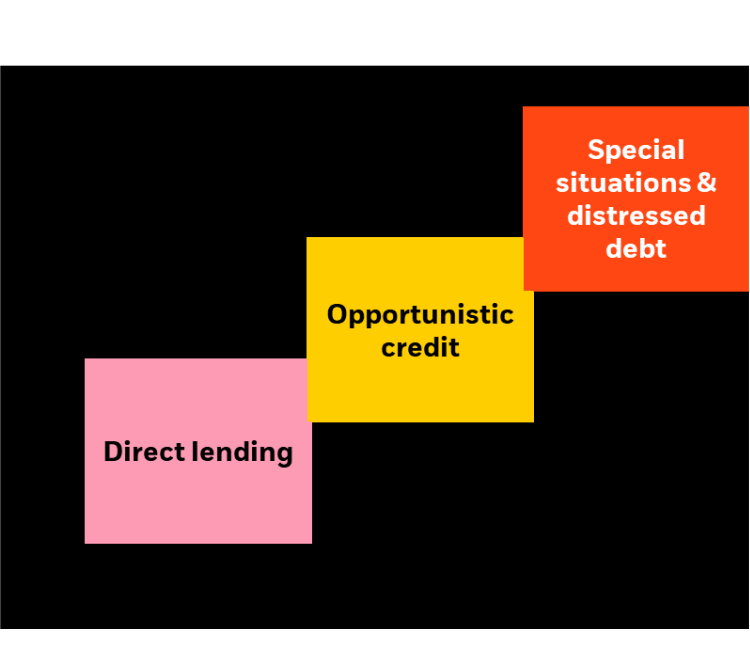
Private credit strategies cover a range of risk and return profiles and private credit funds can differ by strategy, the type of debt provided, and position in the capital structure. Capital structure refers to the way a company is financed based on the proportion and type of debt and equity on its balance sheet. This determines how, and in what order, capital is repaid in the event of bankruptcy. For example, senior debt is at the top of the capital structure and repaid first, making it lower risk, while junior or subordinated debt sit near the bottom of the capital structure just above equity, which is repaid last. Strategies with lower risk typically provide lower return than those with higher risk.
Three common private credit strategies are:
Direct lending. Provides senior debt financing, often in the form of secured loans, to “middle market” companies with enterprise values between $100 million and $2.5 billion. Returns are driven primarily by income. Historically, direct lending has been the most widely used strategy in the private credit space.
Opportunistic credit. Focuses on debt investments driven by corporate transformations or market disruption. Returns are typically higher than in direct lending but lower than in special situations and distressed investing.
Special situations and distressed debt. Targets companies facing unique circumstances, including businesses showing signs of stress or distress as well as healthy, growing businesses that face legal complexities, time-sensitive capital needs, or other factors that make conventional financing unavailable. These strategies may involve a broader range of instruments and risk profiles. Returns are typically driven by income, price appreciation or equity participation.
Exhibit 1: Private Credit strategies will vary in levels of risk and return profiles
Private debt investments are less liquid and more complex than traditional assets, which can create hurdles for individual investors. That said, illiquidity and complexity “premiums” (the compensation for these higher risks, in the form of higher return potential or attractive negotiated rates) can be a useful tool in portfolio construction to offset more traditional risk exposures.
Why invest in private credit?
Private credit can be a compelling alternative to traditional fixed income investing and has historically demonstrated lower risk compared to other alternative asset classes, such as private equity, given its higher position in the capital structure.
Potential benefits of private credit investing include:
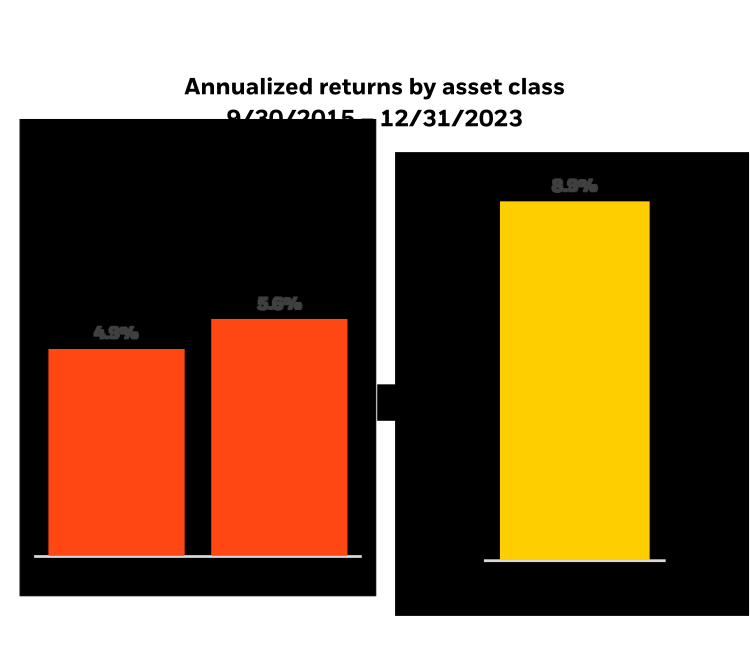
- Higher income and return potential. Historically, private credit has offered higher income and total return than traditional loans and high yield investments, as illustrated in the chart below.
- Diversification through an expanded opportunity set. With more companies staying private for longer and needing capital to support their growth, private credit can offer access to opportunities unavailable in public markets. Investing across public and private markets can offer portfolio diversification through exposure to differentiated income and return drivers.
- Structural protections. Fixed income investments often involve lender protections known as covenants; Private credit typically relies on more covenants than public fixed income, and covenants can be flexibly negotiated and renegotiated.
What are the risks of private credit investing?
Recently, investors have expanded access to private market investments primarily through non-traded registered funds, which offer relatively low investment minimums and straightforward reporting. This has allowed more investors to tap into private markets with investments that are easy to implement.
Private credit investments involve market, credit and operational risks. Private loans are typically less liquid than publicly traded bonds and may offer limited transparency given that they are not subject to public reporting and regulatory requirements. Because private credit investments are not actively traded, investors expect higher returns as compensation for reduced liquidity and increased complexity.
Private credit offers investors a differentiated way to access income and diversification by lending directly to companies outside of public markets, often with stronger structural protections than traditional credit. While these investments involve lower liquidity and greater complexity, investors have historically been compensated through higher yields and attractive risk‑adjusted returns. For those able to tolerate these trade‑offs, private credit can play a valuable role alongside traditional fixed income in a diversified portfolio.
Sign up for the private markets quarterly newsletter
Get timely updates on private markets with curated insights from BlackRock. By subscribing, you’ll receive market updates, product launches, thought leadership, and webinars designed to keep you informed.
Please try again

Explore more
Products
-
-
BY ASSET CLASS
-
LITERATURE

© 2026 BlackRock, Inc. All rights reserved.
MKTG0726-5767826-EXP0727