Skip to content

Welcome to the BlackRock site for Qualified Clients and Sophisticated Investors.
Before you proceed, please take a moment to review and accept the following Terms and Conditions.
The information and material on this website, including any offering document, is intended to be used for information purposes only. None of the information constitutes an offer to the public of securities or fund units under any applicable legislation (including but not limited to the Israeli Securities Law, 1968 and the Israeli Joint Investment Trust Law, 1994), or an offer to sell, or a solicitation or an offer to purchase, any financial instruments, including but not limited to the investment products.
The Qualified Client/Sophisticated Investor section of this website and its content is restricted to “Qualified Clients”/Sophisticated Investors” (as defined below) only and is not intended for retail or private investors who are not “Qualified Clients” or “Sophisticated Investors”.
For the purposes of these terms, references to a "Qualified Client" mean a qualified client pursuant to the First Schedule to the Israeli Regulation of Investment Advice, Investment Marketing and Investment Portfolio Management Law, 1995 (“the Investment Advice Law”), while reference to “Sophisticated Investors” mean a qualified investor pursuant to the Israeli Securities Law, 1968 (the "Securities Law”).
By clicking below, you confirm and consent to meet the definition of Qualified Client/Sophisticated Investor, to have the relevant knowledge and experience to receive the detailed information and documents about BlackRock and iShares products and to fall within one of the following categories:
Qualified Client:
- a joint investment trust fund or a Fund Manager
- a management company or a provident fund as defined in the Control of Provident Funds Law
- a licensed insurance company
- an underwriter qualified in accordance with Section 56 (c) of the Securities Law investing for its own account
- a licensed banking corporation and auxiliary body corporate, as defined by Israeli Banking (Licensing) Law 1981, other than a joint service company
- a licensee under the Investment Advice Law
- a member of the Tel Aviv Stock Exchange
- an entity which is wholly owned by an entity which falls within this list;
- an unlicensed corporation (other than an entity that incorporated in order to obtain services) whose equity capital exceeds NIS 50 million
- A corporation incorporated abroad, with characteristics of activity similar to those of a corporation named in this list
Sophisticated Investor:
- A mutual fund or a company that manages a fund
- a licensed provident fund
- a venture capital fund1
- a licensed management company that manages a provident fund
- a licensed insurance company
- A corporation with 50 million ILS equity
- an underwriter qualified in accordance with Section 56 (c) of the Securities Law investing for its own account
- a licensed banking corporation or auxiliary corporation as defined by Israeli Banking (Licensing) Law 1981 which intends to invest for its own account or for entities which fall within this list
- a licensed portfolio management company investing for its own account or for entities which fall within this list
- a licensed investment advising company or investment marketing company as defined in the Investment Advice Law investing for its own account
- a member of the Tel Aviv Stock Exchange investing for its own account or for entities which fall within this list
- an entity which is wholly owned by an entity which falls within this list;
In accessing the website as a Qualified Client or Sophisticated Investor you will be undertaking, warranting and representing to the BlackRock Group that you are a Qualified Client or Sophisticated Investor, as applicable. Please note that BlackRock will be acting in reliance upon your undertaking, warranty and representation.
As a matter of general policy, BlackRock will not conduct regulated investment activities with any person as a result of their receiving information from the website, unless agreed otherwise with a Qualified Client or Sophisticated Investor. Anyone who is not a Qualified Client or a Sophisticated Investor should not access the Website.
You understand and consent that due to your classification as a Sophisticated Investor, the protections granted to investors under the Securities Law will not be available for you. For example, you may be offered and sold investments that are not regulated or supervised by the ISA, that are not subject to any disclosure obligations (accordingly, there might be no available information with respect to thereto), and that are not permitted to be publicly offered in Israel) and consent thereto. Furthermore, you understand and consent that even if any information provided by BlackRock was considered "Investment Marketing" (without derogating from the fact that it should not be treated as such), BlackRock would not be required to comply with the following requirements of the Investment Advice Law, due to your classification as a Qualified Clients: (1) ensuring the compatibility of service to the needs of client; (2) engaging in a written agreement with the client, the content of which is as described in section 13 of the Investment Advice Law; (3) providing the client with appropriate disclosure regarding all matters that are material to a proposed transaction or to the advice given; (4) a prohibition on preferring certain Securities or other Financial Assets; (5) providing disclosure about "extraordinary risks" entailed in a transaction (and obtaining the client's approval of such transactions, if applicable); (6) a prohibition on making Portfolio Management fees conditional upon profits or number of transactions; (7) maintaining records of advisory/discretionary actions. Based on all of the above, you confirm that you are aware of the consequences of being classified as a Qualified Client and a Sophisticated Investor, including the consequences listed above, request and consent to be classified as a Qualified Client and a Sophisticated Investor.
By accessing this website, you consent to receive information on this website in English, unless you inform us otherwise.
Please note that the Privacy Policy includes important information on the use of cookies on our website, to which you agree by clicking above.
Legal Information
None of the material within this website is intended to be relied upon as a forecast, research or investment advice, and is not a recommendation, offer or solicitation to buy or sell any securities or financial product or to adopt any investment strategy. Any opinions expressed may change as subsequent conditions vary. The information and opinions contained in this material are derived from proprietary and non-proprietary sources deemed by BlackRock to be reliable, are not necessarily all-inclusive and are not guaranteed as to accuracy. Any investments named within this material may not necessarily be held in any accounts managed by BlackRock. Reliance upon information in this material is at the sole discretion of the reader. Past performance is no guarantee of future.
BlackRock Investment Management (UK) Limited is not licensed as, a portfolio manager, investment adviser or investment manager under the Investment Marketing and Investment Portfolio Management Law- 1995 (the "Advice Law") or any other applicable law, nor does it carry insurance as required thereunder. BlackRock Investment Management (UK) Limited is not, and will not be providing any investment advice, investment marketing or portfolio management services to the Investor. BlackRock and the Funds managed by BlackRock are not subject to the laws and supervision that apply to mutual funds in Israel.
BlackRock benefits from investments made by investors in Israel in the products mentioned in this website, as well as in other products managed by third parties with whom BlackRock is involved in a business contract. In particular, BlackRock manages the foreign funds mentioned in this website, and therefore benefits from investments of Israeli investors in them (inter alia, by charging a "management fee" as specified in the prospectus and in the Annex to the prospectuses of such funds). Therefore, BlackRock has a "Connection" to such products, a personal interest in their sale, and might prefer such products over other products. Accordingly, any advice BlackRock provides, is considered, for the purpose of the Investment Advice Law, as Investment Marketing (and not Investment Advising). The complete and updated information regarding the names of such asset managers to the products of which BlackRock has a "connection" (and the types of products issued by each one) is available upon request.
Accessibility statement
BlackRock is committed to making its websites accessible following the current Web Content Accessibility Guidelines (WCAG).. These improvements are part of our broader effort to meet legal and regulatory requirements and to ensure an inclusive digital experience for all users.
By accepting these terms and conditions, you consent to communicate with us in English unless you inform us otherwise.
1“Venture Capital Fund” means a corporation primarily engaged in investments in other corporations which are engaged, at the time of the investment, in research and development or in the production of innovative or high technology products or processes, and where the risk of such investment is typically higher than the risk involved in other investments.
BlackRock Investment Management (UK) Limited is not licensed as, a portfolio manager, investment adviser or investment manager under the Investment Marketing and Investment Portfolio Management Law- 1995 (the "Advice Law") or any other applicable law, nor does it carry insurance as required thereunder. BlackRock Investment Management (UK) Limited is not, and will not be providing any investment advice, investment marketing or portfolio management services to the Investor.
I/We confirm that each time I/We log onto to this website, that I/We are Qualified Investors as such term is defined under the Securities Law of 1968 and Qualified Clients under the Advice Law and understand that this website is designated solely for Qualified Investors that are also Qualified Clients, and will not be permitted to view or access the content thereof until I confirm my status as such. I am aware and consent to the implications of being designated as a Qualified Investor and a Qualified Client, including not being entitled to certain protection available under law. Should this status as a Qualified Investor and Qualified Client change, I/We will inform BlackRock Investment Management (UK) Limited which may have the impact of limiting or withdrawing access to the website.


Inside alternatives
Introduction to Private Markets
Hello, I’m Fabio Osta, BlackRock’s Head of Alternatives for EMEA Wealth.
Today Private Markets are playing an increasingly important role in the global economy. They are becoming a core component within the whole portfolio for more and more clients.
And this is happening at the same time as private markets themselves are evolving in three important ways
First, private markets are becoming more accessible.
New structures are making it easier than ever for private markets to be accessed by a wider range of investors.
Second, private markets are becoming more holistic.
This is fundamentally about blending public and private markets.
As private markets become easier to access, we expect them to become a standard component of client portfolios, not a niche allocation. Over time, we see the traditional 60/40 portfolios evolving toward something closer to 50/30/20.
Third, private markets are becoming more transparent.
Investors today have far greater visibility into general partners, underlying assets, and performance than ever before. And this matters—because transparency is critical for confidence, portfolio construction, and long-term decision making.
Hear from Fabio Osta, Head of Alternatives for EMEA Wealth, as he shares three things we’re thinking about to help wealth investors capture the opportunity in alternatives and private markets.
Key takeaways
Capital at risk. The value of investments and the income from them can fall as well as rise and are not guaranteed. Investors may not get back the amount originally invested.
- Private markets are an expanding segment of alternative investments that are becoming a core component of modern portfolios.
- These strategies offer differentiated return potential driven by illiquidity and complexity premiums but require a long-term investment horizon and careful manager selection.
- Structural shifts, including more companies staying private and reduced bank lending, are driving increased opportunity and growth in private markets.
What are private markets?
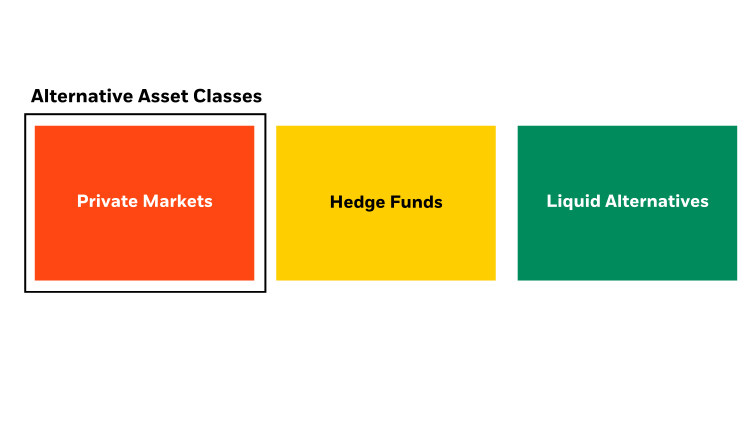
In the context of alternative investments, private markets are distinguished by the fact that they are not listed and traded on public exchanges. Once harder to access, the evolution of private markets may present a new set of opportunities for investment portfolios.
In recent years, product innovation has allowed more investors to allocate solutions ranging from private equity and private credit to real estate and infrastructure. Private markets are overall moving from a niche allocation used primarily by large institutions to becoming a core component of modern portfolio construction.
Core exposures to consider are:
- Private equity: Investments in private companies, including buyouts, growth equity and venture capital.
- Private credit: Direct lending and other non-bank lending strategies to private companies and an increasing number of public companies seeking alternative capital sources.
- Real estate (debt or equity): Strategies focused on the acquisition, management and/or disposal of real estate properties to generate returns.
- Infrastructure: Investment in the facilities, services, and physical systems considered essential to everyday life and economic productivity.
What are the key differentiators in private markets?
Private markets are not traded on a public exchange like stocks and bonds, although they can now be accessed through non-traded, registered fund vehicles. Private investments typically prioritize long-term value creation over quarterly results.
Private market investing happens over a longer time horizon. These assets are generally less liquid than those on public markets, meaning they take more time or are more difficult to sell; by contrast, publicly traded mutual funds are designed to provide daily liquidity. In return for this lower liquidity, investors have historically been able to expect higher returns – this is commonly referred to as “illiquidity premium.”
Another differentiator in private markets is complexity. Success in private markets depends on specialized skills and experience. The best managers know how to uncover unique opportunities and navigate complex investments to drive potential returns, which makes manager selection critical.
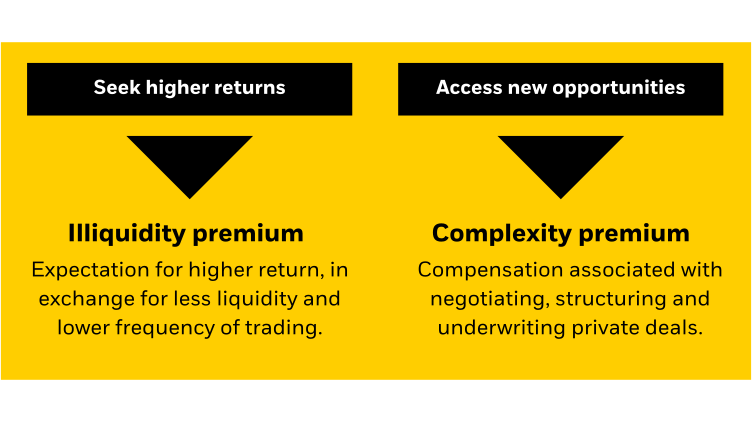
Why consider private markets?
- Expanded opportunity set
Private companies are a growing part of the economy, offering wealth creation opportunities as more companies stay private for longer. - Differentiated return potential
Private markets have historically delivered attractive risk-adjusted returns and differentiated investment opportunities. These return differentials are often attributed to illiquidity and complexity premiums. - New access points
Ten years ago, private markets were mostly only available to institutional and high-net-worth investors. Industry innovation and better data and transparency are making private markets more accessible to individual investors, whether through evergreen products or whole portfolio managed solutions and services that blend public and private markets investments in a single account.
Exhibit 1: Private markets may offer long-term return opportunity
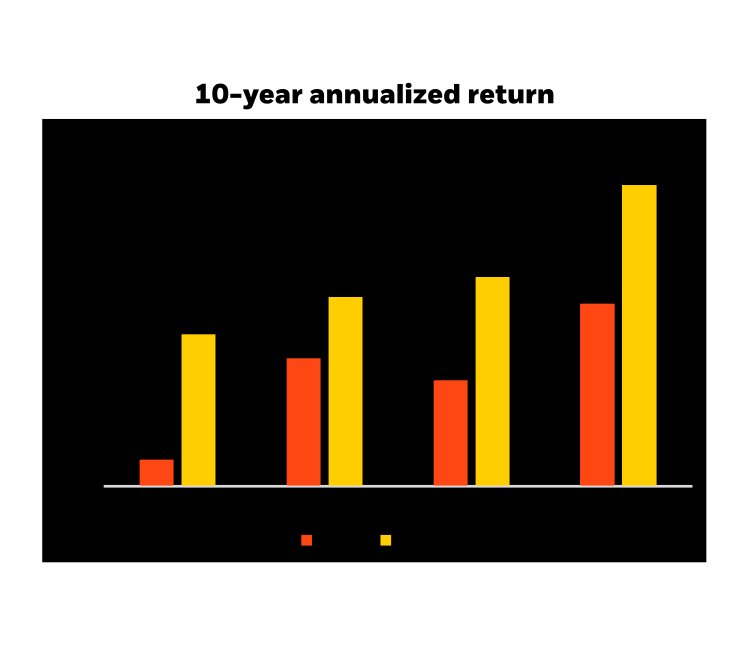
Source: Preqin Insights+, S&P CapIQ. Federal Reserve, MSCI. Data as of May 16, 2025. Note: Data for 10 year returns is based on rolling returns ending Q4 2024 with annualized geometric average. Public indices are total return. Index returns are for illustrative purposes only and do not represent actual fund performance. Index performance returns do not reflect any management fees, transaction costs or expenses. Indexes are unmanaged and one cannot invest directly in an index. Past performance is no guarantee of future performance.
Asset class proxies are the following: Public REIT: S&P Global REITs TR Index, Public Infra: S&P Global Infrastructure Index, U.S. high yield: ICE BofA US High Yield Index, Russell 2000: Russell 2000 Total Return index, S&P 500: S&P 500 Total Return Index. Real Estate, Private Debt, Infrastructure, and Private Equity are calculated through Preqin®’s proprietary benchmarking team and are not based on publicly available indexes.
What is driving growth in private markets?
Long-term trends continue to support the case for private markets.
Risk has become increasingly concentrated in public markets as large indexes are dominated by growth-oriented technology stocks. Among the number of total listed companies, the 20 largest names now represent greater than 30% of global stock market capitalization versus just under 14% in 2015. (See Exhibit 1) This coincides with a shrinking number of public stock issuance over the past decade as companies stay private longer.
Exhibit 2: Public stocks have become increasingly concentrated
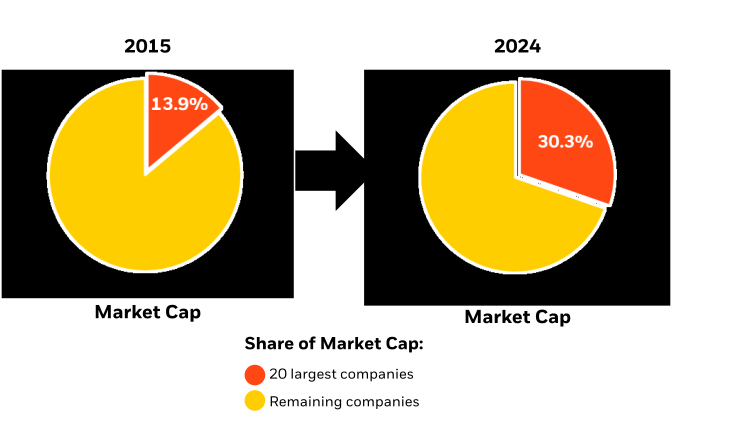
Source: Preqin Insights+, Aladdin, MSCI Data as of November 2025, Based in the Market Capitalization of the MSCI ACWI IMI. For illustrative purposes only. Asset allocation and diversification strategies do not guarantee a profit and may not protect against loss. Indexes are unmanaged and index performance is shown for illustrative purposes only. It is not possible to invest directly into an index.
Capital formation increasingly takes place in private markets – today, 81% of companies with revenues over $100m are private. With banks reducing lending and public markets shrinking, private capital has become essential to funding business investment, innovation and economic growth. As a result, investors are rethinking traditional exposures and exploring how private markets can expand their opportunity set.
Source: S&P Capital IQ, BlackRock. Represents the number of global companies with annual revenues greater than $100 million. Data are based on availability as of April 22, 2026.
Exhibit 3: A growing opportunity set
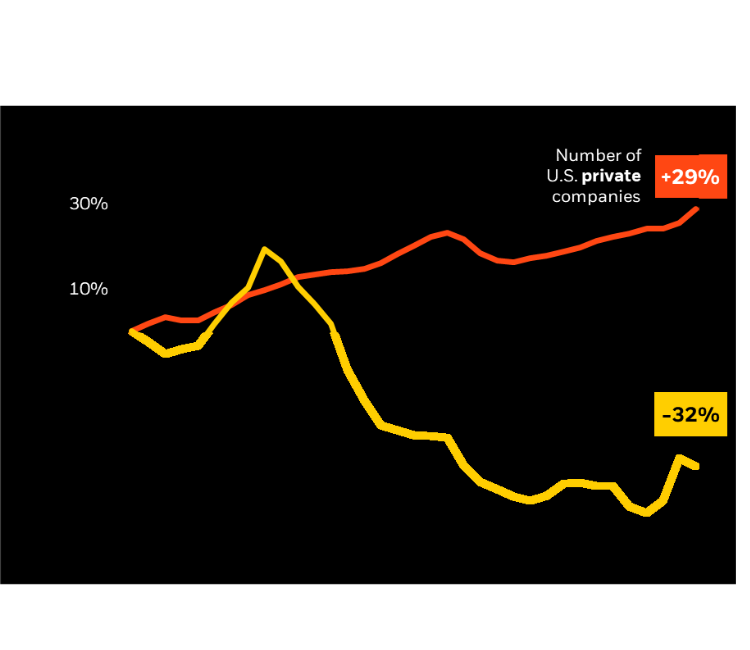
Source: U.S. Census Bureau - Center for Economic Studies - Business Dynamics Statistics (2022) and World Federation of Exchanges database; for more information on the World Federation, please refer to the Important Notes. Both sources, represents the latest data as of 2022 as derived on 2 April 2025. The graph denotes the growth or decline for both US public and private companies from 1988 until 2022. Past performance is no guarantee of future performance.
Exhibit 4: Banks retreating from credit markets has created private financing opportunities
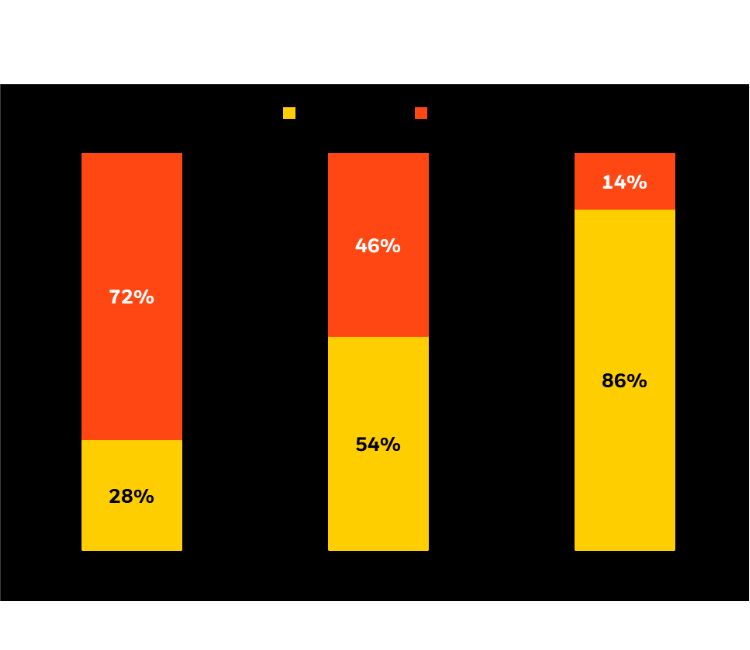
For illustrative purposes only. S&P LCD, Pitchbook LCD as of 3/31/24. Both displays as of latest reported data. Select dates are shown to illustrate a trend over 20+ years. Non-bank lenders refer to financial institutions without a full banking license and those which cannot accept public deposits. This includes venture capitalists, insurance companies, micro-loan firms, and currency exchange (Source: World Bank).
Exhibit 5: Traditional portfolios are evolving.
With private markets offering a potentially compelling risk/return profile, more investors may seek to allocate to private markets alongside traditional stocks and bonds.
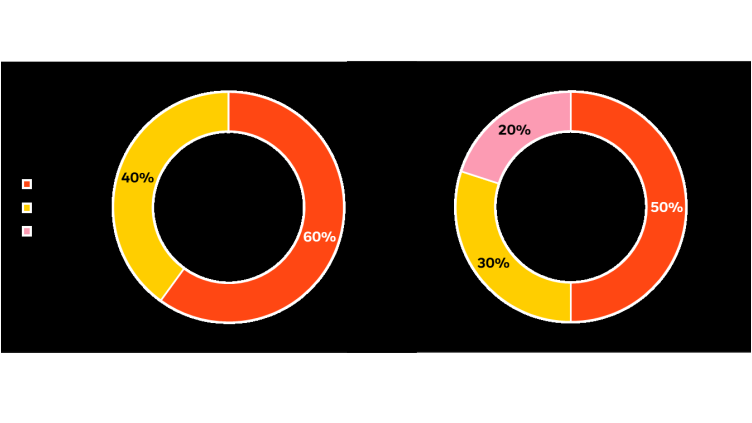
Source: BlackRock Alternative Portfolio Solutions. This information is not intended as a recommendation to invest in any particular asset class or strategy or as a promise – or even an estimate - of future performance. Historical example looks at a 60% MSCI ACWI, 38% Bloomberg Agg Bond Index, and 2% cash portfolio vs. a 51% MSCI ACWI, 22% Bloomberg Agg Bond Index, 2% cash, 9% Burgiss Private Equity Manager Universe (which includes 7.727 private equity funds, vintages 1978-2023, and time-weighted quarterly returns), 6% Cliffwater Direct Lending Index, and 10% “diversifying alternatives” sleeve made up of the Credit Suisse Equity Market Neutral, Credit Suisse Multi-Strategy, and Credit Suisse Global Macro Indexes.
How to access private markets
Recently, investors have expanded access to private market investments primarily through non-traded registered funds, which offer relatively low investment minimums and straightforward reporting. This has allowed more investors to tap into private markets with investments that are easy to implement.
Key considerations for private market investments:
- Manager selection
There can be dispersion in returns among private market strategies. To pick a manager you trust, consider industry expertise, a demonstrated track record, scale, fees and reporting transparency.
- Access points
Product innovation has allowed individual investors greater access to private markets. New registered fund structures offer more transparency and operational efficiency than their predecessors.
- Liquidity needs
While new structures may offer limited liquidity and shorter lock-ups than traditional funds, private market investments are designed to focus on a longer time horizon for value creation. Consider your spending needs and investment period when allocating to private markets.
Private markets are reshaping how investors think about portfolio construction. As access continues to improve, private equity, credit, infrastructure and real estate are playing a growing role alongside traditional stocks and bonds. With thoughtful implementation and a long-term perspective, private markets can help expand opportunity sets and lead to superior investment outcomes.
Sign up for the private markets quarterly newsletter
Get timely updates on private markets with curated insights from BlackRock. By subscribing, you’ll receive market updates, product launches, thought leadership, and webinars designed to keep you informed.
Please try again

Explore more
Products
-
-
BY ASSET CLASS
-
LITERATURE

© 2026 BlackRock, Inc. All rights reserved.
MKTG0726-5767787-EXP0727