Never Done by Aladdin®
Strategic innovation and market adaptation with Fisch AM
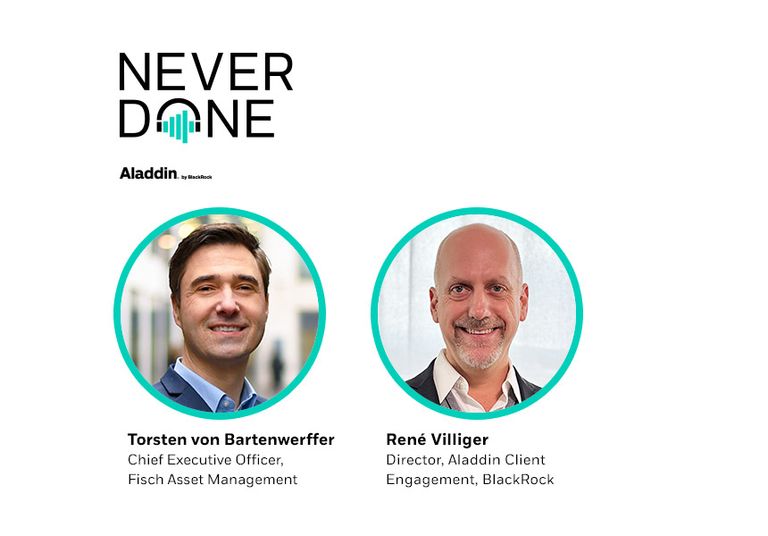
Torsten von Bartenwerffer, Chief Executive Officer, Fisch Asset Management, and René Villiger, Director, Aladdin Client Engagement, discuss the evolution of the asset management industry in Europe, Fisch’s strategic approach to growth consolidation and operational risk management, and the new exciting opportunities ahead of them.
Read the full transcript
[RENE VILLIGER]
How do you define innovation at Fisch Asset Management?
[TORSTEN VON BARTENWERFFER]
Well, we are talking about an industry that in part still uses fax, facsimiles, which I think were invented in the 19th century by a Scotsman.
[RENE VILLIGER]
Torsten, the recent environment has been quite challenging for asset managers in Europe. Having efficient processes and being able to keep pace with changes has never been more important. We have entered a high rates regime and seen a lot of volatility in the markets. How has Fisch navigated through this environment?
[TORSTEN VON BARTENWERFFER]
At Fisch Asset Management, navigation of regime changes, rates and corresponding market movements is something that we actually do embrace as active managers. And although it's not always fun, it sure makes our job more interesting and essentially helps us to create value for clients, which is why we exist. But you're right, it has been quite a ride when it comes to rates and market volatility.
So, if we look at the broader environment, fixed income is certainly an asset class as a whole that is making or has made a comeback. So, for us, interesting is not only the fact that there are interest rates again, but also the fiscal and monetary path forward that we anticipate will make things a lot more interesting than the past 30 years as a gargantuan amount of government debt, and hence tendencies for things like financial repression meet business cycles.
It also means inflation flares and also potential geopolitical risks. So, to us, this seems almost like an ideal environment to manage actively. During the last few years, European asset managers have had a challenging time, not only fixed income and convertibles. I think that generally since ‘21, the average cost income ratio in asset management has risen nine percentage points to 65, according to a McKinsey study.
Margins are obviously always a topic, but have specifically suffered during the no interest rates years and specifically in fixed income, and hence, to us, it's very important to optimize our structure and our business model to be as efficient as possible. And while we're seeking investment risk, the operational risks are something that we want to stay clear of. And as the CEO of this company, I very much see challenges also as an opportunity to improve with fixed income markets and specifically convertibles subdued, we went within the company through a growth consolidation cycle, which did not happen too often in the company's history, as we have always been quite spoiled and quite successful in the markets ever since. So, it was always growth, and the last 2 or 3 years have been a bit more of a grind. So not everybody likes that. But I think it's also healthy in a company lifecycle.
And actually our founders have been preparing us for that very well with a very comforting balance sheet and, of course, no debt. We did use the time to improve on a few things, processes and cutting a bit of fat here and there, but also to build up the qualifications in the teams and distribution capabilities.
[RENE VILLIGER]
Before becoming CEO of Fisch Asset Management, you have had other roles at the firm. How has the asset management industry evolved over the years, and what new perspectives does the position as a CEO bring to you?
[TORSTEN VON BARTENWERFFER]
Well, after university, I held multiple jobs, mostly portfolio management roles in different company sizes. For example, I started at a large Swiss bank and went towards a smaller outfit and more of a private banking one, a multi-family office, and then several product houses and asset managers. And I think seeing these different outfits, both in terms of processes that helped my career, probably on two angles.
Firstly, I was running money for almost all my career and actually in a lot of different asset classes in fixed income, multi-asset, also equities. And I think that equipped me with a certain technical understanding of what it takes to run portfolios well. Obviously, some of these things that also be learned the hard way as it happens in business cycles, but I think that's helped a great deal.
Also something I think that sets me apart from others, at least I'd like to believe that, is that I can appreciate both the fundamentals side of things and also the quantitative and systematic elements, which I think are just too often put into competition rather than appreciating them for the synergies that they offer. Even more valuable in my current job, moving from portfolio management to CEO, where I unfortunately do not run money anymore, which I think is a bit of a shame, is experience.
Experience is, of course a little bit of a fuzzy concept, so let's refer to it as behavioral pattern recognition, something that helps making better decisions and staying calm because you have generally already seen a few things. So I think that helps to see situations less hyperbolic and as they are portrayed and more what they actually are.
So I guess over time that leads to a few things. One of them I’d like to hope, enhanced decision making, so anticipating outcomes and ideally choosing a better or even the best course of action. It helps to improve your emotional intelligence. So you are familiar with some patterns. You gain experience and understand other people's actions and reactions, so that helps you for interpersonal relationships also.
And two other things are calmness under pressure. Specifically, as I said, you have seen a few things already and it also creates some humbleness in terms of continuous learning because each experience, good or bad, is adding to your repertoire of patterns that you can recognize at a later point. So I think this is even more important as the pressures in the financial industry tend to stay the same over time.
In the asset management world, companies like us, like Fisch Asset Management, are constantly something that I like to call the RAMP. R.A.M.P, where R stands for Regulation, A for Adaptation to markets and trends. And M, unfortunately, for diminishing Margins. But still the P for endeavor to providing an attractive Performance to our clients. This RAMP concept does imply a few things.
One of them is that only the relevant players can survive, so relevant can mean relevancy in terms of size or filling niches, where the latter is very much what we do as an asset management boutique. No matter what you choose, though, in terms of professionalism, I think you have to be up there with the leading companies as investors provide a very thin margin of error.
That's also why we like to partner with you, and I actually think that is a good thing. I have had a job in Operation Due Diligence in the past, at the beginning of my career. Operational risk is the one you don't get paid for, so risk means less things can happen than actually do happen. But you have to manage those still with a great level and attention to detail because otherwise details hit you only given enough time.
[RENE VILLIGER]
You mentioned Fisch going through a difficult period and consolidation, coming out of a diet. Can you share your vision for the company's growth over the next five years, and what steps are you taking to achieve it?
[TORSTEN VON BARTENWERFFER]
Certainly, like I just mentioned, I think it's eventually all about relevance. So specifically for a smaller player like us just being cute and Swiss and “Heidi” doesn't really cut it. So what's relevant for us is portfolio management proximity, customization, and of course, at the end of the day, performance is all that matters. So relevance, I think, has a push and pull component.
And as always, the sweet spot is where the market kind of clears between client demand with regards to a boutique and a corporate offering that we can deliver. So I'd like to interpret that like the three things that I just mentioned. So, client proximity, you can’t just call the PM or the CEO normally in one of the larger players. And much more than the bigger players, we can provide customized solutions that do matter to our clients rather than competing on price alone. I think that's what the boutique asset management model is essentially.
And thirdly, people invest with us, of course as I mentioned, for performance. So a long-term performance which includes up and down markets and with our tilt to convexity and quality, for example on the CB side, down markets are in fact a source of alpha for us.
So, this is about what I want to achieve. For that, I think we need to build on strength. As a boutique, we can only do so many things. So I think with our product focus and corporate bonds of all sorts, convertibles and multi-assets, we have found our focus, really. It's about portfolio management and client focus. We have been at 13 billion assets under management with the asset classes that we have run.
Currently, we are about half of that. And getting back to the level that we were would be the primary goal for now. So we think about reshuffling plans, if at all, only afterwards. So it's first of all, it's finding back to old strength. We have always liked to work with strong partners, be it you or maybe a collaboration with someone who has the funds but is looking for expertise, say in fixed income or CBs or portfolio management in general, which is what we have.
The steps are to hold the quality of people high, to keep being in touch with clients and markets, and actively work with our partners to go beyond what we could achieve only by ourselves.
[RENE VILLIGER]
In these plans, how do you think about the role that technology fundamentally plays within your investment process, and does it enable your teams to take advantage of market opportunities?
[TORSTEN VON BARTENWERFFER]
I believe that technology plays a role on multiple layers. First of all, technology that keeps you alive and you only know it when it does not work. Second layer would be technology that lets you do your work efficiently, and the third layer would be technology that makes you excel in what you do.
For the first thing, technology that keeps you alive, that would be portfolio management and backup systems. You need ideally 100% uptime and redundancy. Therefore, we move to the cloud.
Secondly, for the technology that lets you do your work, I think it's information systems like data and research provider, Excel, and sort of all the day-to-day tools that you actually use to be able to do what you do.
And thirdly, the technology that makes you excel, that's very specific tools that support our main two pillars. That means it has to feed into the USBs of our company in case of performance, client proximity and customization. So for PM, it would be tools that make us gain an edge on the market, like specific screeners that encompass very specific knowledge that not everybody has, things like that. And on the client proximity side, it's reporting and presentation towards the outside world.
So we have, for example, customized an LLM that generates curated queries that put together customized client reportings and presentations much better than a human can do. So it's not actually AI creating these presentations, but we use it to run queries against a database. So that has the effect that we instantly have a quality control over what comes out on the other side.
So having said so, of course all these technologies are essentially worthless without the processes to run them. And of course the people who run them are also very important. So technologies help us, they are a tool, but people and processes are equally important.
[RENE VILLIGER]
And the data supporting...
[TORSTEN VON BARTENWERFFER]
Of course.
[RENE VILLIGER]
Kind of along that train of thought, so what has been the biggest impact of streamlining your workflows? How has technology helped you reduce operational risk? The risk that you don't get paid for.
[TORSTEN VON BARTENWERFFER]
Exactly. Yeah, that's unfortunately the case. So you don't get paid for this risk neither as an investor nor as a company having it. So risk always means more things could happen that actually do happen. But by the same token, they probably hit you when you're able to cope with it the least. So in short, we don't want them. Hence, it's important that such risk can be identified and addressed quickly.
Take for example, investment compliance. In 2019, I think it was, we changed our investment compliance monitoring tool and restructured our processes and essentially the whole investment compliance concept. So pre-trade checks are now automatically conducted at several points along the investment process. We organized rules for that in different categories, and this enabled us to substantially reduce the daily monitoring effort and also helps us prioritizing whenever we get violation notifications.
We now have less alerts in general, although the transaction volumes have almost doubled. So we were counting about 18,000 violations with approximately 60,000 trades in ‘19, and we now only count about 10,000 violations with about 100,000 trades for ’23. So that's quite an improvement. Also, we can detect real issues much faster. Our monitoring efforts were reduced from approximately two hours to around 15 minutes today.
I think that's quite dramatic in terms of step forward. As I said before, technology is only as useful as the people you have to do it and know how to use it. For example, I would not know how to operate a spaceship, so it would be pretty useless to me. But luckily I think we have very good people specifically on the risk management, and also on the data side, that collaborate with you very well, so we really happy about the outcome and the progress that we made in recent years.
[RENE VILLIGER]
With the rise in emerging technologies like AI, and you mentioned having implemented them, LLM at Fisch, how do you define innovation at Fisch Asset Management?
[TORSTEN VON BARTENWERFFER]
Well, we are talking about an industry that, in past, that uses fax, facsimiles, which I think were invented in the 19th century by a Scotsman. So generally, while anybody obviously wants to be sexy in that regard, AI is obviously something that's super topical. So at Fisch we tried to be realistic about it. Of course, we don't use fax anymore, and we're not going currently overboard with AI, but we certainly try to make good use of it.
Innovation in the context of emerging technologies like AI, for us, it's about harnessing tools to enhance our core strength rather than just adopting a technology for its own sake. So I would define innovation as a strategic application of advanced technologies to improve our ability to make informed decisions and deliver superior value at the end to our clients. So for our organization, innovation in terms of AI means integrating it to support and augment our expertise without losing sight of what we do best.
It allows us to be opportunistic, take advantage of new possibilities, while also ensuring we do not become a university. So we try to remain focused on our core competencies and using AI as a tool to enhance decision making processes. Ultimately, innovation is about staying true to our mission while embracing new technologies that help us execute it more effectively.
It's not about being at the forefront of technology change, really for us, but we are, of course, thoughtful about integrating changes that help us to drive our sustainable growth and success. Interestingly, I think this fits our Swiss DNA. The Swiss neither invented banking or finance, nor pharmaceutical, chemical industry, or even mechanical watchmaking, but they were still striving to fine-tune processes for efficiency and regulatory compliance, giving them an edge in innovation off the basis of engineering. And I think that's the approach we want to follow. Also, on the technological side.
[RENE VILLIGER]
With everything we talked about, what gets you most excited about the next 2 to 3 years?
[TORSTEN VON BARTENWERFFER]
Well, as CEO of Fisch Asset Management, I'm particularly excited about a few aspects of our business. For the markets generally, I think there is a fixed income renaissance, the return of meaningful interest rates after a long period of near-zero or even negative yields presents to us some exciting opportunities in the fixed income space. This new environment also allows us to leverage our expertise in corporate bonds, convertibles and emerging markets to generate attractive returns to our clients.
The evolving market conditions, including rate volatility and the upcoming need potentially for elements like financial repressions to manage government debts, create a very dynamic environment where I think our expertise in convertibles and corporate bonds makes a lot of difference. And also, what seems to be certain at this point in time is that probably the next few years will be a bit more dynamic than the last few years.
So I think that the anticipated fiscal and monetary landscape, with the geopolitical risks that we think we could be facing, creates this ideal environment for active management. And in terms of growth and recovery, I think that after a period of consolidation, we are looking forward to return to our growth trajectory. As I mentioned earlier, our goal is to regain and surpass our previous asset under management of around 13 billion, which would be a significant milestone for us.
And last but not least, I think it always stays a people's game in terms of teams development. We have invested in our team and our processes during this consolidation periods, and we are obviously eager to see these improvements bear fruit. So the enhanced skills and efficiencies we've developed should position us quite well for the opportunities ahead. Overall, I'm most excited about showcasing how our boutique business model with its focus on performance, client proximity and customization, is quite well-suited to navigate and capitalize on the market environment that we expect going forward.