TIPO DE PRODUTO
IDEIAS DESTACADAS
PERSPETIVAS
Não é um investidor privado? Para conteúdos mais relevantes, por favor actualize o seu tipo de usuário.
Hi, I’m Rafael Iborra, BlackRock’s Head of Model Portfolio Solutions, International.
Portfolio construction is about making clear choices - balancing risk and return over time, with each part of the portfolio playing a defined role. Here are three things to consider as private markets become a more important part of that conversation.
First, private markets introduce differentiated return drivers.
Unlike public equities and bonds, returns are shaped by long term capital, active ownership, and less liquid assets. This leads to different performance patterns and greater dispersion - creating opportunities that behave differently across market cycles.
Second, they expand the opportunity set beyond public markets.
Private investments provide access to companies, sectors, and value creation levers that aren’t available in public markets, giving investors new ways to pursue growth, income, and diversification.
Third, when integrated thoughtfully, private markets can strengthen portfolio outcomes.
Alongside public markets, they can improve diversification, support more stable outcomes over time, and help align portfolios with long term objectives – in turn contributing to more resilient portfolios and enhanced return potential.
Hear from Rafael Iborra, BlackRock’s Head of Model Portfolio Solutions, as he shares three key themes on thoughtfully incorporating alternatives into portfolios.
Capital at risk. The value of investments and the income from them can fall as well as rise and are not guaranteed. Investors may not get back the amount originally invested.
Traditional diversified portfolios are typically anchored to broad public benchmarks – known as indexes – which track the performance of a large group of public securities. While public indexes are transparent, there are limitations from a portfolio construction perspective:
This means a traditional 60% equity/40% bond (60/40) portfolio can be structurally overexposed to two primary return drivers: equity beta and bond duration. In simple terms, this means the portfolio’s performance is largely driven by stock market movements and interest rate changes, with limited diversification beyond these risks.
However, a wider range of investors are gaining access to a broader range of asset classes, and this translates to greater opportunity to potentially enhance portfolio outcomes by targeting new sources of risk and return.
Private markets - investing in securities, assets, and opportunities that aren't available on the public market/stock exchange - are becoming critical exposures for those looking to access a broader set of portfolio building blocks, particularly as the proportion of opportunities shift from public to private markets.
While the number of public companies has been shrinking in recent decades, the number of private companies is on the rise. In the U.S., the number of large private companies (those with 100+ employees) has grown by 46% over the past 30 years, while the number of public companies has fallen by 24%.1 The trend is not isolated to the U.S., as research shows the number of listed companies has declined across many developed economies.
Companies are also increasingly seeking private funding, with just 25% of the leveraged loan market funded by banks in 2024 compared to 72% 30 years earlier.2
Taken together, this illustrates that modern capital formation extends beyond public exchanges, creating a larger role for private markets and allowing portfolios to participate more fully in an evolving and expanding investment landscape.
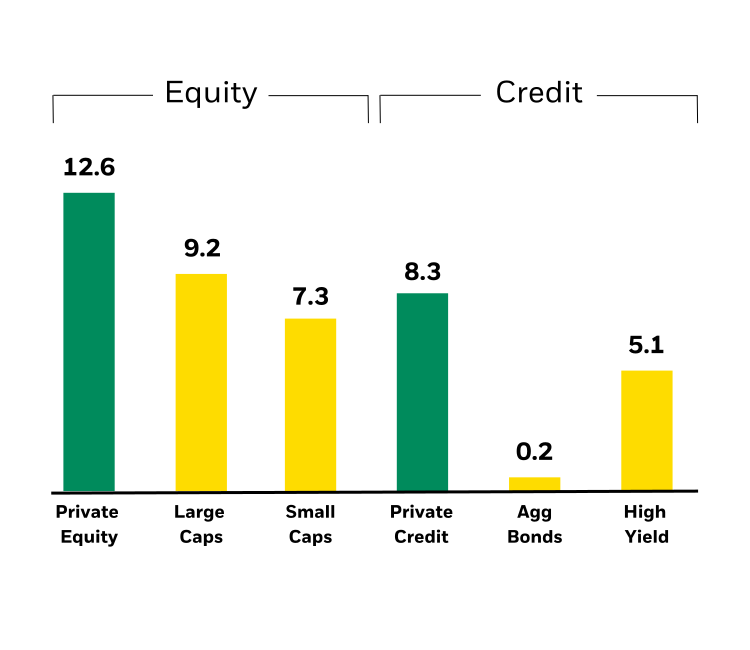
Private equity and private credit are two of the most common private market exposures. Both have delivered higher returns than traditional asset classes over the past decade.
An opportunity for enhanced returns: Ten-year average annual returns as of year-end 2024
Source: Bloomberg, MPI, measuring returns from 12/31/14 through 12/31/24. “Private Equity” represented by the Preqin Private Equity Index as of 9/30/24. “Large Caps” represented by the MSCI ACWI NR Index, “Small Caps” represented by the MSCI ACWI Small Cap NR. “Private Credit” refers to the Preqin Private Debt Index, “Agg Bonds” refers to the Bloomberg Global Aggregate TR Index, and “High Yield” refers to the ICE BofA US High Yield TR Index. Past performance does not guarantee or indicate future results. Index performance is shown for illustrative purposes only. It is not possible to invest directly in an index.
Real estate and infrastructure are two other popular private asset classes. Their role in portfolios is often to provide a mix of potential capital appreciation and income, as well as an inflation hedge given that they are real assets with tangible economic value.
Returns in private markets are driven by different structural factors than public markets, which can make them compelling complements in a diversified portfolio:
The “optimal” allocation to private markets will depend on the individual investor’s goals and risk tolerance. For example, if an investor was nearing retirement age, they may wish to take less risk, and allocate less to private markets than a more risk-prone investor who is seeking higher returns.
While the decision can be decidedly individual, today’s market landscape does challenge the continued applicability of a traditional 60/40 portfolio. It may mean that the definition of ‘diversification’ needs to evolve along with the investing backdrop.
A 50/30/20 framework provides one way to reflect today’s broader opportunity set:
Effectively, this model suggests that equity exposure is moderated from 60% to 50% and fixed income is reduced from 40% to 30%, opening a 20% opportunity to add other diversified return drivers.
This new allocation will have a meaningful impact on a portfolio’s risk/return profile. Many of our BlackRock professionals suggest a like-for-like funding strategy wherever possible: meaning equity-like alternatives investments are funded out of existing equity-like assets in the portfolio, and the same applies to new bond-like investments.
Funding higher-risk allocations from lower risk bond sleeves can increase overall portfolio risk, while sourcing lower-risk allocations from higher risk stock sleeves could decrease risk and potentially also impact expected returns.
Modern capital markets extend well beyond traditional public equity bond benchmarks. Private markets offer access to unique opportunities that can complement positions in traditional assets.
According to a recent BlackRock survey, wealth professionals expect allocations to private markets to increase significantly by 2030, with over 70% of wealth investors projected to allocate between 5–20% of their portfolios. This compares with today, where around two‑thirds of wealth investors are believed to allocate just 0–5% to private markets.3
Whether working toward a 20% allocation or another level better suited to client needs, we offer a four-step framework for thinking about and incorporating a private markets strategy:

1. Source: U.S. Census Bureau – Statistics of U.S. Businesses, The World Bank World Federation of Exchange Databases as of December 2023. Represents the latest data available.
2. Source: S&P LCD, Pitchbook LCD as of March 31, 2024.
3. The survey was conducted at BlackRock’s Private Markets Wealth Summit in London on 27 March 2025, with 70 wealth professionals from 17 countries across.
Europe and the Middle East. “Wealth investors” here are respondents’ clients. There is no guarantee that any forecasts made will come to pass. For illustrative purposes only.
MKTG0526-5503901-EXP0527