LifePath Dynamic (LPD) is BlackRock’s actively managed target date strategy, designed to improve retirement outcomes through dynamic portfolio positioning. Built on LifePath Index’s time-tested glidepath, it adds a steering wheel to actively navigate markets. This update breaks down performance, positioning, and what’s ahead.
A quarter closer to retirement: LifePath® Dynamic

LifePath® Dynamic Q3 performance takeaways
What drove LifePath Dynamic performance in Q3?
Both active asset allocation and underlying strategies drove strong Q3 results, with contributions from equity, currency and fixed income positioning.
How did we adjust portfolio positioning this quarter?
We trimmed our underweight to long-term U.S. Treasuries as yields rose and maintained a diversified approach across equities, fixed income, and currencies.
How are we navigating the next turn on the glidepath?
We're increasing diversification, taking a selective approach to bonds, and positioning for long-term trends in a higher-inflation, more uncertain market environment.
About LifePath Dynamic
LPD combines two powerful levers often treated separately: long-term lifecycle design and active market positioning. Our glidepath is built on enduring structural forces—like demographics, income needs, and longevity—while our portfolios dynamically adjust to changing market conditions. Together, this approach helps enable participants to take the right risk, at the right time, across a lifetime.
Our approach is deliberately selective. Rather than layering multiple overlapping strategies, we build portfolios from a flexible set of high-conviction, complementary strategies—each designed to deliver a distinct source of return. The result: more precise risk-taking, clearly measurable sources of alpha, and a portfolio built to perform across market environments. This stands in contrast to traditional fund-of-funds approaches, which can dilute conviction and lead to index-like outcomes at active fees.
What drove active returns last quarter? Let’s break down the key themes, positioning decisions, and trades that shaped performance in Q3.
_______________________________________________________________________________________________
What drove LifePath Dynamic performance in Q3?
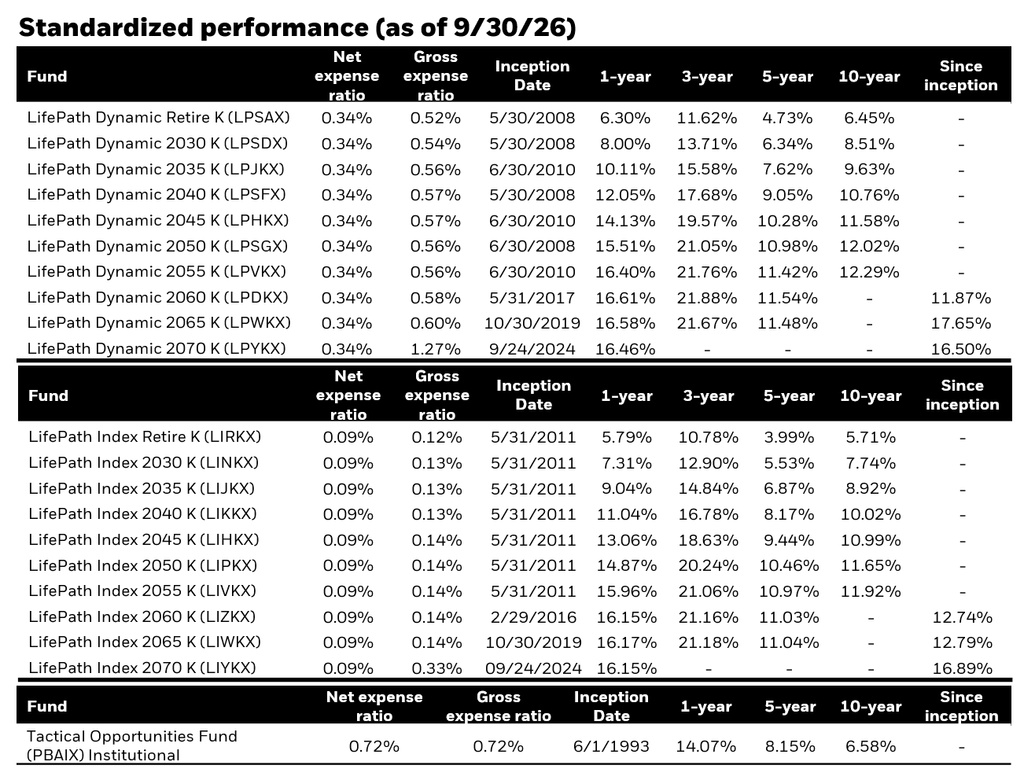
LPD enters Q4 with strong momentum, outperforming its baseline peer — LifePath Index (LPI) — across all vintages year-to-date. This builds on a consistent track record of excess returns, with LPD delivering an average of 77 basis points and 66 basis points of net-of-fee outperformance across vintages over 3- and 5-year periods, respectively1.
Contributors
Portfolio sleeves: Performance was positive overall. Tactical Opportunities (macro sleeve) was the strongest contributor, with Diversified Equity (domestic equity sleeve) slightly up, capturing opportunities across global and local markets. Diversified Fixed Income (domestic fixed income sleeve) was also added over the period.
Asset allocation: Equity positioning was a strong driver of performance, driven in large by our underweight to tech in the cross section as tech came under pressure early in the period. Currency positioning also added to performance, with our underweight US vs ROW and underweight US vs. YEN, AUD, and CAD benefitting from the dollar weakening over the period. Performance from fixed income positioning also added over the quarter, as our underweight to the 30-year part of the US Treasury curve benefited from higher long-end yields, partially offset by a modest overweight at the 10-year point.
Detractors
There were no notable detractors over the period.
A strong Q3 for LPD
Source:
Source: BlackRock, as of 9/30/2026. Performance is net of fee for the mutual fund K share. Returns shown for periods greater than one year are annualized. Past performance does not guarantee future results. Active performance is the difference in the standardized performance of LifePath Dynamic vintages and LifePath Index vintages. *Data calculated with a since mandate transition date of 12/01/2016. This is the first day of the month following the investment strategy change for LPD which occurred on 11/7/2016.
How did we adjust portfolio positioning this quarter?
Portfolio adjustments this quarter focused primarily on fixed income. As long-end yields moved higher and bond prices fell, our underweight to the long end of the yield curve benefited. We used that move as an opportunity to trim the underweight and lock in gains, while maintaining an overall cautious stance on duration. Across the rest of the portfolio, we stayed disciplined as markets balanced resilient U.S. growth, AI-led capex, persistent energy and services inflation risks, and a more complex global policy backdrop.
Equities: We continue to favor relative value exposures tilting away from the U.S. and towards international equities, specifically in Asia. Equity leadership remained narrow and heavily driven by large AI-related names, while resilient U.S. growth and AI capex supported parts of the market. The team continued to monitor whether growth was broadening beyond a concentrated set of sectors and whether global demand (particularly from China) would support non-U.S. cyclicals.
Fixed income: We continued to manage duration selectively. In August, with long-end U.S. yields near the top of the post-GFC range and 30-year real yields elevated, we further trimmed the portfolio’s underweight to the long end of the U.S. curve, taking a small amount of profit ahead of key policy and market events. Late in the quarter, we trimmed that underweight again as pricing continued to move in our favor, viewing current levels as another opportunity to lock in gains.
Currencies: FX remained an important part of the market backdrop, with cross-border carry flows, Japan intervention dynamics, dollar strength, and hedging costs all influencing broader market pricing. We’re keeping a close eye on these dynamics, as funding and FX volatility can amplify moves across rates and risk assets.
Quick take: Q3 positioning changes were concentrated in fixed income. We further trimmed the underweight to the long end of the U.S. yield curve as yields and real yields moved higher, taking profits while maintaining a selective approach to duration. Across equities and currencies, the focus remained on diversification as markets navigated narrow AI-led leadership, energy-driven inflation risk, policy uncertainty, and pressure on long-end rates from heavy Treasury issuance and weaker demand for long-duration bonds.

How are we navigating the next turn on the glidepath?
We’re moving away from a long period of low inflation and easy growth into a more uncertain environment, where inflation may stay higher and global dynamics are changing. Recent events aren’t the cause of this change—they’re accelerating a transition already in motion.
So what are we doing in LifePath Dynamic?
Staying diversified for a wider range of outcomes: Leveraging a broader toolkit—including inflation-sensitive exposures like commodity-linked currencies—to help navigate a market where inflation, geopolitics, and policy uncertainty remain key risks.
Taking a more selective stance on bonds: With inflation risks still present and long-end yields elevated, we are selective in how we position across rates. During the quarter, we trimmed our underweight to the long end of the U.S. curve as pricing moved in our favor, while continuing to monitor term premia, Treasury issuance, Fed balance-sheet policy, and liquidity conditions.
Positioning for structural global shifts: Including evolving growth dynamics tied to AI-driven capex, uneven regional growth, and changing global capital flows. The team continues to see AI capex as an important growth impulse, but one that remains concentrated across data centers, semiconductors, and related sectors rather than evenly distributed across the economy.
Staying alert to inflation and policy risks: The inflation backdrop has become more nuanced, with some signs of disinflation but continued stickiness in services and renewed pressure from energy and refined products. At the same time, central-bank communication, balance-sheet policy, and global policy divergence remain important drivers of market pricing.
Quick take: As markets remain in a higher-inflation, more uncertain regime, we’re positioning portfolios with broader diversification, selective bond exposure, and a focus on long-term global trends – while staying diversified across regions and asset classes as AI-led growth, energy inflation, policy divergence, and liquidity risks continue to shape the market backdrop.
Key asset class performance Q3 2026
Markets delivered mixed results in Q3, with top U.S. stocks and Tactical Opportunities leading gains while real estate, infrastructure, and small-cap equities lagged, highlighting the value of diversification.
Source:
Morningstar Direct as of 9/30/2026. Indices: Listed infrastructure represented by S&P Global Infrastructure Index, U.S REITs represented by FTSE Nareit All Equity REITs TR, small-cap U.S. equity represented by Russell 2000 Index, core bonds represented by Bloomberg US Agg Bond Index, international equity represented by MSCI ACWI Ex USA Index, large-cap U.S. equity represented by Russell 1000 Index, and top 20 U.S. stocks represented by S&P 500 Top 20 Select Index. Index performance is for illustrative purposes only. Index performance does not reflect any management fees or expenses. Indexes are unmanaged and one cannot invest directly in an index. Past performance does not guarantee future results.

Reflections from the Path – LifePath Quarterly Webcast
Join retirement experts for Inside Retirement: Reflections from the Path as they review LifePath’s Q3 2026 performance, share market positioning insights, and highlight the latest research shaping retirement investing and outcomes.
Markets will shift. Retirement goals do not.
Staying invested through cycles is essential to long-term outcomes. This quarter reinforced the value of combining a long-term glidepath with active portfolio management — using a broader toolkit, trimming risk where appropriate, and staying focused on resilience through volatile market conditions.
For retirement investors, success is not about reacting to every headline. It is about staying invested in portfolios built to adapt — with diversified sources of return, thoughtful risk management, and a clear focus on helping participants reach their long-term goals.
FAQs
LifePath products
LifePath® Dynamic
LifePath® Dynamic Funds are designed to generate consistent excess returns by combining lifecycle expertise with a differentiated active management approach.
Retirement income
This next generation of TDF solutions includes an option to purchase a lifetime income stream from insurers that can provide participants with retirement income for life.
LifePath® Index
Our flagship solution offers strategic asset allocation and access to our research IP at a low cost.
Contact our dedicated retirement team
What topics are top of mind for you?
'Inside retirement' is BlackRock's hub for timely retirement insights, research and thought leadership - designed for financial professionals all in one place.