Never Done by Aladdin®
The journey to democratize private markets
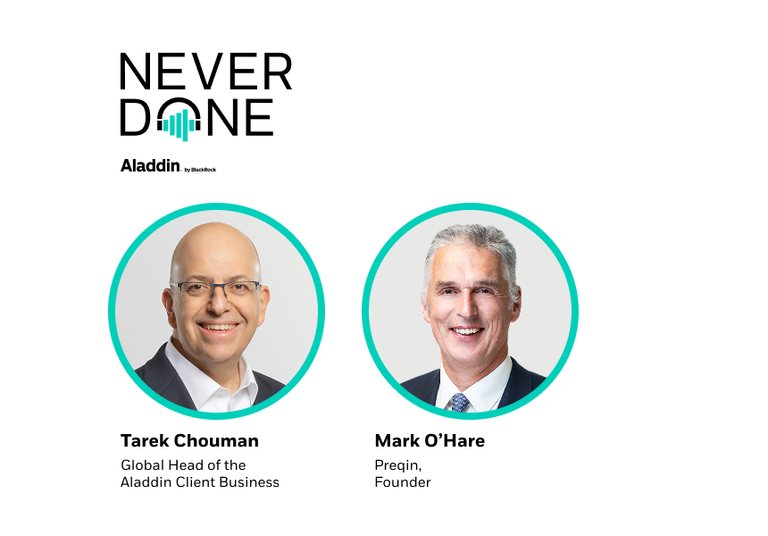
Tarek Chouman, Global Head of the Aladdin Client Business, and Mark O’Hare, Preqin, Founder, share their journeys in private markets—with eFront and Preqin respectively—and discuss how innovation in data and technology is driving democratization and a whole portfolio approach.
Read the full transcript
[TAREK CHOUMAN]
You have a plethora of assets that can be lodged in a private markets portfolio. It can be paintings. It can be horses. Anecdotally, in the Middle East...
[MARK O’HARE]
Tarek, I own a horse and believe me it's not a good investment.
[TAREK CHOUMAN]
And I vividly remember we had, at one point back in the days, to configure eFront to support camels for high-net-worth individual in Saudi.
[MEERA JESSA]
Mark and Tarek, I am so excited for this conversation. When I was reflecting on what we would talk about today, I was thinking about the private markets and how it's largely opaque and underexplored, especially if you think about where it was 20 years ago. And as someone who's been in the financial markets for over 20 years and been very focused in the public markets, I humble myself and say it's quite opaque, even for me, as someone who sits in this seat and I suspect is a mystery to many, even those who are in the financial markets. You both are pioneers in this space and I'm excited to come out of this conversation and learn a lot more.
But I would really love to dive into your experience. Mark, you founded Preqin, which is a leading private markets data provider. Tarek, you were the CEO of eFront and we really want to dig into this conversation. So, Mark, I'll start with you. When you were sort of thinking about starting Preqin, what were the original sort of sparks that made you think about even going down this avenue?
[MARK O’HARE]
Absolutely. Financial data is incredibly important. You mentioned that private markets and it was mostly private equity in those days, venture capital and private equity are opaque. And in one sense, they really are. And I think Walter Wriston, the chairman of Citicorp, said back in 1976 that information about money is as valuable as money itself. Now, if somebody said that in 2025, you'd say, yeah, right, we know that. We know that, that's a given. But back in 1976, that was really, really quite an insightful thing to say. And having previously been an entrepreneur in financial data with another business, I realized that there was in fact, a big opportunity in data on the private markets. And sure enough, there was. What I didn't realize, at that time was back in 2002, private markets were something like 4 or 500 billion of dollars of AUM worldwide. Today, it's $13 trillion.
That means, from Preqin’s selfish perspective, what a fantastic market to be involved with to those tailwinds of growth. But the really important thing, to your point earlier, is given that private markets have gone from a small and optional thing to have in your portfolio, they are now such a big part of the total investable universe and a growing part of the total investable universe. As an investor, you kind of have to be in there, because if you're not in there, you're simply missing out on large parts of the investable universe. So, you're not at the efficient frontier.
[MEERA JESSA]
That totally makes a lot of sense. And when you think about the investable universe and the investment lifecycle, a lot of that, Tarek, in thinking back to your days of eFront and bringing together the investment lifecycle and what eFront does today. When you think about your early days and how you got started in this, why did you pick this industry?
[TAREK CHOUMAN]
By accident.
[MEERA JESSA]
Please tell us more about that.
[TAREK CHOUMAN]Really by accident, because the founder of eFront, Olivier Dellenbach, was more in technology. And when I joined, we always have believed in the power of technology and how technology can make the world better. But we did not, at the time when eFront started, we did not know where technology could generate enough value because technology brings efficiency, brings analytics, brings productivity, better management of your processes, etc. etc..
Now where to apply it? You have a plethora of domains to which you can apply technology, and we didn't know what was the best way. Basically, where are the pockets of lack of productivity towards which we could bring technology? And it's mainly due to the fact that eFront was owned by VCs, and in particular one VC who needed technology to improve their portfolio management capabilities.
This portfolio that held eFront in it, and this is how we learned that there is a massive pocket of lack of productivity and efficiency in this domain to which technology can create significant improvement. And this is where the two concepts coincided and were brought together to create what eventually eFront became.
[MEERA JESSA]
That's interesting. Actually, I didn't know that. So, there's a very big parallel here with BlackRock and Aladdin and Aladdin needing BlackRock and BlackRock needing Aladdin to be able to manage the investment portfolio. So maybe I'm leading the witness here, and this would be a question for you both but perhaps Tarek, I'll start with you, is what led to the BlackRock eFront partnership?
[TAREK CHOUMAN]
Being loyal to the same concept of what we called the user provider model. We wanted indeed to start with BlackRock in the same way Aladdin was a BlackRock system before anyone else. What Mark just mentioned around private markets and how private markets have been evolving over the years. It was obvious that the diversification of the portfolio of BlackRock needed to move and evolve from public markets exclusively to public and private markets, made it again coincide from how can we support, from a technology perspective, this business and how can we bring private markets to Aladdin?
Hence this increased proximity. And we brought private markets to Aladdin through eFront in order to allow BlackRock and our clients subsequently to benefit from this increased proximity between public and private. That led us eventually to the creation of the whole portfolio concept at a time where even the concept of private markets was still new to many people in public markets, and now, with Preqin, the addition of data which enriches the way we can help our clients, starting with BlackRock, but including all of our clients around private markets and private markets data.
[MEERA JESSA]
That's very sort of easy to digest in the way you described it, Tarek. I guess my question to you, Mark, would be, so the merger with eFront happened around six years ago, where private markets weren't really being talked about in the forefront. And I think, Tarek, we still called it alternatives, which I know you tell us often it's not alternatives, it's private markets, which we’ll dig into a little bit later. But what was the pivotal moment for you, Mark, in making the decision that BlackRock was the right next step for Preqin?
[MARK O’HARE]
Before answering that, can I reflect on something that Tarek...
[MEERA JESSA]
Please. Yeah.
[MARK O’HARE]
...has just talked about. So, I think private markets were very opaque 20 years ago. And I think Tarek is absolutely right that eFront and Aladdin have brought better processes, better technology to bear and have changed things a lot in private markets, just as, immodestly, Preqin has provided better data and made that available and so on.
And when we look forwards, frankly, we barely started. We're still at base camp if this is a mountain climbing expedition, because if you think about private markets, they deliver many good things to investors. And as we said earlier, they're becoming even more vital if you want access to the whole investable universe. And that's why allocations keep going up, why new investors keep coming into private markets.
But, and the big but is despite what eFront has done, despite what Preqin has done, today, private markets are still very clunky, inefficient and complicated to work in. Now what BlackRock has done in public markets is streamline it and make it so much easier and more efficient to process for investors to get allocation. And that is the challenge that lies ahead of us, is to get private markets, in terms of the processes, the tools, the efficiency, the data, the monitoring and so on forwards and catch up with where public markets are. So that's the huge opportunity for all of us to serve our customers better.
[TAREK CHOUMAN]
Yeah.
[MARK O’HARE]
And then what was the journey for Preqin? As I said, we'd been really fortunate with the tailwinds of growth in private markets. So, we'd grown as a business. We saw there was a tremendous runway of growth still ahead of us as a private business, as an independent company. But, you know, starting in 2023, we thought it was prudent to ask ourselves the question, how can we go further and faster?
Should we stay independent as we are? Should we bring in a big investor to take a minority stake? Should we partner with one of the private equity firms who keep knocking on our door? Should we find a strategic partner like BlackRock? Should we think of an IPO? And as we looked at those, it became very clear that there were some strategic partners who could bring not just money, but access to markets, technology, data, to really make us go further and faster. And top of the list was BlackRock and we are delighted to be a part of the firm.
[MEERA JESSA]
I want to touch back on something that you said, Mark, and I guess the way I would think about it is the democratization of private markets and giving the everyday investor access to private markets. Tarek, what does that mean in practice? How do we do that in practice?
[TAREK CHOUMAN]
Well, that's a vast question.
[MEERA JESSA]
Yes, it is.
[TAREK CHOUMAN]
But I would like to illustrate it with a personal example that for me is quite revealing when we speak about the democratization of private markets. I remember vividly a few years ago around the Christmas tree, when people used to ask me what do you do for a living? I explained that we provide technology solutions for private equity. Nobody understood what private equity meant.
People told me, “Private equity? What is this?” So, I explained and fast forward a few more Christmas trees later it became like, “You are in private equity, right? Are there specific funds you think I should invest into?” And this shift for me was quite revealing in how the understanding of what private markets were becoming and getting closer to the individual.
This being said, I do not think today that we have an absolute crisp story about how to make private markets available to everyone. I think it's still much an institutional business more than individual business or exposure. It's definitely evolving. Technology is at the forefront of how this could happen. Tokenization is one aspect related to it and there are many players, including us, BlackRock, who are working on it. And we do believe that, with Preqin, we are able, and we are going to be able, to make it even more affordable, available, understandable going forward.
[MEERA JESSA]
So can you, Mark, given what Tarek just talked about in terms of Preqin data and investors being able to use it, can you break down for us an example of how that would work in reality for our listeners?
[MARK O’HARE]
Absolutely. And I think Tarek is absolutely right to talk about the distinction between institutional investors and private investors. So, at the institutional end of things, at one level, private capital isn't opaque. It's very transparent. And I think you would argue that when institutional investors invest in a private equity fund or in a co-investment, a direct co-investment, they actually have better access to data on that investment than they do in the public markets, because they have reams and reams of due diligence materials.
What they don't have often is the full context, by which I mean what are mid-market German distribution companies trading at the moment? How do they typically value things relative to other GPs? The data that Preqin has and increasingly has with BlackRock, given all of the data that BlackRock sits on and the engineering and AI skills, that's going to transform the availability of contextual information and benchmarks for the biggest investors.
If you think of the individual person investing in their 401 (k) or private health pension fund, given all the data in the world, can you realistically do the level of due diligence that institutional investors will do in a company? So, what information can be helpful? And I think there it comes down to really good benchmarks so that you know what the performance is. If I'm going to invest in a private debt fund or an infrastructure fund or a private equity fund, what's the performance of that asset class been like? What can I expect? If you have great benchmark information, you can make better informed choices.
[MEERA JESSA]
So, let me zoom out a little bit. We're seeing a shift of the traditional portfolio with public markets. Your mom and pop investors, everyone understands. And when we think a shift that we're making with the whole portfolio, and it's everything from public equities to private credit, ETFs to infrastructure, it's all gaining traction. How would you define “whole portfolio” for our listeners, and what does the vision for this look like in your mind?
[TAREK CHOUMAN]
From our clients, from BlackRock, we want to be able to have a holistic view of our assets, regardless of the asset class in which we have invested. Whether you have invested in public equities in the US, or in private infrastructure in Australia, as a Chief investment officer or Chief risk officer, can you afford not to be able to compare the performance, the exposure you have?
The figure is the outcome you are getting from a portfolio where you do not have the visibility across all the asset classes. You need to be able, as a CIO, as a CRO, as an organization who is accountable for the money that you are managing, you need to be able to benchmark, to Mark's point earlier, everything. And you know what? Not only benchmark the performance, you need to benchmark things. And this is the beauty of Preqin and the data that we were referring to earlier. Everything is benchmark-able. Anything could be benchmarked beyond the performance, beyond the sector, the geography, the vintage, etc. Terms can be benchmarked, deal valuations, because to Mark's point, when he spoke about being able to invest in a specific asset about which they have the data, even if you have the data about a particular target, whether it's a fund, a company or whatever, you need to be able to compare yourself and this is the complexity in private markets, is that you need the data to be able to do this.
And from a whole portfolio perspective, it makes it even more complicated, because if you have all the asset classes, you need to have a lot of data to do those benchmarks, to do those comparisons. The whole portfolio today, we are speaking about it, we believe that in few years it will become the norm. And honestly, I don't even think that it would be worth at one point highlighting it because it will become so normal that not having a whole portfolio would be the anomaly versus how we are depicting it today.
[MEERA JESSA]
So, when you talk about the data and the benchmarking, a number is just a number unless you can compare it to something, right? You can't really make sense of it is how I would sort of paraphrase what you're saying, Tarek. So, data really is the fabric of the investment platforms we're talking about. And we're in the world of data and technology.
So, when you think about data and technology with the intersection of private markets, investments in general, where do you see data evolving in the landscape for investing overall?
[MARK O’HARE]
Well, it's becoming more and more available and the quality is increasing. And I'd like again to reflect on something Tarek talked about. He talked about you're the CIO of an institution. Well the individual with a 401 (k), they are their own CIO and they have exactly the same needs. And the challenge for us as providers of services to the investing community is how can we get, along with this democratization that we're talking about, how can we get tools and information that is, on the one hand, comprehensive and accurate and correct, and on the other hand, digestible and understandable for individuals? And that's no mean feat, but we're working on it.
So how is data evolving? I think we all believe that AI is self-evidently real and here to stay, and that is changing data already. What you need, however, in order to make the AI work is you have to have the right data to put in at one end of the funnel to feed the models. And that's one of the exciting things for the industry and for investors, and was one of the key factors for us at Preqin in deciding to become part of the BlackRock family.
What you need in order to provide the best service and the best information to the investing world, we need to have the biggest data set in the world. We need to respect privacy and confidential data. We need to extract insights from it using AI and engineering to drive benchmarks and averages. And then we need to make all of that digestible and understandable for the investor in the street with a private pension plan, or their 401 (k). So, it's a non-trivial task, but we know how to do it. We know what needs to be done.
[MEERA JESSA]
So, Tarek, based on everything Mark just said right now. And he talked about enlightening the data, right? And using an AI to do this. And data being the fabric and the underlying sort of platform to feed intelligence and models and whatnot, how do we use technology to get us to, I guess, what I would call the North Star being the whole portfolio for us at BlackRock, how do we use technology to get there?
[TAREK CHOUMAN]
Well, what Mark has described is exactly true. You need to have data. Clearly. You need to have a lot of data, preferably relevant data, absolutely accurate data. This is your starting point. Technology, AI being one of those, an important one because of its ability to be able to look at large volumes of data, because it allows you to spot correlations and relationships and connecting dots that potentially a human brain wouldn't be able to spot. This is the beauty of technology.
You need to be able to interact with this technology properly in order to generate the analytics that will allow you to make decisions. It's not complicated when I say it this way, but to be able to interact with the technology is complicated because you need to ask the right questions to generate the right outcome for you to be able to make the right decisions, to be able to manage your diversification level within your portfolio, to be able to manage your risks. This is how we started Aladdin coming from risk. And we bring all this together to be able to converge towards a situation that optimizes, not necessarily maximizes, but optimizes the outcome for your investor.
[MEERA JESSA]
So, I want to reflect on something that I was thinking about this morning on my commute over. I was in a client meeting, I want to say about a year, a year plus ago, we were talking about private credit and their portfolio, and they mentioned something that really made me stop—that they're investing in music rights. So, I learned, because I asked the client and I'm not shy, that they're packaging and selling the music rights as an investment product.
And it just got me thinking that there's more and more esoteric assets out there, right? And in many ways, it feels like the private markets today are where the public markets were 100 years ago, right? Full of potential still forming their structures, and what's the norm and how do we get people talking the way people talk about stocks and bonds.
How far, and this is a question to you both, do you think this evolution will go?
[MARK O’HARE]
That is a fantastic question. And I think in a sense language is a barrier. We've talked about alternative assets no longer being appropriate. Well guess what. Ten years from now we won't talk about private markets and public markets. We'll talk about the portfolio because investors don't want private assets. They don't want public assets. They want an investment portfolio that meets their needs and is tailored to their requirements.
And they don't care whether it's public or private. And liquidity is actually a continuum. That's what it's actually all about. On the one hand, some investors absolutely need daily liquidity, hourly liquidity. On the other hand, if you can give a fund manager, an investment manager, illiquidity, you can surrender your liquidity by becoming an LP in a private equity firm, for example.
You're giving that manager optionality and choice. And should that manager should she or he be able to derive X returns from having that liquidity? Absolutely.
[MEERA JESSA]
Right.
[MARK O’HARE]
So, we'll have a world where there's a continuum, a spectrum of liquidity from low to high, and already it's not binary, because already in private markets you've got the growth of secondaries, for example, you've got more liquidity there.
In public markets, they may be listed, but not all of them are liquid. You try selling a big slug of stock in a small cap, in a listed company. You can't.
[MEERA JESSA]
You can't. Yeah.
[MARK O’HARE]
So, ten years from now we'll talk about assets and a portfolio and what levels of liquidity different kinds of investments have. That's my take.
[TAREK CHOUMAN]
I hear you and I agree with this. And I think the liquidity or the premium that is related to liquidity or lack of liquidity thereof has been always the constant topic when it comes to opposing public markets and private markets. And in fact, if I connect what Mark has just said with one of your initial questions, Meera, around democratization of private markets.
And if you think about it, going from institutions to high-net-worth individuals to eventually individuals investing for the sake of optimizing their 401 (k), you have a plethora of assets that can be lodged in the private markets portfolio. So, when we speak about the diversity of assets, let alone asset classes and the liquidity concern around it, and if you extend it to what we have seen around crypto, around digital assets in general, this is something that goes and corroborates what Mark was speaking about. At the end of the day, it's a portfolio. And this is what is our focus at BlackRock.
[MEERA JESSA]
So really investing is limitless. It's a creative field. I don't think people look at finance as a creative field, but everything you've both talked about has been embedded in creativity. So, if we fast forward to 2030, everything we've talked about, what are you the most excited about in the next five years?
[MARK O’HARE]
I'm excited about a number of things. I'm excited about the continued growth of private markets. We've got a mantra at Preqin which is 30 by 30, and usually we underestimate the growth. So, it's about $13 trillion today. We believe it'll be $30 trillion before long. I think part of that will depend on greater access to all, the democratization we've talked about.
I think a necessary condition for that is what Tarek and I have been talking about, which is the simplification of the whole process and the information. I think there's one specific investment area you can't ignore as an investor, and that’s AI. It's absolutely real. And the question for investors is how do you play the AI game? And I find it helpful to think about three ways of playing that game.
One is the actual providers of AI. I think the other one is AI is impacting on every single business on the planet. And as with any other revolution, some will be leaders and adapt and others will fall behind and AI will sort out a lot of winners from losers.
The third thing is, think back to the gold rush in California. Some people made fortunes finding gold. Others made fortunes providing picks and shovels. So, there is definitely an investment play on the data centers, the power that's needed and so on that will drive the AI revolution. So, there's loads to be excited about.
[TAREK CHOUMAN]
Well, listen to react on the spot to what both of you have said. It's a no brainer, if I can say it this way, that technology and AI in particular, and even before 2030, it's moving at a pace where every single day something new is happening. The beauty of what we have is that the proximity between finance in general and the way finance evolves and moves and holds its own enhancement capability in it, plus technology, the compounded impact of tech plus finance is an area that doesn't exist anywhere else.
This combination is so unique, and we are literally writing the book ourselves. Each one of us in this world of finance and tech, we are writing a book that is evolving. We don't know what the final chapter is, but we are writing it and it's so exciting to be part of this pool of authors of how finance and tech is being combined to make it, for all of us, a better future in the upcoming days and years.
[MEERA JESSA]
So, in saying that, you've really teed up my next question. Tarek, what's never done for you?
[TAREK CHOUMAN]
Well, I think that what has not been done yet is something that we are working on today. So, it's a very simple answer...
[MEERA JESSA]
I like that.
[TAREK CHOUMAN]
...to your question. We are working on it today, and honestly, I truly believe in the power of what we are doing in this field. We as BlackRock, with our clients, with our partners, with the companies with whom we are operating, we are building something that is going to be the future that we don't know about yet, but we are working on it.
This is quite magical and a bit scary and exciting at the same time, is that we are working on something that will evolve into something that we are not aware of today.
[MEERA JESSA]
I love that. Mark, what's never done for you?
[MARK O’HARE]
Well, listen, I think business and investment are a competitive sport, right? But they're a competition with no finish line. Business is never finished. There's always the next thing. And similarly with investments. So, in that never-ending competitive game, what does any business need to succeed? And I think you need three things.
I mean the first and obvious one is a lot of hard work and resource. But the other thing that you need is, and it's a constant battle, is a judicious balance between humility, knowing that we don't know it all. We only exist to serve our customers. What do they need? We have to listen to them aggressively. You have to ask them what their emerging needs are. But at the same time as that humility, we need the courage to think of things they haven't thought of. So, Henry Ford said, if I asked my customers what they wanted, they'd have said a faster horse, right? So, I think we and all of us in the market need that hard work resource, humility and courage, and that's what makes it fun.
[MEERA JESSA]
It's all about the journey, not the destination.
[TAREK CHOUMAN]
Absolutely.
[MEERA JESSA]
Tarek and Mark, thank you both so much for being here today. It's truly been enlightening for me and I think will be for our listeners as well. We really appreciate you taking the time, and thank you so much.
[TAREK CHOUMAN]
Thank you.
[MARK O’HARE]
Thank you. The pleasure's ours.