Never Done by Aladdin®
The art of the possible with Sudhir Nair, Global Head of Aladdin
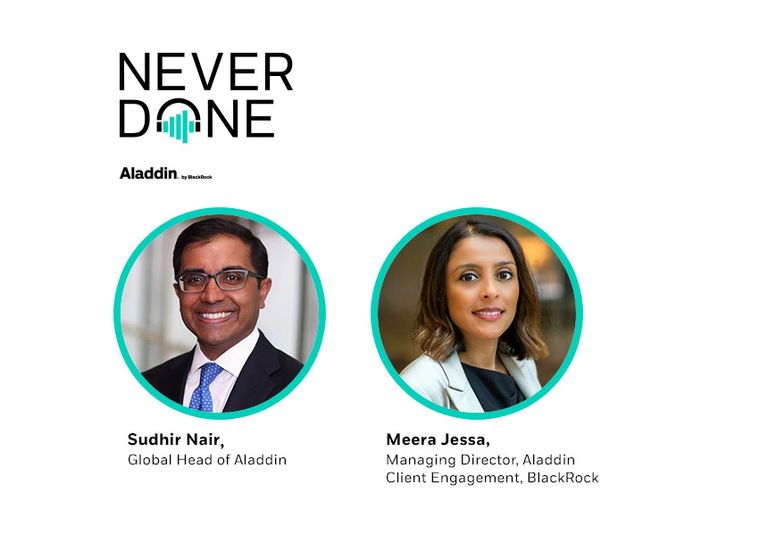
Meera Jessa and Sudhir Nair explore how technology is reshaping industries, and the way we work and live. Sudhir highlights how innovation—especially when it comes to data and AI— will transform investment management, unlocking the future potential of firms, talent, shifting client needs, and the evolution of global public and private markets.
Read the full transcript
[MEERA JESSA]Sudhir, thank you so much for joining me today. I'm so excited to have this chat with you.
[SUDHIR NAIR]Thanks, Meera.
[MEERA JESSA]Someone told me you're a big Giants fan.
[SUDHIR NAIR]New York Giants football. Yes. Don't hold it against me. And, by the way, I did not think knowing you Meera that this is where we were going to go, but I'll roll with it.
[MEERA JESSA]Don't ask me how this came across my inbox, but I read an article that said that the NFL processes 500 million data points a season, and I was astounded to see the level of data that's available in the NF. And the AI portion of this really made me think about the future, because AI is this abstract concept and everyone talks about how it's going to change the way we work, but it's also going to change the way we live. So, in your seat, how do you think about AI, not just for the business, but also more broadly?
[SUDHIR NAIR]Well, I think the reference, and I saw you getting out of your comfort zone there talking about the NFL, so I'm proud of you.
[MEERA JESSA]I appreciate that.
I think the parallel to the NFL is a good one. These businesses and these industries have relied on data, and data-based, data-driven decisioning since the beginning. But what we're seeing across the board, in athletics and manufacturing, and certainly in investing, the way people use data, the amount of data that's available and the techniques and technologies that are increasingly becoming available to interpret that data are just going off the charts in terms of orders of magnitude and size and scale and power. And what you can do with that and how you can advance and accelerate your data-driven decisioning and thinking is just redefining the game. And in the case of football, it's really redefining the game. Same is true in basketball. In the case of investing in the capital markets, it is equally redefining the game. And I think of the way a scout would evaluate talent and how to invest in their ability to use incredible time series of data on the performance of that individual dating back to probably their high-school or middle-school years and being able to understand trends and strengths and weaknesses and performance under different situations. That's not dissimilar to how a portfolio manager now has the ability to use incredible amounts of data and AI to do all sorts of predictive analysis on the performance of a potential investment idea. So these concepts truly translate across the enterprise. Same is true if you actually are running a team, you can use thousands and thousands of hours of videotape and study it. Or you can use all of the underlying data and statistics with an AI layered on top of it to truly help you identify what are the highest probability plays you can run, what's the best defense to guard against. All of these things now you have an ability to turbocharge your decision making. Same is true in running your investment operations.
So, here at BlackRock, as you're very well aware, we have been not strangers to leveraging AI. We have been thinking about and obsessed with AI as part of our business process for long before it was a household expression and everyone was using ChatGPT. And for us, AI is a way of making our process better. Not unlike a football coach would leverage AI increasingly to have the team operate better. That is so true for every investment organization around the world. Whether it's the workflow or how your client officers face off to and engage with all of your clients, there's just such an ability to leverage the vast amounts of data and have the AI help and prompt and provide important guidance on how to make that touchpoint and interaction so much more meaningful.
[MEERA JESSA]Absolutely, and I will tell you that I have now added prompt engineer onto my skill set. Who would've thought I would've been able to do that three years ago?
[SUDHIR NAIR]Congratulations.
[MEERA JESSA]Thank you. I'm pretty proud of myself but jokes aside, the landscape of us as people and the skills we need is changing. You were talking about how scouts look at players and plays and if they had data versus watching hours and hours of video, that changes what an organization or an industry needs in terms of talent. This shift of having AI and technology is really going to reshape the workforce. When you think about that and you think about the talent in our technology world, or even just when we think about BlackRock–how are you really thinking through the future types of skills we need in our organization? The types of people we need to hire, the types of people we need to nurture and grow to really help us to keep continue doing what we're doing?
[SUDHIR NAIR]I will not profess to be smart enough to have some incredible prediction on how AI is going to influence the workforce, but I know it will. I think we have always tried to find talent at all levels that is fundamentally curious, that has an innate desire to try and find questions and solve questions. And as much as so many of the colleagues that join us or work here have specific skill sets, I think most people who have long great careers at BlackRock, I think share the common experience of having worked on multiple things, been exposed to different areas and had to quickly adapt and develop a whole new suite of knowledge seemingly on the fly. That is like a core competency of how we've thought about talent management here at the company. And I think even in an AI world, in fact probably increasingly and more importantly in an AI world, we're going to need to double down on finding those people that fundamentally love to be curious, love to solve questions, and love to use the best available tooling available to them in order to help and facilitate that. And work collaboratively leveraging technology, but importantly with other humans.
So I actually don't think it's going to change the nature of the type of person that we're going to want, I really don't. I do think that, as best as I can tell, there's only 24 hours in a day, and I do think that these capabilities are going to increasingly free up time. And we will do, as we always do, we will find a great new way to occupy that time. And I think about some of the things that I did when I was a new analyst here at BlackRock. They've all been automated away, just through process improvement, not even necessarily technology process improvement, and certainly not AI process improvement. But that doesn't mean we don't keep our next batch of new analysts joining increasingly busy. We've just elevated the game in terms of our expectations on them making the role that much more enriching and rewarding and accelerating their career path. So, I think, we'll just all up our game and find ways to do even more and be even that much more productive.
[MEERA JESSA]You've obviously probably seen in your time working and all the experiences you've had a lot of changes in the industry. What do you think are some of the key trends that are really shaping our society in the future?
[SUDHIR NAIR]For me, the most profound trend I've seen is I think the understanding and really the appreciation for the important role technology plays. And I would say I joined an industry at a time when I think technology was more or less an afterthought. And there were certain people, certain firms, and BlackRock was one of them—it was one of the primary reasons I joined and was drawn to it— where there was a realization that technology, it wasn't furniture, it wasn't the physical monitors and keyboards on people's desks, but it was a lever, it was a catalyst that could actually transform the way business is done. And I would say that now, if you make a statement like that, it sounds very boring and rote and passé. But it's been a heck of a journey to get to a place where people, I think, broadly appreciate and understand how important technology can and should be.
And let me give you an example. My kids are now old enough that they ask and they want to know what do I do all day? And what's the purpose of what I do?
And one of the ways I explain it to them is, very simply, BlackRock has this mission, which is to help more and more people experience great financial outcomes. There's eight billion people in the world, and each and every one of those people has the right and needs to participate in the growth of the capital markets. They understand the basic concepts that you can invest in stocks and bonds and hopefully their values go up over time and that's a way of building wealth.
The way I explain it, it's about helping to bring assets and things you can invest in, which are becoming increasingly interesting, complex, and diverse. At one point it was stocks and bonds. Now it's infrastructure and crypto assets, that's a plethora of things. How do you bring together that incredible collection of assets, package it into a portfolio that's appropriate for an individual, and then deliver it to them in a way that they can participate in that benefit and achieve a better financial outcome. That crucial last mile to their doorstep is increasingly and oftentimes only through technology. So I view a big part of my purpose and what I'm doing here is trying to help. It's like a logistics job. It's like I work for a packager, right? The only way you can do that in my mind is through harnessing the power of technology.
[MEERA JESSA]That's really interesting that you talk about all these sort of different asset classes. When I think about the everyday investor and it's really synthesizing in the most simple way how do you access the capital markets? And I think the diversification of these new assets you've been talking about is a really interesting moment right now. We at BlackRock talk a lot about the private markets—when we talk about infrastructure, real estate, how does an everyday investor think about that concept? Because I think the idea of stocks and bonds is baseline, now everyone seems to understand how to invest in that, but this new thing, can you talk to us a little bit about what does that really mean?
[SUDHIR NAIR]These types of investments and these types of assets, they're just like every other asset in your portfolio. They're just different in how they're structured, in how you access them than traditional liquid stocks and bonds. But they're just like every other asset in your portfolio. And the more we can demystify, the more we can simplify and the more we can bring standardization, transparency, and accessibility to this incredibly important part of the investing landscape and make it available to more and more people, the better it will be. And, we see it increasingly moving in this direction where it's a meaningful part of the portfolio that's providing long-term ballast and stability.
Can you talk to us a little bit about what does it really mean for BlackRock and Aladdin and how we are looking to solve this conundrum of the private markets?
[SUDHIR NAIR]So, Aladdin grew up very much as a public markets oriented technology and it wasn't until 2019 when we did our first major technology acquisition with eFront that we had the opportunity to bring side by side, through this concept of the whole portfolio, public markets investment technology alongside private markets investment technology. And for me that was like an eye-opening moment because all of a sudden you realize that these two things that have been thought of as completely different, separate, different teams. They don't speak to each other, they sit on different floors, they'll never use the same system. All of a sudden you see them side by side and you realize, you know what, they're not that different. I mean, they are different, but certainly increasingly clients are going to want them to coexist within a portfolio.
And the more we built that strategy out, the more we brought this side by side, whole portfolio concept to clients and across BlackRock, it was glaring to me how the public market side was vibrant. It was alive with live data, real time pricing, daily valuations. The private market side was still very opaque, sparse at times. You needed to have multiple sources of the data in order to have some confidence and fidelity that what you were looking at was accurate. And it just dawned on us that for this to work and for people to really be able to manage these portfolios, both the risk, but also all of the investment outcomes, private markets data was going to need to experience a step function in maturation. Which led us to, about three months ago, we closed our next acquisition which is a company called Preqin, which is one of the leaders in the industry in private markets data. For the last 20 years, they have been focusing on building, this really robust private markets data set, which if you think about combining that now with the capabilities across both Aladdin and eFront, you see a world where increasingly that private markets part of the portfolio will become as vibrant, as robust, as trustworthy as its public market counterpart. I'm excited because I think, we have an opportunity through both using it here at BlackRock, but across the Aladdin community, partnering with all of our great clients around the world to make this Preqin data set as great as the industry needs it to be and accelerate the progress we can make in the underlying wiring and plumbing of how the private markets works, so that way we can democratize it and we can make it more accessible to more investors around the world.
[MEERA JESSA]So, I want to go back to your journey at BlackRock. You've been here a long time, and I look to you as someone who is part of the DNA of this firm. Can you talk to us a little bit about your journey at BlackRock?
[SUDHIR NAIR]I am excited because in just over a month I'm going to be celebrating my 25 year BlackRock anniversary, which is something that I'm quite proud of. As I believe you're aware, I started pretty much out of school in our graduate analyst program and I've been fortunate enough to retain a seat on this rocket ship for what is now a quarter of a century. And it scares me a little bit to be able to say that, I feel like I should have more wisdom than I do today when you talk about things like a quarter of a century, but it has been and continues to be just a tremendous amount of fun. And people ask me often, what keeps you there? And for me, I believe I have a very entrepreneurial spirit. I love the idea of building new things and I love the idea of building new things with purpose.
And when I joined the firm 25 years ago, yes, it looked different. Yes, its shape was different. Yes, its size was different, but there was then this scrappy, entrepreneurial, disruptive spirit that I just loved. And that spirit was pointed towards a very specific purpose, which was trying to help clients be better at managing their investments in portfolios.
And you fast forward 25 years from now, the firm is bigger, the firm is a little bit different, the firm has a different shape, but that same entrepreneurial spirit is as strong, if not stronger than ever. And I think this passion to disrupt and change all for the benefit of people in the world has been such a unifying force in my professional career and to be honest in my life.
[MEERA JESSA]How do you personally navigate through all these trends and new things that are emerging, whether it be asset classes, whether it be new technology?
[SUDHIR NAIR]I view it as an important part of my job. And one of the things I enjoy most is talking to people. Making sure, you can spend a lot of time stuck in your day to day, which we all find ourselves needing to do that at least for some period of time. But I think it's really, really important, particularly if you are part of an organization, part of an industry that's fast moving and quickly evolving to spend just as much, if not more, time out in the field. Learning. Absorbing. Speaking to clients. Talking to competitors. Speaking to people in other industries to understand how they're experiencing some of these trends and changes. These are just conversations. These are little nuggets so that you can try and then stitch them together. Try and recognize and spot patterns, but equally as important, bring that information back to your colleagues. So, collectively you can try and decipher which way the world is going.
We don't always get it right, but I think the worst thing you can do is not have a view. And as someone who leads a really vibrant technology organization, the thing I worry about the most is falling behind. The changes that are happening in the industry, the thing I get excited about the most is having the opportunity to play a role in driving and shaping some of those changes in the industry. But so much of that relies on just being out in the market, speaking to clients, and bringing that feedback into our thinking, so we can try and stay a step ahead.
[MEERA JESSA]You talked about getting excited about a lot of stuff. If you were to tell me one thing you're the most excited about in the next two to three years, what would it be?
[SUDHIR NAIR]I think this idea of private markets. I look at what's happened in the public markets, even in the 25 years that I've been working and seeing this path and progression of how the maturity of the public markets led to really just phenomenal growth. And I think the same will be true for the private markets. I think it will happen in a much shorter timeframe than 25 years. And I get very excited about even playing a small role in that. And being able to try and help be the pace car in setting the direction for some of that change.
And here at BlackRock, we have so many incredible colleagues and capabilities. Having an opportunity to be in the room to try and synthesize the change, understand the change, and then guide clients through the change. If we're able to advance that agenda, that will be something I'd be very proud of and it would be from a career perspective, something that I think would rank up there in terms of some of the greatest achievements.
[MEERA JESSA]I totally agree with you. It's definitely a very exciting time. I never thought in my career I'd be talking about canals and airports if I'm honest with you. So, one question before we wrap. What's never done for you?
[SUDHIR NAIR]Ooh, what's never done? I probably should have anticipated that given the name of the series. But you know what? I'll flip it. What is ever done? Honestly, what's ever done? All the best things, all the coolest things are never done. Fashion, never done. Look at the way we're dressed. We might be close to done, but fashion never done.
[MEERA JESSA]I think my kids would look at me and say, I'm done for sure.
[SUDHIR NAIR]Food, restaurants? We're here in New York City, the coolest restaurants are never done. They're always improving. So, athletics teams, we talked about the Giants, they're never done. Humans pushing the art of the possible in sport. Nothing is ever done. And I would say one thing that I can say with great confidence is never done is technology. And for me, I think, this idea of staying relevant is incredibly important.
And relevance is a point in time measurement. And in order to stay relevant, you really need to have your finger on the pulse of two things. One, what's happening now. And importantly, what do you think's going to happen in the future. And I love that aspect of technology because of all the places I just mentioned, I don't think there's a space that's moving faster and in a more disruptive way than technology. And it is just fun to be on the ride.
And this role, being part of Aladdin, being part of BlackRock is a great seat to not only watch it, but participate in it, and to the extent we can help drive it and shape it for the benefit of our clients.
[MEERA JESSA]I could not agree more. Sudhir, thank you so much. I really appreciate you taking the time and it was great as always to have a chat with you.
[SUDHIR NAIR]Thank you, Meera.