Never Done by Aladdin®
Renovating the house: reimagining operating models with Citisoft
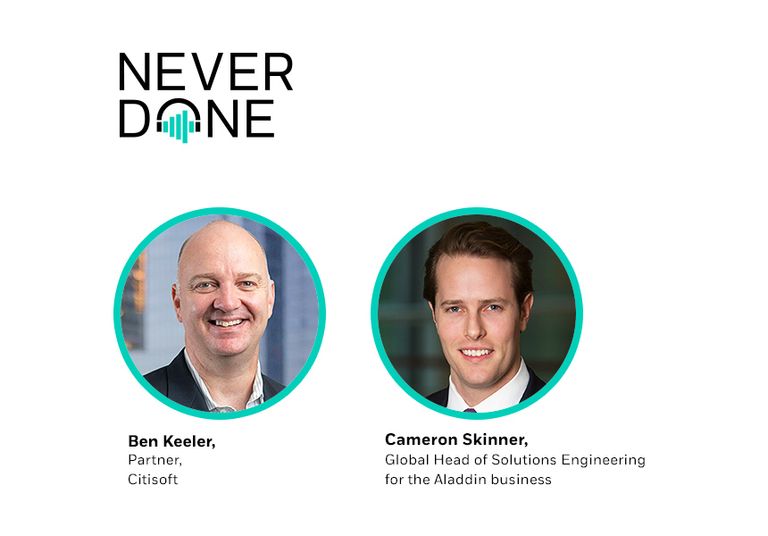
Ben Keeler, Partner, Citisoft, and Cameron Skinner, Global Head of Solutions Engineering for the Aladdin business, explore how asset managers are rethinking target operating models—focusing on the shift toward data centric foundations, modular architectures, and more dynamic, real-time workflows.
Read the full transcript
[MEERA JESSA]
Super excited to talk to you both today.
[BEN KEELER]
Thank you for having us.
[MEERA JESSA]
But before we get into it. Ben, I hear you're an avid traveller. You must have some good stories.
[BEN KEELER]
Guilty as charged. I'll credit my half-Canadian heritage for unlocking the power of travel.
[MEERA JESSA]
So, tell me about a place you've been to that was transformational for you.
[BEN KEELER]
There are certainly places that are impactful for who I am as a person. I would specifically highlight Tofino, which is a place on the western coast of Vancouver Island. Very, very special. Makes a tall guy like me feel very small, just because of the natural beauty and being in those surroundings. There are lots of examples though, of travel and how it's impacted my career. Clearly, traveling with clients and for clients is a core part of who I am, and certainly what Citisoft does as well.
[MEERA JESSA]
Cam, I know you pretty well. However, I was very surprised to learn that you surf before work. I can't even fathom that.
[CAMERON SKINNER]
I've been known to. I want to clarify. It's not every morning because you can't go surfing in New York every morning. And I think that, to many people, just the concept of surfing in New York is a totally foreign concept. I grew up surfing. I grew up in Rhode Island, so I've been around the water for a lot of my life.
There's actually good surf in New York in the late summer and the fall and winter too, if you want to brave that. It was one of those escapes that still felt like it was attainable. And so even to this day, I'll wake up early in the morning and I'll go down and spend a couple of hours in the water, and it's really centering and refreshing, and it's a nice way to escape a little bit.
[MEERA JESSA]
So, we work in an industry that is full of jargon and one term that I would love for us to depict today is “target operating model.” What does this mean? How do firms think about it? How do we think about it here at BlackRock? When I think about a target operating model, it is like renovating an old house almost. You've got the pipes and the wiring, you've got the floors you've got to redo. The house can be amazing in this renovation. And you can put lipstick on a pig, but the foundations need to be right is how I look at it. And it always comes with a long-term plan. As those of us that have renovated houses, it never goes to plan, right?
So, let's start to demystify what target operating model really means, because in the client conversations I have, I certainly see people going down different routes. Maybe I start with you, Ben. How would you describe a target operating model? And maybe you can even start with how would you describe this to your kid?
[BEN KEELER]
An operating model is an abstraction. It's a vision that sits at the intersection of business, technology, operations and data that clearly depicts, essentially, how an investment manager, in this particular case, operates their business. It's helpful for me to talk about what it's not. It's not an application architecture. It's not a business strategy.
So, when I think back to how I would talk about it back when my kids were five. I'm a huge fan of a series of books from the 70s and 80s by a gentleman, David Macaulay, who wrote “The Way Things Work”, but if you look it up, cathedrals, pyramids, airports, really an early look into systems thinking. You could even go back into, Richard Scarry books, and looking at the airport and trying to figure out how all these unique elements kind of work together. I think about it like that.
And what we're dealing with now is we're dealing with business applications, we're dealing with partnership decisions, we're dealing with incredibly complex data integration challenges and doing it all in real time within our business. So, I think about a target operating model as an abstraction that essentially explains that.
And that's the “operating model” segment. The second part of it is “target”. So naturally there is something aspirational as it relates to target. Part of our business is to go in, identify what someone's house looks like today, talk about what they're looking for in the future, and then help them through that gnarly process of merging the two. And so the target operating model is clearly that North Star that our clients follow in order to follow on their journey.
[MEERA JESSA]
So, if I pull on that thread a little bit around abstraction, and then you also said target. Cam, you're really at the heart of all the conversations that we're having with clients today around the target and where they want to end up. How have you seen this evolve, even if you looked at the last year, for example?
[CAMERON SKINNER]
So, it's been evolving particularly quickly recently. I've been working with clients for a decade here at BlackRock, and the pace of change over the last 18 months has been particularly acute. It's been very noticeable. We've had to change the way that we even interact on a day-to-day basis with clients, and a lot of it is centered around components of the way Ben described target operating model.
When we think about things, we think about oftentimes the technology and the data as underpinning those components. So, if maybe we go back to the house analogy. If you're going to do a renovation, you want to make sure the foundation is sound. Are all the major systems ok? The plumbing, the wiring, those components?
So, getting the foundation and basis in place is really important when we think about this. And the way the clients have been approaching it is some of them want a prefab house, others want to customize components. And they want to make sure that, again, you have the baseline in place to be able to add “Oh, maybe I want to put a custom room over here.” You need to make sure the foundation can support it, that the plumbing is there, the electrical, the roof, etc. all of those things. And so, if we now bring it back to what's happening in the industry and what we're seeing, that equates to someone wanting to add in their own proprietary technology as they build these operating models.
There was a past podcast where a few people were talking about basically how you think about “Change Alpha”, and ultimately the way that we approach things is clients don't have unlimited resources. They need to pick their bets. And so, when they choose where in the operating model to place their bets again, target state, where they want to be investing, where they want to go with strategy over time—what we like to do is we like to partner with them to better understand where they can allocate capital effectively when building out their dream home, and where they can look to basically buy things off the shelf and help use commoditized, well proven out technologies, data systems that we can help put in place for them to help optimize how they, again, apply that capital and meet their target strategy going out into the future.
[MEERA JESSA]
Ben, you talked about partners as well in the ecosystem. This is a question for both of you. How is the industry using partners to evolve this operating model?
[BEN KEELER]
Well, I'd start by picking up on what Cam mentioned as it relates to specialization versus commoditization. It is the beginning of a lot of conversations. What was unique ten years ago is no longer unique. And the business architecture as a capability is something that's actively required not every 3 to 5 years now, but as a core competency of our investment management clients to be able to move the ball along every day and make those active decisions.
The target operating model conversations have been so much more dynamic. For me, it's data, service from third parties, and then getting people to help evolve your business architecture���really probably where people are using partners like myself more often. And then from a technical perspective, APIs and more integrated workflows where you are bringing in active data sets during the day, which used to be completely a nonstarter as it related to the daily rails of the investment management business. Nowadays, it really is much more real-time.
[CAMERON SKINNER]
So maybe to build off something that Ben said, you are fundamentally choosing partners who are going to be strategic in nature very often. You're going to make big investments in the partnership. When you go in and install a new investment platform, that is a multi-year decision and commitment that you're making. While on the other hand, when you look at other components of this, because there are APIs, because we've opened up systems over the last five years, and people are more comfortable with the technology, you're less wedded to some of those partnerships that you might have had in the past.
And so, yes, you're locking into the backbone partnership or to the core partnerships, but then you maintain optionality on the other things. So when you think about what that target is and what that strategy is, as you're constructing what your abstract operating model is going to be, understanding where you want to have commitment and lock-in versus optionality in the future to be able to sub out, given the pace of change in certain technologies, is a core feature that needs to be thought of as clients are going through and planning these components.
[MEERA JESSA]
As you were talking Cam, the pace of change is really resonating with me, and I'm going to draw parallels back to the house. If it wasn't clear to you, I am thinking about redoing my kitchen.
[CAMERON SKINNER]
I am too and it's a little triggering.
[MEERA JESSA]
Oh, so stressful. So, a few years ago when I started thinking about doing my kitchen, I was like, I want teal cabinets. So, I was talking to a mate about this and she looked at me and she was like, “Honey, teal is so done.” And it's all about the black or the darker colors now. And this is literally a span of two years. And I was like, if I had started my kitchen renovation two years ago, I would not be cool anymore. So, when I think about our industry and these bets that people are making on their backbone and the pace of change, by the time these transformations happen, things have changed again and nothing comes to mind for me more than two areas when it comes to the rate of change in our industry—private markets and AI.
I was quite surprised that institutional investors have 30% of their portfolios, roughly in private markets, according to the Preqin article that I read. And so, if you look at the private markets, they are very opaque. And the change that's happening in our industry, how do we think about private assets and this shift in the operating model? Because nobody really knows the “target” part of “target operating model” for private assets.
[BEN KEELER]
Good question. I do think that it's well understood now that we're talking about liquidity continuum at its core. I also have done some of that research and recognize that actually of the firms in North America that have over $100 million of revenue, 90% of those are private firms. So, there's this huge opportunity set that's out there. But now, obviously, the drive is to make that much more accessible, whether that be through retirement vehicles or high net worth channels.
It's an interesting challenge for the industry. But clearly, if we're going from $13 trillion in assets today to potentially $30 trillion in assets by the end of 2030, which is a common estimate, clearly volumes are going to go through the roof. Expectations, as it relates to valuation, analytics, there's only one place that those expectations are going to go—and that's up.
So, really bringing private investments into a more daily and intraday environment. So, it is about exposing the data, bringing the data into those core backbones and treating it in some sort of capacity, which is similar to the way that we look at public assets today.
[MEERA JESSA]
The data is messy, though, and the assets are esoteric. I remember when I was talking to Mark and Tarek, we were talking about buying camels. Now, I know that goes very, very far into the esoteric. But how do you unpack all that, Cam? And how do you standardize that? We talked a lot about commoditization, which is really another way of saying standardization. How do you do that in a market where that just doesn't exist?
[CAMERON SKINNER]
So, this, I think, is a really key feature, and we've done a ton of thinking about this internally. And part of the core strategy needs to be to not overly standardize things. And I think this is what you see happening in the market today. And if you look at all the systems out there, the big backbone systems, a lot of them started in the public market space and they're now adding in privates.
But we started in the public market space in Aladdin and we acquired eFront in 2019 and integrated them in. We did that with Preqin this year. But along this journey, what we've come to realize is that while you have to be able to represent publics and privates in the same portfolio, and therefore your target operating model needs to be able to support those two things together in a commingled way. You cannot lose the fidelity and the uniqueness of the data sets that exist within private markets.
We talked about how data is going to increase in terms of the velocity of it, the transparency to it, etc. in that space. But it's fundamentally never going to be perfectly merged with publics. Now, of course, they can live together in one area, but you still need to make sure that they're represented correctly and that you're treating them with the right care.
And as you think about then combining these two things into one view, a holistic portfolio analysis, you can do that with the set of analytics and KPIs and other data that you bring together, but you still need to make sure that these things are represented correctly.
[MEERA JESSA]
So, it's embrace the uniqueness. Don't try and jam it in and make it something that it's not.
[CAMERON SKINNER]
Yes, I think that the overall model to represent these things holistically maintains uniqueness between these two. Not complete. They can be brought together to a degree, but they don't need to overlap perfectly.
[MEERA JESSA]
That makes a lot of sense. So, I want to pivot a little bit because we talked about foundations a lot and the foundations of AI—it's really data. And look, we could debate that because other people have different views on that, perhaps. But if you don't get the data right, anything you put on top of that in terms of models and whatever it is, is just never going to work. Right?
It's like garbage in, garbage out. So, when you think about the technology, the target operating model, the evolving marketplace, the pace of change is very fast. How is AI going to impact the target operating model of the future?
[BEN KEELER]
Well, from Citisoft’s perspective, broadly, we do think that it will be fundamentally impactful for all functions. That is a workflow discussion at some point where we need to engage with clients at a fairly practical level to talk about, “Okay, don't just say AI to me. Here's my daily workflow. Show me and walk through those workflows together to see where there's opportunities.”
I do think that AI as an efficiency tool, clearly has a lot of legs, and people are actively adopting and looking for their partners to help them along that journey. Consultants play a role in helping to ask the first principles questions. Why? Why do you do it the way that you do? And how can AI ultimately help you along that efficiency journey?
Going back and looking at history, there was a period of time where research and ideation about investment management kind of operated on its own, very different than the daily rails, again, of producing investment management change, whether it be executions and new product development. Right now, AI adoption is in fairly early innings. It's an accelerator. People are looking at different insights.
Obviously, as you mentioned, you need to get the data right in order to be able to flesh that out. That still feels like it's in fairly early innings. Mark O'Hare actually mentioned being at kind of base camp. I totally agree with that. There is a tremendous amount of capability available in AI. You do need to train those tools appropriately. You need to train the people appropriately in order to use it. But as an example, most firms get information about their daily investment management process, and the outlook of their portfolios based on dashboards or even printed reports, today. In the world of AI, it's almost going to be impossible to have that many layers involved in producing the information. AI will ultimately help with the data governance and the data discovery that will help with bringing new insights, and we're doing this today.
[MEERA JESSA]
Cam, now I know that you like to do your research. But when you look at the research people do and then there's the investment process. When I think about how we've been talking about it here at BlackRock and Aladdin, perhaps we've taken a different view and it's a bit more federated. When you look at AI and how it's going to impact the target operating model, it has to be together, right? When we look at the future.
[CAMERON SKINNER]
As Ben was speaking, the first thought that crossed my mind about this is that I kind of think back to one of the earlier statements that I made, which is about how there are pieces that are now modular in an operating model, and there are pieces that are foundational in an operating model.
[MEERA JESSA]
What does that mean?
[CAMERON SKINNER]
The ability to swap out different components as you think about the investment process, whether it's going to be portfolio construction tools, whether it's going to be research hubs, whether it's going to be bringing various AI agents into the workflow. Those are the types of things that I think will only accelerate into the future. The pace of change of AI is incredible. I think when you had the previous podcasters on talking about the ever-changing landscape of AI, it was a replay of an old one where they hadn't even coined the term, “agentic AI” yet. But they were talking about agents being brought into team chats, and now, like everyone's talking about agentic AI.
[MEERA JESSA]
That's right.
[CAMERON SKINNER]
And so, like across the operating model it's going to be transformational. And so, when I talk about modularity it's being able to have a platform and an operating model in place that allows you to move with the pace of change that we're seeing in the market, without having to fully re-implement every single component of that model, year-in, year-out. I think that's the name of the game today. When you think about how AI changes the operating model, it changes the places where you want to make sure you really get your bet correct and where you want to maintain optionality in terms of bringing things to the table to evolve your investment process, to evolve your governance process, to evolve your analytical process, etc.
[BEN KEELER]
As an example, I think it's really important just to call out some specifics. I can certainly see places like personalization in wealth management really benefiting from AI and the power that it brings to the table to unlock personalization at scale.
I often think about the dichotomy between a trader and what a daily trader is responsible for versus an agent. There are guardrails that we can put in place. There are constraints that we can apply. There's business logic now that we can code. We can't replace the judgment of the trader. That is the secret sauce. But certainly there's an aspect to AI that does allow for a much greater scale. I think about that in more of a product or a client context, or maybe even getting into standard use cases like you mentioned, in terms of support and client service and those types of things, that makes sense to me.
[CAMERON SKINNER]
Yeah, and you could draw corollaries to the overall target operating model discussion we've been having this whole time. When you think about, again, when you go to build the target operating model, where do you build versus where do you buy? Where do you think about commoditization? Where do you think about specialization? It's similar when you think about deployment of AI within your walls. Where do you want to maintain control over things? Where do you want the human in the loop? Where do you want them able to exercise their judgment, versus where are maybe the lower risk areas that can be streamlined when you think about building those new workflows for the world, a year from now, two years from now, three years from now.
[BEN KEELER]
Now, just back to the practical side of me. My team spend years of our lives helping to prove trusted investment book of record data. It's hard to believe that we're going to be in a place in five, ten years where that's just gone, because people still need trust in the data at a very fundamental level. So, I'm super excited about the possibilities, but also realistic about what our role, your role as BlackRock, as a provider, our role as consultants, to help people build that trust.
[MEERA JESSA]
You know, as you were talking about the algo wheels, I grew up in fixed income trading, and I remember the whole sort of shift of fixed income markets being electronified, and it was just open outcry on the floor and not in the regular open outcry way. And look, you can argue that maybe the fixed income markets are not electronified today, but they're definitely way more electronified than they used to be.
So, when I think about sort of algo wheels, the fixed income market, the change and everything that we're having, do you think there's such a thing as target operating model for our industry in the form of singularity?
[BEN KEELER]
I'm glad there's not. I would be out of a job. I don't believe that. For me, there are standards. I think of all the words that we've been using here during this podcast—it's a backbone, it's a partner. Somebody that I can partner with on the core of my business, giving me something that I can wake up every day, know that the lights are going to come on, know that I can actively work my portfolio and know that I have a partner that I can work with on some of these more bleeding edge types of cases.
But in general, back to your house analogy, everybody's house is a little bit different. The constraints are very different. As an example, I just flew in last night. Amazing to me, the transformation at LaGuardia again, being on that shuttle for the majority of my life, they didn't build that structure that way because they were able to just look at a blank sheet of paper.
They had to build it that way to work around the old terminal. There is a reason why you are taking those escalators, and you're moving up and down and you're doing those things. They did that beautifully. That's a target operating model, right? That's understanding you have to work within the constraints that you're given, and not everybody's house is going to look exactly the same.
[CAMERON SKINNER]
Ben, I think that analogy is quite apt. And I couldn't agree more on the fact that the concept of singularity, I think, as an operating model in the investment management space is probably not realistic, nor is it wanted. In fact, I would say that there's more dispersion in the last 18 months that I've seen from talking to clients than I had seen in the previous, let's call it five years.
[MEERA JESSA]
Interesting.
[CAMERON SKINNER]
And so, if we go back to the pieces that you want to keep custom versus the pieces that you want to keep standard. I'm sure when you look at LaGuardia, the terminal is unique. There's no other LaGuardia in the world. There's no way that it's shaped like another airport. But there are pieces of commonality when you think about all the things that they cater to. All of them have gates, all of them have modern escalators. There are certain foundational pieces that have to be shared. And I think what you'll see is a push towards commonality there—having more and better and timely data sources in the market, having better updated technology.
So, you will get these trends that will push their way through the investment management industry that I think will be positive to the greater good, but you'll continue to maintain and, I think, accelerate towards the customized aspect of everyone's target operating model. Everyone's house is slightly different, and that personalization we're going to get from company to company will be based off of where they think they have the edge, or where they align their ethos to their investment management philosophy. And I think that those things will all become very distinct. And you've already seen that with brand building and with specialization and things today, I think that will only accelerate.
[MEERA JESSA]
So, Cam, what's never done for you?
[CAMERON SKINNER]
The question that I was anticipating, I wonder why. So, it's funny, the role that I'm in and honestly being at this company for a decade, I don't think I've gone through a single day where I haven't learned something new. And I know this is a cliché answer, but saying that the learning is never done is something that I truly believe, and I think that it keeps us agile at the firm and in the roles.
I mean, not only is there a plethora of information available to be able to learn from colleagues here and from kind of the scale of the organization, but having to adapt to those exact client examples that I mentioned earlier. I'm constantly learning from clients. I'm constantly talking to practitioners that are doing their day-to-day job who face problems sometimes similar, sometimes unique, and everything deserves a high level of care and a different approach and a critical approach to thinking through what the right solution is and how can we build it for the future as well.
I can't just deliver a solution that's going to work for them today and have them be satisfied. We have to think about what that strategic target is. How are they going to want to be working five years out, ten years out into the future? And making sure that what is constructed with them, not just for them, but with them, is appropriate. And so, it's the constant learning day in, day out, that is never done for me.
[MEERA JESSA]
I love that answer. Ben, what's never done for you?
[BEN KEELER]
Well, I learn through travel. So again, tying back to the beginning of our conversation, traveling personally, traveling to meet my clients. That's where I grow the most and where I learn the most. There are lots of examples, though, of travel and how it's impacted my career. Clearly, traveling with clients and for clients is a core part of who I am, and certainly what Citisoft does as well.
And our profession is about learning and applying very quickly. People understand how valuable immersion is when you're talking about folks learning language. Okay, go to the place and you'll scale up pretty fast because you're thrown into the pool a little bit. So, I would say travel.
[MEERA JESSA]
What's the next place?
[BEN KEELER]
Good question. I'm bringing my children to Hawaii next.
[MEERA JESSA]
Lovely.
[CAMERON SKINNER]
Very nice.
[BEN KEELER]
Thank you. And I've been a couple times but we're going to go explore some new spots.
[MEERA JESSA]
That's great. Well thank you both for joining me today.
[BEN KEELER]
Thank you.
[CAMERON SKINNER]
Thank you.