Never Done by Aladdin®
It takes guts: redefining scale and insight with Alpha FMC
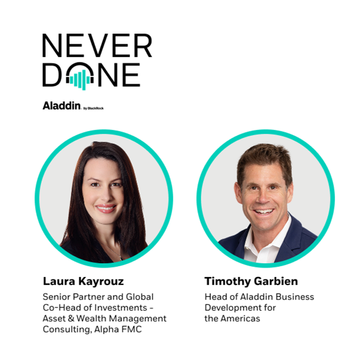
Laura Kayrouz, Senior Partner and Global Co-Head of Investments – Asset & Wealth Management Consulting at Alpha FMC, and Tim Garbien, Head of Aladdin Business Development for the Americas, discuss how asset managers are transforming through a total portfolio approach.
Read the full transcript
[MEERA JESSA]
Laura, Tim, I cannot tell you how excited I am to have this conversation with you guys. I cannot think of a better way to start 2026. Before we get started, Laura, I heard you are a dive master. What's the most interesting place that you've dived?
[LAURA KAYROUZ]
I would say the most special place that I've been able to experience so far, with a long list that I still would like to experience, is I was on a liveaboard boat for about five days off the Great Barrier Reef, so that allows you to get to very special, untouched spots that even most divers can't get to on a day trip. It is something that allows you to really appreciate kind of this bigger world that is around us.
[MEERA JESSA]
So, I have the introductory Padi and I did a dive in Iceland, where you touch the Eurasia and the North American plate, and then the dive master said to me, you've got to be really careful on how you're doing the dive, otherwise you'll float off into the ether. I was terrified. I think the real feat would be, can we get Tim to come diving with us?
[TIM GARBIEN]
I think the answer is just a hard no. The fun fact, if you like about me is I start every day the same way, and it does dovetail a little bit, Laura, into how you wrapped up your diving experience. I do think of every day as a blessing and an opportunity. I start by walking with the dogs when I don't have to get in super early here at BlackRock. I sometimes catch like a sunrise, which gives me a little bit of perspective to go along with the unconditional love and responsibility that comes with the dogs.
[MEERA JESSA]
So, it's a new year. We're in 2026. Two questions for you. One, what's top of mind for your clients and what are you most excited about in 2026?
[LAURA KAYROUZ]
What I am most excited about this year is the number of clients that are continuing to embark on something new and that is these large-scale transformations. Because I must be honest, it takes a lot of guts to do it. And when I say that, it's like hand over heart, you know that if folks are sitting down with Alpha or the BlackRock team, they've done a lot of pre thinking and they've started to unpack and realize the number of requirements and gaps that they need to solve for, and that's when the fun stuff starts, because we can go in there and help them put the pieces together for that journey.
[MEERA JESSA]
It takes guts, vision, and great execution. You need to have all of them to be able to really do this. How about you, Tim?
[TIM GARBIEN]
I would say very much in line with what Laura was saying. It's really about the people, i.e. yes, organizations make a decision to do a big transformation. It's actually the people. It's the Chief Operating Officer, the actual human who's putting her life on the line, so to speak. And I think about some of the clients that we have where we held hands to go on this adventure. And what they've achieved, not only from a growth scale perspective, but what I see happening with the culture, the talent and the organization from a human perspective is absolutely amazing.
So, I'm excited for more of the same. I'm excited to see that not only is the capability when we come together relevant and valuable for the largest asset managers and asset owners, but we're seeing lots of adoption in the mid-market because they can achieve the same types of things through this type of partnership that maybe the very, very large have. So, I'm excited to be back at it in 2026.
[MEERA JESSA]
So, I was reading something the other day around gold and gold prices, and I think maybe we had talked about this a little bit as well Tim. And given the global uncertainty and the demand for safe assets, the price of gold in 2025 increased like what, 60%? And the reason I want to talk about gold a little bit is we're in this world where the traditional assets that people normally invest in is really shifting.
So, I would love to hear your views on how that mix is changing, whether it's through gold or other esoteric assets, and how you think about the conversations you're having with your clients. Maybe I'll turn that over to you first, Tim.
[TIM GARBIEN]
We've seen private assets explode within the portfolios of asset managers and asset owners all over the world. We've seen real assets, which obviously gold is in that category. But where my brain really went is this idea of TPA and a lot of discussion, I do a lot of business in Canada, for example, and they were a bit on the forefront, particularly in the Maple 8 and the idea of TPA and the idea of looking at investments.
[MEERA JESSA]
When you say TPA, what do you mean?
[TIM GARBIEN]
I mean the total portfolio approach. Just the idea here is that when you're looking at an investment, looking at it vis-a-vis the entire book across one portfolio, even though you may have hundreds or thousands of institutional separate accounts or funds, looking at it in the lens of one portfolio.
[MEERA JESSA]What are you seeing, Laura, with this shift of the non-traditional assets with the clients you're talking to?
[LAURA KAYROUZ]
This is the next stage of the visionary world that asset managers, asset servicers, insurance asset managers and quite honestly wealth as well comes into this picture because even individuals want to be able to access different types of asset classes into their portfolios. If we shift back 10 to 15 years ago, a lot of the shops still had a particular focus area. You might have an asset manager that is focused on purely fixed income, another that might be focused purely on equities. And then you still had your hedge fund organizations that might have done a little bit more of those private asset classes back then. What we've seen start to come to fruition is the growth of some of these through AUM and the opportunities that when you bring together both those, kind of, fixed income and equity asset classes into a multi-asset fund, that was a breaking point.
Another breaking point that came in that was very valuable to some of the fund's performances and strategies was integration of derivatives. And then we started talking about this convergence of bringing ETFs into the market space. And that exploded. And here we are today—there's two bigger ones that are now getting added to all of these. It's digital assets cryptocurrencies. How do we do blockchain. And on top of it to Tim's point private assets private credit. The belle of the ball. Everybody's moving that direction. But let's not be remiss to talk about real estate and infrastructure. These are putting pressures on asset managers to make sure that they can look at the right foundational data sets.
Also, how they bring forward easy decision making. What are the right analytics? But what we're also not touching on yet is we used to follow indices very clearly. We've had to help our clients shift to also reacting to global and macroeconomic changes. And this is where we need to start blending the total portfolio view through technology so that clients can pick up and enable the strategies of the total portfolio approach. And that is the key and the race that many are on now to unlock.
[MEERA JESSA]
And what do you think that these firms and leaders need to be doing to be really successful in that race?
[LAURA KAYROUZ]
I think, Tim, you and I were talking about how people need to view scale. The definition of scale is different in today's world for many. Again, scale was really about how big can we get? Let's grow AUM. Let's put bodies to doing this—higher talent, more likely, probably on the front office side, which is still very much there today.
But scale is also about the strategy in that in some cases, the niche investment spaces that folks see value in. So, scale could be improvements of technology so that you can do more and put your talent into higher value tasks. Scale could be maybe looking at mergers and acquisitions to bring two incredible organizations together to expand their global footprint.
When you go when you talk to a client today, before any large transformation, we always recommend that we spend some time to really talk about what their actual North star is. I use a silly phrase where it's like, what is the next phase of growing up that you want to obtain as an organization? How does this also align to your culture, that North Star that you define and create pillars for will then allow you to drive a more successful transformation into the future.
[MEERA JESSA]
So, scale means, it's a little bit jargony as well when we talk in our industry, right? Or maybe any industry, but it can mean so many different things as you pointed out Laura. Tim, in the questions you're getting from leaders and as you are talking to industry participants, how do you take scale and turn it into an actual tangible strategy? Demystify that for us.
[TIM GARBIEN]
Well, I think you're hitting the nail on the head in terms of the word scale being extremely nebulous. So, the first thing that I try to do is really understand when the Chief Operating Officer, the Chief Information Officer, talks about achieving scale, what do they actually mean? Laura touched on some of these things, like the idea of being able to grow organically, i.e. an asset manager, winning more business and having more institutional separate accounts, but having the same human resource needed to basically run those is an element of scale. Being able to, through inorganic growth, do a lift out or an acquisition and be able to plug that in. There's a time to market element to that as well. And competitive advantage potentially there. I always think about like time to ROI, things of that nature.
Also, it's relevant for a strategy or product rollout. If you could be first and you can get faster to ROI—hugely, hugely important. The thing that Laura was talking about, which really gets my engine revving though, is this idea of how does it unlock talent? So, the idea where there are professionals, highly skilled professionals and they're able to basically do activities that are much more value-accretive. So, scale sometimes seems like human resource or even a decrease in the human resource. I actually think the idea of unlocking the ability to do more value-accretive tasks not only leads to better outcomes for the clients in the short term, but which you end up getting is your employees, your team, having a greater sense of purpose, being happier. You're getting better employee retention, you're getting loyalty, and you're getting more cohesion.
And I always like to pose the question is culture something that you prescribe or is it something that happens to you? I think it's somewhere in between. And with scale as it relates to talent, you're actually getting a culture uplift, which is just massive.
[MEERA JESSA]
So, I have a question off the back of that, because I like the way in the term that you use, which was value-accretive task. But to me that's almost a synonym for everything else is done by—here's another jargon word— AI. You knew I was going to go there.
[LAURA KAYROUZ]
You have to.
[MEERA JESSA]
You have to.
[LAURA KAYROUZ]
Everybody wants to talk about it.
[MEERA JESSA]
So now, AI, we're all living it and breathing it. How do you think about Gen AI talent and then what that does to the culture that you described him?
[TIM GARBIEN]
Well, very optimistically. If Gen AI can help with the tasks that are less value-accretive, less interesting, and it can free up the talented professional to do the more value-accretive, you have a win-win. I think it's important just to double-click on the idea that if someone is doing portfolio reconciliation as a big chunk of their day and they can be the manager of AI agents to do that as a very small sliver of their day, and they can think about more value-accretive things, like to Laura's point from before, like, how do we democratize private markets to retail and wealth?
[MEERA JESSA]
I totally agree. I would love to hear your take, Laura, because I think we always talk about AI and how it can bring efficiency gains and what does it mean for the changing workforce and the talent, which is what really Tim was just talking about, but what does it mean on the other side of the coin of how you actually drive your strategies and how things change in the front office as a result of AI and how your decision making is more optimized?
[LAURA KAYROUZ]
I think there's a few things that we can unpack here as far as the journey, but I'll start maybe first with the shining star dream—behavioural analytics. Some might say they're there and they can do it now.
[MEERA JESSA]
What does that mean—behavioural analytics? You knew I was going to ask.
[TIM GARBIEN]
That’s a nebulous jargon that I really like.
[LAURA KAYROUZ]
And I think we're going to be tasked to helping our clients truly define that and helping to hopefully carve some of these paths on what that can be in the future. With that said, everything comes down to how teams trust data. And if foundational data is something that is an area that a firm is concerned, especially the front office, risk teams, portfolio managers, traders and even the compliance team feel that they are unable to trust—that's a problem and we need to fix that first. So, how can we simplify where possible? But more importantly, understand the data and have the right checks and balances so that trust can be gained? Because once you have the trusted data and your architecture is quote unquote “safe-guarded” to your best ability with checks and balances, you can start to get to the places then that Tim was touching on, which many of our clients are doing today.
This helps them protect firms and ensure that they are in line and managing across their teams and various dependencies appropriately. Firms have incredibly rich historical data if it's right on top of active tools that they're using in day-to-day management. So, imagine a world where you can pull in from a behavioural analytic standpoint, how a firm has done historically, how their peers from publicly available information is able to overlay that, how you can look at current economic trends and headline news on how that can inform how trades and portfolio management decisions can be made—that unlocks something special.
[TIM GARBIEN]
On the AI if I might add a couple of extensions there, perhaps. On the idea that I can help with scale, I'll use that word again, in terms of coding, I've thought a lot about this, and I think a lot of people have come out with the idea that we're going to be able to do orders of magnitude, more lines of code with less people, which I think
[MEERA JESSA]
My favorite jargon term: do more with less.
[TIM GARBIEN]
Orders of magnitude. So, if you're putting out a million lines of code, you're doing, I don't know, a billion, with potentially less people. But it occurs to me that I think what's going to end up happening is you're actually going to get much more code. But if you look at the product lifecycle, you're still going to need to do review iteration, bug fixes and everything else, such that you're probably going to have actually the same number of people with a lot more output.
And I think that's where we're potentially going with this in the short to medium term, at least. I won't go and delve into the long term at this moment. The other thing I think about as it relates to AI here is you're an investor or a portfolio manager and you have a platform. We talked about the data. You have tons of workflows at the ready, different screens, different user experiences, all designed to do specific things.
I think what the AI is actually going to tell you is: I want to do this task. Here are the APIs, workflow tools that you'll use and how to put it together in order to get the most optimal outcome. And I think in a platform environment, AI could be really, really interesting in that regard.
[LAURA KAYROUZ]
I agree with you on that, Tim. And we have many discussions with our clients about where to invest that time and what makes a lot of sense for many, maybe not all, but quite a large percent is yes. Do the data fixes, but then partner with your technology partner to help think through what they're going to be releasing or what's already available, because that in and of itself unlocks things that their technology teams don't have to build, don't have to manage, and is a high maintenance. So, if they do eventually want to do some of their own internal AI, well, don't recreate the process. Think about what you're already getting out of the box and have an appreciation of the roadmap.
[MEERA JESSA]
So, we're on this journey. At first when you started talking, Laura, I was thinking, well, the destination is trusted data, but now I'm rethinking it. Is that the destination? I don't really know. And where are we and where are our clients on that journey? What's the realistic view of where we are right now?
[LAURA KAYROUZ]
Well, there's a tough statistic out there and it's popped up in various different articles. On average, we see that 70% of AI ventures fail within a client, meaning a client might try to start building their own view of a behavioural analytic, or they might try to start building out a more systematic portfolio construction using some of the foundation pieces.
But it's difficult to get it across the finish when a lot of the data, again, is not trusted. So, data is actually still the driver to many of these internal program-led that are unfortunately a lot of time, effort and dollars that go out the window.
[MEERA JESSA]
70% is astounding. I'm really surprised to hear that, to be honest.
[LAURA KAYROUZ]
It really is. And I think an important piece to unpack on that is this isn't this simple stuff, right? So, when you're talking about complex Gen AI, that's when you see the higher percentage of failure. So, there is a variance on how to define them.
[TIM GARBIEN]
When you're asking about—is data the destination.
[MEERA JESSA]
Trusted data.
[TIM GARBIEN]
Trusted data, is it the destination? I will just humbly submit—it's not the destination, it's the fuel. So, the destination is actually the insights that the PMs and the investors will look at and the insights being reliable, but also competitively differentiated is where the money is made. That's the destination in my humble view.
[LAURA KAYROUZ]
I couldn't agree more.
[MEERA JESSA]
As three people who try our very, very best not to talk in acronyms and jargon. I have a bit of a fun question for you. What is a jargon term that you would be okay with never hearing again?
[LAURA KAYROUZ]
This might be kind of on the list of do you want to say it's jargon or not, but federated model.
[MEERA JESSA]
Oh, federated. That's a good one.
[LAURA KAYROUZ]
Because I think as an industry, we see so much value in creating a more collaborative environment. I think moving away from federated model is something that is an evolution, it’s still happening. And I think many clients, through some of the technology transformations that they've already done have started to succeed in that.
[TIM GARBIEN]
How many do you want? I'll go with the word integrated. Integrated, highly nebulous, not sure what it means. It sometimes slips into another fan favorite called turnkey.
[MEERA JESSA]
Oh, turnkey.
[TIM GARBIEN]
Turnkey. I won't even explain why I have massive challenges with that. And then I would say just in the lexicon, the idea of people saying “to be clear” is something that I just like to end for all of mankind. Because if people's intention is not to be clear to begin with, I'm just not sure what the point is.
[MEERA JESSA]
If it wasn't clear to you what mine was when I dropped it earlier, the one I cannot really stand is “do more with less”. Because what does that even mean? And “do more with less” is not just in our industry. It's in the way we live our lives. And I don't think I could do more with less. My cup is full.
[TIM GARBIEN]
My cup is run over exactly.
[MEERA JESSA]
We're going to end with a question I always like to ask my guests. Laura, what's never done for you?
[LAURA KAYROUZ]
Well, I was originally going to say laundry, but I've been told it's said many times. So with that said, what's never done is if you continue to work on yourself and improve yourself, whether it's through keeping up to speed on what's happening in the world or making sure that you're there for a colleague or a friend, I think constantly evolving is a really important thing because it brings so much enrichment, not just to your own life and path, but also to those that are close and around you.
I think that's a really important thing to always be aware of and be mindful that sometimes, hey, we got to pivot too and do things differently.
[MEERA JESSA]
I love that. Self-growth. I always tell people I'm a work in progress. And I'll be never done.
[TIM GARBIEN]
Your acronym is WIP.
What am I never done with? Pursuit of the meaning. What is the purpose? And I'm everyday grateful and trying to think through that. In the meantime, and very apropos with Laura, I truly believe that every day I never lose. I either win or I learn, and I believe in that.
[MEERA JESSA]
Laura, Tim, thank you both so much for joining us today. This was a great conversation. Have a great 2026 and I'm sure I'll see you both soon.
[TIM GARBIEN]
Thank you, Meera.
[LAURA KAYROUZ]
Thank you so much Meera. It was a delight and thank you, Tim.