Many macro portfolios look diversified on the surface. Yet beneath the positions often lies a surprising reality: a small number of underlying views can drive the majority of portfolio risk. This research explores why breadth, the number of truly independent sources of return in a portfolio, may be one of the most overlooked drivers of resilience in macro investing.
Don't Lose Your Breadth: The Key to Macro Resilience

Key points
01.
Diversification may be an illusion
A portfolio can hold dozens of positions across asset classes and still be driven by only a handful of underlying macro views. When those views are wrong, diversification can disappear precisely when investors need it most.
02.
Breadth may matter more than conviction
Our analysis of macro hedge funds suggests that portfolios with greater effective breadth, the number of independent opportunities represented in a portfolio, have historically delivered more consistent risk-adjusted outcomes.
03.
True resilience starts with independent sources of return
Whether systematic or discretionary, macro investors can potentially improve portfolio resilience by allocating risk across distinct factors, insights and opportunity sets rather than concentrating risk on a small number of dominant themes.
The diversification paradox in macro investing
Macro investing offers access to some of the broadest opportunity sets in financial markets. Investors can express views across equities, rates, currencies, commodities and credit, spanning regions and economic regimes.
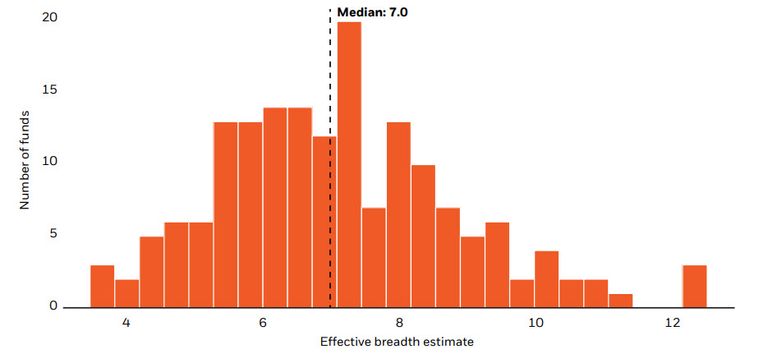
Yet many macro portfolios are less diversified than they appear. As Figure 1 illustrates, macro hedge fund breadth tends to be quite low on average, with the upper end sitting at about 12 on average, a median of only about 7.
Figure 1: Distribution of Average Effective Breadth across Macro Hedge Funds
Source:
HFRI, Blackrock; as of 3/31/2026. While there may be various way to do this, being limited to only returns reduces the number of possible techniques. We use the following procedure, which we believe is a reasonable approach to provide a description of the range of effective breadth across the macro fund universe. For each HFRI Macro constituent fund, we estimate the fraction of return variance attributable to each of 67 systematic asset allocation strategies (spanning carry, momentum, value, seasonal, and defensive strategies across developed and emerging market FX, equities, bonds, swaps, credit, and commodities). Using rolling 36-month windows, we run a forward stepwise regression: at each step, we regress the current residual fund return on every remaining (unused) factor individually, select the factor with the highest univariate R², record its beta, and residualize the fund return to the factor. The variance explained by the k-th factor selected is computed as (Var(Y_{k-1} )- Var(Y_k ))/Var(Y) , where Y is the original fund return series in the window, Y_{k-1} is the residual entering step k, and Y_k is the residual after removing the k-th factor's contribution; these shares sum to the total R² of the full decomposition and provide an ordering-aware measure of each factor's marginal explanatory power, as well as the relative share of risk explained by each factor. Using this decompositions of percent contribution of active risk (PCAR) spent on each factor, we can understand the level of diversification across insights of each fund. Using the concept of the “Herfindahl-Hirschman Index (HHI)”, which measures the level of concentration in a portfolio, we compute the inverse using following equation to convert PCAR estimates by explanatory strategy to an estimated level of effective breadth inherent within each portfolio: Effective Breadth=1/(Σ_strategy PCAR_strategy^2 ). We look at averages over 3-year rolling periods to reduce the impact of any particular time period in our analysis.
Positions that look independent at the instrument level often reflect the same underlying macro thesis. A portfolio may contain dozens of trades, but if they are all driven by a single growth, inflation or policy view, effective diversification can be far lower than expected.
The result is a paradox: portfolios that appear diversified during normal market conditions can become highly concentrated during periods of stress.
Why breadth matters
Breadth, the number of independent opportunities represented in a portfolio, is one of the central concepts of the Fundamental Law of Active Management.
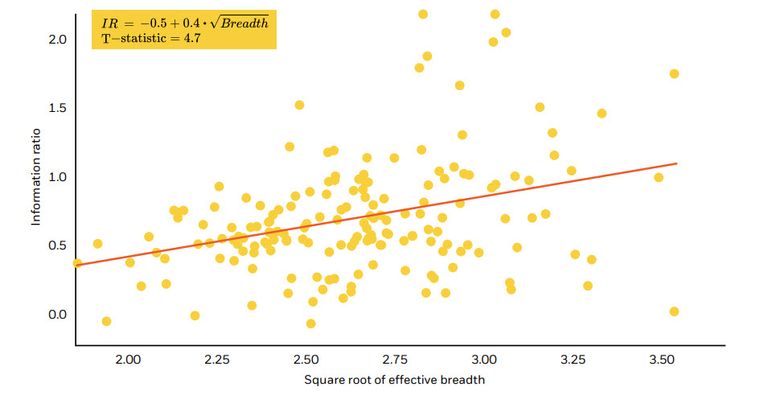
Our research suggests that breadth is not simply a theoretical construct. Across the macro hedge fund universe, higher effective breadth has historically been associated with stronger information ratios and more consistent performance outcomes. Figure 2 illustrates the positive relationship between effective breadth and realized information ratios.
Figure 2: Relationship between the square root of effective breadth and information ratios across funds in HFRI Macro Index
Source:
HFRI, BlackRock, as of 3/31/2026
The implication is straightforward: expanding the number of truly independent sources of return may improve portfolio resilience without requiring investors to increase conviction or risk.
What investors may be missing
Many approaches to diversification focus on positions, asset classes or geographies.
But portfolios ultimately succeed or fail based on the underlying drivers of risk.For systematic investors, hidden concentration can emerge when multiple signals load onto the same dominant factors. For discretionary investors, concentration can arise when multiple trades express a common macro view.
In both cases, apparent diversification can overstate true independence.
Building breadth by design
The strongest macro portfolios are not necessarily those with the most positions. They are often those with the greatest number of independent opportunities.
This research explores practical approaches to expanding breadth—from diversifying across principal drivers of return in systematic strategies to allocating risk across differentiated macro insights in discretionary portfolios.
The goal is not diversification for its own sake. It is to preserve risk capacity, reduce concentration-driven drawdowns and maintain flexibility when opportunities emerge.
A structural source of macro resilience
As macro markets become increasingly interconnected, understanding the difference between apparent diversification and true breadth may become more important than ever.
Read the paper to learn why breadth may be one of the most underappreciated drivers of long-term macro resilience.
Read the full report

Raffaele Savi
Global Head of BlackRock Systematic and Co-CIO of Systematic Active Equities

Phil Green
Head of Global Tactical Asset Allocation

Stephanie Lee
Co-lead Systematic Macro, Portfolio Manager, BlackRock Systematic

Richard Murrall
Portfolio Manager, Global Tactical Asset Allocation Team

Michael Pensky, CFA
Deputy CIO, Portfolio Manager, Global Tactical Asset Allocation

Jeff Shen, PhD
Co-Head and Co-CIO of BlackRock Systematic Active Equities
Explore more Systematic insights
At BlackRock, our Systematic investing platform combines alternative data, data science and deep human expertise to help modernize the way we invest and construct portfolios on behalf of our clients.
Using LLMs to Read the World’s Economic Narrative
Discover how Large Language Models (LLMs) are reshaping macro research, providing a level of pattern recognition and narrative understanding that traditional tools cannot match.
Augmented Investment Management
In our data-rich world, active managers face the challenge of distilling several information sources into a holistic view. Learn how we use machine learning to help combine investment signals and design alpha models.