Skip to content

Welcome to the BlackRock site for institutional investors
Before you proceed, please take a moment to review and accept the following Terms and Conditions:
BY CLICKING ON “I AGREE”, I DECLARE I AM A WHOLESALE CLIENT AS DEFINED IN THE CORPORATIONS ACT 2001.
What is a Wholesale Client?
A person or entity is a “wholesale client” if they satisfy the requirements of section 761G of the Corporations Act.
This commonly includes a person or entity:
- who holds an Australian Financial Services License
- who has or controls at least $10 million (and may include funds held by an associate or under a trust that the person manages)
- that is a body regulated by APRA other than a trustee of:
(i) a superannuation fund;
(ii) an approved deposit fund;
(iii) a pooled superannuation trust; or
(iv) a public sector superannuation scheme.
within the meaning of the Superannuation Industry (Supervision) Act 1993 - that is a body registered under the Financial Corporations Act 1974.
- that is a trustee of:
(i) a superannuation fund; or
(ii) an approved deposit fund; or
(iii) a pooled superannuation trust; or
(iv) a public sector superannuation scheme
within the meaning of the Superannuation Industry (Supervision) Act 1993 and the fund, trust or scheme has net assets of at least $10 million. - that is a listed entity or a related body corporate of a listed entity
- that is an exempt public authority
- that is a body corporate, or an unincorporated body, that:
(i) carries on a business of investment in financial products, interests in land or other investments; and
(ii) for those purposes, invests funds received (directly or indirectly) following an offer or invitation to the public, within the meaning of section 82 of the Corporations Act 2001, the terms of which provided for the funds subscribed to be invested for those purposes. - that is a foreign entity which, if established or incorporated in Australia, would be covered by one of the preceding paragraphs.


Private Markets
AI: The real estate opportunity
Our investors explore how AI is transforming real estate investing by automating tasks, optimizing operations, and creating new investment opportunities.
Key takeaways
-
01
AI will be transformational
Digital disruption and AI are among the most transformative forces shaping future economic trends and asset performance in this market cycle.
-
02
How we interact with the built environment is changing
AI is reshaping real estate investment by driving shifts in sector demand and redefining society’s expectations of the built environment.
-
03
Real estate investors aligning with AI will outperform
Investors who proactively align their strategies with AI-driven shifts are positioned to achieve stronger returns.
0:04
Real estate, one of the world's longest standing asset classes, is colliding with the world's most advanced technologies, artificial intelligence.
0:13
The result is a powerful transformation that's reshaping how we work, live, invest and experience the world around us.
0:22
AI is revolutionizing real estate, starting with how companies utilize space, and will impact living, logistics and hospitality.
0:32
Real estate is also essential for AI growth, highlighting the need for more specialized real estate such as cutting edge data centers.
0:40
Data centers are a combination of both real estate and infrastructure, encompassing both the physical building, the real estate and energy and the systems within it.
0:50
The infrastructure data centers share many fundamentals with logistics properties.
0:55
Both rely on strategic site selection, land availability, power and digital connectivity.
1:03
Data centers also have unique characteristics and are far more complex than just sheds with power.
1:09
How AI will impact the way we work is another hot topic for real estate investors.
1:15
This will have a profound implication for the office sector, accelerating the dispersion between best in class properties and everything else.
1:24
At the same time, many believe that AI will free up people's time, creating more time for socializing, travelling and the pursuit of hobbies.
1:32
This could be a strong tailwind for hospitality and hotels as businesses that cater to health, Wellness and passion driven experiences will thrive.
1:41
AI is making us better investors too.
1:43
We are the proud holders of the first of its kind AI real estate investment patent for AI driven capital crowding model.
1:51
This groundbreaking innovation uses artificial intelligence to help investors understand future demand for real estate.
1:59
AI is vastly altering the real estate landscape and there will be winners and losers.
2:04
We dig into these themes in our AI and real Estate paper, and we look forward to talking with you more about how the intersection of AI and real estate will shape the future.
The AI Opportunity in Real Estate
AI is reshaping how we live, work, and use real estate. As machine learning and generative AI drive innovation and efficiency, they’re also redefining property demand. Discover which sectors are poised to thrive, and how investors can lead in an AI-powered future.
AI will have far reaching impacts on how we live, work and play, and therefore how we interact with the built environment. Advances in machine learning and generative AI are accelerating innovation, automating complex tasks, and unlocking new efficiencies and revenue opportunities for companies.
As these new technologies change the business landscape for companies, they’re also changing the ways that companies use real estate. If not today, they will impact in the very near future. No one truly knows how this transformation will reshape society. What we do know however, is that this is not a short-lived phenomenon.
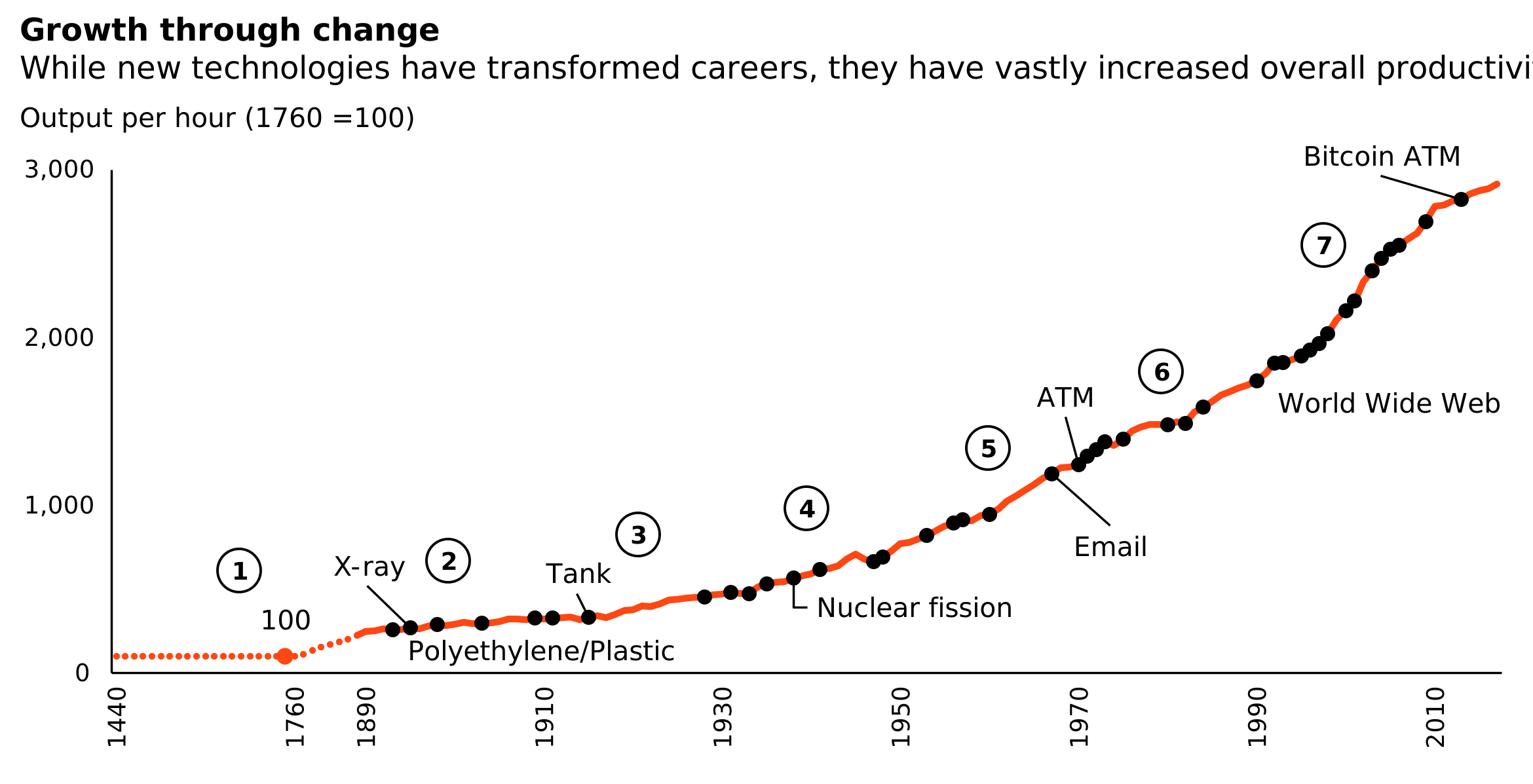
Source: Note: Labour productivity index (1760-100) created using UK and US data. UK data from 1760 to 1889 taken from BoE's 'a millennium of macroeconomic data for the UK'. US historical series from 1890 to 2017 created using Kendrick (1961) and BLS (non-farm business sector; real output per hour) data. US and UK historical series spliced together to arrive at a longer data history starting from 1760 up until 2017. Source: Kendrick (1961), BLS, BOE, Barclays Research, Blackrock, March 2025. The black dots represent the new technological innovations with the major ones labeled.
By identifying the property sectors positioned for success, and those likely to face challenges in an AI-driven future, we can build conviction on which sectors and markets will outperform. For example, real estate investors will play a crucial role in the data-center value chain. At the same time, real estate investors can also benefit from AI’s potential to support the energy transition.
Real estate investors will play a crucial role in the evolution of the AI value chain. The scale-up of AI is fueling enormous demand for data centers. AI is valued as a roughly US$4 trillion global opportunity1. Data center demand is a representation of the physical infrastructure needed to achieve that.
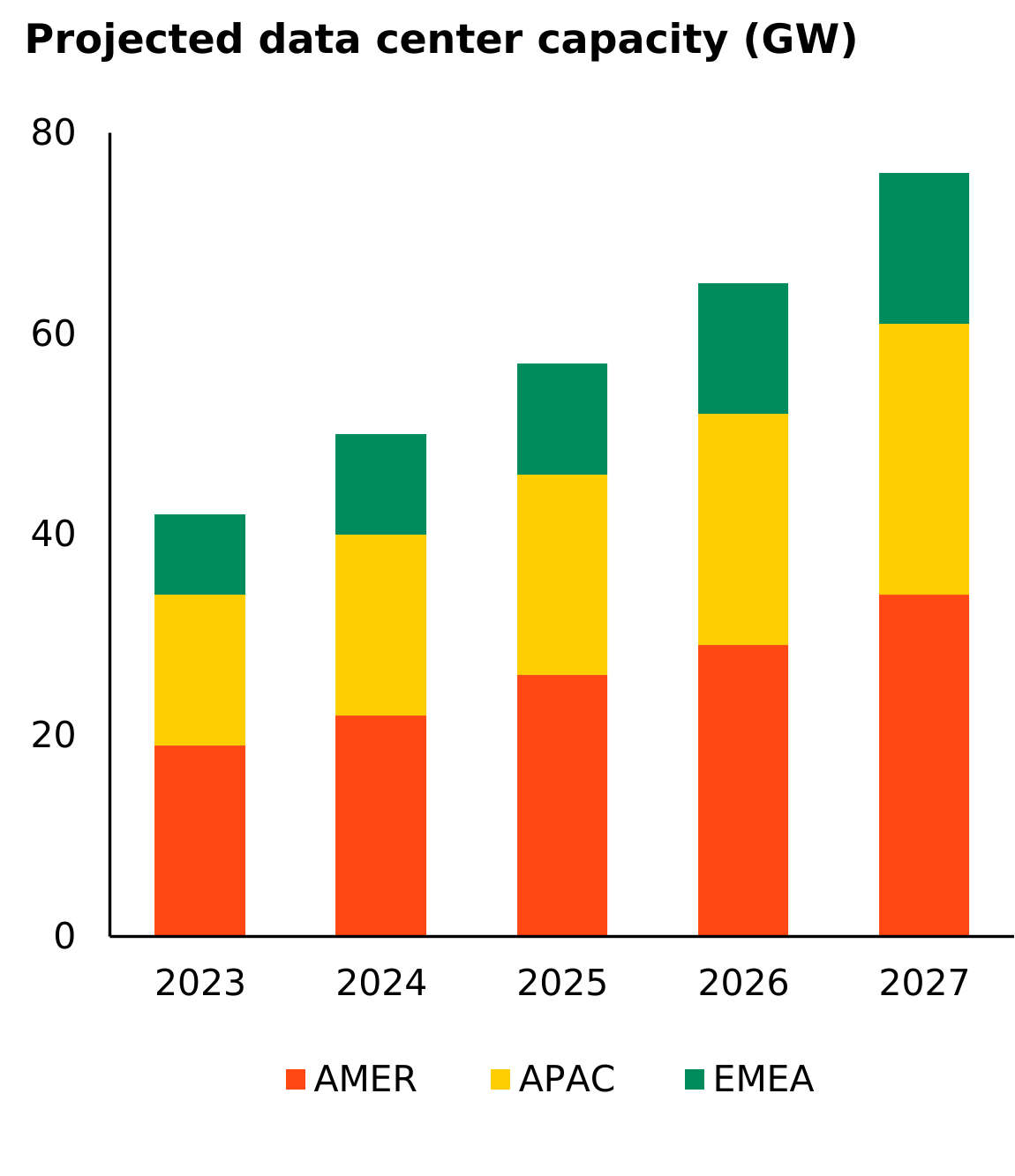
Source: JLL Research, 2024, Structure Research, Note: Capacity includes hyperscale and colocation, BlackRock, March 2025. Forecasts may not come to pass.
Data centers share similar fundamentals with traditional real estate, such as logistics, however they are more complex than simply a ‘shed with power’. Both rely on site selection, land availability, connectivity, and infrastructure, but data centers do not have docks, have increased site coverage and can have different physical characteristics. The availability of power, however, is vital, along with proximity to urban hubs and transport routes. Investment timelines are also similar, with typical hold periods of around four years.
The acute supply-demand imbalance in the data center market is evident, as existing infrastructure struggles to meet the soaring demands of AI applications.
As with any growing sector, real estate investors should consider risks related to data centers, especially regarding exit strategies and liquidity. Strong expertise and robust relationships with key stakeholders and operators are essential to ensure a favorable risk-return profile.
At many points in the data-center supply chain, investment into data centers follows a duration and level of risk appetite that can align with the risk return profile of value-add real estate investment.
Source: 1. McKinsey and Company, 01/28/2025
Author

Simon Durkin
Head of Global Real Estate Research and Portfolio Analytics.

Chloe Soar
Associate, Real Estate Research and Strategy.
Explore more
Investment Capabilities
Events & webcasts


Investing involves risk, including possible loss of principal. Asset allocation and diversification may not protect against market risk, loss of principal or volatility of returns. Actual investment outcomes may vary. The model portfolios should not be construed as investment advice. There is no guarantee that these investment strategies will work under all market conditions or are suitable for all investors and each investor should evaluate their ability to invest long-term, especially during periods of downturn in the market. No representation is being made that any account, product, or strategy will or is likely to achieve profits. The above are representations of various model portfolios and no guarantee is being made that the structure of other similar portfolios will remain the same or that similar results will be achieved.
Risk Warnings
Capital at risk. The value of investments and the income from them can fall as well as rise and are not guaranteed. Investors may not get back the amount originally invested.
Past performance is not a reliable indicator of current or future results and should not be the sole factor of consideration when selecting a product or strategy.
Changes in the rates of exchange between currencies may cause the value of investments to diminish or increase. Fluctuation may be particularly marked in the case of a higher volatility fund and the value of an investment may fall suddenly and substantially. Levels and basis of taxation may change from time to time.
The information contained in this document, does not constitute and should not be construed as an offer of, invitation or proposal to make an offer for, recommendation to apply for or an opinion or guidance on a financial product, service and/or strategy. Whilst great care has been taken to ensure that the information contained in this document is accurate, no responsibility can be accepted for any errors, mistakes or omissions or for any action taken in reliance thereon. You may only reproduce, circulate and use this document (or any part of it) with the consent of BlackRock.
The information contained in this document is for information purposes only. It is not intended for and should not be distributed to, or relied upon by, members of the public.
The information contained in this document, may contain statements that are not purely historical in nature but are “forward-looking statements”. These include, amongst other things, projections, forecasts or estimates of income. These forward-looking statements are based upon certain assumptions, some of which are described in other relevant documents or materials. If you do not understand the contents of this document, you should consult an authorised financial adviser.
This material is for distribution to Professional Clients (as defined by the Financial Conduct Authority or MiFID Rules) only and should not be relied upon by any other persons
In the UK and Non-European Economic Area (EEA) countries: this is Issued by BlackRock Investment Management (UK) Limited, authorised and regulated by the Financial Conduct Authority. Registered office: 12 Throgmorton Avenue, London, EC2N 2DL. Tel: + 44 (0)20 7743 3000. Registered in England and Wales No. 02020394. For your protection telephone calls are usually recorded. Please refer to the Financial Conduct Authority website for a list of authorised activities conducted by BlackRock.
In the European Economic Area (EEA): this is Issued by BlackRock (Netherlands) B.V. is authorised and regulated by the Netherlands Authority for the Financial Markets. Registered office Amstelplein 1, 1096 HA, Amsterdam, Tel: 020 – 549 5200, Tel: 31-20-549-5200. Trade Register No. 17068311 For your protection telephone calls are usually recorded.
IN SOUTH AFRICA: Please be advised that BlackRock Investment Management (UK) Limited is an authorised Financial Services provider with the South African Financial Services Conduct Authority, FSP No. 43288.
For qualified investors in Switzerland: This document is marketing material. This document shall be exclusively made available to, and directed at, qualified investors as defined in Article 10 (3) of the CISA of 23 June 2006, as amended, at the exclusion of qualified investors with an opting-out pursuant to Art. 5 (1) of the Swiss Federal Act on Financial Services ("FinSA").
For information on art. 8 / 9 Financial Services Act (FinSA) and on your client segmentation under art. 4 FinSA, please see the following website: www.blackrock.com/finsa
For investors in Israel: BlackRock Investment Management (UK) Limited is not licenced under Israel's Regulation of Investment Advice, Investment Marketing and Portfolio Management Law, 5755-1995 (the “Advice Law”), nor does it carry insurance thereunder.
This material is for distribution to Professional Clients (as defined by the Financial Conduct Authority or MiFID Rules) only and should not be relied upon by any other persons
For information on investor rights and how to raise complaints please go to https://www.blackrock.com/corporate/compliance/investor-right available in Italian.
For investors in Bahrain: The information contained in this document is intended strictly for sophisticated institutions.
For investors in Qatar: The information contained in this document is intended strictly for sophisticated institutions.
For investors in United Arab Emirates: The information contained in this document is intended strictly for Professional Investors.
For investors in Dubai (DIFC): The information contained in this document is intended strictly for Professional Clients as defined under the Dubai Financial Services Authority (“DFSA”) Conduct of Business (COB) Rules
BlackRock Advisors (UK) Limited - Dubai Branch is a DIFC Foreign Recognised Company registered with the DIFC Registrar of Companies (DIFC Registered Number 546), with its office at Unit L15 - 01A, ICD Brookfield Place, Dubai International Financial Centre, PO Box 506661, Dubai, UAE, and is regulated by the DFSA to engage in the regulated activities of ‘Advising on Financial Products’ and ‘Arranging Deals in Investments’ in or from the DIFC, both of which are limited to units in a collective investment fund (DFSA Reference Number F000738).
For investors in Saudi Arabia: The information contained in this document is intended strictly for Institutional and Qualified Clients (as defined by the Implementing Regulations issued by Capital Market Authority) only and should not be relied upon by any other persons.
Issued by BlackRock Saudi Arabia, authorised and regulated by the Capital Market Authority (License Number 18- 192-30). Registered office: 7976 Salim Ibn Abi Bakr Shaikan St, 2223 West Umm Al HamamDistrict Riyadh, 12329 Riyadh, Kingdom of Saudi Arabia, Tel: +966 11 838 3600. CR No, 1010479419. For your protection telephone calls are usually recorded. Please refer to the Capital Market Authority website for a list of authorised activities conducted by BlackRock Saudi Arabia
The information contained in this document, does not constitute and should not be construed as an offer of, invitation or proposal to make an offer for, recommendation to apply for or an opinion or guidance on a financial product, service and/or strategy. Whilst great care has been taken to ensure that the information contained in this document is accurate, no responsibility can be accepted for any errors, mistakes or omissions or for any action taken in reliance thereon. You may only reproduce, circulate and use this document (or any part of it) with the consent of BlackRock.
The information contained in this document is for information purposes only. It is not intended for and should not be distributed to, or relied upon by, members of the public.
The information contained in this document, may contain statements that are not purely historical in nature but are “forward looking statements”. These include, amongst other things, projections, forecasts or estimates of income. These forward looking statements are based upon certain assumptions, some of which are described in other relevant documents or materials. If you do not understand the contents of this document, you should consult an authorised financial adviser.
In Hong Kong, this material is issued by BlackRock Asset Management North Asia Limited and has not been reviewed by the Securities and Futures Commission of Hong Kong. This material is for distribution to "Professional Investors" (as defined in the Securities and Futures Ordinance (Cap.571 of the laws of Hong Kong) and any rules made under that ordinance) and should not be relied upon by any other persons or redistributed to retail clients in Hong Kong.
In Singapore, this is issued by BlackRock (Singapore) Limited (Co. registration no. 200010143N) for use only with institutional investors as defined in Section 4A of the Securities and Futures Act, Chapter 289 of Singapore. This advertisement or publication has not been reviewed by the Monetary Authority of Singapore.
In South Korea, this information is issued by BlackRock Investment (Korea) Limited. This material is for distribution to the Qualified Professional Investors (as defined in the Financial Investment Services and Capital Market Act and its sub-regulations) and for information or educational purposes only, and does not constitute investment advice or an offer or solicitation to purchase or sells in any securities or any investment strategies.
In Taiwan, independently operated by BlackRock Investment Management (Taiwan) Limited. Address: 28F., No. 100, Songren Rd., Xinyi Dist., Taipei City 110, Taiwan. Tel: (02)23261600.
In Australia & New Zealand, issued by BlackRock Investment Management (Australia) Limited ABN 13 006 165 975, AFSL 230 523 (BIMAL) for the exclusive use of the recipient, which warrants by receipt of this material that it is a wholesale client as defined under the Australian Corporations Act 2001 (Cth) and the New Zealand Financial Advisers Act 2008 respectively BIMAL is not licensed by a New Zealand regulator to provide ‘Financial Advice Service’ ‘Investment manager under an FMC offer’ or ‘Keeping, investing, administering, or managing money, securities, or investment portfolios on behalf of other persons’. BIMAL’s registration on the New Zealand register of financial service providers does not mean that BIMAL is subject to active regulation or oversight by a New Zealand regulator.
This material provides general advice only and does not take into account your individual objectives, financial situation, needs or circumstances. Before making any investment decision, you should therefore assess whether the material is appropriate for you and obtain financial advice tailored to you having regard to your individual objectives, financial situation, needs and circumstances. Refer to BIMAL’s Financial Services Guide on its website for more information. This material is not a financial product recommendation or an offer or solicitation with respect to the purchase or sale of any financial product in any jurisdiction. Information provided is for illustrative and informational purposes and is subject to change. It has not been approved by any regulator.
This material is not intended for distribution to, or use by, any person or entity in any jurisdiction or country where such distribution or use would be contrary to local law or regulation. BIMAL is a part of the global BlackRock Group which comprises of financial product issuers and investment managers around the world. BIMAL is the issuer of financial products and acts as an investment manager in Australia. BIMAL does not offer financial products to persons in New Zealand who are retail investors (as that term is defined in the Financial Markets Conduct Act 2013 (FMCA)). This material does not constitute or relate to such an offer. To the extent that this material does constitute or relate to such an offer of financial products, the offer is only made to, and capable of acceptance by, persons in New Zealand who are wholesale investors (as that term is defined in the FMCA).
BIMAL, its officers, employees and agents believe that the information in this material and the sources on which it is based (which may be sourced from third parties) are correct as at the date of publication. While every care has been taken in the preparation of this material, no warranty of accuracy or reliability is given and no responsibility for the information is accepted by BIMAL, its officers, employees or agents. Except where contrary to law, BIMAL excludes all liability for this information.
No part of this material may be reproduced or distributed in any manner without the prior written permission of BIMAL.
In China, this material may not be distributed to individuals resident in the People's Republic of China ("PRC", for such purposes, not applicable to Hong Kong, Macau and Taiwan) or entities registered in the PRC unless such parties have received all the required PRC government approvals to participate in any investment or receive any investment advisory or investment management services.
For Southeast Asia: This document is issued by BlackRock and is intended for the exclusive use of any recipient who warrants, by receipt of this material, that such recipient is an institutional investors or professional/sophisticated/qualified/accredited/expert investor as such term may apply under the relevant legislations in Southeast Asia (for such purposes, includes only Malaysia, the Philippines, Thailand and Indonesia). BlackRock does not hold any regulatory licenses or registrations in Southeast Asia countries listed above, and is therefore not licensed to conduct any regulated business activity under the relevant laws and regulations as they apply to any entity intending to carry on business in Southeast Asia, nor does BlackRock purport to carry on, any regulated activity in any country in Southeast Asia. BlackRock funds, and/or services shall not be offered or sold to any person in any jurisdiction in which such an offer, solicitation, purchase, or sale would be deemed unlawful under the securities laws or any other relevant laws of such jurisdiction(s). This material is provided to the recipient on a strictly confidential basis and is intended for informational or educational purposes only. Nothing in this document, directly or indirectly, represents to you that BlackRock will provide, or is providing BlackRock products or services to the recipient, or is making available, inviting, or offering for subscription or purchase, or invitation to subscribe for or purchase, or sale, of any BlackRock fund, or interests therein. This material neither constitutes an offer to enter into an investment agreement with the recipient of this document, nor is it an invitation to respond to it by making an offer to enter into an investment agreement. The distribution of the information contained herein may be restricted by law and any person who accesses it is required to comply with any such restrictions. By reading this information you confirm that you are aware of the laws in your own jurisdiction regarding the provision and sale of funds and related financial services or products, and you warrant and represent that you will not pass on or utilize the information contained herein in a manner that could constitute a breach of such laws by BlackRock, its affiliates or any other person
For Other Countries in APAC: This material is provided for your informational purposes only and must not be distributed to any other persons or redistributed. This material is issued for Institutional Investors only (or professional/sophisticated/qualified investors as such term may apply in local jurisdictions) and does not constitute investment advice or an offer or solicitation to purchase or sell in any securities, BlackRock funds or any investment strategy nor shall any securities be offered or sold to any person in any jurisdiction in which an offer, solicitation, purchase or sale would be unlawful under the securities laws of such jurisdiction of BlackRock, Inc. or its subsidiaries in the United States and elsewhere. All other trademarks are those of their respective owners
In Canada, this material is intended for institutional investors, is for educational purposes only, does not constitute investment advice and should not be construed as a solicitation or offering of units of any fund or other security in any jurisdiction.
In Latin America, for institutional investors and financial intermediaries only (not for public distribution). This material is for educational purposes only and does not constitute investment advice or an offer or solicitation to sell or a solicitation of an offer to buy any shares of any fund or security and it is your responsibility to inform yourself of, and to observe, all applicable laws and regulations of your relevant jurisdiction. If any funds are mentioned or inferred in this material, such funds may not been registered with the securities regulators of Argentina, Brazil, Chile, Colombia, Mexico, Panama, Peru, Uruguay or any other securities regulator in any Latin American country and thus, may not be publicly offered in any such countries. The securities regulators of any country within Latin America have not confirmed the accuracy of any information contained herein. No information discussed herein can be provided to the general public in Latin America. The contents of this material are strictly confidential and must not be passed to any third party.
In Argentina, only for use with Qualified Investors under the definition as set by the Comisión Nacional de Valores (CNV).
In Colombia, the promotion of each product discussed herein is carried out through the Representative Office of BlackRock Fund Advisors, authorized by the Colombian Financial Superintendence.
The transmission of this information does not constitute a securities public offering in Colombia. The products discussed herein may not be promoted or marketed in Colombia or to Colombian residents unless such promotion and marketing is made in compliance with Decree 2555 of 2010 and other applicable rules and regulations related to the promotion of foreign financial and/or securities related products or services in Colombia.
With the receipt of these materials, and unless the Client contacts BlackRock with additional requests for information, the Client agrees to have been provided the information for due advisory required by the marketing and promotion regulatory regime applicable in Colombia.
In Chile, The securities if any described in this document are foreign securities, therefore: i) their rights and obligations will be subject to the legal framework of the issuer's country of origin, and therefore, investors must inform themselves regarding the form and means through which they may exercise their rights; and that ii) the supervision of the Commission for the Financial Market (Comisión para el Mercado Financiero or “CMF”) will be concentrated exclusively on compliance with the information obligations established in General Standard No. 352 of the CMF and that, therefore, the supervision of the security and its issuer will be mainly made by the foreign regulator; In the case of a fund not registered with the CMF is subject to General Rule No. 336 issued by the SVS (now the CMF). The subject matter of this sale may include securities not registered with the CMF; therefore, such securities are not subject to the supervision of the CMF. Since the securities are not registered in Chile, there is no obligation of the issuer to make publicly available information about the securities in Chile. The securities shall not be subject to public offering in Chile unless registered with the relevant registry of the CMF.
In Peru, this private offer does not constitute a public offer, and is not registered with the Securities Market Public Registry of the Peruvian Securities Market Commission, for use only with institutional investors as such term is defined by the Superintendencia de Banca, Seguros y AFP.
In Uruguay, the Securities are not and will not be registered with the Central Bank of Uruguay. The Securities are not and will not be offered publicly in or from Uruguay and are not and will not be traded on any Uruguayan stock exchange. This offer has not been and will not be announced to the public and offering materials will not be made available to the general public except in circumstances which do not constitute a public offering of securities in Uruguay, in compliance with the requirements of the Uruguayan Securities Market Law (Law Nº 18.627 and Decree 322/011).
IN MEXICO, FOR INSTITUTIONAL AND QUALIFIED INVESTORS USE ONLY. INVESTING INVOLVES RISK, INCLUDING POSSIBLE LOSS OF PRINCIPAL. THIS MATERIAL IS PROVIDED FOR EDUCATIONAL AND INFORMATIONAL PURPOSES ONLY AND DOES NOT CONSTITUTE AN OFFER OR SOLICITATION TO SELL OR A SOLICITATION OF AN OFFER TO BUY ANY SHARES OF ANY FUND OR SECURITY. This information does not consider the investment objectives, risk tolerance or the financial circumstances of any specific investor. This information does not replace the obligation of financial advisor to apply his/her best judgment in making investment decisions or investment recommendations. It is your responsibility to inform yourself of, and to observe, all applicable laws and regulations of Mexico. If any funds, securities or investment strategies are mentioned or inferred in this material, such funds, securities or strategies have not been registered with the Mexican National Banking and Securities Commission (Comisión Nacional Bancaria y de Valores, the “CNBV”) and thus, may not be publicly offered in Mexico. The CNBV has not confirmed the accuracy of any information contained herein. The provision of investment management and investment advisory services (“Investment Services”) is a regulated activity in Mexico, subject to strict rules, and performed under the supervision of the CNBV. These materials are shared for information purposes only, do not constitute investment advice, and are being shared in the understanding that the addressee is an Institutional or Qualified investor as defined under Mexican Securities (Ley del Mercado de Valores). Each potential investor shall make its own investment decision based on their own analysis of the available information. Please note that by receiving these materials, it shall be construed as a representation by the receiver that it is an Institutional or Qualified investor as defined under Mexican law. BlackRock México Operadora, S.A. de C.V., Sociedad Operadora de Fondos de Inversión (“BlackRock México Operadora”) is a Mexican subsidiary of BlackRock, Inc., authorized by the CNBV as a Mutual Fund Manager (Operadora de Fondos), and as such, authorized to manage Mexican mutual funds, ETFs and provide Investment Advisory Services. For more information on the Investment Services offered by BlackRock Mexico, please review our Investment Services Guide available in www.blackrock.com/mx. This material represents an assessment at a specific time and its information should not be relied upon by the you as research or investment advice regarding the funds, any security or investment strategy in particular. Reliance upon information in this material is at your sole discretion. BlackRock México is not authorized to receive deposits, carry out intermediation activities, or act as a broker dealer, or bank in Mexico. For more information on BlackRock México, please visit: www.blackrock.com/mx. BlackRock receives revenue in the form of advisory fees for our advisory services and management fees for our mutual funds, exchange traded funds and collective investment trusts. Any modification, change, distribution or inadequate use of information of this document is not responsibility of BlackRock or any of its affiliates. Pursuant to the Mexican Data Privacy Law (Ley Federal de Protección de Datos Personales en Posesión de Particulares), to register your personal data you must confirm that you have read and understood the Privacy Notice of BlackRock México Operadora. For the full disclosure, please visit www.blackrock.com/mx and accept that your personal information will be managed according with the terms and conditions set forth therein. BlackRock® is a registered trademark of BlackRock, Inc. All other trademarks are the property of their respective owners.
For investors in Central America, these securities have not been registered before the Securities Superintendence of the Republic of Panama, nor did the offer, sale or their trading procedures. The registration exemption has made according to numeral 3 of Article 129 of the Consolidated Text containing of the Decree-Law No. 1 of July 8, 1999 (institutional investors). Consequently, the tax treatment set forth in Articles 334 to 336 of the Unified Text containing Decree-Law No. 1 of July 8, 1999, does not apply to them. These securities are not under the supervision of the Securities Superintendence of the Republic of Panama. The information contained herein does not describe any product that is supervised or regulated by the National Banking and Insurance Commission (CNBS) in Honduras. Therefore any investment described herein is done at the investor’s own risk. In Costa Rica, any securities or services mentioned herein constitute an individual and private offer made through reverse solicitation upon reliance on an exemption from registration before the General Superintendence of Securities (“SUGEVAL”), pursuant to articles 7 and 8 of the Regulations on the Public Offering of Securities (“Reglamento sobre Oferta Pública de Valores”). This information is confidential, and is not to be reproduced or distributed to third parties as this is NOT a public offering of securities in Costa Rica. The product being offered is not intended for the Costa Rican public or market and neither is registered or will be registered before the SUGEVAL, nor can be traded in the secondary market.
If any recipient of this documentation receives this document in El Salvador, such recipient acknowledges that the same has been delivered upon their request and instructions, and on a private placement basis. In Guatemala, this communication and any accompanying information (the “Materials”) are intended solely for informational purposes and do not constitute (and should not be interpreted to constitute) the offering, selling, or conducting of business with respect to such securities, products or services in the jurisdiction of the addressee (this “Jurisdiction”), or the conducting of any brokerage, banking or other similarly regulated activities (“Financial Activities”) in the Jurisdiction. Neither BlackRock, nor the securities, products and services described herein, are registered (or intended to be registered) in the Jurisdiction. Furthermore, neither BlackRock, nor the securities, products, services or activities described herein, are regulated or supervised by any governmental or similar authority in the Jurisdiction. The Materials are private, confidential and are sent by BlackRock only for the exclusive use of the addressee. The Materials must not be publicly distributed and any use of the Materials by anyone other than the addressee is not authorized. The addressee is required to comply with all applicable laws in the Jurisdiction, including, without limitation, tax laws and exchange control regulations, if any
For investors in the Caribbean, any funds mentioned or inferred in this material have not been registered under the provisions of the Investment Funds Act of 2003 of the Bahamas, nor have they been registered with the securities regulators of Bermuda, Dominica, the Cayman Islands, the British Virgin Islands, Grenada, Trinidad & Tobago or any jurisdiction in the Organisation of Eastern Caribbean States, and thus, may not be publicly offered in any such jurisdiction. The shares of any fund mentioned herein may only be marketed in Bermuda by or on behalf of the fund or fund manager only in compliance with the provision of the Investment Business Act 2003 of Bermuda and the Companies Act of 1981. Engaging in marketing, offering or selling any fund from within the Cayman Islands to persons or entities in the Cayman Islands may be deemed carrying on business in the Cayman Islands.
As a non-Cayman Islands person, BlackRock may not carry on or engage in any trade or business unless it properly registers and obtains a license for such activities in accordance with the applicable Cayman Islands law. For Domincan Republic, any securities mentioned or inferred in this material may only be offered in a private character according to the laws of the Dominican Republic, falling beyond the scope of articles 1 numeral (31), 46 et al of Law 249-17 dated 19 December 2017, as amended and its Regulations. Since no governmental authorizations are required in such offering, any “securities” mentioned or inferred in this material have not been and will not be registered with the Stock Market Superintendency of the Dominican Republic (Superintendencia de Mercado de Valores de la República Dominicana), and these “securities” may only be circulated, offered and sold in the Dominican Republic in a private manner based on the criteria established under Dominican laws and regulations.
© 2025 BlackRock, Inc. or its affiliates. All Rights reserved. BLACKROCK, iSHARES and ALADDIN are trademarks of BlackRock, Inc. or its affiliates. All other trademarks are those of their respective owners.
EPMH1225E/M-5019061