You are now leaving BlackRock’s website

You are leaving BlackRock’s website and entering a third-party website that is not controlled, maintained, or monitored by BlackRock. BlackRock is not responsible for the content or availability of the third-party website. By leaving BlackRock’s website, you will be subject to the third-party website’s terms, policies and/or notices, including those related to privacy and security, as applicable. Please review such policies and notices on the third-party website.

Global Insights

May 5, 2026|BlackRock Investment Institute

Conflict drives structural reset for Gulf economies

Structural pressures in focus

The Middle East conflict marks a structural shift for the region – a supply shock with lasting implications across energy, capital flows and logistics. Disruptions to systems underpinning global energy and trade, with the Strait of Hormuz at the center, are likely to reverberate for years. For the Gulf Cooperation Council (GCC), this implies a repricing of geopolitical risk and a pivot toward domestic investment and resilience. State-anchored financing will play a larger role — supporting industrial capacity, logistics and infrastructure, and security-linked sectors including energy, defense, and food systems — ultimately shaping the region’s post-conflict equilibrium.

GCC economies enter this period with substantial financial firepower – around US$7 trillion in sovereign wealth and reserve buffers – alongside persistent external surpluses. Yet, these buffers are unevenly distributed and increasingly deployed with strategic intent. See chart. Economies with stronger fiscal positions, deeper capital markets and greater export flexibility, notably Saudi Arabia and the UAE, are better positioned to sustain spending and investment through disruption.

For investors, the implications are structural. The adjustment is unfolding along three dimensions: wider dispersion across economies and markets, a reallocation of capital inward with global spillovers and a shift in the region's transformation toward resilience, security and more domestically anchored growth.
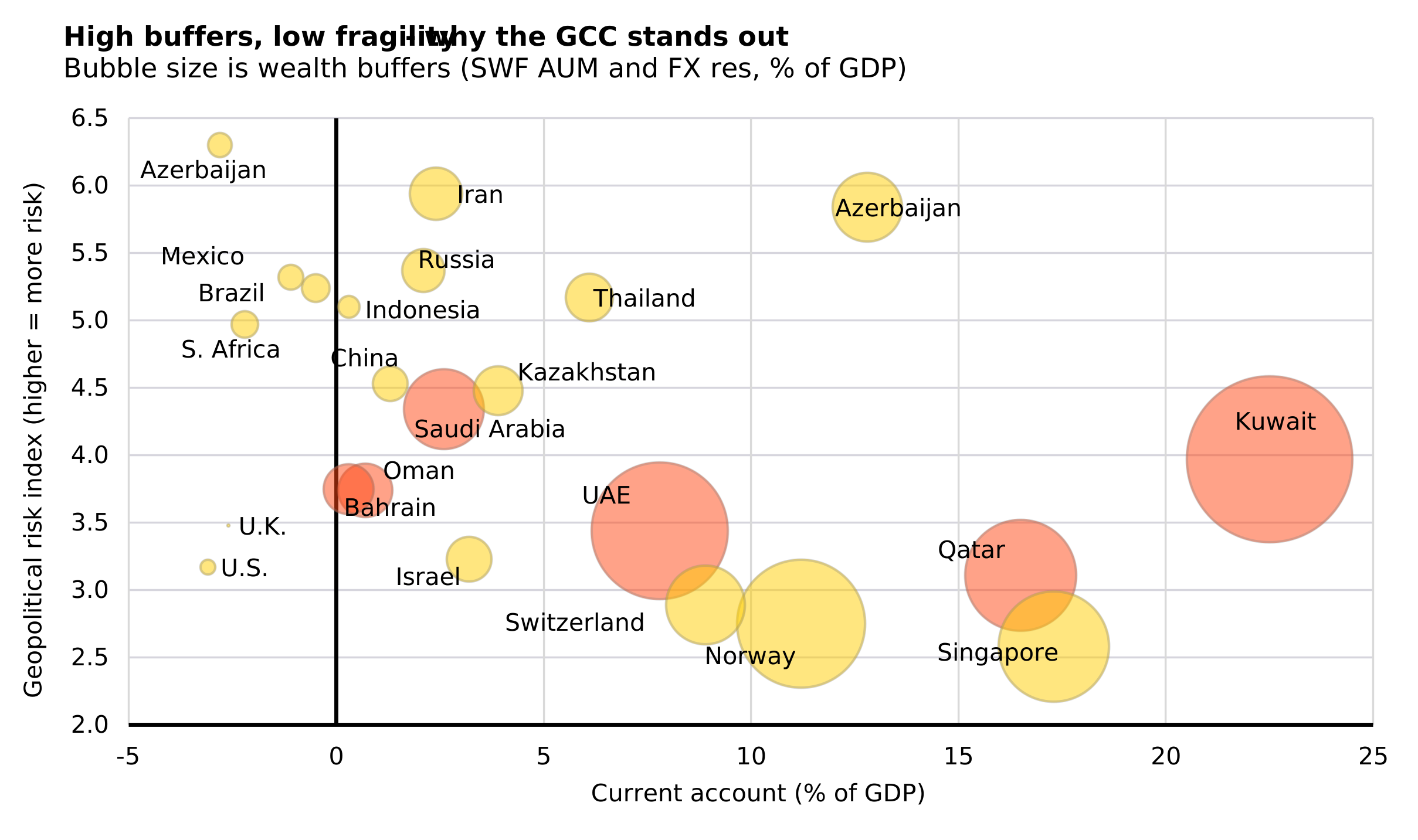
The bubble chart shows current account balances vs. geopolitical risk, with bubble size indicating wealth buffers.
Source:

BlackRock Investment Institute, GCC statistical offices, IMF, Geopolitical Risk Index, April 2025, Notes: Chart shows in the current account as % of GDP (x-axis), indicating whether resilience is being replenished or eroded, the geopolitical risk index (y-axis), capturing how frequently shocks may occur, and the wealth buffers calculated as sovereign assests under management and FX reserves as a % of GDP (bubble size), reflecting the depth of financial buffers.

Investment implications

1. Dispersion widens across economies and markets

The impact across GCC economies is not uniform. Transit dependent exporters face larger fiscal and growth impacts, while more diversified and flexible economies are better insulated. Our estimates suggest aggregate GCC GDP contracts by around 2.1% in 2026, masking wide dispersion — with outcomes ranging from Oman’s 2.6% expansion to Qatar’s 9.1% contraction. Beneath the headline, weakness is increasingly driven by non-oil activity. Sector-level shocks point to a 2–5% contraction in non-oil GDP, led by tourism and logistics and extending into real estate, construction and broader domestic demand.

At the market level, these differences are feeding into asset pricing. In equities, earnings pressure is concentrated in tourism, logistics and real estate, with knock-on effects for domestic demand. In credit, spreads are widening most sharply where fiscal buffers are thinner and financing flexibility is more limited. At the same time, funding channels are fragmenting, with more than $10 billion in private placements gaining traction as execution certainty trumps syndicated risks.

2. Capital reallocates inward with global spillovers

The more durable shift is in capital flows. GCC sovereign wealth funds, historically a major source of global liquidity, face a growing pull toward domestic priorities, reflecting weaker foreign direct investment, rising domestic financing needs and a higher premium on economic security. In our estimates, USD $50–100 billion could be redirected inward in the near-term.

As capital turns inward, the GCC's role in global capital markets is shifting — from a consistent provider of external liquidity to a more domestically anchored allocator — even as key corridors such as the U.S. and China remain central. Recent policy initiatives — including the UAE’s US$ 272 million (AED 1 billion) national industrial resilience fund — underscore the shift toward state-led capital deployment into domestic industrial capacity and strategic sectors. Capital allocation is being redirected toward structural sectors such as AI, advanced manufacturing and mining, alongside strategic areas including defense, logistics and food and water security. Recent attacks on AI infrastructure and data centers underscore how data, compute and energy systems are becoming embedded in the geopolitical domain — raising risk premia and reinforcing the need for investment in domestic platforms.

The global implications are material. A reduced GCC role as a buyer of global assets, including U.S. Treasuries at a time of elevated issuance, tightens global funding conditions at the margin. Outbound flows become more selective, with greater scrutiny of discretionary sectors such as real estate, entertainment and sports.

3. Transformation continues, but on new terms

The GCC diversification story remains intact, but it is being recalibrated. Across GCC economies, the emphasis is shifting from scale toward efficiency, from global integration toward greater strategic resilience and from consumer-facing activity toward more industrial and security-aligned priorities.

Defense spending is increasingly focused on localization and domestic capacity rather than procurement alone. Logistics and infrastructure are being repriced as resilience assets critical to securing trade and energy flows. AI and digital infrastructure continue to expand, with higher capital intensity and a greater role for domestic and sovereign financing. Tourism faces the sharpest near-term cyclical pressure across the region, even as it remains a long-term strategic priority, particularly in Saudi Arabia.

Rising uncertainty is reinforcing policy divergence across the GCC, with differences in geopolitical alignment and financing capacity meaning that fiscally stronger economies are better placed to advance transformation while others face harder trade-offs.

Bottom line

For GCC economies, the current shock represents a structural inflection point rather than a transitory disruption. Dispersion across GCC countries and markets is widening, capital is being redirected inward with implications for global liquidity and GCC growth models are shifting toward resilience and strategic priorities.

In a more fragmented and supply-constrained world, the edge for investors lies in identifying GCC economies with the capacity to sustain investment, absorb shocks and deploy capital decisively through volatility.


Related insights

Future of finance playing out in the Middle East

Gulf economies are accelerating diversification beyond hydrocarbons, channeling investment into non-oil sectors as finance shifts toward deeper, market-based capital systems.

Read more

Japan: starting to deliver

Ongoing shareholder-friendly corporate reforms are a key reason we added to our overweight to Japanese equities last month. Read more in our latest Asia insights.

Read more

Sign up to receive BlackRock's latest institutional insights

*Denotes required fields

Read BlackRock's privacy notice

Sign up to receive BlackRock insights

Stay ahead with actionable intelligence from BlackRock's global team of specialists

BlackRock

© 2026 BlackRock, Inc. All rights reserved.

FOR PUBLIC DISTRIBUTION IN THE U.S., CANADA, LATIN AMERICA, AUSTRIA, BELGIUM, DENMARK, FINLAND, FRANCE, GERMANY, IRELAND, ISRAEL, ITALY, LIECHENSTEIN, LUXEMBOURG, NETHERLANDS, NORWAY, PORTUGAL, SOUTH AFRICA, SPAIN, SWEDEN, SWITZERLAND, THE UNITED KINGDOM, HONG KONG, SINGAPORE AND AUSTRALIA. FOR INSTITUTIONAL, PROFESSIONAL, QUALIFIED CLIENTS/INVESTORS IN OTHER PERMITTED COUNTRIES.

General disclosure: This document is marketing material, is intended for information and educational purposes only, and does not constitute investment advice, a recommendation or an offer or solicitation to purchase or sell any securities or any investment strategies. The opinions expressed are as of May 2026 and are subject to change without notice. Reliance upon information in this material is at the sole discretion of the reader. Investing involves risks. This information is not intended to be complete or exhaustive and no representations or warranties, either express or implied, are made regarding the accuracy or completeness of the information contained herein. This material may contain estimates and forward-looking statements, which may include forecasts and do not represent a guarantee of future performance.

In EMEA, in the UK and Non-European Economic Area (EEA) countries: this is Issued by BlackRock Investment Management (UK) Limited, authorised and regulated by the Financial Conduct Authority. Registered office: 12 Throgmorton Avenue, London, EC2N 2DL. Tel: + 44 (0)20 7743 3000. Registered in England and Wales No. 02020394. For your protection telephone calls are usually recorded. Please refer to the Financial Conduct Authority website for a list of authorised activities conducted by BlackRock. In the European Economic Area (EEA): this is Issued by BlackRock (Netherlands) B.V. is authorised and regulated by the Netherlands Authority for the Financial Markets. Registered office Amstelplein 1, 1096 HA, Amsterdam, Tel: 31-20-549- 5200. Trade Register No. 17068311 For your protection telephone calls are usually recorded. In Italy, for information on investor rights and how to raise complaints please go to https://www.blackrock.com/corporate/compliance/investor-right available in Italian. BlackRock Advisors (UK) Limited - Abu Dhabi Global Market (ADGM) Branch is a Branch of a Foreign Company registered with the Abu Dhabi Global Market Registration Authority (Registered number 21523), with its office at Floor 25, Al Sila Tower, Abu Dhabi Global Market Square, Al Maryah Island, Abu Dhabi, UAE, and is regulated by the ADGM Financial Services Regulatory Authority (“FSRA”) to engage in the regulated activities of ‘Arranging Deals in Investments’; ‘Advising on Investments or Credit’ ‘Managing Assets’; and ‘Managing in a Collective Investment Fund’ (FRSA Reference 240099). Blackrock Advisors (UK) Limited - Dubai Branch is a Dubai International Financial Centre (DIFC) Foreign Recognised Company registered with the DIFC Registrar of Companies (DIFC Registered Number 546), with its office at Unit L15 - 01A, ICD Brookfield Place, DIFC, PO Box 506661, Dubai, UAE, and is regulated by the DFSA to engage in the regulated activities of ‘Advising on Financial Products’ and ‘Arranging Deals in Investments’ in or from the DIFC, both of which are limited to units in a collective investment fund (DFSA Reference Number F000738).

In Albania, Angola, Armenia, Azerbaijan, Botswana, Bulgaria, Egypt, Georgia, Ghana, Jordan, Kazakhstan, Kenya, Kosovo, Lebanon, Mauritius, Morocco, Mozambique, Namibia, Nigeria, North Macedonia, Pakistan, Rwanda, Serbia, Tanzania, Turkey, Uganda, Uzbekistan, Zambia, Zimbabwe, this document is intended strictly for central banks and sovereign investors only. In Israel: BlackRock Investment Management (UK) Limited is not licensed under Israel’s Regulation of Investment Advice, Investment Marketing and Portfolio Management Law, 5755-1995 (the “Advice Law”), nor does it carry insurance thereunder. In South Africa, please be advised that BlackRock Investment Management (UK) Limited is an authorized financial services provider with the South African Financial Services Board, FSP No. 43288. In the ADGM, the information contained in this document is intended strictly for Professional Clients. In the DIFC, this material is intended strictly for Professional Clients as defined under the Dubai Financial Services Authority (“DFSA”) Conduct of Business (COB) Rules. In the Kingdom of Bahrain and the Sultanate of Oman, the information contained in this document is intended strictly for sophisticated institutions. In the State of Kuwait, the information contained in this document is intended strictly for sophisticated institutions that are ‘Professional Clients’ as defined under the Kuwait Capital Markets Law and its Executive Bylaws. In Qatar, the information contained in this document is intended strictly for sophisticated investors and high net worth investors. In the Kingdom of Saudi Arabia, this material is for distribution to Institutional and Qualified Clients (as defined by the Implementing Regulations issued by Capital Market Authority) only and should not be relied upon by any other persons. In United Arab Emirates (UAE) (excluding the DIFC and the ADGM: the information contained in this document is intended strictly for Professional Investors. In Australia and New Zealand, issued by BlackRock Investment Management (Australia) Limited ABN 13 006 165 975 AFSL 230 523 (BIMA). The material provides general information only and does not take into account your individual objectives, financial situation, needs or circumstances. Refer to BIMAL’s Financial Services Guide on its website for more information. In New Zealand, this material is for the exclusive use of the recipient, who warrants by receipt of this material that they are a wholesale client as defined under the New Zealand Financial Advisers Act 2008 respectively. BIMAL is not licensed by a New Zealand regulator to provide ‘Financial Advice Service’ ‘Investment manager under an FMC offer’ or ‘Keeping, investing, administering, or managing money, securities, or investment portfolios on behalf of other persons’. BIMAL’s registration on the New Zealand register of financial service providers does not mean that BIMAL is subject to active regulation or oversight by a New Zealand regulator. In China, this material may not be distributed to individuals resident in the People’s Republic of China (“PRC”, for such purposes, excluding Hong Kong, Macau and Taiwan) or entities registered in the PRC unless such parties have received all the required PRC government approvals to participate in any investment or receive any investment advisory or investment management services. In Hong Kong, this material is issued by BlackRock Asset Management North Asia Limited and has not been reviewed by the Securities and Futures Commission of Hong Kong. In Japan, this is issued by BlackRock Japan. Co., Ltd. (Financial Instruments Business Operator: The Kanto Regional Financial Bureau. License No375, Association Memberships: Japan Investment Advisers Association, The Investment Trusts Association, Japan, Japan Securities Dealers Association, Type II Financial Instruments Firms Association) for Institutional Investors only. All strategies or products BLK Japan offer through the discretionary investment contracts or through investment trust funds do not guarantee the principal amount invested. The risks and costs of each strategy or product we offer cannot be indicated here because the financial instruments in which they are invested vary each strategy or product. In Singapore, this is issued by BlackRock (Singapore) Limited (Co. registration no. 200010143N). This advertisement or publication has not been reviewed by the Monetary Authority of Singapore. In South Korea, this information is issued by BlackRock Investment (Korea) Limited, for distribution to Qualified Professional Investors (as defined in the Financial Investment Services and Capital Market Act and its sub-regulations). In Taiwan, independently operated by BlackRock Investment Management (Taiwan) Limited. Address: 28F., No. 100, Songren Rd., Xinyi Dist., Taipei City 110, Taiwan. Tel: (02)23261600. For other APAC countries, this material is issued for Institutional Investors only (or professional/sophisticated /qualified investors, as such term may apply in local jurisdictions). In Latin America, no securities regulator within Latin America has confirmed the accuracy of any information contained herein. The provision of investment management and investment advisory services is a regulated activity in Mexico thus is subject to strict rules. For more information on the Investment Advisory Services offered by BlackRock Mexico please refer to the Investment Services Guide available at www.blackrock.com/mx.

©2026 BlackRock, Inc. All Rights Reserved. BLACKROCK is a trademark of BlackRock, Inc., or its subsidiaries in the United States and elsewhere. All other trademarks are those of their respective owners.

BII0526-5458548-EXP0527