China: from scale to returns
Last week’s U.S.-China summit in Washington came against a Chinese economy that is increasingly two-speed: sluggish household spending and a soft housing market contrast with strong exports and faster growth in strategic industries. That divide is also visible in corporate profits and margins, reinforcing why a broad China call is too blunt. We are neutral China equities tactically but see selective opportunities where industrial strength translates into pricing power, stronger margins and durable shareholder returns.
We use our mega-force framework to assess how long-term shifts are reshaping industries and profitability In China and how those shifts are playing out across AI-related industries, electrification and automation. These areas increasingly rely on a common set of enabling technologies — including batteries, motors, power electronics and embedded compute — that we group as “electrotech”. Industrial policy has helped build that scale in strategic sectors, alongside growing company-level innovation and competitiveness. China has significant manufacturing scale across parts of this stack.
But growth alone is not enough. What matters is whether companies can preserve margins and returns as they scale rather than see them eroded by price competition. We look for that in whether margins hold up as companies grow, whether their advantage extends beyond domestic scale and low cost, and whether new sources of demand are translating into shareholder returns.
Sharp divergences
China industrial profits by sector, 2024-2026
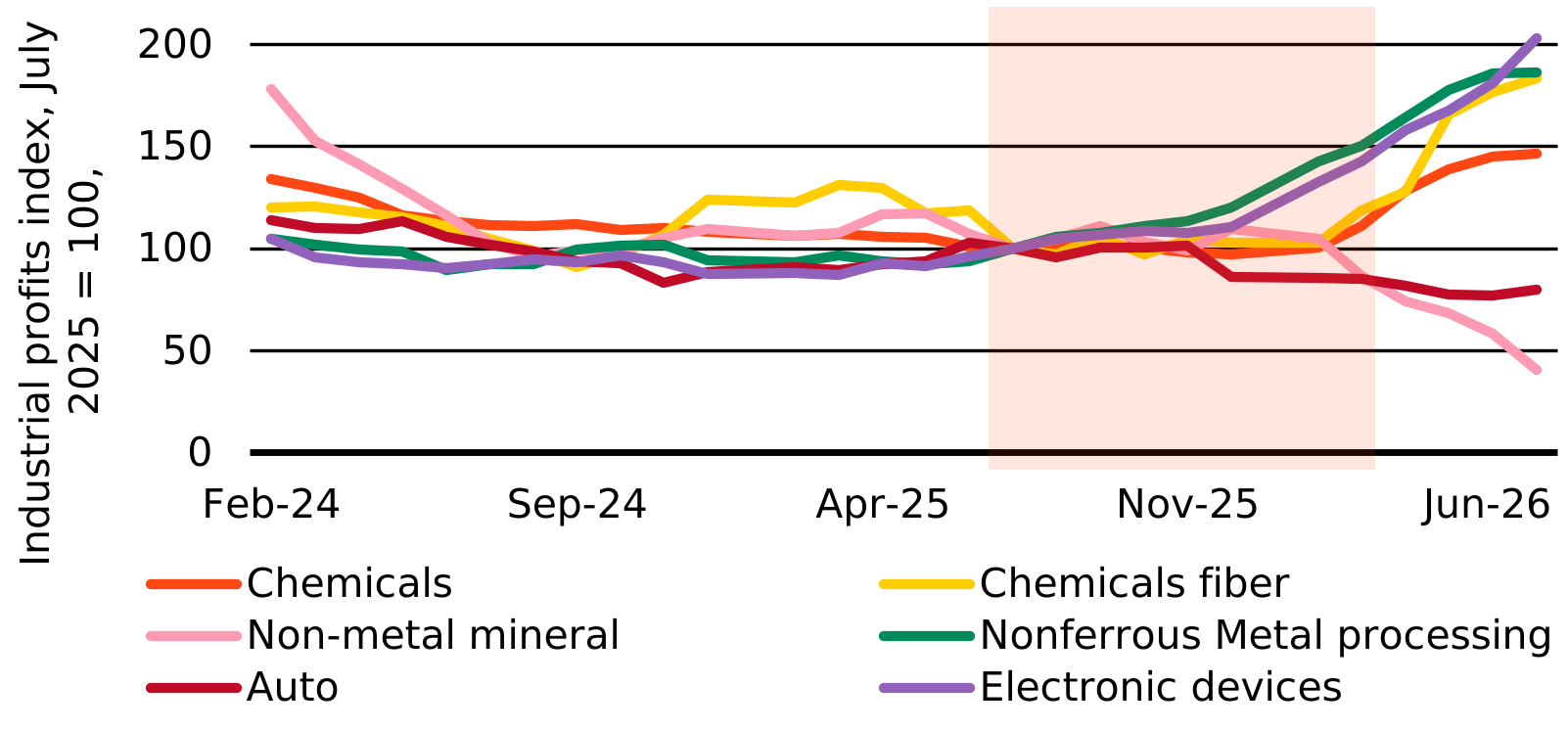
Source: BlackRock Investment Institute, with data from National Bureau of Statistics, September 2026. Note: The chart shows six-month moving averages of seasonally adjusted industrial profits for selected sectors, indexed to 100 in July 2025, when China stepped up “anti-involution” measures aimed at curbing excessive competition in prices and production. The shaded area runs from July 2025, when anti-involution efforts accelerated, through February 2026, before the oil-price surge following the Iran conflict.
Industrial profits are diverging sharply across sectors in China, as the chart above shows. Official data for the first seven months of 2026 show profits in electronics rose 110%, while auto profits fell 20.4% and cement remained weak. Global AI demand is supporting profits in electronics, while production cuts are helping chemicals and non-ferrous metals recover. Industrial policy has helped direct capital and capacity toward strategic industries as China seeks to build globally competitive companies in key sectors. Beijing’s “anti-involution” push to curb excessive price-cutting and overproduction is helping profits in some sectors, but its impact is uneven. The policy response highlights the problem: output and market share can rise even as price competition erodes margins. Differentiation and barriers to entry can help companies sustain pricing power as they grow.
That dispersion is visible in markets too: the MSCI China index has lost 11% in U.S. dollar terms this year to Sept. 21, while the MSCI China Information Technology index has gained 7% — an 18 percentage-point gap, according to Bloomberg data. At company level, selected AI hardware suppliers show how rapid growth can coincide with stronger economics. At two selected Chinese optical-transceiver and PCB suppliers, revenue more than doubled between 2022 and 2025 while gross margins rose by 5–12 percentage points, according to Bloomberg data. In both cases, rapid growth coincided with margin expansion — evidence of scale translating into stronger economics and, potentially, returns. Solar provides the counterexample. Gross margins at three leading Chinese manufacturers fell by 14–25 percentage points between 2021 and 2025, and all three posted negative returns on equity in 2025, according to Bloomberg data. The contrast shows why scale alone is insufficient: rapid growth can coincide with improving margins, while large-scale production can coexist with collapsing profitability.
Overseas profit margins for exporters can show whether stronger company economics extend beyond the domestic market. Heavy machinery is one useful case: Chinese manufacturers have increasingly turned to exports as domestic construction demand has weakened. In 2025, overseas gross margins at two large Chinese heavy-machinery makers were 6.6–10.9 percentage points above their domestic margins, according to Bloomberg data. The pattern extends beyond machinery but is not universal: a large battery maker showed a 7.4 percentage-point gap, while a major home-appliance maker showed virtually none. The data do not establish what drives the difference, but the contrast is consistent with some manufacturers facing less intense price competition or selling a different mix of products overseas. Nor do higher overseas gross margins automatically mean better overall returns once tariffs, localization costs and execution risks are taken into account. Geopolitical risk matters too: companies with greater exposure to shifts in global trade and technology policy may face changes in market access, costs and supply chains. But where the gap is sustained, it can be one sign that a company’s advantage extends beyond domestic scale and low cost.
The gap between industrial opportunity and shareholder returns is harder to judge in newer sources of demand. Electrotech can serve both established electrification needs and emerging areas such as physical AI — AI embedded in machines and industrial systems. China already has a large automation base: it installed 354,000 industrial robots in 2025, 59% of the global total, according to the International Federation of Robotics. Physical AI could broaden demand for robotics and automation, but for some component suppliers already serving robotics ecosystems it accounts for only a small share of revenue today. The scale of future power demand is much clearer. The International Energy Agency expects China alone to add about 2,600 terawatt-hours of electricity demand by 2030, roughly equivalent to the European Union’s current consumption. Spending is already much more visible in power infrastructure. State Grid plans up to RMB4 trillion (roughly U.S.$600 billion) of fixed-asset investment in 2026–30, about 40% more than in the previous five years. That makes the demand opportunity easier to see, but not which suppliers will benefit most. What matters is whether they have enough differentiation — through qualification requirements, switching costs, proprietary technology or service — to protect margins as spending grows. We remain neutral China equities tactically, while seeing selective opportunities where growth is already translating into stronger margins and returns - particularly in AI hardware, power and grid equipment, and selected industrial-automation and physical-AI enablers.
Authors



Related insights
Conflict drives structural reset for Gulf economies
The Middle East conflict is driving a structural reset across the GCC, widening dispersion, redirecting capital inward and boosting strategic sectors.