Key takeaways
- AI disruption requires a bottom-up approach. Its impact will vary significantly by company and sector, making fundamental underwriting and security selection increasingly important.
- Scale and adaptability can separate winners from losers. Larger businesses with strong cash flows, established customer relationships and the resources to invest in AI may be better positioned to navigate disruption.
- AI is expanding the private credit opportunity set. The infrastructure buildout is creating financing opportunities beyond traditional sponsor-backed lending, including with large corporate and investment-grade borrowers.
Artificial intelligence is driving investment, reshaping corporate spending and redefining how businesses compete. For credit investors, the central challenge is assessing how AI’s impact will vary across industries, companies, and business models. Because the financial effects are only beginning to emerge, we believe evaluating AI requires a bottom-up approach grounded in company fundamentals, management insight, and industry expertise rather than broad thematic assumptions.
Evaluating software through a credit lens
Software has become a focal point for concerns about AI disruption, but, in our view, the sector should not be viewed through a single lens. Recent volatility reflects both uncertainty around AI and pre-existing weaknesses in businesses financed during a period of elevated valuations, abundant capital, and excessive leverage. In many cases, underperformance stems as much from execution challenges, competitive pressures, or unrealistic growth assumptions as from generative AI. The sector is therefore likely to produce both winners and losers, requiring investors to assess each company’s competitive position, scale, customer relationships, and ability to adapt.
One of the most significant shifts underway is a renewed focus on fundamentals. During the software boom, many investors prioritized growth over profitability, assuming future scale would eventually generate substantial cash flow. However, as uncertainty around AI grows, lenders are focusing more closely on whether companies can generate enough cash to repay their debt. This means prioritizing visibility into near- and medium-term earnings over aggressive assumptions about how an industry might evolve five years from now.
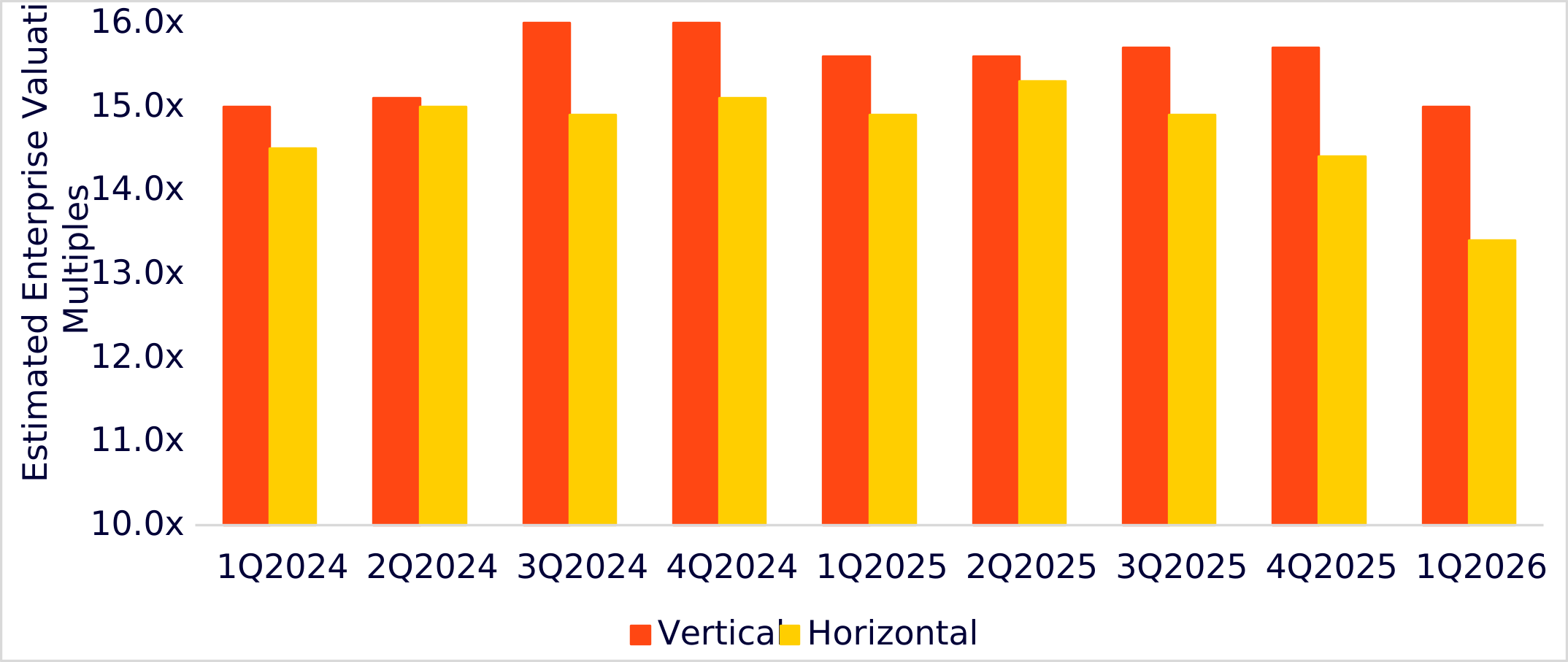
Exhibit 1: Widening valuation gap between vertical and horizontal software businesses
Source:
Lincoln Lens- Private Market Intelligence, BlackRock . As of 1Q2026. Industry classifications as well as vertically and horizontally integrated software business distinctions based on Lincoln International estimates. Multiples above reflect Lincoln estimates as of the given valuation period.
This shift is also leading to more conservative transaction structures, including lower leverage, stronger documentation and greater downside protection. As a result, the market may become increasingly bifurcated: businesses with relatively low AI disruption risk could continue to secure attractive financing terms, while those facing greater uncertainty may encounter tighter structures, lower leverage, and higher borrowing costs.
Scale matters in an AI economy
Developing meaningful AI capabilities requires substantial investment, and AI remains expensive. Large, established businesses often have advantages that smaller competitors may struggle to match, including stronger cash flow generation, broader customer bases, and greater flexibility to absorb the cost of innovation due to their scale.
Within software, those advantages are particularly important as companies are racing to build AI-enabled products while maintaining competitive positioning. Larger firms may be better equipped to invest in new capabilities, experiment with emerging technologies, and adapt to changing customer demands. As a result, there may be investor opportunity in market-leading businesses capable of incorporating AI into their offerings rather than being displaced by it.
Sectors facing significant risks
While software dominates much of the public conversation around AI, we believe industries that can be transformed by automation and productivity gains also deserve a closer look. More specifically, we see legal services, business process outsourcing, and a range of business-to-business service providers as areas where AI could have significant implications.
The common thread among these sectors is reliance on repeatable tasks . Any business whose value proposition is a repeated task is potentially threatened by AI. At the same time, this does not necessarily imply that these businesses disappear. Increasingly, the conversation is shifting toward how companies can use productivity improvements to enhance profitability and adapt pricing models rather than becoming obsolete.
Financing the AI infrastructure buildout
Few areas have attracted more attention than the massive buildout of AI infrastructure, including data centers, computing capacity, and supporting technologies. The scale of capital investment has led some observers to draw comparisons with the telecommunications buildout of the late 1990s. However, the current environment differs in a key respect.
Unlike the excess fiber infrastructure that remained unused after the telecom bubble burst, much of today's AI-related infrastructure already has committed users before construction is complete. For credit investors, however, financing these projects often depends less on predicting future technology outcomes and more on evaluating the strength of counterparties. Many transactions are supported by large hyperscalers and investment-grade corporate borrowers whose credit profiles provide a meaningful layer of protection.
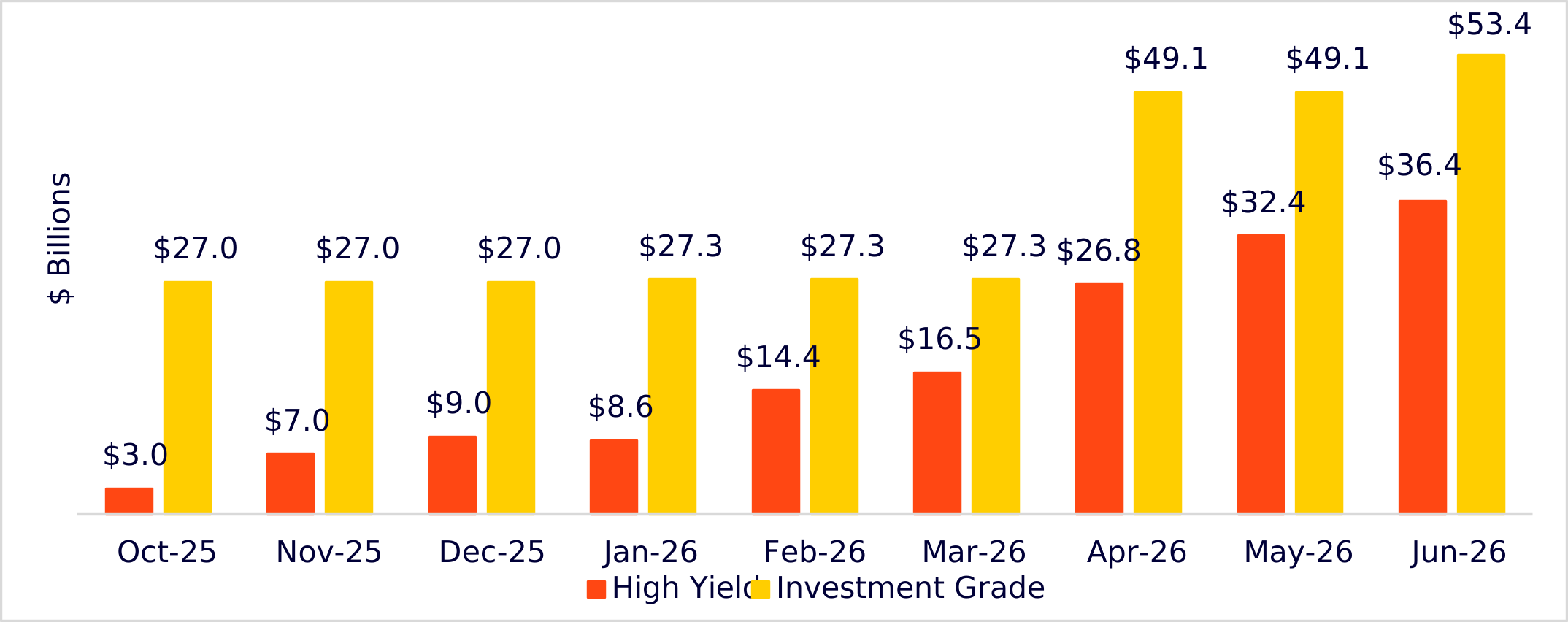
Exhibit 2: IG/HY AI data center bonds outstanding by month ($B)
Source:
Bloomberg, Barclays Research, BlackRock . As of June 25, 2026 . Excludes issuance by neocloud Core Weave , which has $6.5 billion of regular-way HY bonds outstanding.
The AI transformation is also reshaping the private credit opportunity set. While the asset class was historically primarily associated with sponsor-backed leveraged buyouts, opportunities are increasingly emerging from large corporate borrowers and investment-grade companies seeking flexible financing solutions. As private credit continues to mature, managers are participating across a broader range of corporate financing needs, including the infrastructure and capital investment required to support AI development.
Conclusion
For investors, the central lesson may be that uncertainty itself creates opportunity. Neither AI's ultimate winners nor its long -term effects will be obvious from today's vantage point. What matters is maintaining discipline, diversification, and a focus on underlying business fundamentals.
We believe strong portfolio construction requires not only diversification across individual investments but also across sectors. Exposure to a broad range of industries can help investors navigate periods of disruption and market shocks which, in recent years, have included the COVID pandemic, elevated interest rates, inflation, and now major technological changes.
As AI continues to reshape the investment landscape, private credit managers best positioned to succeed may be those that resist simplistic narratives, focus on cash-flow generation, and remain disciplined in identifying opportunities amid change.
Looking for more Private Credit content? Check out: Alternatives | BlackRock
Institutional outlook
Monthly publication for institutional investors delivering macro market perspectives with asset class level implications.
Peer study and analytics
Actionable analysis of industry peers, focusing on allocation decisions, investment strategies and risk management.