BLACKROCK INVESTMENT INSTITUTE
Mega forces: An investment opportunity
Mega forces are big, structural changes that affect investing now - and far in the future. This creates major opportunities - and risks - for investors.
BLACKROCK SUSTAINABILITY
Please read this page before proceeding as it explains certain restrictions imposed by law on the distribution of this information and the jurisdictions in which our products and services are authorised to be offered or sold.
By entering this site, you are agreeing that you have reviewed and agreed to the terms contained herein, including any legal or regulatory restrictions, and have consented to the collection, use and disclosure of your personal data as set out in the Privacy section referred to below.
By confirming below, you also acknowledge that you:
(i) have read this important information;
(ii) agree your access to this website is subject to the disclaimer, risk warnings and other information set out herein; and
(iii) are the relevant sophistication level and/or type of audience intended for your respective country or jurisdiction identified below.
The information contained on this website (this “Website”) (including without limitation the information, functions and documents posted herein (together, the “Contents”) is made available for informational purposes only.
No Offer
The Contents have been prepared without regard to the investment objectives, financial situation, or means of any person or entity, and the Website is not soliciting any action based upon them.
This material should not be construed as investment advice or a recommendation or an offer or solicitation to buy or sell securities and does not constitute an offer or solicitation in any jurisdiction where or to any persons to whom it would be unauthorized or unlawful to do so.
Access Subject to Local Restrictions
The Website is intended for the following audiences in each respective country or region: In the U.S.: public distribution. In Canada: public distribution. In the UK and outside the EEA: professional clients (as defined by the Financial Conduct Authority or MiFID Rules) and qualified investors only and should not be relied upon by any other persons. In the EEA, professional clients, qualified clients, and qualified investors. For qualified investors in Switzerland, qualified investors as defined in the Swiss Collective Investment Schemes Act of 23 June 2006, as amended. In DIFC: 'Professional Clients’ and no other person should rely upon the information contained within it. In Singapore, public distribution. In Hong Kong, public distribution. In South Korea, Qualified Professional Investors (as defined in the Financial Investment Services and Capital Market Act and its sub-regulations). In Taiwan, Professional Investors. In Japan, Professional Investors only (Professional Investor is defined in Financial Instruments and Exchange Act). In Australia, public distribution. In China, this may not be distributed to individuals resident in the People's Republic of China ("PRC", for such purposes, excluding Hong Kong, Macau and Taiwan) or entities registered in the PRC unless such parties have received all the required PRC government approvals to participate in any investment or receive any investment advisory or investment management services. For Other APAC Countries, Institutional Investors only (or professional/sophisticated /qualified investors, as such term may apply in local jurisdictions). In Latin America, institutional investors and financial intermediaries only (not for public distribution).In Latin America, no securities regulator within Latin America has confirmed the accuracy of any information contained herein. The provision of investment management and investment advisory services is a regulated activity in Mexico thus is subject to strict rules. For more information on the Investment Advisory Services offered by BlackRock Mexico please refer to the Investment Services Guide available at www.blackrock.com/mx.
This Contents are not intended for, or directed to, persons in any countries or jurisdictions that are not enumerated above, or to an audience other than as specified above.
This Website has not been, and will not be submitted to become, approved/verified by, or registered with, any relevant government authorities under the local laws. This Website is not intended for and should not be accessed by persons located or resident in any jurisdiction where (by reason of that person's nationality, domicile, residence or otherwise) the publication or availability of this Website is prohibited or contrary to local law or regulation or would subject any BlackRock entity to any registration or licensing requirements in such jurisdiction.
It is your responsibility to be aware of, to obtain all relevant regulatory approvals, licenses, verifications and/or registrations under, and to observe all applicable laws and regulations of any relevant jurisdiction in connection with your access. If you are unsure about the meaning of any of the information provided, please consult your financial or other professional adviser.
No Warranty
The Contents are published in good faith but no advice, representation or warranty, express or implied, is made by BlackRock or by any person as to its adequacy, accuracy, completeness, reasonableness or that it is fit for your particular purpose, and it should not be relied on as such. The Contents do not purport to be complete and is subject to change. You acknowledge that certain information contained in this Website supplied by third parties may be incorrect or incomplete, and such information is provided on an "AS IS" basis. We reserve the right to change, modify, add, or delete, any content and the terms of use of this Website without notice. Users are advised to periodically review the contents of this Website to be familiar with any modifications. The Website has not made, and expressly disclaims, any representations with respect to any forward-looking statements. By their nature, forward-looking statements are subject to numerous assumptions, risks and uncertainties because they relate to events and depend on circumstances that may or may not occur in the future.
No information on this Website constitutes business, financial, investment, trading, tax, legal, regulatory, accounting or any other advice. If you are unsure about the meaning of any information provided, please consult your financial or other professional adviser.
No Liability
BlackRock shall have no liability for any loss or damage arising in connection with this Website or out of the use, inability to use or reliance on the Contents by any person, including without limitation, any loss of profit or any other damage, direct or consequential, regardless of whether they arise from contractual or tort (including negligence) or whether BlackRock has foreseen such possibility, except where such exclusion or limitation contravenes the applicable law.
You may leave this Website when you access certain links on this Website. BlackRock has not examined any of these websites and does not assume any responsibility for the contents of such websites nor the services, products or items offered through such websites.
Intellectual Property Rights
Copyright, trademark and other forms of proprietary rights protect the Contents of this Website. All Contents are owned or controlled by BlackRock or the party credited as the provider of the Content. Except as expressly provided herein, nothing in this Website should be considered as granting any licence or right under any copyright, patent or trademark or other intellectual property rights of BlackRock or any third party.
This Website is for your personal use. As a user, you must not sell, copy, publish, distribute, transfer, modify, display, reproduce, and/or create any derivative works from the information or software on this Website. You must not redeliver any of the pages, text, images, or content of this Website using "framing" or similar technology. Systematic retrieval of content from this Website to create or compile, directly or indirectly, a collection, compilation, database or directory (whether through robots, spiders, automatic devices or manual processes) or creating links to this Website is strictly prohibited. You acknowledge that you have no right to use the content of this Website in any other manner.
Additional Information
Investment involves risks. Past performance is not a guide to future performance. The value of investments and the income from them can fall as well as rise and is not guaranteed. You may not get back the amount originally invested. Changes in the rates of exchange between currencies may cause the value of investments to diminish or increase.
Privacy
Your name, email address and other personal details will be processed in accordance with BlackRock’s Privacy Policy for your specific country which you may read by accessing our website at https://www.blackrock.com.
Please note that you are required to read and accept the terms of our Privacy Policy before you are able to access our websites.
Once you have confirmed that you agree to the legal information herein, and the Privacy Policy – by indicating your consent – we will place a cookie on your computer to recognise you and prevent this page from reappearing should you access this site, or other BlackRock sites, on future occasions. The cookie will expire after six months, or sooner should there be a material change to this important information.
Weekly video_20260427
Nicholas Fawcett
Senior Economist
BlackRock Investment Institute
Header:
CAPITAL AT RISK. MARKETING MATERIAL.
Opening frame: What’s driving markets? Market take
Camera frame
We think the Middle East conflict only piles onto inflationary pressures already bubbling under the surface. Higher yields are here to stay, in our view. That means long-term government bonds are no longer effective diversifiers against equity market declines.
Title slide: Persistent inflation constrains policy
We think the Middle East conflict only piles onto inflationary pressures already bubbling under the surface. Higher yields are here to stay, in our view. That means long-term government bonds are no longer effective diversifiers against equity market declines.
1. Too-rosy view on inflation
Prior to the Middle East conflict, markets ignored signs that inflation’s downward trend had already stalled. Core services inflation remained stubbornly high. An aging population and immigration curbs make for a tight labor market. Add the AI-led capex boom and tariff-driven goods inflation, and it was clear to us that core inflation would stay hot.
Markets have embraced this view: They are pricing out U.S. rate cuts and expect the European Central Bank to raise interest rates this year instead of staying put.
2. A world shaped by supply
The big picture? We’re in a world shaped by supply, where supply constraints are the main drivers of inflation. So central banks face a stark trade-off between reining in inflation or supporting economic growth.
There’s more pushing up on inflation too: Governments are rushing to invest in energy security and defense. And the costs of key AI inputs like semiconductors are rising as capacity lags demand.
This is the backdrop facing the Federal Reserve and other major central banks as they meet this week.
3. Diversification mirage
All this doesn’t bode well for government bonds, which have struggled to offset equity declines throughout the Middle East conflict. This underscores what we call a 'diversification mirage' in our Global Outlook. We think it’s a core feature of the post-pandemic world.
Outro: Here’s our Market take
We prefer stocks over bonds as we see persistent inflation pressures keeping interest rates higher for longer. We also see thematic opportunities linked to AI.
Closing frame: Read details: blackrock.com/weekly-commentary
Inflation pressures predate the Middle East supply shock, leaving central banks constrained on policy. We prefer equities over government bonds.
The S&P 500 crawled to a record even as oil prices rose on more Middle East disruptions. It shows skepticism over the AI buildout’s payoff is dissipating.
We expect the Fed and other key central banks to leave policy rates unchanged this week as they face a tough trade-off between growth and inflation.
Supply disruptions emanating from the Middle East conflict have piled onto inflation pressures that were already bubbling under the surface. This week’s central bank run lays bare the bind policymakers face between reining in inflation and supporting growth and jobs. We think higher yields are here to stay – and that long-term government bonds are no longer effective diversifiers against equity declines. We stay overweight U.S. and EM equities on the rapid AI buildout.
Too hot for comfort
Annual core services inflation, 2006-26
Source: BlackRock Investment Institute, U.S. Bureau of Economic Analysis, Eurostat, with data from Haver Analytics, April 2026. Note: The line for the U.S. shows core services excluding shelter PCE inflation. Inset shows inflation dynamics for the latest 12 months.
Markets projected U.S. rate cuts before the Iran war erupted – and ignored signs that inflation’s downward trend had already stalled as core services inflation remained stubbornly high. See the chart’s inset on the right. The reason: An aging population and immigration curbs make for a tight labor market. Add the AI-led capex boom and tariff-driven goods inflation, and it becomes clear why broader core inflation is running above central bank targets. Markets flipflopped when the Middle East supply disruptions caused price spikes in energy and base chemicals. They are now pricing out U.S. rate cuts this year and expect the European Central Bank to hike instead of staying put. This shift reflects a recognition that inflation is running above pre-pandemic levels – a trend we see persisting for now.
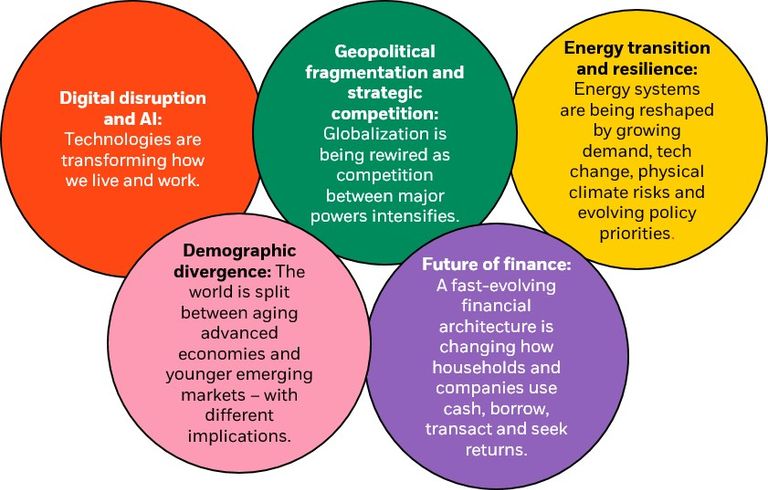
The big picture is that we are in a world shaped by supply. The Middle East conflict has supercharged existing supply constraints and intensified mega forces – structural changes such as the energy transition, geopolitical fragmentation and AI disruption. Supply disruptions of energy, chemicals and other industrial materials are increasing inflation pressures, albeit with disparate effects across regions. Europe and parts of Asia are feeling the brunt given their dependence on imported energy. The U.S. is more shielded as a net energy exporter. The conflict is reinforcing the resolve of governments around the world to invest in energy security and defense, adding to towering debt loads and putting upward pressure on inflation.
At the same time, an accelerating AI buildout is creating outsized demand for energy, data centers and specialized labor. This is bumping into worsening capacity and political constraints that are increasing costs. Prices of key AI inputs such as semiconductors are rising as capacity struggles to keep pace with demand. We think AI’s productivity gains could quickly offset such “chipflation” and other price pressures – and push down inflation. But this hasn’t happened yet.
Such is the backdrop for the Fed and other major central banks as they meet this week. They face a stark trade-off between trying to bring down inflation or supporting economic growth and jobs. No change in policy rates is expected, and the key is to watch for signs whether policymakers are growing concerned about persistent inflation, even if they look through price pressures caused by Middle East supply disruptions.
We stay risk-on in this environment. We are overweight U.S. and EM equities as major AI firms are now showing they can monetize their tools. We stay underweight long-term government bonds. They struggled to offset equity declines throughout the Iran war. This underscores the “diversification mirage” outlined in the Q2 update to our 2026 Global Outlook: This is a structural feature of the post-pandemic environment as the term premium – the extra compensation investors demand for holding long-term bonds – rises on concerns over high debt loads. We prefer short-dated credit and Treasuries for quality income instead, and EM hard-currency debt as it leans toward commodity exporters benefiting from supply disruptions.
We prefer stocks over bonds as we see inflation pressures keeping interest rates higher for longer. We also eye thematic opportunities across power and infrastructure on AI demand and a scramble for energy security.
The S&P 500 notched a fresh record even as oil prices rose as shipping traffic in the Strait of Hormuz almost crawled to a halt. This shows the AI mega force is shaping up even stronger than we envisaged in our 2026 Global Outlook. Previous market skepticism over AI — that major players were spending heavily but not making money — is dissipating and turning into belief. AI adoption is rising and revenue growth is accelerating.
We focus on a packed week of central bank decisions. We expect the Fed, ECB, BoE and BoJ to hold rates steady – though the latter is more finely balanced. Even if the BoJ stays on hold, we expect policymakers to signal more hikes are on the table this year. We watch the ECB and BoE decisions to see if they will look through energy-driven inflation rather than respond to the risk of it spreading into wider price pressures.
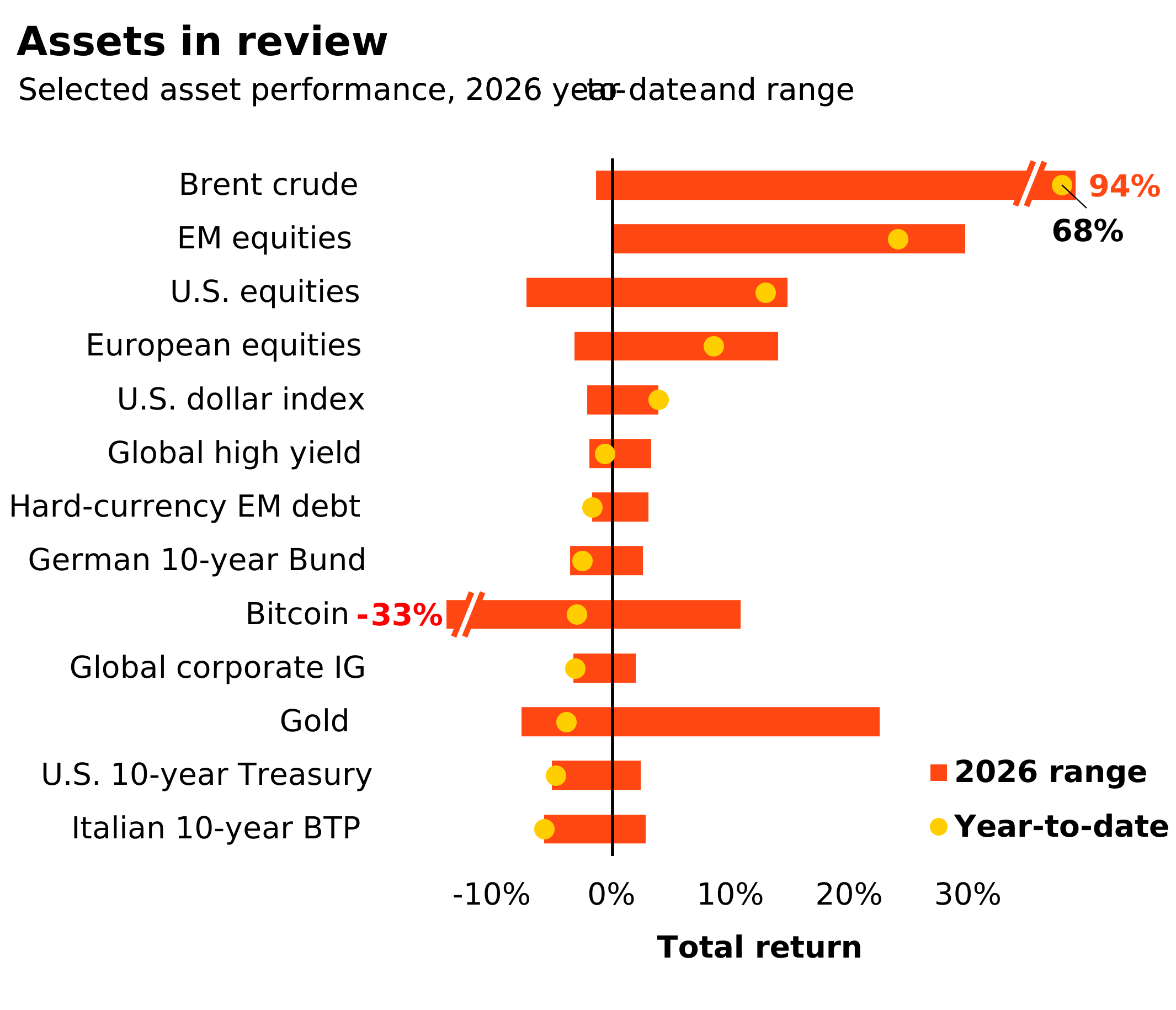
Past performance is not a reliable indicator of current or future results. Indexes are unmanaged and do not account for fees. It is not possible to invest directly in an index. Sources: BlackRock Investment Institute, with data from LSEG Datastream as of April 23, 2026. Notes: The two ends of the bars show the lowest and highest res at any point year to date, and the dots represent current year-to-date res. Emerging market (EM), high yield and global corporate investment grade (IG) res are denominated in U.S. dollars, and the rest in local currencies. Indexes or prices used are: spot Brent crude, ICE U.S. Dollar Index (DXY), spot gold, spot bitcoin, MSCI Emerging Markets Index, MSCI Europe Index, LSEG Datastream 10-year benchmark government bond index (U.S., Germany and Italy), Bloomberg Global High Yield Index, J.P. Morgan EMBI Index, Bloomberg Global Corporate Index and MSCI USA Index.
Bank of Japan interest rate decision
Federal Reserve interest rate decision
U.S. PCE & GDP; ECB, BoE interest rate decision
Read our past weekly market commentaries here.
Our highest conviction views on six- to 12-month (tactical) and over five-year (strategic) horizons, April 2026
| Reasons | ||
|---|---|---|
| Tactical | ||
| Favor AI beneficiaries | We favor infrastructure and equipment supporting the AI buildout such as semiconductors, power and data centers. We think they stand to benefit no matter AI’s eventual winners or losers. We see the AI boom lifting U.S. corporate earnings. underpinning our U.S. equity overweight. | |
| Selected international exposures | We like hard-currency EM debt on economic resilience, disciplined fiscal and monetary policy and a high ratio of commodities exporters. We’re also overweight EM equities, preferring commodity exporters and AI beneficiaries. In Europe, we favor equity sectors like infrastructure. | |
| Evolving diversifiers | We suggest looking for “plan B” portfolio hedges such as thematic opportunities related to the AI built-out and search for energy security. Long-term U.S. Treasuries no longer provide a buffer against equity market declines, and gold also has shown to be an ineffective diversifier. | |
| Strategic | ||
| Portfolio construction | We favor a scenario-based approach as AI winners and losers emerge. We lean on private markets and hedge funds for idiosyncratic returns and to anchor portfolios in mega forces. | |
| Infrastructure equity and private credit | We find infrastructure equity valuations attractive as geopolitical fragmentation and the AI build-out underpin structural demand. We still like private credit but see an increase in dispersion of returns. This highlights the importance of manager selection. | |
| Beyond market cap benchmarks | We get granular in public markets. We favor DM government bonds outside the U.S. Within equities, we favor EM over DM – and get selective in both. In EM, we like India because it sits at the intersection of mega forces. In DM, we like Japan amid inflation and corporate reforms. | |
Note: Views are from a U.S. dollar perspective, April 2026. This material represents an assessment of the market environment at a specific time and is not intended to be a forecast of future events or a guarantee of future results. This information should not be relied upon by the reader as research or investment advice regarding any particular funds, strategy or security.
Six- to 12-month tactical views on selected assets vs. broad global asset classes by level of conviction, April 2026

We have lengthened our tactical investment horizon back to six to 12 months. The table below reflects this and, importantly, leaves aside the opportunity for alpha, or the potential to generate above-benchmark returns – especially at a time of heightened volatility.
Six- to 12-month tactical views on selected assets vs. broad global asset classes by level of conviction, April 2026
| Asset | Tactical view | Commentary | ||||
|---|---|---|---|---|---|---|
| Equities | ||||||
| United States | We are overweight. Contained damage to global growth from the Mideast conflict and strong earnings expectations – particularly in tech – keep us risk-on. | |||||
| Europe | We are neutral. Europe’s high exposure to the energy shock from the Mideast conflict makes it vulnerable to higher inflation and lower growth. | |||||
| UK | We are neutral. Valuations remain attractive relative to the U.S., but we see few near-term catalysts to trigger a shift. | |||||
| Japan | We are neutral. Japan’s exposure to imported energy may erode strong equity gains powered by healthy corporate balance sheets and governance reforms. | |||||
| Emerging markets (EM) | We are overweight yet stay selective. We favor Asian countries that manufacture critical AI components and Latin American energy and commodity exporters. | |||||
| China | We are neutral. Trade relations with the U.S. have steadied, but property stress and an aging population still constrain the macro outlook. Relatively resilient activity limits near-term policy urgency. We like sectors like AI, automation and power generation. | |||||
| Fixed income | ||||||
| Short U.S. Treasuries | We are neutral. Shorter-term bonds are relatively attractive as the market has woken up to persistent inflation and higher rates. | |||||
| Long U.S. Treasuries | We are underweight. Yields already faced upward pressure from rising term premia, as investors demand more compensation for the risk of holding long-term debt. The recent energy price shock compounds this by aggravating pre-existing inflationary pressures. | |||||
| Global inflation-linked bonds | We are neutral. We think inflation will settle above pre-pandemic levels, but markets may not price this in the near term as growth cools. | |||||
| Euro area government bonds | We are neutral short-term European government bonds. The market has repriced the ECB policy path more in line with our view. We think increased German bond issuance to finance its fiscal stimulus package is already largely reflected in the current level of 10-year yields. | |||||
| UK gilts | We are neutral. We expect volatility in gilts over the near-term. Gas powers much of the UK’s electricity, but storage is limited – making it especially vulnerable to a resurgence in inflation. | |||||
| Japanese government bonds | We are underweight. Rate hikes, higher global term premium and heavy bond issuance will likely drive yields up further. | |||||
| China government bonds | We are neutral. China bonds offer stability and diversification but developed market yields are higher and investor sentiment shifting towards equities limits upside. | |||||
| U.S. agency MBS | We are overweight. Agency MBS offer higher income than Treasuries with similar risk, and may offer more diversification amid fiscal and inflationary pressures. | |||||
| Short-term IG credit | We are neutral. Corporate strength means spreads are low, but they could widen if issuance increases. | |||||
| Long-term IG credit | We are underweight. We prefer short-term bonds less exposed to interest rate risk over long-term bonds. | |||||
| Global high yield | We are neutral. High yield offers more attractive carry and shorter duration, but we think dispersion between higher and weaker issuers will increase. | |||||
| Asia credit | We are neutral. Overall yields are attractive and fundamentals are solid, but spreads are tight. | |||||
| Emerging hard currency | We are overweight. EM hard-currency indexes lean towards Latin American commodity exporters such as Brazil that stand to benefit as Mideast supply plummets. | |||||
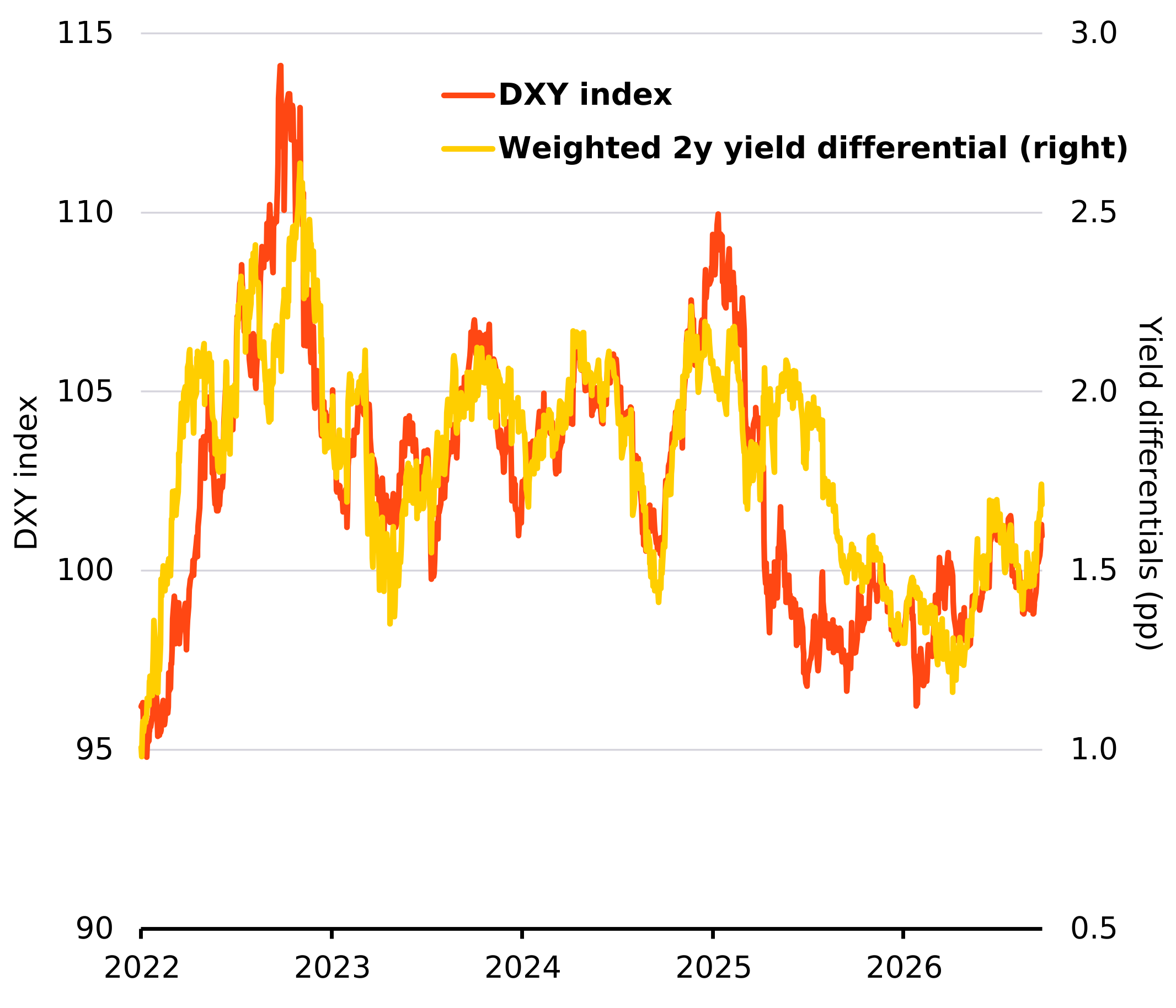
| Emerging local currency | We are neutral. The U.S. dollar has been strengthening as a safe-haven currency in the wake of the Middle East conflict. This could reverse year-to-date gains driven by a falling USD. | |||||
Past performance is not a reliable indicator of current or future results. It is not possible to invest directly in an index. Note: Views are from a U.S. dollar perspective. This material represents an assessment of the market environment at a specific time and is not intended to be a forecast or guarantee of future results. This information should not be relied upon as investment advice regarding any particular fund, strategy or security.

Six to 12-month tactical views on selected assets vs. broad global asset classes by level of conviction, April 2026

We have lengthened our tactical investment horizon back to six to 12 months. The table below reflects this and, importantly, leaves aside the opportunity for alpha, or the potential to generate above-benchmark returns – especially at a time of heightened volatility.
| Asset | Tactical view | Commentary | ||
|---|---|---|---|---|
| Equities | ||||
| Europe ex UK | We are neutral. We would need to see more business-friendly policy and deeper capital markets for recent outperformance to continue and to justify a broad overweight. We stay selective, favoring financials, utilities and healthcare. | |||
| Germany | We are neutral. Increased spending on defense and infrastructure could boost the corporate sector. But valuations rose significantly in 2025 and 2026 earnings revisions for other countries are outpacing Germany. | |||
| France | We are neutral. Political uncertainty could continue to drag corporate earnings behind peer markets. Yet some major French firms are shielded from domestic weakness, as foreign activity accounts for most of their revenues and operations. | |||
| Italy | We are neutral. Valuations are supportive relative to peers. Yet we think the growth and earnings outperformance that characterized 2022-2023 is unlikely to persist as fiscal consolidation continues and the impact of prior stimulus peters out. | |||
| Spain | We are overweight. Valuations and earnings growth are supportive relative to peers. Financials, utilities and infrastructure stocks stand to gain from a strong economic backdrop and advancements in AI. High exposure to fast-growing areas like emerging markets is also supportive. | |||
| Netherlands | We are neutral. Technology and semiconductors feature heavily in the Dutch stock market, but that’s offset by other sectors seeing less favorable valuations and a weaker earnings outlook than European peers. | |||
| Switzerland | We are neutral. Valuations have improved, but the earnings outlook is weaker than other European markets. If global risk appetite stays strong, the index’s tilt to stable, less volatile sectors may weigh on performance. | |||
| UK | We are neutral. Valuations remain attractive relative to the U.S., but we see few near-term catalysts to trigger a shift. | |||
| Fixed income | ||||
| Euro area government bonds | We are neutral short-term European government bonds. The market has repriced the ECB policy path more in line with our view. We think increased German bond issuance to finance its fiscal stimulus package is already largely reflected in the current level of 10-year yields. | |||
| German bunds | We are neutral. Markets have largely priced in fiscal stimulus and bond issuance, and expectations for policy rates align with our view. | |||
| French OATs | We are neutral. Political uncertainty, high budget deficits and slow structural reforms could stoke volatility, but current spreads incorporate these risks and we don’t expect a worsening from here. | |||
| Italian BTPs | We are neutral. Demand from Italian households is strong at current yield levels. Spreads tightened in line with its sovereign credit upgrade, but a persistently high debt-to-GDP levels means they likely won’t tighten further. | |||
| UK gilts | We are neutral. We expect volatility in gilts over the near-term. Gas powers much of the UK’s electricity, but storage is limited – making it especially vulnerable to a resurgence in inflation. | |||
| Swiss government bonds | We are neutral. We don’t think the Swiss National Bank will slash policy rates to below zero, as markets expect. | |||
| European inflation-protected securities | We are neutral. Our medium-term inflation expectations align with those implied in current market pricing. | |||
| European investment grade | We are neutral. We favor short- to medium-term debt and Europe over the U.S. An intense re-leveraging cycle to support the AI buildout could put upward pressure on U.S. spreads, making Europe relatively more attractive. | |||
| European high yield | We are overweight. Spreads hover near historic lows, but credit losses have been limited in this cycle and better economic growth in 2026 could reduce them further. | |||
Past performance is not a reliable indicator of current or future results. It is not possible to invest directly in an index. Note: Views are from a euro perspective, April 2026. This material represents an assessment of the market environment at a specific time and is not intended to be a forecast or guarantee of future results. This information should not be relied upon as investment advice regarding any particular fund, strategy or security.