Jean Boivin
Head — BlackRock Investment Institute
Dollar resilience
Fundamentals help explain the dollar’s resilience, supporting our view that it’s too soon to call for its demise. Yet we don’t think this portends a sustained rally.
Market backdrop
A soft U.S. jobs report helped cap gains in U.S. 10-year Treasury yields. Yet the structural forces driving long-term yields remain intact.
Week ahead
We look to September FOMC meeting minutes for details on the central bank’s discussion underscoring its first rate hike in three years.
The U.S. dollar has rallied over the past month, taking its gains this year to about 4% against developed-market currencies. Its resilience suggests it may be too soon to write off the dollar’s long-term role. Familiar drivers like rate differentials and risk sentiment help explain the rebound. Yet the greenback is stronger than the level suggested by our analysis. With markets pricing more Fed tightening than we think will materialize, there is limited scope for a sustained dollar bull run.
U.S. dollar index vs. trade-weighted two-year yield differential, 2022–2026
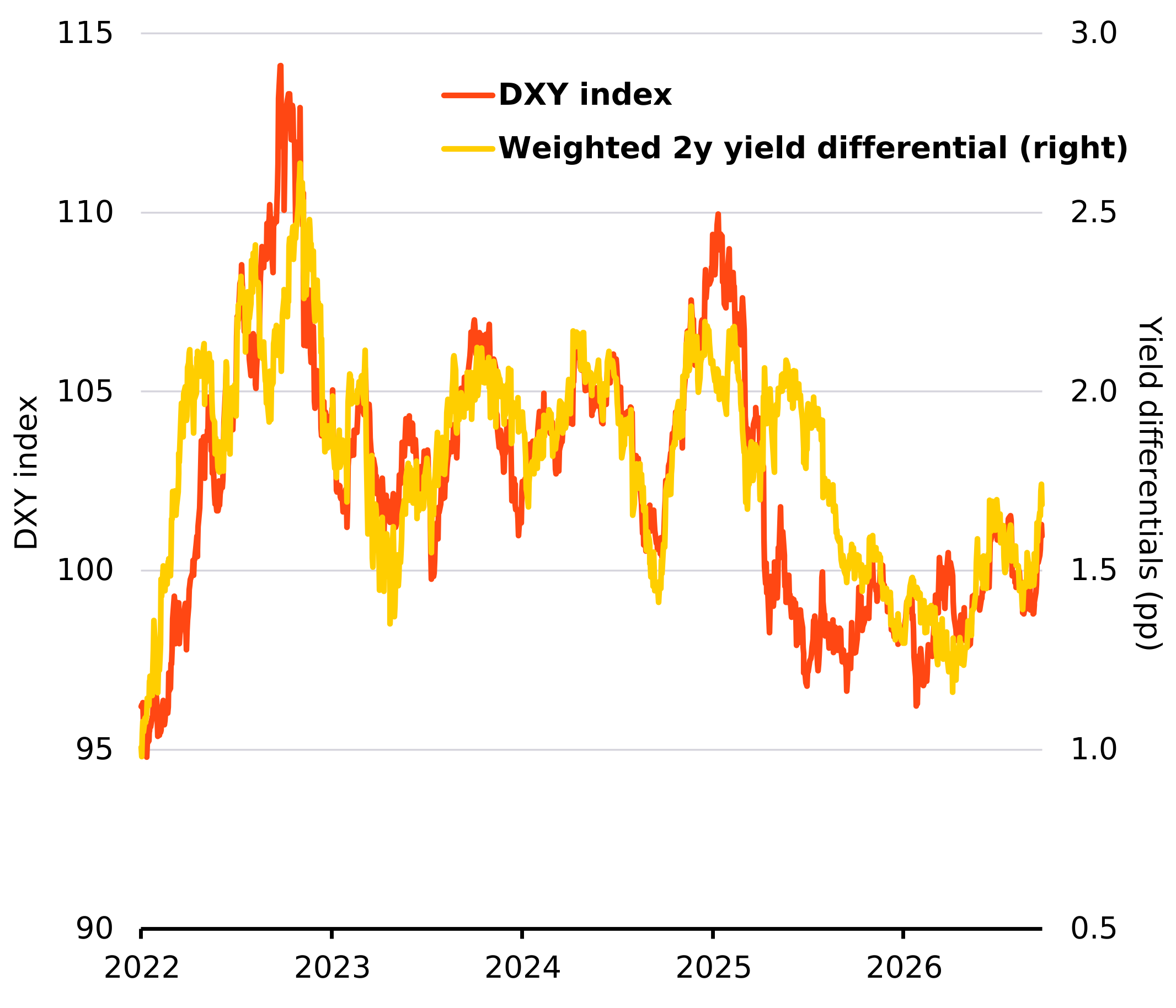
Source: BlackRock Investment Institute, with data from LSEG Datastream, October 2026. Notes: The orange line shows the U.S. Dollar Index (DXY). The yellow line shows the trade-weighted average U.S. two-year yield differential versus Germany, Japan, the UK, Canada, Sweden and Switzerland (right axis), using DXY currency weights. Yield differentials are shown in percentage points.
The dollar’s journey over the past 18 months has been telling. It fell sharply after President Donald Trump’s “Liberation Day” tariff announcements fueled warnings about dollar debasement, stabilized, then weakened again this summer amid Fed credibility concerns. It has since rebounded as Fed rate expectations swung dramatically – from as many as two cuts this year to one hike already delivered and more tightening priced. The dollar has closely tracked the resulting shift in two-year yield differentials. See the chart. The DXY has now retraced most of its post-April 2 tariff decline. That supports our pushback last year against the dollar debasement narrative. Yet we don’t expect a sustained appreciation cycle. Even with Fed repricing, strong U.S. growth and robust equity inflows, our analysis suggests the dollar is stronger than these and other fundamental drivers imply. The bar for further gains is high.
Start with the Fed rate path. The dramatic repricing has provided a powerful boost to the dollar and dollar assets this year. Markets have gone from pricing cuts at the start of the year to pricing roughly four more hikes over the next 12 months, on top of last month’s rate increase. We think that is too much. Last week’s weaker-than-expected jobs report highlights a macro backdrop that remains fluid. If expectations for further Fed tightening are pared back, the yield differentials that have helped drive the dollar’s rebound could narrow and weigh on the currency. A weaker dollar would reinforce our broader risk-on stance and create a more supportive backdrop for our EM equity overweight.
Next come capital flows. Strong U.S. growth, corporate earnings and AI investment have helped U.S. equities outperform since the start of the war in Iran, drawing global capital into dollar assets. Foreign investors poured nearly $1 trillion into U.S. equities and investment fund shares in the 12 months to July, including a record $426 billion in the second quarter alone, according to the Bureau of Economic Analysis. We expect that support to persist as earnings growth stays robust. U.S. equity outperformance should provide a partial offset if Fed repricing narrows yield differentials and weighs on the dollar.
Our analysis also captures traditional drivers, including risk sentiment and term premium. The latter has eased slightly after briefly rising this summer, as the Fed’s September hike helped restore central bank credibility. On balance, we see little room for another sustained dollar upswing. Instead, we see the currency staying around current levels, if not somewhat weaker. That is hard to square with the structural debasement narrative that started emerging last year: if investors were losing confidence in the dollar’s long-term role, we would expect a bigger deviation from the dollar’s fundamental drivers. That doesn’t mean the risks have disappeared. The fiscal backdrop remains challenging, with a $1.9 trillion deficit and public debt near 101% of GDP. While not a driver of the dollar today, these risks could return to the fore.
The dollar’s resilience shows its moves are still largely explained by fundamental drivers rather than concerns about its long-term role. A stable or moderately weaker dollar would also reinforce our EM equity overweight.
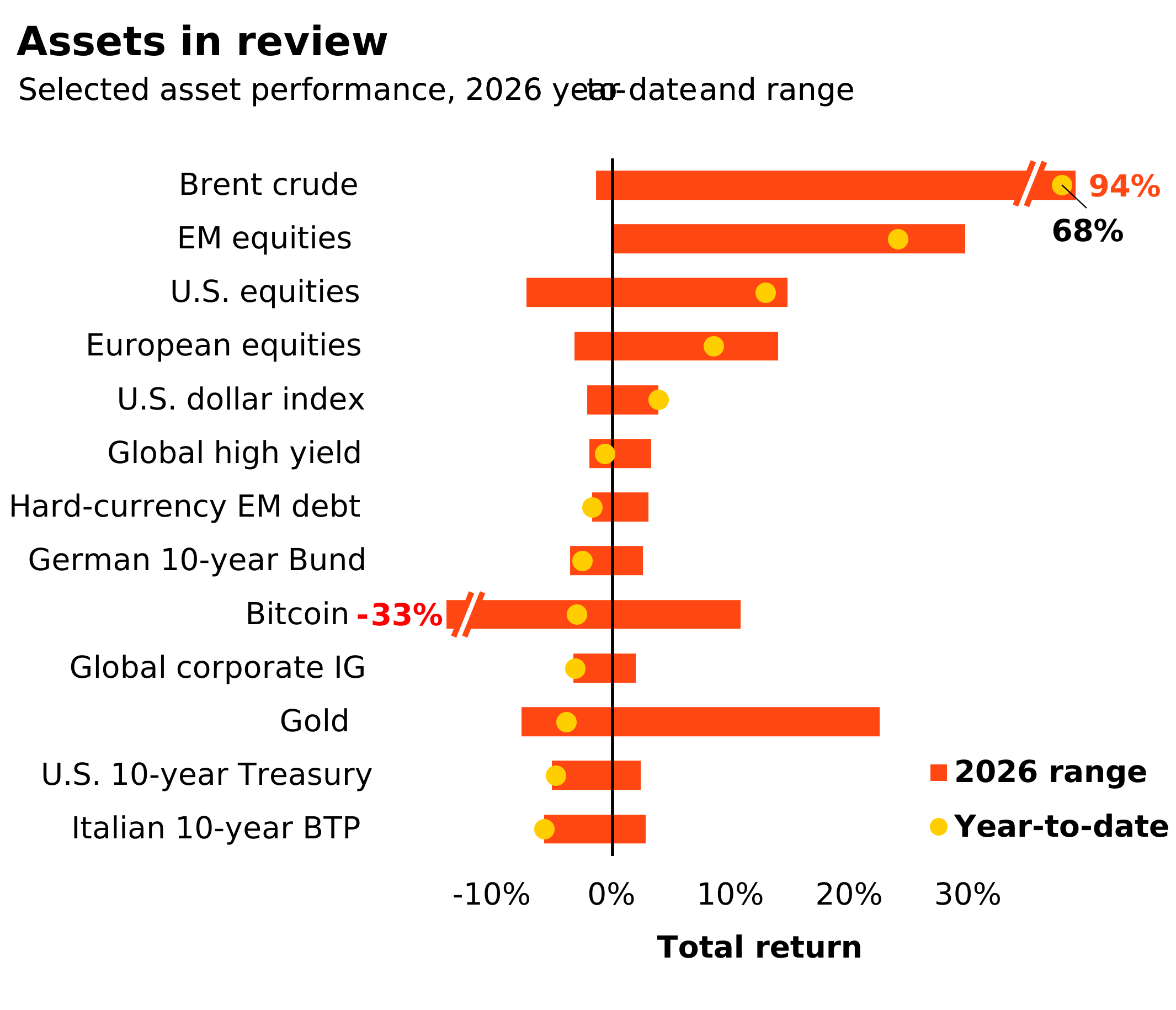
The global bond selloff deepened last week, with U.S. 10-year Treasury yields climbing to 5.34%, their highest level since 2002. A softer-than-expected jobs report added to the volatility as investor expectations for Fed tightening whipsawed. We see a consistent story: shifts in Fed expectations can influence rate moves in the near term, but they do not alter the structural forces driving long-term yields, including the intensifying competition for capital we have long described.
We look to September FOMC meeting minutes in a light macroeconomic data week. After the Fed raised interest rates for the first time in three years, we’re keen to see how hawkish the discussion surrounding the decision was among committee members. We also eye preliminary consumer sentiment data from the University of Michigan, after the index fell to its second-lowest reading ever at the end of September.
Oct. 5
Global composite/services PMI final
Oct. 6
U.S. international trade; EU & UK construction PMI
Oct. 7
FOMC minutes
Oct. 9
UMich preliminary consumer sentiment
Read our past weekly market commentaries here
Since we launched our mega forces framework it has become clearer how their intersection shapes almost all our investment views and opens up alpha opportunities. They cut across asset class labels, spurring a rethink of portfolio construction. Investors need to be deliberate about the economic or thematic exposures they own, the vehicles they use to implement them and their investment horizons.
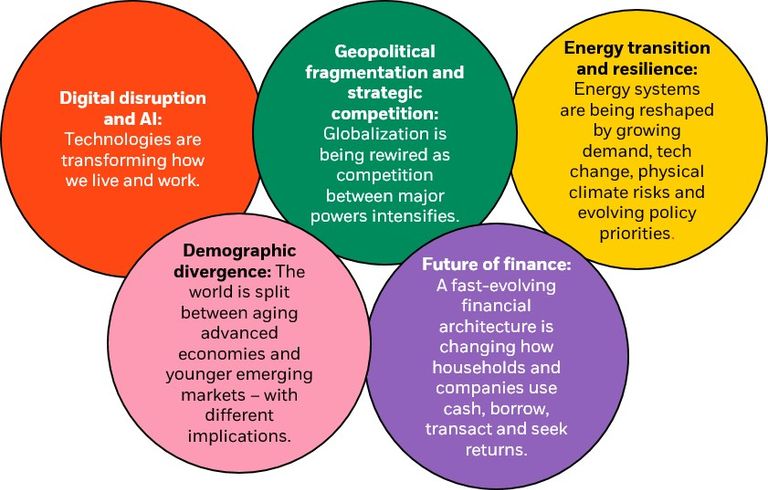
Our highest conviction views, October 2026
Note: Views are from a U.S. dollar perspective, October 2026. This material represents an assessment of the market environment at a specific time and is not intended to be a forecast of future events or a guarantee of future results. This information should not be relied upon by the reader as research or investment advice regarding any particular funds, strategy or security.
Six- to 12-month tactical positioning, October 2026
This shows the implementation of our key investment views from the previous page through an asset class lens.

Past performance is not a reliable indicator of current or future results. It is not possible to invest directly in an index. Note: Views are from a U.S. dollar perspective. This material represents an assessment of the market environment at a specific time and is not intended to be a forecast or guarantee of future results. This information should not be relied upon as investment advice regarding any particular fund, strategy or security.
Six to 12-month tactical views on selected assets vs. broad global asset classes by level of conviction, October 2026
We have lengthened our tactical investment horizon back to six to 12 months. The table below reflects this and, importantly, leaves aside the opportunity for alpha, or the potential to generate above-benchmark returns – especially at a time of heightened volatility.
Past performance is not a reliable indicator of current or future results. It is not possible to invest directly in an index. Note: Views are from a euro perspective, October 2026. This material represents an assessment of the market environment at a specific time and is not intended to be a forecast or guarantee of future results. This information should not be relied upon as investment advice regarding any particular fund, strategy or security.

Stay informed on our latest weekly Market take. Listen wherever you get your podcasts.