Rick Rieder
CIO of Global Fixed Income – BlackRock
Markets have been unusually calm for a year marked by policy shocks, geopolitical flare-ups, and record Treasury issuance. While the ride so far has been smoother than expected, largely thanks to the incredible resilience of the US economy, we’re quickly approaching the most seasonally volatile stretch of the year—it may be time to brace for a few more bumps on the ride.
The good news? What looks threatening is usually a pothole (a sharp but shallow divot) rather than a sinkhole (a structural collapse).
Every year, like clockwork, markets stumble through late summer. Liquidity thins. Supply surges. Economic data softens. And investors—preoccupied with their beach plans—step away from their screens.
This July’s price action already hints at what's coming: a compression of volatility, a spike in equity valuations, and crowded positions ripe for unwind. History reminds us that August–October is the worst period for S&P returns and credit excess returns alike.
The punchline? Volatility across equities, credit, and FX is priced for perfection – in our view making hedges in these asset classes worth owning ahead of this typically weaker seasonal period.
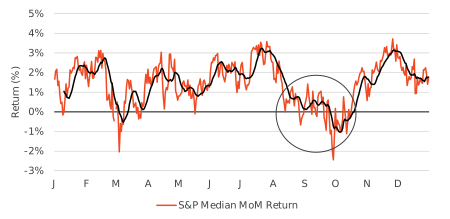
Bloomberg, as of 7/22/2025. Past performance is no guarantee of future results. Index performance is shown for illustrative purposes only. It is not possible to invest directly in an index.
In this midst of an easing cycle, the front of the curve offers a rare sweet spot: fair valuations, healthy real yields, and asymmetric upside if growth wobbles. A dip in data could easily send the US 2Y and 3Y lower, delivering capital gains and positive carry in the meantime.
While implied volatility is cheap across most asset classes, rates are one place where it remains expensive. Selling high-strike payers or owning agency mortgages earns premium where vol remains sticky. Mortgages pull double duty—diversifying credit risk, throwing off attractive spread, and helping fund downside protection in other corners of the portfolio like IG CDX or equity puts.
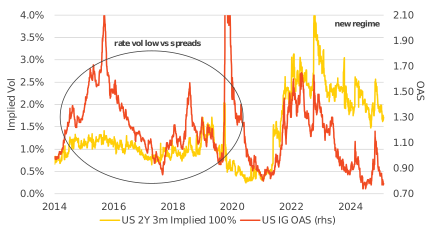
Bloomberg, as of 7/22/2025
Despite scary headlines, markets aren’t broken. They’re shock-absorbing.
As we noted in the FT, volatility hasn't disappeared. It’s just being absorbed by a structurally strong economy that remains one of the world’s most shock-resistant.
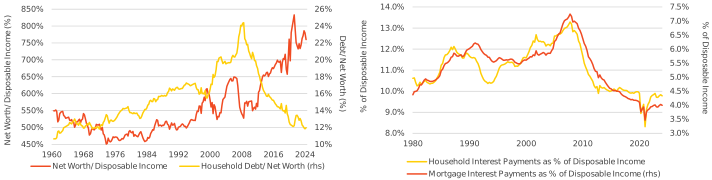
Federal Reserve, as of 3/31/2025
While private sector balance sheets are pristine, public‑sector leverage looks more precarious today. Washington now issues $570bn of Treasuries every week– larger than the entire national debt of many G‑20 members. Even with a revenue rebound, the deficit is still tracking over $1.3 trillion for the year.
This is why productivity—particularly via AI—isn’t just a nice-to-have. It’s a fiscal necessity.
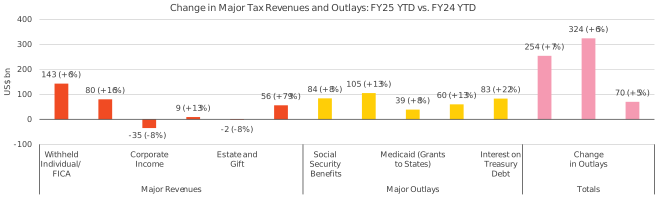
US Treasury, as of 7/15/2025
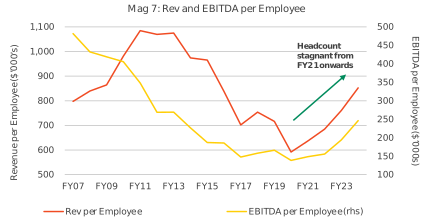
Between now and 2028, global AI infrastructure spend is projected to exceed $2.2 trillion. And companies aren’t just talking about productivity — it's happening:
AI gains aren’t theoretical — it’s a CapEx boom, a labor substitute, and a margin expander all rolled into one. For investors, this means durable earnings growth at scale… even in a slowing macro environment.
Bloomberg, and company filings, as of 12/31/2024
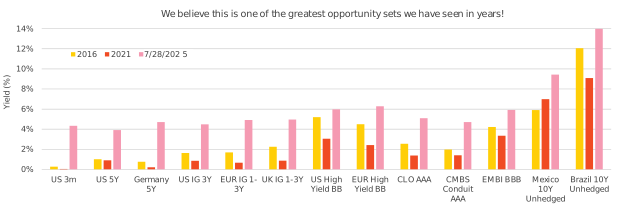
In fixed income, starting yield still explains most of your outcome. And the good news? Today’s starting point is historically excellent.
Based on current index yields, you now build a 6–7% income portfolio with sub-3% volatility, largely from high-quality assets. And for those who want more, there's convexity in mortgages, spread compression in Europe, and select credit still priced for upside.
We’re not chasing long-duration Treasuries or junk. This is about constructing ballast—real income from real cash flows that support the rest of the portfolio through volatility.
Bloomberg, as of 7/28/2025. US IG = Bloomberg US Aggregate Corporate Index, US HY = Bloomberg US Corporate High Yield Index, EUR IG = Bloomberg Pan-European Aggregate Corporate Index, EUR HY = Bloomberg Pan-European High Yield Index, CLO AAA = JP Morgan US AAA CLO Index, CMBS Conduit = Bloomberg US Agency CMBS Index, EMBI = JP Morgan Emerging Markets Bond Index.
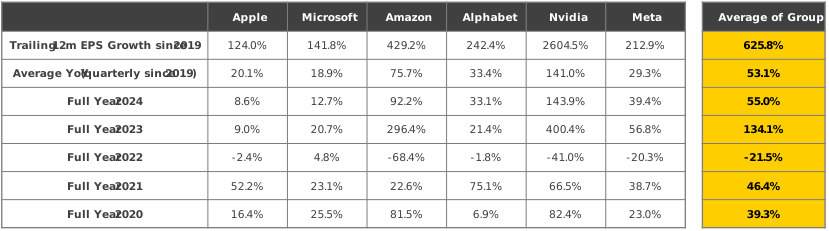
Valuations may be high, but so is earnings growth. In fact, the top companies in the S&P 500 now throw off $651bn of free cash flow with 55% ROE, yet carry less leverage than prior cycles. We think it makes sense to own them – just size correctly and consider pairing with hard‑asset laggards (defense, copper, power, GLP‑1 health plays) for balance.
The Magnificent 7? Their contribution to the S&P's P/E has 8x’edin the last decade, not because of multiple expansion—but because they are minting money. It’s the most profitable corporate landscape we’ve seen in a generation.
You’re not just buying high multiples — you’re buying compounding cash flow machines.
Bloomberg, as of 7/11/2025. For illustrative puposes only. Not meant as a recommendation to buy or sell any security listed.
AI isn’t digital-only. It requires real-world infrastructure—power, copper, storage, cooling. Commodities and industrials are becoming core to tech exposure, not just inflation hedges.
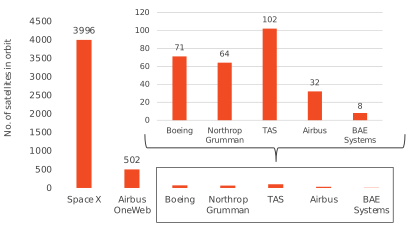
At the same time, defense and space are undergoing a structural renaissance. Geopolitics is forcing governments to reindustrialize—and fast. Commercial space launches now outnumber government ones, and private capital is pouring into autonomy, materials, and next-gen energy.
Union of Concerned Scientists and Berenberg estimates, as of 09/06/2024
Yes, potholes are coming. Seasonals say so. But this isn’t a sinkhole regime.
The U.S. economy is stable. Income is abundant. Tech is transformative. And opportunities span far beyond the index.
This is a moment to:
As we ride into this seasonally sensitive period, don’t be afraid to drive on. Take advantage of cheap insurance. Harvest income as a ballast. Let compounding do the rest.
Investing involves risks, including possible loss of principal. Past performance is no guarantee of future results. Index performance is shown for illustrative purposes only. It is not possible to invest directly in an index.