Matthew Nili
Managing Director, Head of U.S. and Canada Liability Driven Investing (LDI)
For many corporate defined benefit plans, the first half of 2026 did more than improve funded status—it reinforced a changing strategic question. After years in which sponsors were asked how quickly they could close deficits, many are now asking how to protect, deploy, or intentionally spend surplus. Today’s environment combines three important features: funded ratios near multi-decade highs, discount rates that remain meaningfully higher relative to the post-global-financial-crisis period, and credit spreads that offer less compensation for incremental risk than sponsors have often received historically. In our view, the opportunity may not simply be to “de-risk.” There is a new opportunity to convert a strong funded position into a durable enterprise outcome - lower balance-sheet volatility, preserved surplus, enhanced retirement benefits, or more flexible endgame optionality.
Growth remains positive, but the policy debate has shifted from how quickly inflation returns to target to how much persistence the economy can absorb before financial conditions need to remain tighter for longer. The Federal Reserve’s June 2026 projections1 reflected this tension: stable growth and employment, but a higher inflation path and a higher projected policy-rate path than earlier in the year. For pension sponsors, that combination is consequential. It supports higher discount rates today, but it also raises the cost of waiting if the next major move in rates is lower rather than higher. More broadly, the policy framework itself may be shifting away from the highly guided, reaction-function-driven environment that shaped much of the post-GFC period. For LDI investors, that argues for less reliance on predicting the next Fed move and more emphasis on whether today’s yield levels, curve exposures, and funded-status risks justify action now.
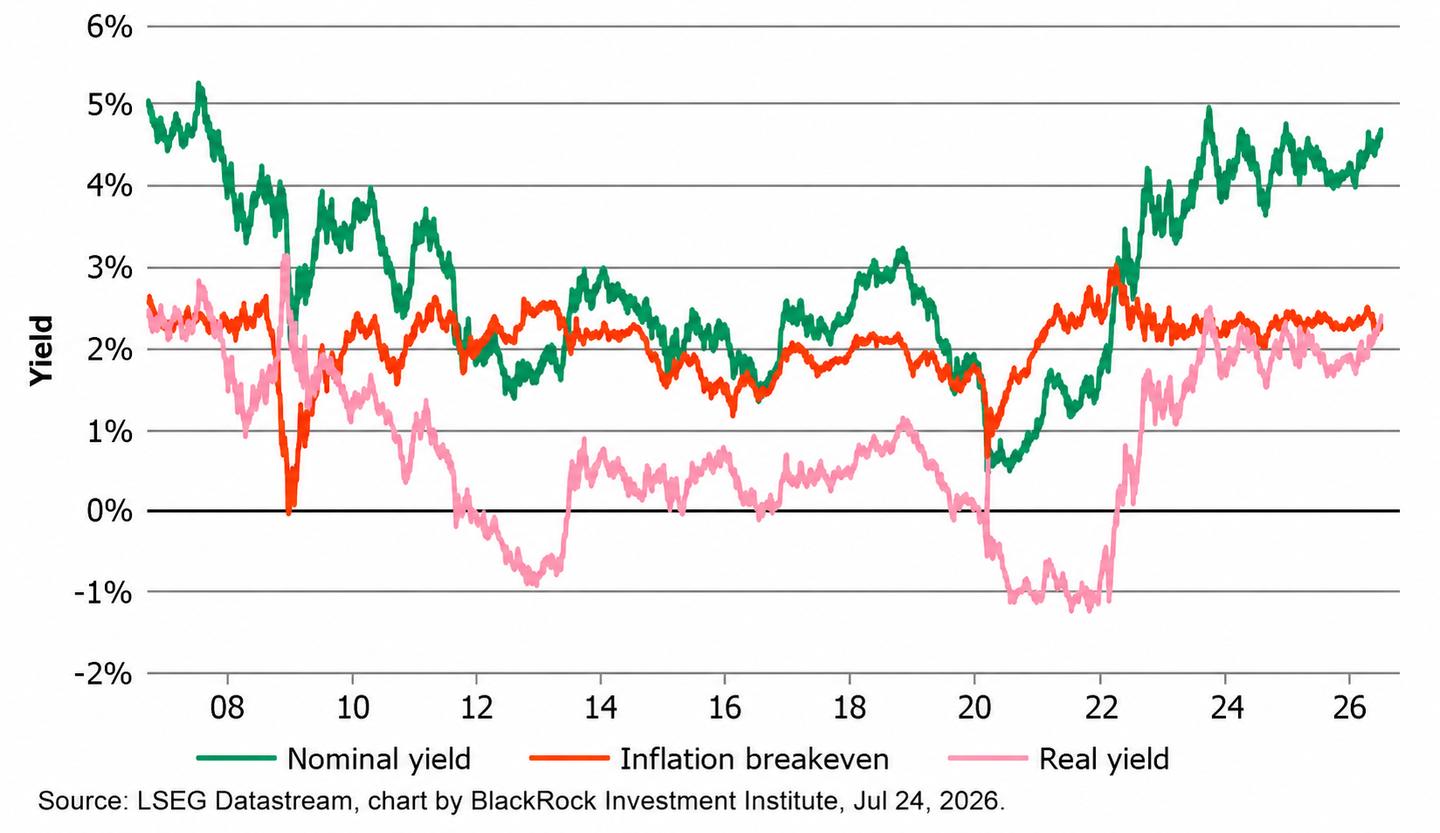
The most important market signal for LDI investors has been the rise in real yields. Inflation expectations have been comparatively contained, while nominal yields have moved higher as investors demanded more real compensation for capital. This is not merely a market observation; it directly affects sponsor decisions. Higher real yields make long-duration hedging assets more compelling, increase the opportunity cost of remaining underhedged, and reduce the cushion available to risk assets if growth expectations weaken.
The implication is that the hedge decision should be framed less as a tactical call on rates and more as a capital allocation decision. If a sponsor can hedge liabilities at yields that are attractive relative to recent history, while the plan is already fully funded or in surplus, the hurdle for remaining materially underhedged should be high.
Treasury yields moved higher across most maturities during the first half of 2026, but the move was not uniform. Intermediate maturities experienced the largest increases, while the long end rose more modestly. See Exhibit 2. That pattern is important for LDI portfolios because pension liabilities are not exposed to “duration” in the abstract; they are exposed to specific points on the curve.
This is where generic de-risking language can fall short. A plan can increase its hedge ratio and still leave meaningful funded-status risk if the hedge portfolio does not match the liability’s key-rate profile. Sponsors should therefore evaluate hedge effectiveness across rate tenors, curve shocks, and liquidity needs—not just against a single duration statistic.
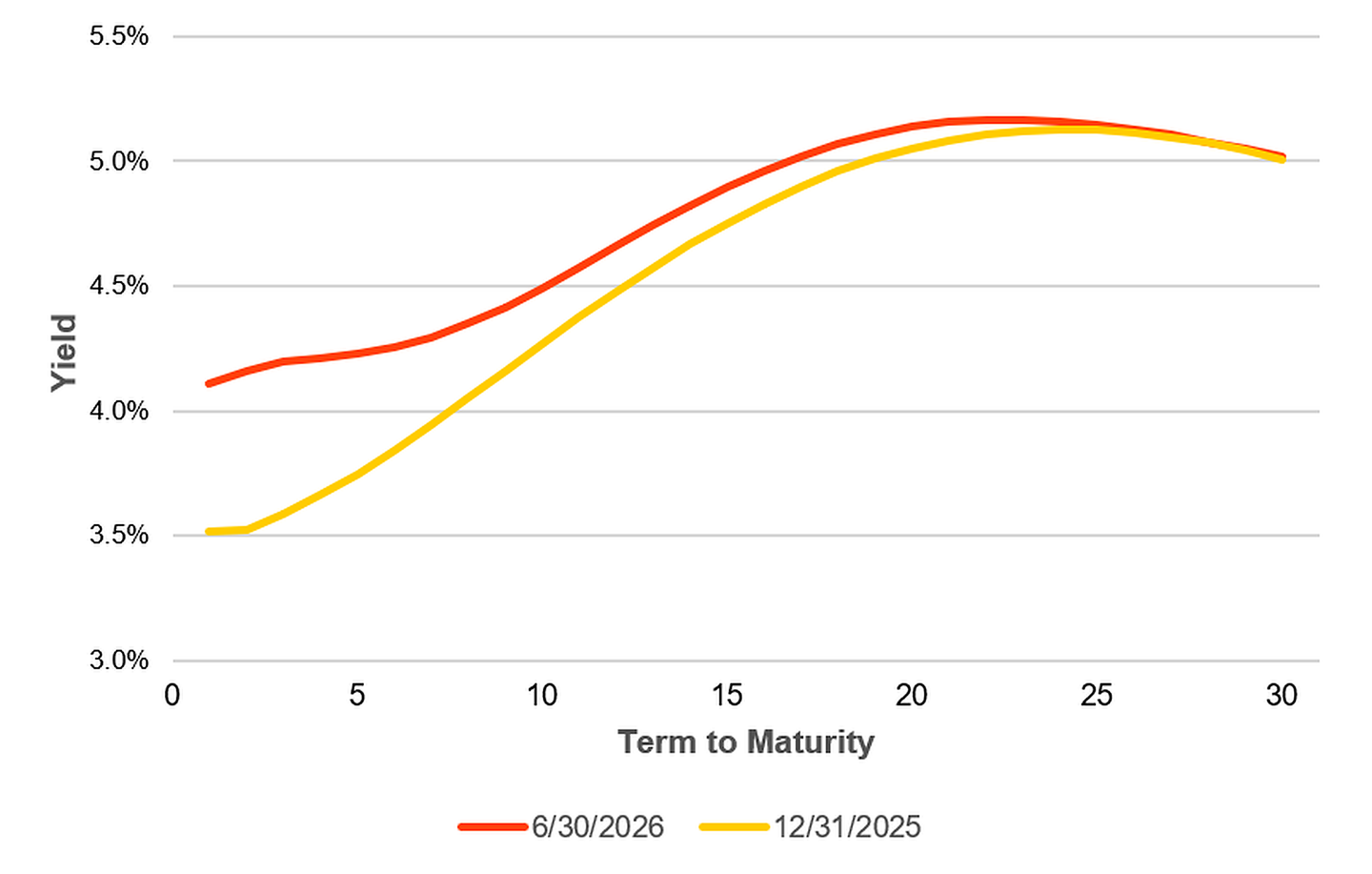

Source: Source: ICE Bank of America Merrill Lynch spot curves published as of 6/30/2026.
For illustrative purposes only. Past market data is not indicative of future results.
Credit markets present a different challenge: all-in yields remain attractive, but spreads are tight by historical standards. A sponsor may be well paid for owning long-duration fixed income in absolute yield terms, while being less well compensated for taking additional credit beta. In other words, the income opportunity is real, but the margin for error in credit selection is thinner.
For LDI portfolios, this argues for a more intentional credit architecture: diversified issuer exposure, close monitoring of downgrade risk, maturity concentration, and a clear view on whether spread exposure is being used to hedge liability discount-rate movements, generate income, or both.
The strategic implication is nuanced. Credit remains central to liability hedging because corporate discount rates embed credit spreads. But when spreads make up a smaller share of the total discount rate, interest-rate exposure may dominate funded-status movement, while spread widening can still erode surplus depending on the environment.
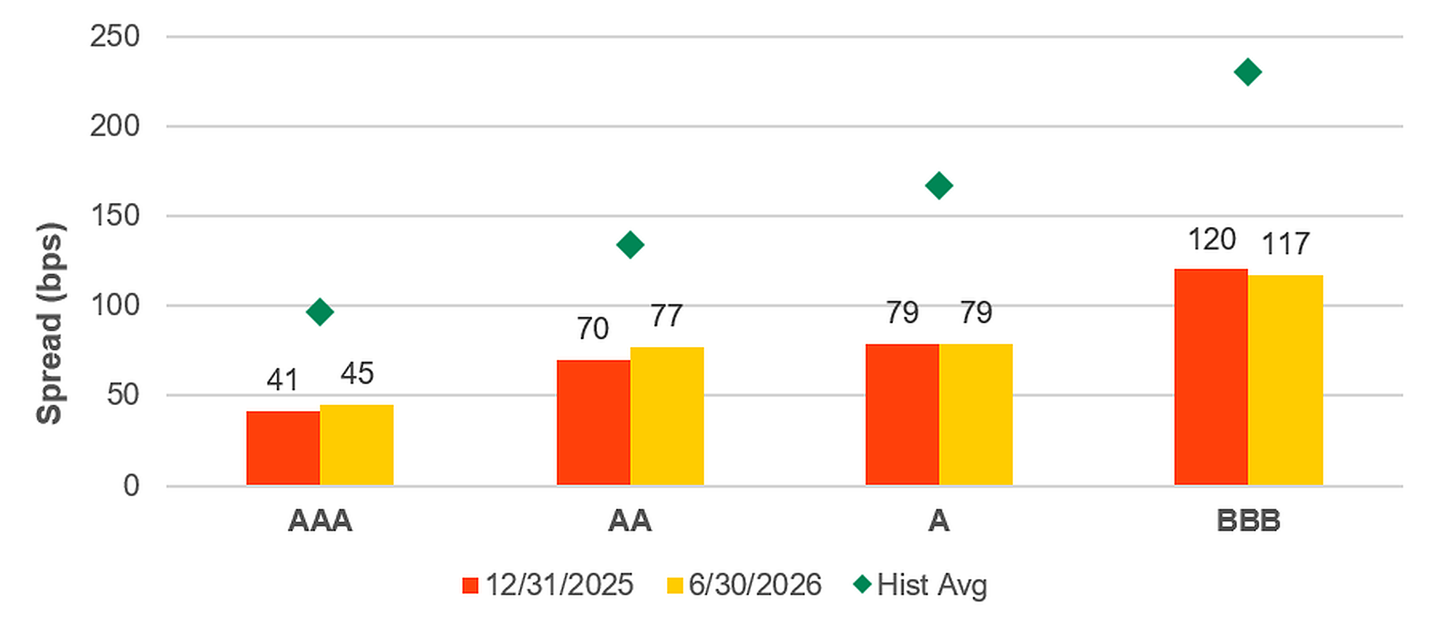
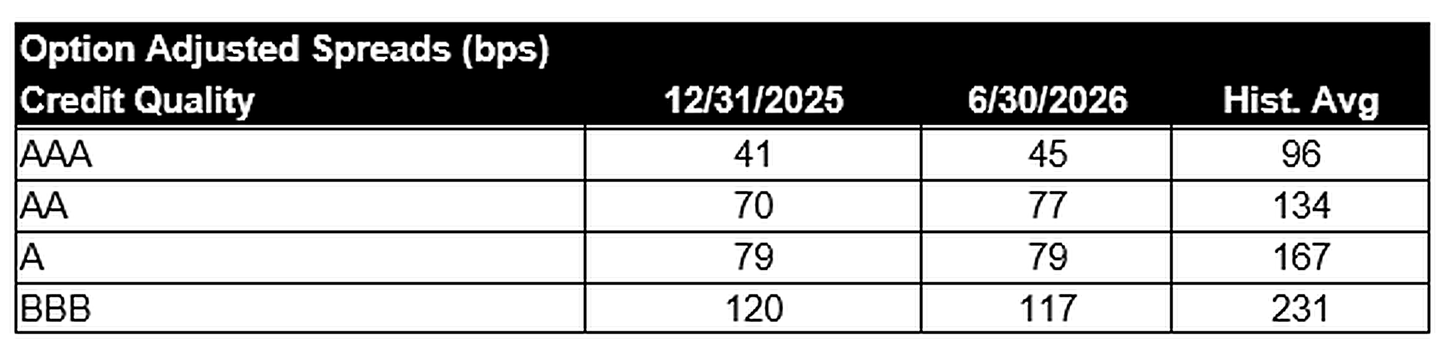
Source: Bloomberg U.S. Long Credit Aaa Index, Bloomberg U.S. Long Credit Aa Index, Bloomberg U.S. Long Credit A Index, Bloomberg U.S. Long Credit Baa Index as of 6/30/2026. Past performance does not guarantee future returns. Indices are unmanaged. One cannot directly invest in an index. AAA, AA, A and BBB represent different credit qualities within the investment grade corporate universe. Historical Average refers to the average OAS calculated over an 18-year period, beginning in 2008.
Improved asset performance combined with elevated discount rates has left many corporate defined benefit plans fully funded or in surplus. Recent industry data2 has highlighted aggregate funded ratios above 100%, with measures approaching levels not seen since the early 2000s.
That said, the improvement is generally not treated as a finish line. Surplus introduces a broader set of choices: preserve the balance sheet benefit, increase hedge precision, reopen or redesign retirement benefits, or redeploy excess assets within the constraints of plan rules and sponsor objectives. The most effective governance conversations start with a simple question: what does the sponsor want the surplus to do?
The current environment creates a rare opening to move from funded-status improvement to funded-status durability. We see four practical implications for sponsors and their advisors.
1. Reframe the risk budget around surplus protection. For plans in surplus, the primary risk may no longer be chronic underfunding; it may be giving back hard-won funded status through a combination of lower rates, wider spreads, and equity volatility. Hedge-ratio decisions should therefore be evaluated against downside funded-status outcomes, not only expected return.
2. Move from duration matching to curve-aware hedging. The curve move over the first half of 2026 showed why aggregate duration is an incomplete measure. Sponsors should review key-rate alignment, liability cash-flow buckets, and the potential role of Treasury STRIPS, spread assets, derivatives, or completion overlays to close specific hedge gaps.
3. Separate the yield opportunity from the spread-risk decision. Elevated all-in yields support fixed income ownership, but tight credit spreads require selectivity. Sponsors should ask whether incremental spread exposure is being rewarded, whether downgrade risk is properly budgeted, and whether private high grade credit or other diversifying exposures improve resilience.
4. Use surplus to expand the strategic conversation. A surplus position can support multiple endgames: hibernation, risk transfer, continued plan sponsorship, or broader retirement benefit strategy. The right answer depends on the sponsor’s balance sheet, workforce objectives, accounting sensitivity, liquidity needs, and appetite for governance complexity.
The first half of 2026 reinforced a more important point than “rates are higher” or “funded status is strong.” It showed that many sponsors have entered a new phase of pension management in which surplus is no longer hypothetical. The highest-value decision is now how to protect and use it.