Jul 06, 2026 | By Lisa Goldberg, Nate Bridgers
After‑Tax Strategies for Early Investors with Concentrated Stock

Key takeaways
- Investors with IPO securities benefit most when concentration risk and exposure to capital gains are considered early.1
- Managing concentrated stock from an IPO may require multiple after-tax strategies, combining exclusion, deferral, offsetting, and hedging rather than relying on a single solution.
- There is no one-size-fits-all approach to concentrated stock risk, as the right strategy depends on lock up agreements and restrictions, as well as each investment portfolio’s tax profile, liquidity needs, and long-term goals.
2026 is the year of high-profile tech IPOs, with valuations at eye-popping levels. For early investors with low-cost-basis holdings, an IPO creates new opportunities while also introducing the challenge of managing concentration risk and, for some investors, doing so without triggering significant capital gains taxes. This may be a champagne problem, but it needs to be solved nevertheless and can be addressed through thoughtful planning. We lay out an after-tax framework for managing concentrated stock, organized around four principles: exclude the gain when possible, defer it when exclusion is not possible, offset it through loss harvesting, and hedge and diversify concentration risk when appropriate2. There is no single best strategy for managing the risk and potential tax impact of a concentrated position, which is why effective pre-IPO planning for early investors requires careful coordination. In the case study that follows, we walk through the key questions, resources, and considerations many investors should weigh when navigating a highly appreciated stock.
Case Study: What Should Early Investors Consider Before an IPO?
Fifteen years ago, an investor took a chance on an early-stage Silicon Valley tech startup, writing a $500k check at a time when the company was little more than a pitch deck. Today, that bet is worth $20 million. As the company prepares to go public, the investor asks the question: is it time to diversify?
As a long-term planner and no stranger to risk, the investor is a believer in capital markets and comfortable with volatility. They seek a diversified portfolio because they dislike the idea of future returns hinging on the fortunes of a single company. The investor and their team of professionals sit down with four clear goals in mind:
- Diversify concentrated equity position3.
- Manage the tax impact of the substantial unrealized gain.
- Reposition the portfolio's objectives.
- Share the good fortune with charitable organizations.
A first step is a walkthrough of an after-tax portfolio management framework for concentration stock built around four principles: exclude, defer, offset, and hedge/diversify.
Exclude: Using QSBS to Reduce Federal Capital Gains
The investment team explains a provision called Qualified Small Business Stock, or QSBS. Originally designed by Congress to encourage investment in early-stage American companies, QSBS allows qualifying shareholders, often early backers of tech and manufacturing businesses, to exclude a capital gain of up to $10 million from federal tax. For this investor, that could mean selling roughly half of the position without owing a dime in federal capital gains tax, a powerful first step toward diversification4.
When the investor asks what else they might need to know, the investment team advises them to confirm with a tax professional that the shares meet the QSBS qualification requirements. The team mentions residency in some states could mean they need to pay state capital gains. However, the federal exclusion does the heavy lifting, knocking out the largest portion of the tax bill.
Defer: Charitable Remainder Trusts (CRUTs) after an IPO
Having worked with the investor for many years, the investment team knows how important charitable giving is to them. The team recommends that they consider deferring tax on a portion of the concentrated position by contributing it to a Charitable Remainder Unitrust (CRUT) and immediately selling it once the lockup period expires.
Here's how a CRUT works: As soon as the investor transfers $5 million in shares to the CRUT, they receive an immediate charitable income tax deduction equal to the present value of the remainder interest that will eventually pass to charity. The CRUT, itself a tax-exempt entity, can then sell those shares without triggering immediate capital gains. The investor receives a 5% annual distribution from the trust, and the embedded gain is recognized gradually as distributions are paid. Because CRUT distributions follow a strict tier-ordering rule, the taxable character of each payment flows out worst to best: ordinary income first, then short-term capital gains, then long-term capital gains, and finally return of principal.
That tier-ordering drives the investment team’s asset allocation recommendation. They steer the investor to minimize the allocation toward fixed income in the CRUT, since the interest income would be paid out as ordinary income, the worst possible tax treatment under the CRUT's distribution rules. Instead, consider a low-cost S&P 500 ETF as the core holding, giving the investor diversified U.S. equity exposure without producing meaningful ordinary income.
Offset: Harvesting losses with tax-aware Long/Short Strategies
QSBS solves the federal capital gain tax issue on the first half of the investor’s position, and the CRUT defers another portion of the gain on the second half. But two tax bills remain: state residency capital gains tax on the QSBS sale, and the capital gain distributions that will flow out of the CRUT each year. To address them, the investment team turns to the third pillar of the framework: offset.
The recommendation is to put $6 million of the QSBS proceeds into a tax-aware long/short strategy, which relaxes the long-only constraint found in traditional equity portfolios.
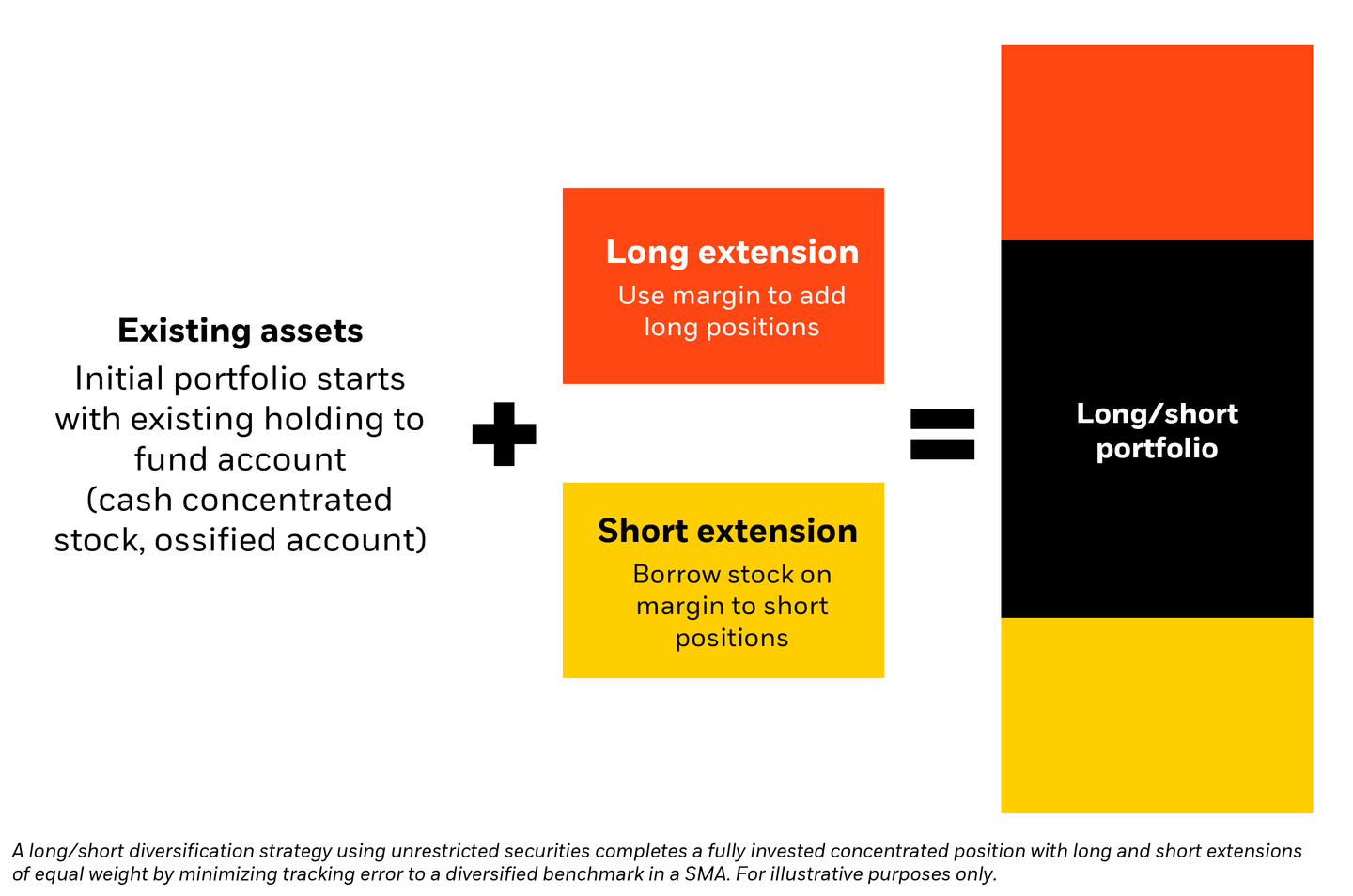
The long/short portfolio manager can express investment views by overweighting stocks with characteristics a portfolio manager favors and shorting stocks with characteristics a portfolio manager wants to underweight, all while maintaining beta-1 market exposure. With positions on both sides of the book, a portfolio manager can systematically harvest capital losses as part of the ongoing risk management process.
For the investor, those realized losses can be used to help offset state capital gains tax on the initial QSBS sale and absorb the gains distributed from the CRUT over time, mitigating two ongoing tax drags.
Hedge & Diversify: Reducing single‑stock risk with option strategies and state-specific Munis
With the remaining $5 million of shares, the investment team turns to the fourth and final principle of the framework: hedge and diversify. Rather than sell the stock outright and trigger another round of taxable gains, the investment team suggests qualified covered calls on the concentrated stock to dampen the volatility in the underlying stock.
We highlight two outcomes from a tax perspective that may occur when selling a qualified covered call:
- Scenario A: Stock rallies. To avoid having shares called away, a portfolio manager could close the existing call and write a new one with a higher strike price and a later expiration date (commonly referred to as 'rolling up and out'). The cost of closing the original call typically generates a realized loss. Those realized option losses can be used to tax-neutrally trim additional shares, gradually reducing concentration without a net tax bill.
- Scenario B: Stock declines. The options make money that helps cushion the stock’s drawdown. These option gains are taxed at the short-term capital gains rate. However, since the tax-aware long/short portfolio may generate net short-term losses, those short-term losses, first go towards offsetting short-term capital gains and then may offset additional long-term cap gains from the sale of the stock.
Lastly, as part of the diversification plan and beyond the $6 million allocated to the tax-aware long/short strategy, the investor deploys the remaining $4 million of QSBS proceeds into state-specific municipal bonds. Because some state specific Munis are exempt from both federal and state income tax, they provide a tax-efficient source of income while diversifying the portfolio, adding a high-quality, fixed-income sleeve that complements the equity-heavy structure of the rest of the portfolio.
Putting the IPO After‑Tax Framework into action
Using the framework of exclude, defer, offset, hedge, and diversify, the investment team was able to help accomplish a few goals. We recap the framework and the investment team’s discussion below:
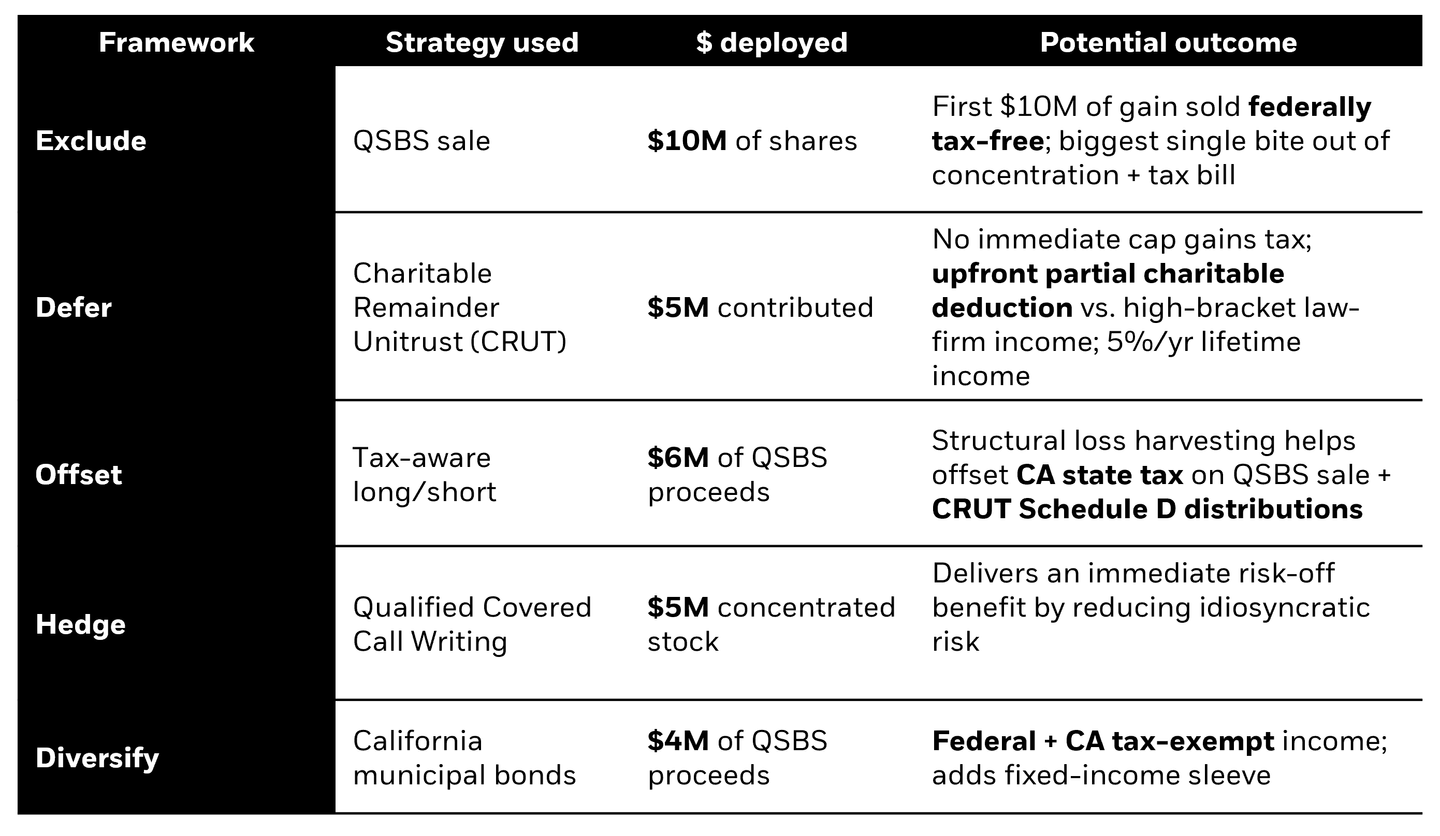
The investor walked in with a $20 million concentrated stock position, a looming IPO, and four goals: diversify the position, manage the tax impact, reposition the portfolio, and position assets to give back to charity. The investor walks out with a coordinated plan that can be implemented once restrictions expire that meaningfully addresses all four.
There is no single best strategy for managing a concentrated position. However, by calibrating the exclude, defer, offset, hedge, and diversify framework to goals, tax profile, and portfolio objectives, a thoughtful discussion can turn a champagne problem into a champagne plan.
Frequently asked questions

Nate Bridgers
Investment Strategist and After-tax Wealth Strategist, BlackRock SMA Solutions

Lisa R. Goldberg
Senior Advisor, BlackRock SMA Solutions
Additional resources
Institutional outlook
Monthly publication for institutional investors delivering macro market perspectives with asset class level implications.
Peer study and analytics
Actionable analysis of industry peers, focusing on allocation decisions, investment strategies and risk management.