
We think investors need to rethink long-term portfolio construction. Why?
First, long-term macro anchors that were central to building long-term portfolios for decades – like stable growth, contained inflation expectations and fiscal discipline – are adrift as the world undergoes a transformation. Second, today’s investment opportunity set has broadened, with the emergence of brand new assets - such as bitcoin - or more granular exposures, such as thematic equities, that together offer a much richer range of granularity than historic asset allocation blocks can provide. Assets historically labelled as "alternative" - from hedge funds to infrastructure - can be thought of as part of a core allocation in this modern definition of a neutral multi-asset portfolio.
In our Rethinking neutral series, we consider what a new “neutral” long-term portfolio looks like. Our first report focuses on hedge funds – and why we believe some investors could carve out more room for hedge fund strategies in portfolios. Our second report focuses on infrastructure and how mega forces are driving enduring infrastructure demand. Our third report rethinks portfolio construction in the age of transformation.
Read how we’re rethinking long-term portfolio construction
In a world with may possible outcomes, the “average” scenario is no guide for portfolios. See the “Monitoring scenarios is key” chart. Yet traditional asset allocation — built around static mixes like a 60/40 stock-bond split — assumes a stable long-term environment. That assumption is misaligned with an economy transforming in real time.
We believe portfolio construction must adapt. That means revisiting key allocation decisions more frequently, incorporating explicit alternative scenarios, focusing on underlying economic drivers rather than asset class buckets, and treating alpha as integral to asset allocation — not an add-on.
The mega forces driving the transformation cut across asset class buckets. The AI buildout, for example, spans surging capital spend, data centers, power generation, infrastructure and private markets. That means what appears diversified on paper may in practice represent a concentrated bet on how transformation unfolds.
It means there is no “easy” long-term portfolio in an era of structural change. But retreating to static allocations or traditional approaches risks missing the opportunity transformation creates. In our view, the greater risk today is inertia.
Monitoring scenarios is key
Illustrative distribution of U.S. equity returns

Forward-looking estimates may not come to pass. Source: BlackRock Investment Institute, February 2026. Note: The illustration shows a hypothetical distribution of U.S. equity returns in the different scenarios underlying our capital market assumptions. Read more here.
Mega forces, like the low-carbon transition, AI and geopolitical fragmentation are driving multi-decade investment needs. Those long-lasting needs make listed and private infrastructure assets an avenue for tapping into enduring demand at attractive valuations, in our view.
Infrastructure assets – real assets essential to economies across transport, energy, digital and utility systems – have cash flows that are typically regulated over long periods, providing defensive attributes like stable cash flows usually linked to inflation.
We think the needed infrastructure buildout to support AI deployment exemplifies the timeliness of the opportunity. Data centers, power networks and fiber systems underpin AI adoption regardless of which companies ultimately lead in the AI race. That’s just one way infrastructure taps into today’s economic transformation.
As a result, our long-term capital market assumptions estimate attractive risk-adjusted returns relative to traditional equities and bonds. We see an opportunity for early adopters to secure exposure while demand for infrastructure capital still exceeds supply, helping keep potential returns and starting valuations attractive.
Harnessing hedge funds
More uncertainty about the future path of economies is driving greater dispersion in stocks. The Wider-ranging stock returns chart below shows the performance of individual S&P 500 stocks has been much more varied since 2020.
Wider-ranging stock returns
S&P 500 stock dispersion, 2010-2025
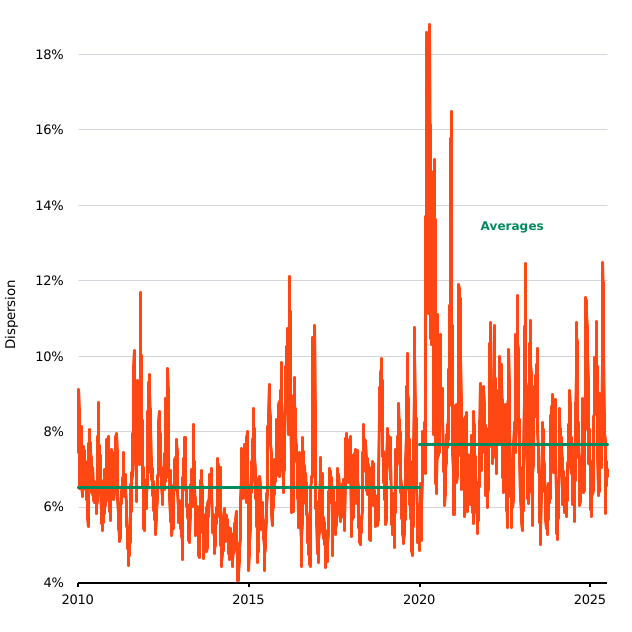
The figures shown relate to past performance. Past performance is not a reliable indicator of current or future results. Capital at risk. Index performance returns do not reflect any management fees, transaction costs or expenses. Indices are unmanaged and one cannot invest directly in an index. Source: BlackRock Investment Institute, with data from Bloomberg, August 2025. Note: The lines show the dispersion of individual S&P 500 stock returns. The chart shows two averages for 2010-2019 and 2020-2025.
We think this more volatile environment that’s driving elevated dispersion can bode well for skilled fund managers to deliver greater active returns, or alpha.
But lost long-term macro anchors also means investors need to make big calls about the future path of the economy and be deliberate about their exposure to fluctuations in factors like growth and inflation, or macro risk. Static exposure to factors has become a drag on returns – a sea change from the years after the global financial crisis. See the Greater potential alpha chart.
Greater potential alphaThree-year excess returns of U.S. equity fund managers
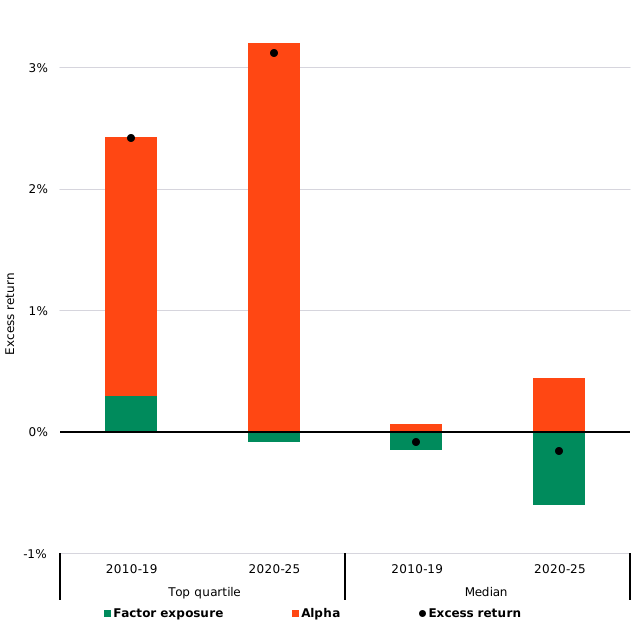
Past performance is not a reliable indicator of future performance. Capital at risk. This information should not be relied upon by the reader as research or investment advice regarding any funds, strategy or security. Source: BlackRock Investment Institute, with data from eVestment and LSEG Datastream, July 2025. Notes: The chart compares the rolling three-year average excess return (into alpha and factor contribution) between 2010-2019 and 2020-2025 – excluding January-June 2020 to avoid skewing the data with pandemic-era volatility – for both top-quartile and median quartile U.S. large cap equity managers in the eVestment universe. We use regression analysis to estimate the relationship between alpha-seeking manager performance and market conditions. Regression analysis is backward-looking and is only an estimate of the relationship. The future relationship may differ.
We see hedge funds emerging as a critical source of return in portfolios as a result. Our research finds that top-performing hedge funds, especially strategies that aim to exploit economic shifts have delivered greater excess returns since the pandemic.
We also see more opportunity for stock picking that can outperform markets – potentially rewarding those that deliberately minimize macro risk to favor stock picking instead.