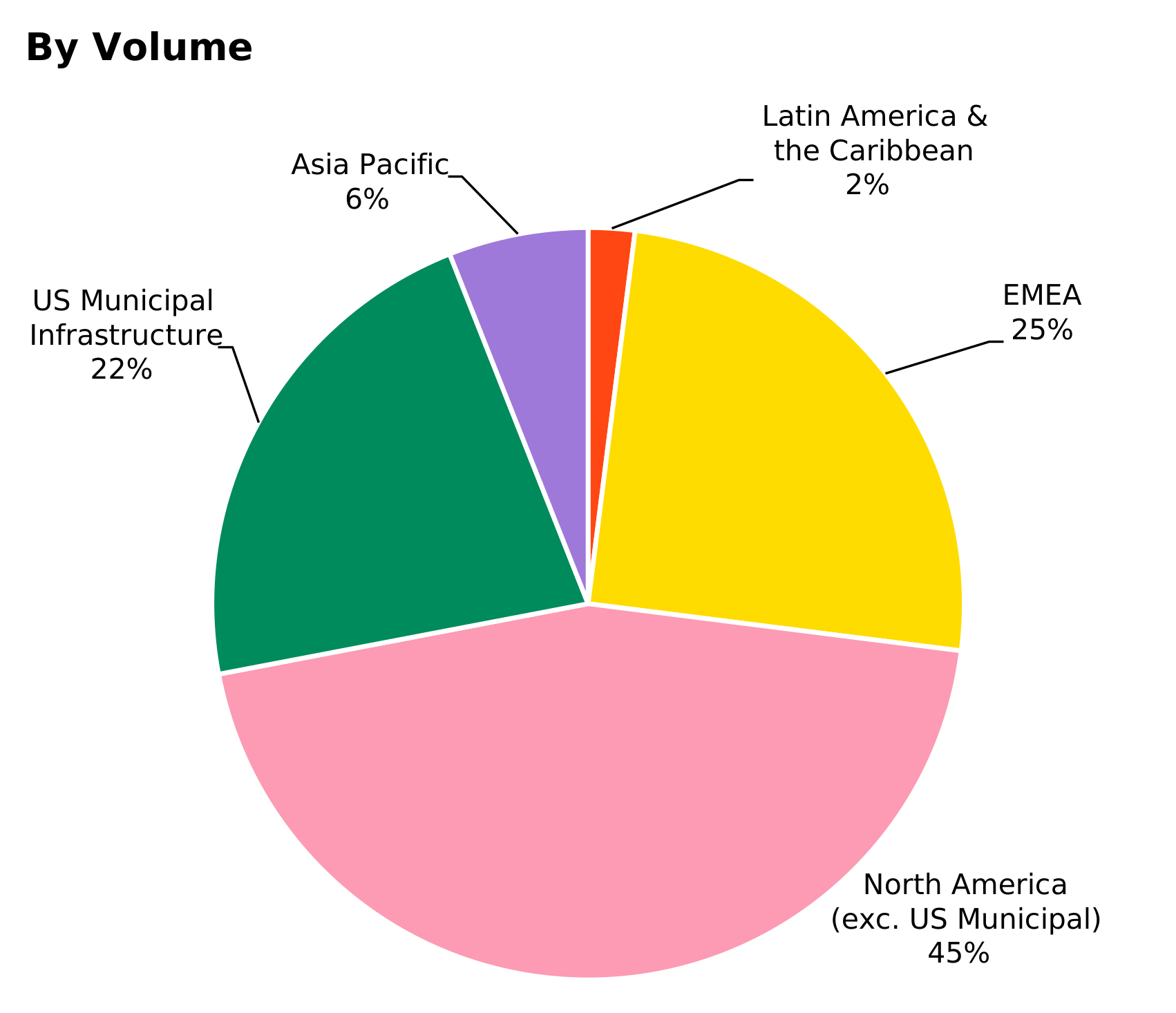
1 Preqin, Institutional Allocation Study 2025, April 2025. Preqin, Global Report: Infrastructure 2025, December 2024.
2 Moody’s Ratings, Infrastructure Default and Recovery Rates, 1983-2024, 3 September 2025.
FOR PROFESSIONAL, ACCREDITED, WHOLESALE AND INSTITUTIONAL INVESTORS USE ONLY – NOT FOR PUBLIC DISTRIBUTION (PLEASE READ IMPORTANT DISCLOSURES)
Important disclosures
This material is provided for educational purposes only and is not intended to be relied upon as a forecast, research or investment advice, and is not a recommendation, offer or solicitation to buy or sell any securities or iShares Funds, nor to adopt any investment strategy. The opinions expressed are subject to change. References to specific securities, asset classes and financial markets are for illustrative purposes only and are not intended to be and should not be interpreted as recommendations. There are risks associated with investing, including loss of principal. The value of investments involving exposure to foreign currencies can be affected by exchange rate movements. Reliance upon information in this material is at the sole risk and discretion of the reader. The material was prepared without regard to specific objectives, financial situation or needs of any investor. You are reminded to refer to the relevant prospectus for specific risk considerations which are available from BlackRock or the iShares websites.
This material may contain “forward-looking” information that is not purely historical in nature. Such information may include, among other things, projections, forecasts, and estimates of yields or returns. No representation is made that any performance presented will be achieved by any BlackRock or iShares Funds, or that every assumption made in achieving, calculating or presenting either the forward-looking information or any historical performance information herein has been considered or stated in preparing this material. Any changes to assumptions that may have been made in preparing this material could have a material impact on the investment returns that are presented herein. Past performance is not a reliable indicator of current or future results and should not be the sole factor of consideration when selecting a product or strategy.
The information and opinions contained in this material are derived from proprietary and nonproprietary sources deemed by BlackRock to be reliable, are not necessarily all-inclusive and are not guaranteed as to accuracy.
In Hong Kong, this material is issued by BlackRock Asset Management North Asia Limited and has not been reviewed by the Securities and Futures Commission of Hong Kong. This material is for distribution to "Professional Investors" (as defined in the Securities and Futures Ordinance (Cap.571 of the laws of Hong Kong) and any rules made under that ordinance) and should not be relied upon by any other persons or redistributed to retail clients in Hong Kong.
In Singapore, this is issued by BlackRock (Singapore) Limited (Co. registration no. 200010143N) for use only with accredited and institutional investors as defined in Section 4A of the Securities and Futures Act, Chapter 289 of Singapore. This advertisement or publication has not been reviewed by the Monetary Authority of Singapore.
In South Korea, this information is issued by BlackRock Investment (Korea) Limited. This material is for distribution to the Qualified Professional Investors (as defined in the Financial Investment Services and Capital Market Act and its sub-regulations) and for information or educational purposes only, and does not constitute investment advice or an offer or solicitation to purchase or sells in any securities or any investment strategies.
In Taiwan, independently operated by BlackRock Investment Management (Taiwan) Limited. Address: 28F., No. 100, Songren Rd., Xinyi Dist., Taipei City 110, Taiwan. Tel: (02)23261600.
In Australia & New Zealand, issued by BlackRock Investment Management (Australia) Limited ABN 13 006 165 975, AFSL 230 523 (BIMAL) for the exclusive use of the recipient, which warrants by receipt of this material that it is a wholesale client as defined under the Australian Corporations Act 2001 (Cth) and the New Zealand Financial Advisers Act 2008 respectively.
BIMAL is not licensed by a New Zealand regulator to provide ‘Financial Advice Service’, 'Investment manager under an FMC offer' or ‘Keeping, investing, administering, or managing money, securities, or investment portfolios on behalf of other persons’. BIMAL’s registration on the New Zealand register of financial service providers does not mean that BIMAL is subject to active regulation or oversight by a New Zealand regulator.
This material provides general advice only and does not take into account your individual objectives, financial situation, needs or circumstances. Before making any investment decision, you should therefore assess whether the material is appropriate for you and obtain financial advice tailored to you having regard to your individual objectives, financial situation, needs and circumstances. Refer to BIMAL’s Financial Services Guide on its website for more information. This material is not a financial product recommendation or an offer or solicitation with respect to the purchase or sale of any financial product in any jurisdiction.
Information provided is for illustrative and informational purposes and is subject to change. It has not been approved by any regulator.
This material is not intended for distribution to, or use by, any person or entity in any jurisdiction or country where such distribution or use would be contrary to local law or regulation. BIMAL is a part of the global BlackRock Group which comprises of financial product issuers and investment managers around the world. BIMAL is the issuer of financial products and acts as an investment manager in Australia. BIMAL does not offer financial products to persons in New Zealand who are retail investors (as that term is defined in the Financial Markets Conduct Act 2013 (FMCA)). This material does not constitute or relate to such an offer. To the extent that this material does constitute or relate to such an offer of financial products, the offer is only made to, and capable of acceptance by, persons in New Zealand who are wholesale investors (as that term is defined in the FMCA).
BIMAL, its officers, employees and agents believe that the information in this material and the sources on which it is based (which may be sourced from third parties) are correct as at the date of publication. While every care has been taken in the preparation of this material, no warranty of accuracy or reliability is given and no responsibility for the information is accepted by BIMAL, its officers, employees or agents. Except where contrary to law, BIMAL excludes all liability for this information.
Any investment is subject to investment risk, including delays on the payment of withdrawal proceeds and the loss of income or the principal invested. While any forecasts, estimates and opinions in this material are made on a reasonable basis, actual future results and operations may differ materially from the forecasts, estimates and opinions set out in this material. No guarantee as to the repayment of capital or the performance of any product or rate of return referred to in this material is made by BIMAL or any entity in the BlackRock group of companies.
No part of this material may be reproduced or distributed in any manner without the prior written permission of BIMAL.
In China, this material may not be distributed to individuals resident in the People's Republic of China ("PRC", for such purposes, not applicable to Hong Kong, Macau and Taiwan) or entities registered in the PRC unless such parties have received all the required PRC government approvals to participate in any investment or receive any investment advisory or investment management services.
For Other Countries in APAC: this material is provided for your informational purposes only and must not be distributed to any other persons or redistributed. This material is issued for Institutional Investors only (or professional/sophisticated/qualified investors as such term may apply in local jurisdictions) and does not constitute investment advice or an offer or solicitation to purchase or sell in any securities, BlackRock funds or any investment strategy nor shall any securities be offered or sold to any person in any jurisdiction in which an offer, solicitation, purchase or sale would be unlawful under the securities laws of such jurisdiction.
The information provided here is not intended to constitute financial, tax, legal or accounting advice. You should consult your own advisers on such matters. BlackRock does not guarantee the suitability or potential value of any particular investment. Investment involves risk including possible loss of principal. International investing involves risks, including risks related to foreign currency, limited liquidity, less government regulation, and the possibility of substantial volatility due to adverse political, economic or other developments. These risks are often heightened for investments in emerging/developing markets or smaller capital markets.
THIS MATERIAL IS HIGHLY CONFIDENTIAL AND IS NOT TO BE REPRODUCED OR DISTRIBUTED TO PERSONS OTHER THAN THE RECIPIENT.
No part of this material may be reproduced, stored in retrieval system or transmitted in any form or by any means, electronic, mechanical, recording or distributed without the prior written consent of BlackRock.
©2026 BlackRock, Inc. or its affiliates. All Rights Reserved. BLACKROCK is a registered trademark of BlackRock, Inc. or its affiliates. All other trademarks are those of their respective owners.