Nostalgia often paints the past in golden hues, but were the "good old days" truly better? In reality, recent decades were often marked by sluggish growth, persistently low bond yields, limited innovation, and drawn-out recoveries from economic downturns. After the Global Financial Crisis, for example, it took nearly ten years for U.S. employment to return to pre-crisis levels—a reflection of how slow and uneven those recoveries could be.
Today, we find ourselves in an entirely different—and far more dynamic—economic landscape, underpinned by the flexibility of our service-driven economy and accelerated by transformative technological advancements. This resilience is clearly demonstrated by the steady growth and stability in consumer spending on services, which has risen consistently at roughly 4% annually over the past decade, even amid broader market fluctuations. Services now comprise 70% of U.S. consumer spending, reflecting an economy uniquely equipped to adapt quickly, absorb economic shocks, and redirect resources toward higher productivity and innovation.
Here’s a closer look at the key forces reshaping the economic landscape—and how investors might approach this new era with clarity and confidence.
Productivity Revolution: AI and Automation
We are in the midst of a productivity revolution, driven largely by AI and automation. Over the past decade, global adoption of industrial robotics has grown at a compound annual rate of 12%, reshaping sectors from manufacturing and logistics to healthcare and finance.
The surge in artificial intelligence is even more dramatic. In 2015, AI-related patents filed globally were nearly nonexistent. Today, more than 120,000 are granted annually. Venture capital funding for AI startups has soared to nearly $100 billion a year—up from virtually zero a decade ago.
These advances are not hypothetical. Companies that integrate AI and automation effectively have achieved materially higher productivity growth rates than their peers. This is not just technological progress—it’s a structural shift that is rewiring the economic engine and presenting new frontiers for investment.
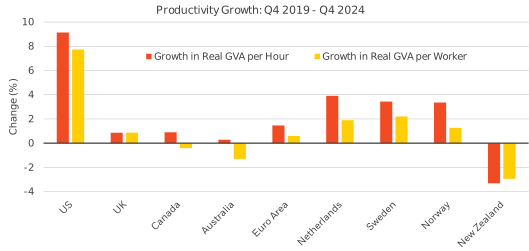
GVA = gross value added. Goldman Sachs, as of 12/31/2024
Historic Yields: It’s About Income, Not Just Duration
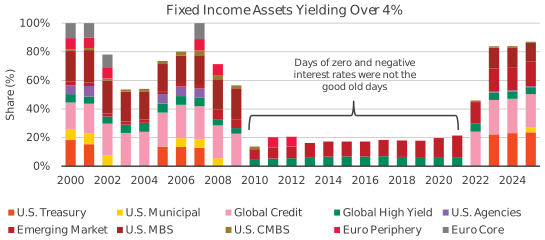
After years of historically low interest rates, the landscape has dramatically shifted, offering investors yields not seen in decades. Front-end Treasury yields now sit near 4%, levels rarely seen in the past 20 years—indeed, yields have been lower than current levels 90% of the time over that period. The elevated front-end creates opportunities throughout the universe of yielding assets unlike anything most investors have seen in their careers.
Today's fixed-income environment is primarily about income rather than duration risk. With yields broadly elevated, investors no longer need to extend maturities or take on undue interest rate risk to achieve compelling returns. Credit sectors, including high-quality corporate issuers and securitized products, currently offer significantly higher yields, frequently in the 6% to 7% range, comfortably surpassing the expected inflation rate of 2% to 3%.
Desynchronized global monetary policy cycles have broadened the opportunity set for portfolios that take advantage of the full scope of global debt markets. Holding duration in Europe and parts of Asia, where cutting paths are more certain and your FX hedge can work for you, is a compelling allocation tool for portfolios today.
This attractive yield environment comes with its own complexities. One of the greatest risks today is rising government indebtedness. U.S. federal debt now stands near historic highs, expected to approach 120% of GDP by decade-end, and government spending continues to accelerate. But there is a powerful counterbalance: sustained private-sector innovation. Investment in productivity, particularly through technology and intellectual capital, may be one of the most effective long-run defenses against fiscal pressure—driving growth that can offset debt accumulation over time. This underscores the importance of careful portfolio construction: emphasizing shorter maturities, high-quality credit exposure, and diligent risk management.
Bloomberg, as of 6/24/2025
Corporate Strength and Robust Returns
The corporate sector has emerged from the stagnant growth of the 2010s and disruption stronger than ever. Years of historically low borrowing costs allowed companies to reset and fortify their balance sheets. Cash holdings as a proportion of total assets for the S&P 500 (excluding financial firms) have steadily grown from 11% at the start of the century to nearly 17% today. Debt, meanwhile, has declined dramatically relative to free cash flow (FCF), nearly halving over the same period.
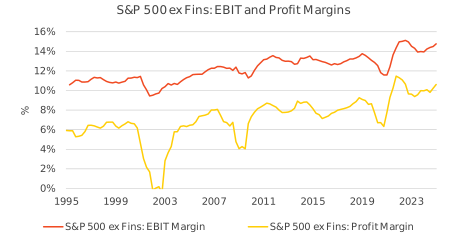
These improvements provide operational agility and enable efficiency-enhancing investments that drive profitability. Consequently, corporate profit margins have reached all-time highs. Return-on-equity (ROE) for the S&P 500 currently averages approximately 19%, notably above the historical norm of about 14%. Strong profitability has translated directly into robust shareholder returns, with dividends and buybacks totaling more than $1 trillion annually.
S&P Global Market Intelligence, as of 3/31/2025
The Private Wealth Boom: A Fundamental Shift
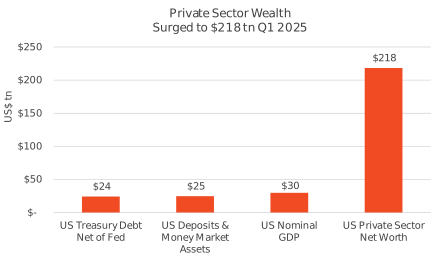
A dramatic shift has occurred in global wealth distribution. Today, total U.S. private-sector wealth has reached approximately $218 trillion—almost triple what it was a decade ago. This enormous accumulation of private capital has profound implications for asset markets, especially given the comparatively smaller pool of available yielding investments.
To illustrate, annual income generated by U.S. fixed-income investments alone now approaches $2 trillion. This recurring inflow creates substantial ongoing demand for diversified, income-producing strategies, providing foundational support across asset classes as wealth continuously seeks productive deployment.
Federal Reserve, Bureau of Economic Analysis, and Bloomberg, as of 3/31/2025
Equities: Supported by Fundamentals and Flows
Equity markets have staged a remarkable comeback from tariff-induced turmoil earlier this year. Today’s valuations reflect robust underlying fundamentals, not merely optimism. Earnings are expanding sustainably, supported in part by a significant rise in long-term investment. S&P 500 companies now invest over $1.5 trillion annually in CapEx and R&D—nearly double the level from 2015. This reinvestment has fueled topline growth and margin expansion, laying a strong foundation for continued earnings momentum.
From a technical perspective, corporate buybacks have outpaced new equity issuance by a remarkable 4-to-1 ratio over recent years, reducing share supply and significantly bolstering market stability.
Meanwhile, the maturation of private markets into a major asset class represents a critical development investors cannot afford to ignore. Today, private markets offer unique avenues for exposure to innovation, enhanced returns, and diversification. Incorporating this growing segment into modern portfolios has become increasingly essential.
While U.S. companies remain the engine of global innovation, there’s also a place for select international equity exposure. Markets like Europe and Japan offer differentiated sector compositions, attractive valuations, and complementary macro dynamics that can enhance portfolio diversification and long-term return potential.
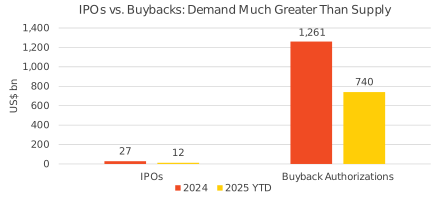
Goldman Sachs, as of 6/11/2025
Navigating Today’s Market: Adapting for the Future
Today's dynamic investment landscape demands a strategic evolution. As technological advancements reshape entire industries, portfolio construction must likewise evolve. Investors looking ahead might consider integrating the following strategic approaches:
- Diversify with New Tools: Leverage public and private markets, currency strategies, and targeted yield-curve positioning to build resilient, responsive portfolios.
- Utilize Modern Hedging Approaches: Employ strategies such as buffered ETFs and derivative-based hedging to mitigate volatility while remaining fully invested.
- Optimize Through Technology and AI: Harness AI-driven analytics, scenario modeling, and sophisticated risk management techniques to proactively refine portfolio strategies.
- Expand Beyond Traditional Assets: Incorporate real assets like real estate, infrastructure, and cryptocurrencies, offering inflation protection and enhanced diversification.
- Prioritize Agility and Flexibility: Maintain nimbleness in portfolios, enabling swift adjustments to capture emerging opportunities or manage evolving risks effectively.
Understanding—and Seizing—the Opportunity
Economic transitions often carry uncertainty, but today's conditions are ripe with clear and compelling opportunities. Investors who understand the transformative nature of these trends—rapid technological adoption, robust corporate fundamentals, and attractive yield environments—can better position their portfolios for sustained growth and protection against potential volatility.
Rather than waiting nostalgically for an idealized past to return, today's landscape encourages thoughtful, informed action. The current economic era isn't something to fear but rather to embrace and navigate proactively.
Today’s moment demands fresh thinking. Those who recognize and respond to these transformative shifts are poised not just to withstand uncertainty—but to thrive amid it.