How years of constant fixed income ETF innovation are empowering investors to navigate today’s markets and build portfolios for the new era.
Innovation meets opportunity

Key takeaways
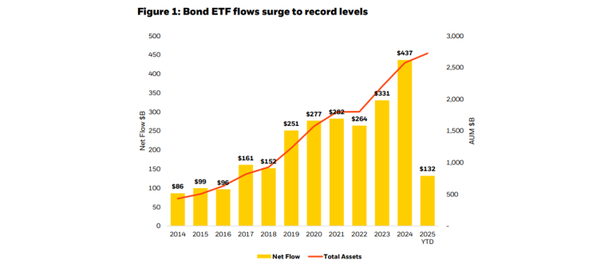
- Client demand for fixed income ETFs is driving significant asset growth with record flows in 2024 and on track to reach $6 trillion in assets under management (AUM) by 2030, if not sooner. Globally, bond ETFs experienced the highest organic asset growth (20%) of any other asset class or investment vehicle last year. And so far in 2025, client adoption continues to accelerate, with assets up 22% on an annualized basis.
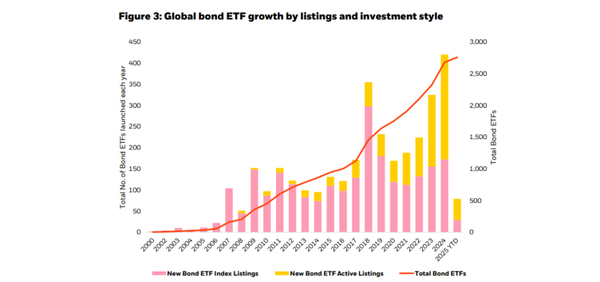
- The flywheel of bond ETF innovation is powering this growth, helping more investors to access exposures and outcomes that were previously difficult to access. Last year a record 420 bond ETFs were launched, enabling investors to tailor their fixed income investments in ways previously unthinkable.
- The ever-increasing toolkit allows investors to take advantage of a generational opportunity in fixed income. Yields are higher than they have been in 20 years. Globally, some 80% of fixed income assets now yield over 4% and we believe they’ll remain elevated for the foreseeable future.
- iShares has been spearheading innovation in bond ETFs for over two decades. Our diverse and evolving product set supports clients globally to navigate across market environments, with more modern, precise ways to reach nearly every part of the fixed income market. As the experts in portfolio construction with a strong heritage in risk management, we understand the tools and exposures that investors require to thrive in a changing world.
Accelerating client adoption
Global bond ETF assets rose 20% organically in 2024 – the highest organic asset growth of any other asset class or investment vehicle.2 The segment reached $2.6 trillion in assets through 2024 as investors increasingly chose the wrapper likely given its benefits, including transparency and efficiency.3 We believe the fixed income ETF market will surge to $6 trillion by 2030 as more investors may view ETFs as a powerful way to access fixed income.4
Relative to equities, fixed income ETFs are in the early stages, presenting a significant opportunity for growth. Fixed income ETFs represent just 2% of the underlying bond market, while equity ETFs represent 10% of the underlying market.5
Bond investing itself is resonating with investors as they seek income, stability and diversification amid volatile markets. Last year, investors allocated more to bonds than they did to any other asset class, adding $1 trillion into bonds globally across mutual funds and ETFs — marking the strongest year of inflows in the past decade.6 ETFs captured about 40% of this record fixed income flow, more than double the allocation that they represent on an asset basis.7
So far in 2025, inflows continue to break records. Through March, global bond ETF flows reached $131.6 billion, which is 2.5x larger than the average first quarter inflows over the last decade.8
Case study: tariff volatility
How iShares Bond ETFs provided resilience to investors during the early April 2025 market upheaval.
In early April 2025, the U.S. Government announced reciprocal tariffs on imports on most of its trading partners, triggering heightened market volatility and a broad market sell-off across assets.
In the U.S., the market experienced one of the most active trading sessions of all time, with all ETFs representing nearly 40% of trades in the U.S., higher than the 28% year-to-date average. On April 4, 2025, high yield ETF exchange volume was greater than total over the counter (OTC) high yield cash bond volumes, seeing over $23 billion traded versus high yield cash bond trades of $21 billion.11 Across the iShares fixed income ETF platform, volumes were elevated and secondary trading in high yield and CLO ETFs, as an example, saw 5-10x their average daily volume.12
Similarly in Europe, iShares fixed income ETF trading volumes were notably higher compared to the industry, reflecting our liquidity depth and reliability in stressed markets. At the peak of early-April market volatility, iShares UCITS fixed income ETFs comprised 9 of the 10-most traded ETFs, providing investors with liquidity and price discovery, while still delivering investment performance and high quality of index tracking.
iShares ETFs have proven to be the industry’s most actively traded – especially in stressed markets when they are needed most.13
Unleashing investors' potential
Today, fixed income investors can simply assemble positions with exposure to thousands of bonds using bond ETFs, allowing them to tailor their investment preferences across different durations, credit qualities, sector allocations, and portfolio outcomes. This is due, in part, to the continuous and accelerating innovation within fixed income ETFs. Last year, the industry launched 420 bond ETFs, marking a one-third increase from 2023 (Figure 3). In the first quarter of this year, more than 75 bond ETFs were introduced – setting the pace for another record year of new ETF issuance.14
The innovation within bond ETFs has enabled investors to access more parts of the market and enhance their portfolios in various ways. This includes reaching difficultto-access but attractive markets like AAA-rated CLOs, constructing a bond ladder, or generating excess income through options. We are witnessing remarkable advancements in both index and active strategies, with several recent innovations particularly remarkable for what they allow investors to do.
Looking ahead, we anticipate continued innovation in public markets with more granular index products, outcome-oriented products and actively managed products. Additionally, new frontiers are emerging, such as ETF access or replication strategies for private markets.
How investors are using fixed income ETFs
Asset managers, pension funds and sovereign wealth funds
Bond ETFs are used as an alternative to single bonds for enhanced liquidity management and efficient access, while helping with liquid portfolio replication and liability management. The breadth of ETFs now provides portfolio managers with the precision and flexibility to express their market views.
Insurance companies
Bond ETFs are being adopted as liquidity sleeves and interim beta in general accounts, but also for broad beta exposure and for supporting with portfolio risk transfer.
Family offices, private banks and advisors
Given their cost-efficiency and transparency, bond ETFs have become a favored vehicle used as portfolio building blocks for implementing both strategic and tactical investment views.
Retail and end investors
Bond ETFs provide a scalable solution to help investors add diversification to their portfolio, offering the advantage of on-exchange trading that the underlying bond market does not provide.
Pioneering more client use cases
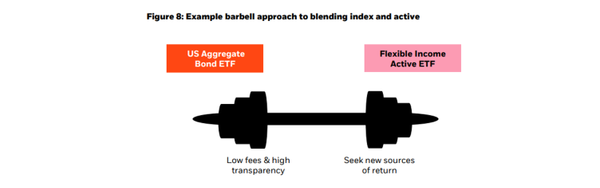
A. Blend index and active bond ETFs to build a diversified, income-focused portfolio Using index ETFs as foundational portfolio building blocks, investors can complement traditional corporate and sovereign allocations, with inflation-linkers, and plus sectors such as bank loans, CLOs, high yield and EM debt to emphasize income.
Alternatively, investors can utilize multi-sector active ETFs with specific income focused objectives, such as a flexible income active ETF, which aims to help investors take advantage of attractive opportunities across a broad range of sectors and dynamically shifts allocations in accordance with the market environment.
By investing in just two ETFs, as illustrated in the chart to the right, investors can gain access to a diverse array of sectors. This can be a scalable solution for an investor of any size seeking to build a diversified portfolio while managing risk and return.

Conclusion
Bond ETF innovation is helping more and more investors experience the benefits of bonds with ease. iShares fixed income ETFs are at the forefront of this innovation, offering the most granular set of building blocks and more modern, precise ways for investors to reach nearly every part of the fixed income market and drive portfolio outcomes. iShares bond ETFs also continue to prove their durability and resilience, setting record volumes during the recent tariff-induced volatility through early April 2025, and helping investors navigate stressed markets.
The convergence of an evolved, robust fixed income ETF toolkit with the most attractive yield environment in years presents a generational opportunity in fixed income, allowing investors to tailor their portfolios in ways that were previously unthinkable.
We hope that this paper will empower investors to revisit their portfolio construction approaches and assess how new innovations in bond ETFs across exposures and investment styles can help them to navigate the market environments of today and tomorrow and achieve their investment goals.
Learn more about iShares
iShares is a part of BlackRock
iShares has been a leader in the ETF marketplace for more than two decades. Our products are built by investment professionals with deep risk management expertise. Learn more.