Discover the world of Investment Trusts, what makes them unique, and how they can be a smart addition to help grow your investment portfolio.
Understanding investment trusts

Capital at risk. The value of investments and the income from them can fall as well as rise and are not guaranteed. Investors may not get back the amount originally invested.
Investment Trusts explained
BlackRock has been managing investment trusts for over 30 years. Discover what makes them unique, and how they can be a smart addition to your investment portfolio with Charlie Kilner, director at BlackRock.
What is an investment trust?
Investment trusts are one of the UK’s most enduring investment options. They are structured as public limited companies that aim to make money by investing in other companies. Like other collective funds, investment trusts aim to grow an investor’s capital by investing in a carefully-curated selection of companies within a single portfolio. Investment trusts are traded on an exchange in the same way as a normal share.
An independent board of directors provides independent oversight, monitoring the performance of the company and looking after shareholder interests. The board chooses a professional portfolio manager, such as BlackRock, to manage the company's investments in line with shareholder interests and goals.
How big is the investment trust sector?
Investment trusts have stood the test of time. The first investment trust launched over 150 years ago, and the sector now has over 300 trusts and £272bn in assets.1 Their longevity is a tribute to the returns they have delivered for investors over the years, and their ongoing relevance as a home for long-term investing.
How do investment trusts differ from other investments?
Investment trusts are managed by experienced fund managers, carefully selected by the board. The closed-ended investment trust structure affords significant investment flexibility, allowing fund managers to focus on long-term investments without the pressure of managing inflows and outflows. This means they are well-suited for active investment management.
Who are Investment Trusts for?
Investment trusts have lots of different uses. They can be used for long-term capital growth, or to generate an income, or for a combination of both. They are a natural choice for children’s savings because they tend to be long-term investments. They can also be useful for people in retirement, who are looking to generate an income from their investments that grows in line with inflation. In both cases, the unique structure of investment trusts is important. You need to pick the right choice for you – some trusts focus on capital growth, such as smaller companies, while others, such as commodities, have a more total return approach.
What do investment trusts invest in?
Investment trusts come in various flavours, each catering to different investment goals. This includes income generation, from dividend-paying companies, capital growth from areas such as smaller companies, or a combination of both, which may be a feature of areas such as commodities. They invest across a range of regions, asset classes and themes, including equities, bonds and alternatives such as infrastructure, renewables, or property. They offer lots of options for portfolio diversification, investing in smaller companies, or emerging markets, alongside large mainstream markets such as the UK, Europe or the US.
Understanding investment trust share prices
The share price for an investment trust may be at a discount or premium to the value of its underlying assets, depending on overall supply and demand in the market.

Net Asset Value (NAV)
Per share, is the total value of the trust's assets minus its liabilities divided by the number of shares.

Premium
If an investor buys and sells shares at the listed share price. If the share price is higher than the NAV, the trust is trading at a premium, due to strong demands.

Discount
If the share price is lower than the NAV per share, the investment trust is trading at a discount. This means there is less demand for the shares.
How do investment trusts compare with unit trusts?
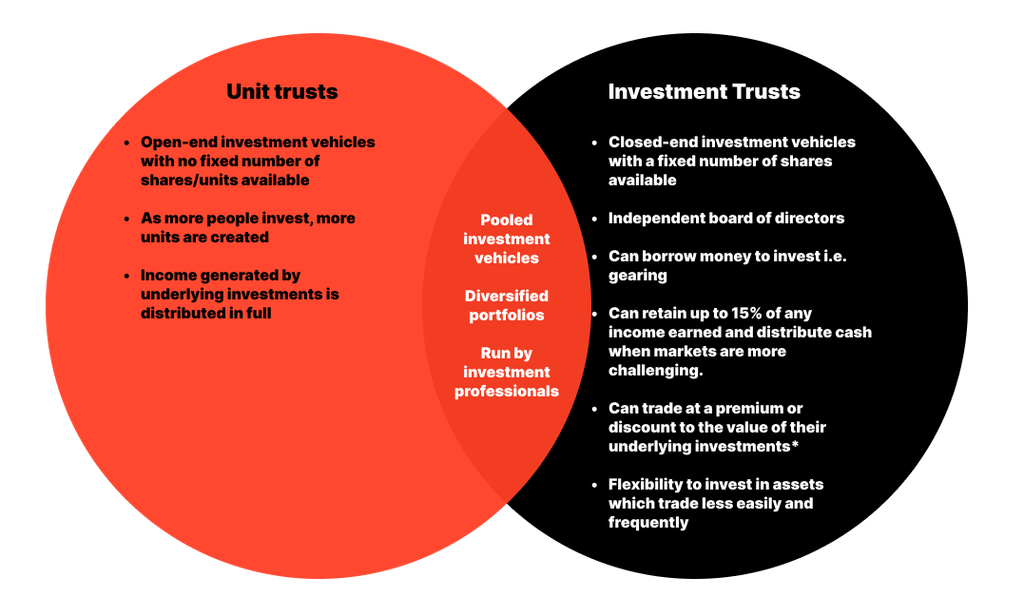
Investment trusts are run as public limited companies, issuing a fixed number of shares at launch. This is a ‘closed-ended’ structure. In contrast, unit trusts are ‘open-ended’. This means they need to buy more assets when there are inflows and sell holdings when there are outflows. For open-ended funds, the price will always reflect the value of the underlying assets, whereas investment trust pricing will reflect demand and supply for their shares in the market.
Unit trusts versus investment trusts
How do investment trusts compare with exchange traded funds?
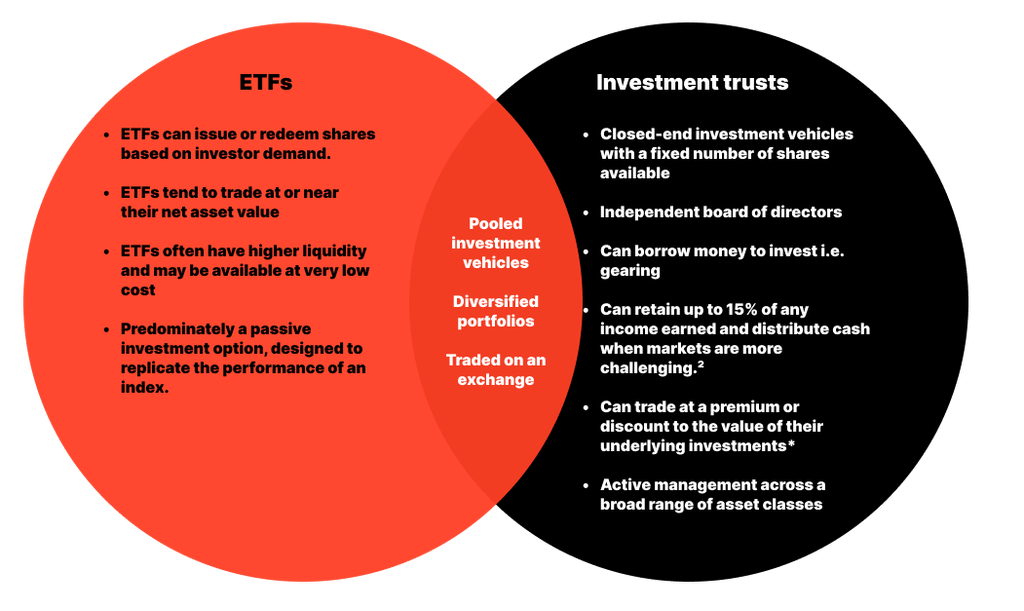
Investment trusts and exchange-traded funds are traded on an exchange. However, they are different in the way they are managed. ETFs are passive funds, usually replicating an index, such as the FTSE 100 or S&P 500, whereas investment trusts are usually active funds, run by a designated fund manager with the aim of beating a benchmark. ETFs are ‘open-ended’, meaning shares are created or redeemed based on investor demand.
Why choose investment trusts?
Investment trusts bring together a diverse range of opportunities within a single structure. There is a breadth of options for investors to choose from, depending on their long-term goals.
Easy access
Alongside traditional routes via stockbrokers, savings schemes and ISA's, fund supermarkets and platforms also offer a range of investment trusts.
Simplicity
Investment trusts give investors access to a wide range of investments which may be too complicated or costly to manage as a directly held portfolio.
Income potential
Many investment trusts have a strong track record of delivering high and/or growing payouts to investors over time, helping their income keep pace with inflation. The Association of Investment Companies (AIC) maintains an annual list of ‘dividend heroes’ – those investment trusts that have consistently increased their dividend for more than 20 years. It also has ‘next generation’ heroes, those trusts that have increased their dividends for at least ten years, but less than 20.
How to invest in investment trusts

Through a financial adviser
A financial adviser can provide independent financial advice, tailored to your specific situation. This can cover investments, tax advice and a long-term financial plan.

Through an investment platform
Investors that don’t require advice can buy investment trusts through an online UK platform. They will vary in terms of cost, service levels and the information they provide.

Through a stockbroker
Investors can also buy investment trusts through stockbrokers. Service can include 'execution-only' for self-directed investors or an ‘advisory’ service.
Maximising income and long term growth
Uncover the strategies, considerations and opportunities
An income and growth strategy can deliver both regular rewards and capital growth to your investments. But navigating the nuances of dividends, compounding and market dynamics requires deep understanding and an educated approach to successfully steer your decision-making.

Growth Opportunities
Seize growth opportunities to maximise income
There’s a world of dynamic investment opportunities. Global equity markets serve as a gateway for robust growth, connecting capital with the most promising long-term ideas. Our comprehensive insights are designed to enhance your portfolio’s growth potential.

Your Path to Building Wealth
Investment Trusts could help you achieve your goals
We’re here to help guide you through your path to wealth building. Discover how our variety of investment trusts can help you reach your financial goals no matter where you are in your life’s journey. Step by step, let's embark on this journey to prosperity together.

Investing for retirement
Building a Financial Foundation for Retirement
Retirement should be a time of fun and adventure, setting behind the cares of working life. It’s become harder to retire in comfort, as life expectancy increases, and governments and companies reduce their contributions. Nevertheless, with forward planning, and careful saving, a prosperous retirement is within reach.

Source:
1 The AIC - Our sector - 31 October 2025
2 Worldometers - How many Countries in Europe? - October 2025
Risk Warnings
Investors should refer to the prospectus or offering documentation for the funds full list of risks.
Capital at risk. The value of investments and the income from them can fall as well as rise and are not guaranteed. Investors may not get back the amount originally invested.