Capital at risk. The value of investments and the income from them can fall as well as rise and are not guaranteed. Investors may not get back the amount originally invested.
Investing for retirement

Retirement should be a time of fun and adventure, setting aside the complexities of working life. But you need your finances to work hard to support it. It’s become harder to retire in comfort, as life expectancy increases, and governments and companies reduce their contributions. Nevertheless, with forward planning, and careful saving, a prosperous retirement is within reach.

Adapting to Change
People retiring today could be looking at a retirement of 30 years or more. The average 50 year old has a one in four chance of reaching 95, and a one in 10 chance of reaching 99.1 At the same time, fewer people have defined benefit schemes: retirees need to be self-reliant to finance a secure retirement.
This comes at a time when the nature of retirement is changing. Increasingly, retirement is not a point in time, but a slowing paring back – potentially involving consultancy, entrepreneurship, part time work. People may be in work for longer. Retirement planning needs to be flexible.
How to save for retirement
Three major sources of pension income
State pension
This is currently £230.25 a week.2 Everyone is entitled to it, as long as they have 35 years or more of National Insurance contributions. The age of eligibility varies, but someone who is 50 years old today can claim their state pension at age 67.3
Workplace pension
All workplaces have to offer their employees above the age of 22 and who earn over a certain level access to a workplace pension scheme.4 Your employer needs to contribute a minimum of 3%, while you will pay 5% and then the government will add tax relief on top.
Personal pension
This is a pension you set up yourself, perhaps if you are self-employed, or you don’t believe that the state or workplace pension will be enough. These are often called SIPPs (self-invested personal pensions) and you can invest in a SIPP through investment platforms, or life and pensions providers.
Your path to retirement
People retiring today could be looking at a retirement of 30 years or more.
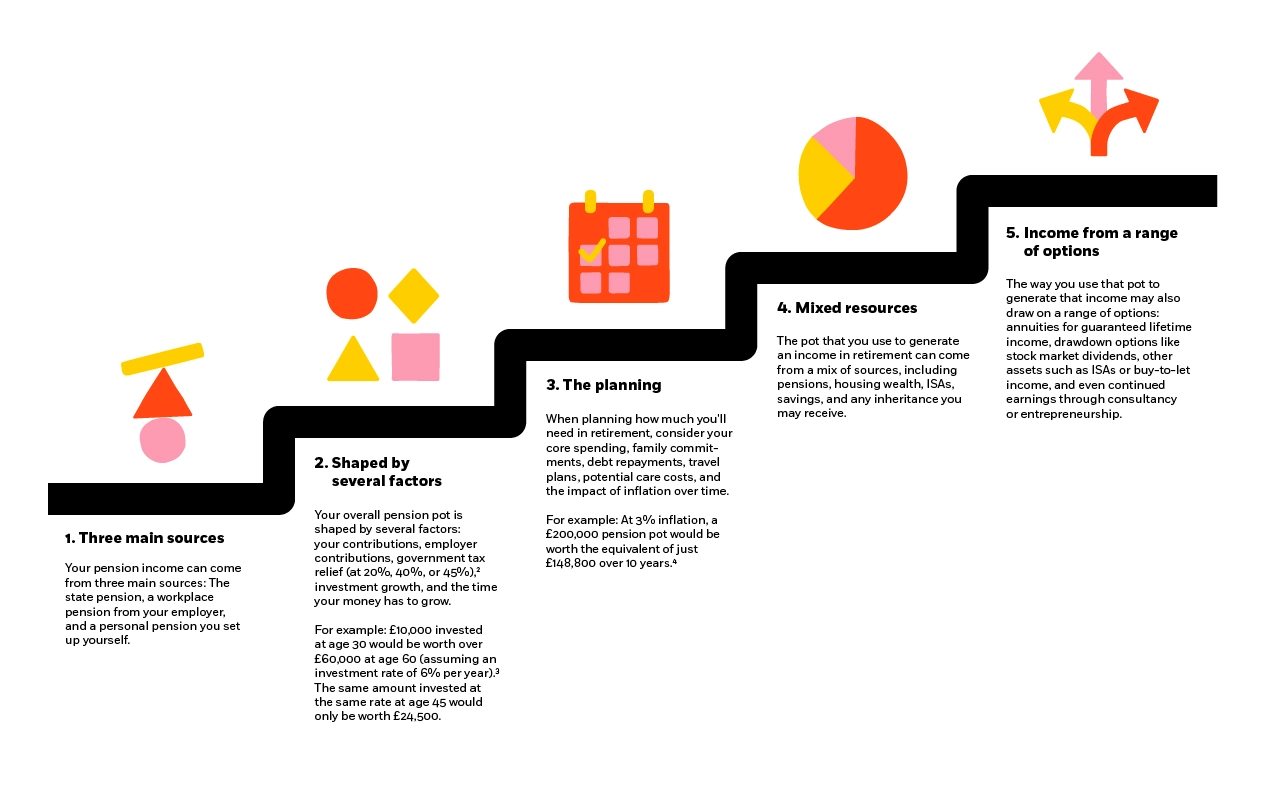
The average 50 year old has a one in four chance of reaching 95, and a one in 10 chance of reaching 99. There are important factors to take into account when building wealth for your retirement.
Building a Financial Foundation for Retirement
In this phase, the priority is to save as much as you can, for as long as you can. You should have four areas of focus:
Optimising Tax Breaks
Make the most of pension tax breaks. In England and Wales, basic rate taxpayers get 20% tax relief on contributions, while higher and additional rate taxpayers get 40% or 45%. You can claim relief on contributions up to 100% of your annual earnings, though this is capped for the highest earners.5

Employer Contributions
Ensuring that you take advantage of your workplace scheme where it is offered. The contribution offered by your employer is very useful, and can help contribute to faster growth in your pension pot.

Starting Early
Starting as early as possible and saving as much as you can give you the best possible chance of growing your retirement pot. The effects of compound interest, often referred to as investing for growth, can be significant over time.

Balancing Your Portfolio
Ensuring that the investment mix is right when investing for retirement income – It may go against your instinct, but it is important not to be too cautious with your retirement pot. You need your capital to grow, and to protect yourself against inflation. Adopting a very cautious, or cash-based approach may not allow this to happen.

Generating an Income in Retirement
Planning how to generate income in retirement is one of the most important financial decisions you will make. The choices can feel overwhelming, but starting with your long-term objectives will help you create a strategy that matches your needs. By clarifying what kind of retirement lifestyle you want, and then reviewing the resources you already have, you can build a clear picture of how to fund the years ahead.
Define Your Retirement Goals
Ask yourself what kind of retirement you want to enjoy:
- Do you plan on extensive travel?
- Would you like to provide financial support to children or grandchildren?
- Are you focused on maintaining security and stability in later life?
Understanding your priorities helps determine the income required for a comfortable retirement.
Assess Your Available Resources
Review all sources of retirement income, including:
- State Pension – check your forecast to see what you will receive.
- Workplace pensions and personal pensions – calculate projected income.
- Other assets – such as buy-to-let property, savings, investments, or potential inheritance.
Combining these gives you a realistic overview of your financial position.
Identify Potential Gaps
If your projected retirement income falls short of your goals, there are only a few solutions:
- Adjust your expectations and lifestyle plans.
- Increase your savings rate before retirement.
- Invest with the aim of generating higher growth.
Each approach carries different implications for risk, flexibility, and long-term security.
Consider Your Risk Profile and Age
Your retirement strategy should reflect both your age and your attitude to risk. Ask yourself:
- How comfortable are you with short-term fluctuations in your investments?
- Would you prefer the security of a guaranteed income, even if it means less flexibility?
These questions will guide the balance between fixed-income products and growth-focused investments.
Key Retirement Income Decisions
Annuities: Guaranteed Income for Life
One option is to use part or all of your pension pot to buy an annuity. An annuity provides a guaranteed income for life, offering certainty but limiting flexibility.
Other Income Sources
Factor in additional income streams such as the State Pension, rental income, or dividends from investments. A diversified approach can reduce reliance on a single source.
The Impact of Inflation
Inflation can erode the value of your savings significantly. For example, at 3% annual inflation, a £200,000 pension pot would only have the purchasing power of £148,800 after 10 years.6 Planning for inflation is essential to preserve long-term security.
Stock Market Exposure
Investments in the stock market may deliver stronger long-term growth but also come with higher volatility and the possibility of capital loss. Balancing growth and stability is key.
Why Professional Advice Matters
Retirement planning involves complex decisions that have lasting consequences. Seeking independent financial advice at this stage can help you:
- Avoid costly mistakes.
- Create a sustainable income strategy.
- Ensure your plan accounts for tax, inflation, and market risk.
A well-structured retirement income strategy, supported by professional advice, can give you the confidence that your financial future is secure.
Investing for growth

Retirement Savings
Investment trusts may support the accumulation phase within a diversified portfolio, potentially helping you access growth opportunities across the global economy.

The role of gearing
Retirement saving can benefit from broader sources of returns. Investment trusts may use gearing to boost exposure, but this can magnify losses in falling markets.

Exploring Markets
Diversification can support more balanced retirement returns. Investment trusts can give access to less explored areas of global markets.
Investing for income

Dividends
Dividends can help your income grow ahead of inflation. To create resilient income, you need to be diversified. With investment trusts, income can come from a range of source.

Structure
Investment trusts have certain structural advantages that could help deliver a steadier income over time.
How BlackRock can help with investing for retirement
Whatever your journey looks like, BlackRock can help. We provide you with a wide range of investment trusts to choose from. Each has its own dedicated webpage where you can explore useful information about the trust to understand if it is a good match for your portfolio.
A useful place to start are our trust factsheets or explainer videos where you’ll find more information about the trust including some of the investments it holds, the level of growth it aims for and its level of risk.
latest insights



Frequently asked questions
Start your investment journey
Discover how to invest through a financial advisor, online investment platform or investment partner.