Tom Becker
Portfolio Manager, BlackRock Multi-Asset Strategies and Solutions
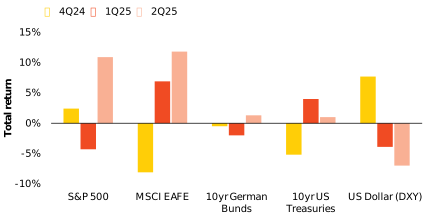
Markets were shaken and stirred by a novel set of policy developments this year. Many of 2025’s asset price moves can be more easily interpreted when viewed in the context of the euphoric US exceptionalism rally that dominated Q4 of 2024. Market attention and relative asset price moves have been dominated by swings in sentiment around US vs. non-US assets – clearly seen in the visual below – but there have also been a series of meaningful country-specific developments outside the US that have catalyzed shifts in our portfolio positioning.1
The last three quarters have seen notable sentiment shifts and asset price moves
Source: BlackRock with data from Morningstar, August 2025. Index returns are for illustrative purposes only. Index performance returns do not reflect any management fees, transaction costs or expenses. Indices are unmanaged, and one cannot invest directly in an index. Past performance is not a reliable indicator of current or future results.
Our investment process focuses on identifying dislocations between macro fundamentals and market prices – and early-year volatility offered plenty of tactical opportunities. We shifted portfolio positions as growth and inflation fundamentals diverged across countries while also capitalizing on price overshoots to unique policy pronouncements. As we enter the final stretch of the year, we outline a handful of macro developments that are informing our portfolio positioning.
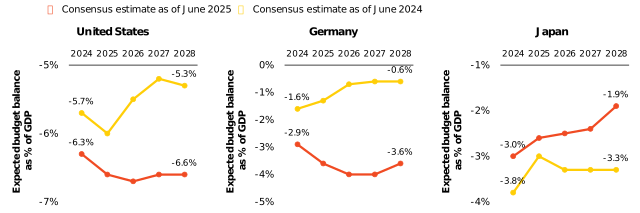
The passage of the One Big Beautiful Bill Act (OBBBA) and the sunsetting of the Inflation Reduction Act (IRA) set the stage for a US capex and construction expansion in the coming quarters. Global corporations have large tax incentives to build structures, datacenters, and manufacturing in the US and a healthy American consumer should provide sufficient demand to back those investments. This boost in activity will come at the expense of a multi-year deterioration in the US budget deficit outlook that now looks materially worse compared to last year’s consensus estimates.
The dominance of fiscal policy as a driver of nominal growth is increasingly a global phenomenon. Germany’s pivot towards deficit spending has been one of 2025’s biggest macro surprises and the associated increase in bond issuance has us positioned short German Bunds. In contrast to the US and Germany, Japan’s exit from decades of debt deflation and sustained, higher nominal growth have improved that country’s fiscal outlook; we’re positioned long Japanese equites and long the Yen.
The fiscal outlook in the US and Germany has shifted to structural budget deficits whereas Japan is now forecast to cyclically improve
Source: BlackRock, with data from Consensus Economics as of 30 June 2025.
Inflation has been a first-order driver of consumer and corporate behavior throughout this US tariff episode. Firms rushed to frontload imports, consumers pulled forward durable goods purchases, and post-Liberation Day price uncertainty slowed real activity in the second quarter. For central banks, this behavioral sensitivity to price shifts is a key challenge for maintaining price stability: inflation isn’t just sticky – it’s shaping economic decision-making.
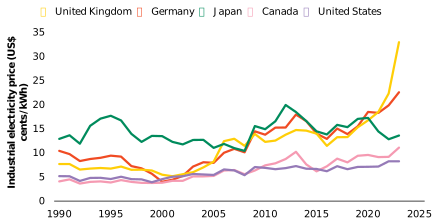
One driver of recent inflation persistence has been electricity prices. Power prices have meaningfully diverged across countries – driven by a mix of regulation, Russia’s invasion of Ukraine, and recent AI datacenter demand – but the general direction of travel for the price of this critical input is up. Rising demand and inelastic supply is always a catalyst for price inflation, and we see rising risks that US electricity prices will converge toward higher global levels and entrench above target services inflation.2
Electricity prices are rising globally, with idiosyncratic country dispersion
Source: BlackRock, with data from International Energy Agency as of 30 June 2025. Prices include taxes.
Central banks across the world have been tweaking their policy stances and reaction functions throughout the year. Some shifts that we have our eyes on include:
As kids return to school, we see a backdrop of resilient global growth with continued upside risks to inflation. Financial conditions are loose, fiscal stimulus could again crowd in private sector investment, and a mix of delayed consumption and expiring capex incentives should boost activity into year-end. The continued entanglement of fiscal and monetary policies keeps us mindful of the strong economic impulse of coordinated policies, particularly if the Fed opts to ease into a fiscal expansion.