Richard Murrall
Portfolio Manager, Global Tactical Asset Allocation Team
2025 has seen the collision of a multitude of fascinating structural and cyclical macro themes. These have included heightened policymaker focus on the Global Rebalancing of trade flows, the ever-lengthening shadow of Fiscal Dominance, and the associated need for Financial Repression – a theme which we expect will command rising market attention.
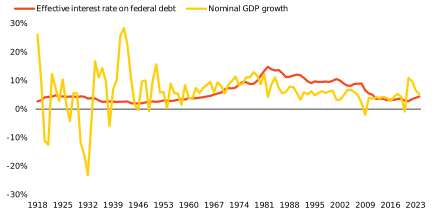
Financial Repression has historically manifested through government intervention across interest rates and sovereign debt investments – particularly in periods of high government debt loads. The first component of this theme focuses on controlling interest rates, specifically attempting to keep the effective interest rate on government debt below the nominal rate of economic growth. For example, as the US government sought to reduce its debt to GDP ratio during the period after World War 2, this involved explicit rules capping private sector interest rates (Regulation Q) as well as outright agreement by the Fed to cap yields on Treasury securities. The upshot of all these measures was a highly accommodative monetary policy stance that ensured interest rates on government debt remained below nominal GDP growth for most of the post-war period up to the 1970s, as the chart below shows.
Interest rates on US government debt remained below nominal GDP growth for most of the post-war period up to the 1970s
Source: BlackRock, GTAA, as of July 2025.
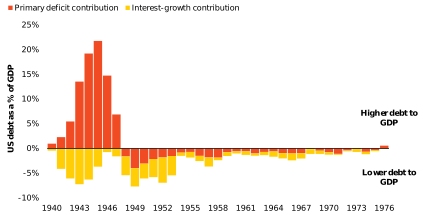
The impact of this easy monetary policy stance on debt sustainability can be seen if we decompose the changes in government indebtedness (measured as the debt-to-GDP ratio) into its two main components: (1) the primary fiscal deficit (i.e., how much the government spends relative to its tax revenue, excluding interest expense) and (2) an interest ‘snowball’ effect , which measures how indebtedness changes due to the wedge between interest rates and nominal economic growth. The analogy is fitting as higher interest expense necessitates the issuance of additional debt thereby inducing further growth in deficits - much like a snowball tends to accumulate size as it rolls uncontrollably downhill.
Over recent years, we have frequently noted that the fiscal response to the pandemic was more comparable to wartime dynamics than standard business cycle economics. These historical periods can provide some context for assessing how financial repression may play out in this cycle. US government debt-to-GDP rose rapidly during the World War 2 but then steadily declined from 100%+ in 1948 to ~25% in 1975. The chart below depicts how that deleveraging was achieved with respect to the two drivers outlined above.
Treasury-backed fiscal surplus and a supportive growth minus interest rate differential drove the decline in debt-to-GDP post-WWII
Source: BlackRock, GTAA, as of July 2025.
Of the nearly 70 percentage points decline in debt-to-GDP after the War, over 40 of those points were achieved by ensuring that nominal growth rates stayed above interest rates with the balance driven by the government choosing to run a primary surplus. This extraordinary fact belies both the power and the limits of financial repression: even with the explicit coordination and agreement of the Federal Reserve to directly cap bond yields, the Treasury still needed to run a fiscal primary surplus for most of the post-war period to return debt-to-GDP to its pre-war level. This will be more difficult today given the stark demographic difference between 1945 and 2025; a primary surplus is much harder to deliver when entitlement spending accounts for around two thirds of government outlays.
Regardless, some form of monetary policy capture will likely be necessary to make sure that this ‘snowball’ effect continues to exert a downward force on debt-to-GDP. The intensification of political pressure on Chair Powell is perhaps unsurprising in this context.
The second of the two main pillars of financial repression involves measures designed to crowd investors into sovereign bonds, usually at the expense of lower real returns to the bondholder. In the post-war era, capital controls were in part intended to crowd investors into domestic sovereign bonds. However, in today’s era of international capital mobility, imposing barriers to capital movement may prove more difficult.
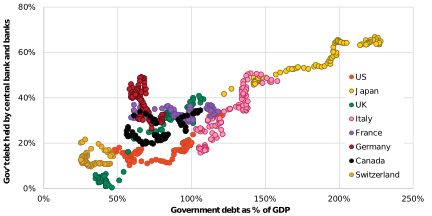
We also note that banking capital regulations introduced around the Global Financial Crisis have made it more challenging for banks to expand their balance sheet to invest in sovereign debt. As a result, central banks have largely supplanted the domestic commercial banking sector as the captive audience for investing in sovereign debt. As the plot below shows, there is a consistent relationship across multiple countries where a higher debt-to-GDP level coincides with a greater proportion of that debt being held by the central bank and commercial banking sector taken together. Comparing the US experience with that of Italy and Japan suggests that there is plenty of room for the Fed’s ownership of Treasuries to expand before we enter uncharted territory – particularly under the oversight of a more pliable Fed Chair.
Countries with higher debt-to-GDP levels show greater takedown of sovereign debt by central and commercial banks
Source: BlackRock, GTAA, as of July 2025.
Our investment process seeks to identify and capitalize on dislocations between macro fundamentals and market pricing, and as such we place a heavy emphasis on understanding what is priced. We note that markets are beginning to anticipate a more dovish Fed when Chair Powell’s term ends: more rate cuts are priced for the second half of 2026 when the Chair position itself and one additional Governor’s seat will have been filled by President Trump. That said, markets are still pricing in a terminal Fed rate comfortably above 3%, which is far higher than the levels that the President has suggested would be appropriate.
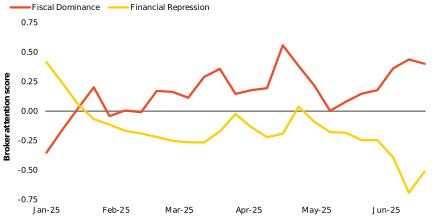
We have also developed a “Broker Agreement to Themes” (BATT) indicator to quantitatively assess market pricing. At its core, the tool leverages our on-team Large Language Model to pull the most thematically relevant sentences from the hundreds of daily broker reports published by research groups across the industry and quantifies their overall agreement with our macro themes. Generally, we perceive a large amount of broker agreement with our themes to suggest that the theme is more priced into markets while greater disagreement would imply scope for the theme to get more embedded across asset prices if our macro analysis turns out to be correct.
The chart below shows the ebb and flow of market sentiment around fiscal policy and financial repression over the course of 2025, and further contributes to our view that there is scope for an increase in market attention to Financial Repression over the coming months.
Broker Agreement to Themes (BATT) score indicates relatively low market focus on financial repression
Source: BlackRock, GTAA, as of July 2025.



Stay ahead of the markets with insights from our strategists and portfolio managers, uncover the latest on the global economy, geopolitics and retirement among other timely investment ideas.