India: follow the money
India's economy has held up relatively well through this year's external shocks. Policy measures to attract foreign capital have strengthened its external financing position. Yet its equity market has had a much harder time. Indian stocks have lagged global and emerging market peers, with elevated valuations and uneven earnings prospects weighing on returns. The contrast highlights a challenge for investors: India's relatively resilient growth isn't translating into equity returns today.
That focus on near-term returns risks obscuring a longer-term development: how Indian households save and invest, and the greater role their money could play in India's capital markets. Domestic institutions have bought Indian equities for 38 consecutive months, including around $8 billion in September despite renewed foreign selling. The sustained buying illustrates the increasingly important role of domestic capital in India's equity market. We see this as part of the future of finance mega force playing out in India. Greater household investment in financial assets could give capital markets a bigger role in funding businesses, creating opportunities beyond those tied directly to economic growth.
Where household money goes
Property and other physical assets accounted for nearly half of the assets Indian households acquired over 2016–25. Our analysis suggests that financial assets could take a significantly greater share over the next decade. Based on our calculations using data from Haver Analytics, the Reserve Bank of India and NSO/MoSPI, households acquired an estimated $7.2 trillion in physical and financial assets over 2016–25. Our scenario puts the equivalent figure at $15.8 trillion over 2026–35.
More important for capital markets is how households allocate that money. India's expanding digital financial infrastructure, including Aadhaar, UPI and account aggregation, has helped make financial services more accessible. Rising incomes and wider access to investment products are also opening more ways to invest. Of every $100 in physical and financial assets Indian households acquired over 2016–25, about $5 went into shares, investment funds and debt securities, as classified in our analysis. Our scenario for 2026–35 puts that figure at about $20, roughly four times the historical share. The larger pool reflects India's economic expansion. The structural shift is where that money goes: a fourfold increase in the share allocated to capital markets.
Household allocation across physical and financial assets, 2016–25 and 2026–35
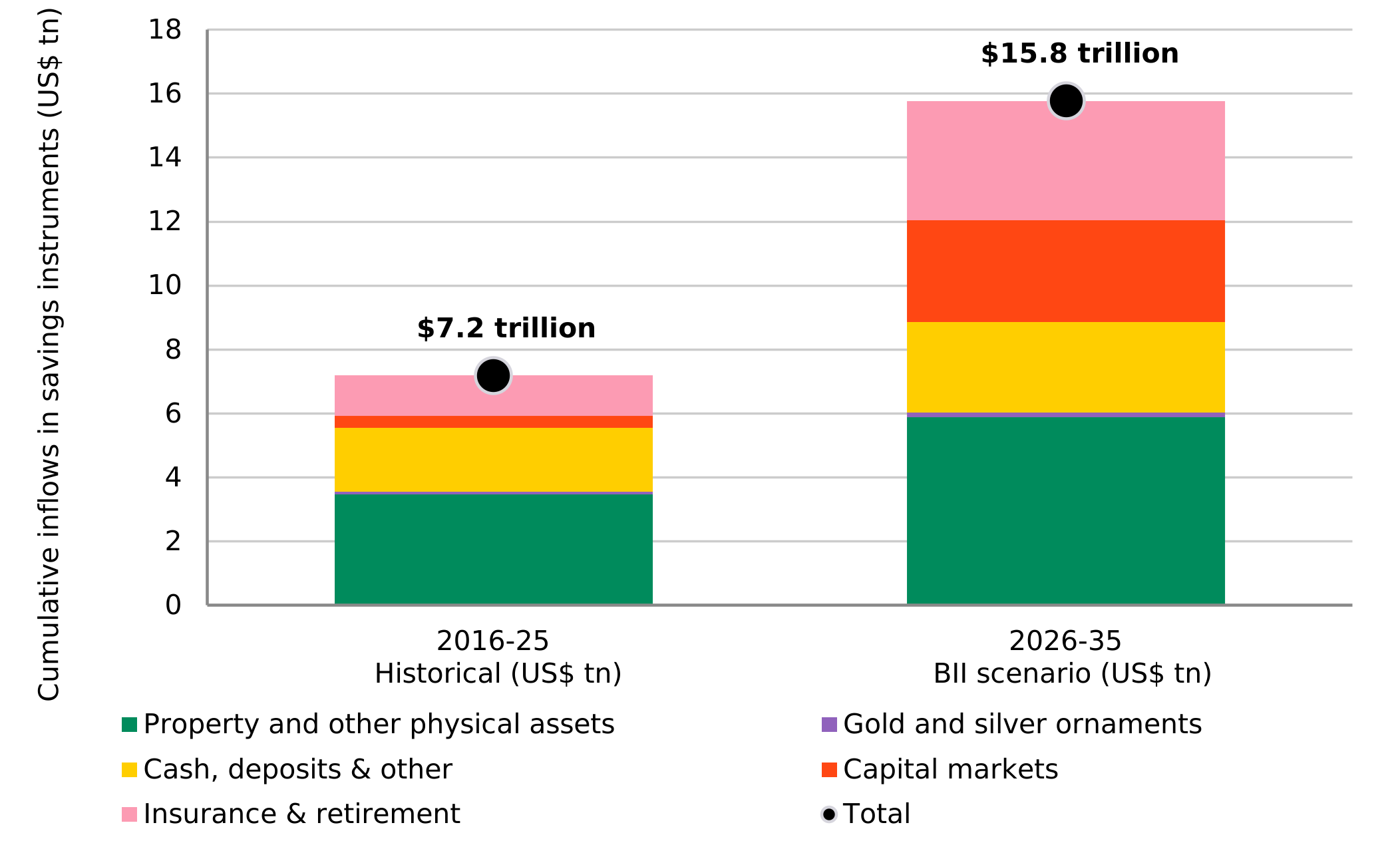
Source: BlackRock Investment Institute, with data from Haver, RBI and NSO/MoSPI. 2016–25 historical; 2026–35 BII scenario. The scenario holds total household asset acquisition constant at its historical share of GDP. Figures cover physical and financial asset acquisition before liabilities; FY2025 data preliminary.
Our scenario also puts financial assets, including deposits, insurance and retirement products, at around 62% of total new household asset acquisition over 2026–35, up from roughly 51% historically.
A broader pool of domestic capital
We expect growing household investment in financial assets to expand the domestic capital available to India's equity and bond markets. Together with foreign investment, a deeper domestic capital base would broaden the sources of funding and reduce India's reliance on overseas flows.
A larger domestic capital base could also give businesses more financing options. We see growing insurance and retirement assets supporting greater issuance of long-dated corporate and infrastructure bonds. A broader pool of equity investors could help companies raise money for expansion. This funding can support infrastructure and innovation, alongside business expansion. The investment opportunity lies both in businesses that channel that capital and in companies that use it productively to generate sustainable earnings growth.
Beyond the growth story
We favor above-benchmark exposure to Indian equities in strategic portfolios over five years and beyond, as outlined in our 2026 Global Outlook. India's expanding workforce, growing investment base and relatively low weight in global equity indices underpin that view. Deeper domestic capital markets add to the longer-term case. We are neutral on Indian equities tactically: large-cap valuations still look expensive relative to regional peers, and earnings prospects vary across the market. We expect a selective market, with returns driven increasingly by earnings delivery.
We see longer-term investment opportunities increasingly extending to businesses that support India’s expanding capital markets and those benefiting from greater access to domestic capital. More households investing in funds, insurance and retirement products should increase demand for financial institutions and wealth-management services. Greater trading and issuance can support exchanges and other market infrastructure. Companies able to raise domestic capital can also benefit, particularly where that funding finances new investment and expansion.
These opportunities have different sources of earnings. Financial institutions and market infrastructure providers stand to benefit from broader participation and greater activity. For companies raising capital, the returns depend on how productively they put that funding to work. Identifying the businesses that benefit most will matter more than simply increasing exposure to the broad market.
India’s investment case extends beyond economic growth to how household capital finances businesses. We see the longer-term opportunity in identifying which companies turn that funding into sustainable earnings growth.
Authors


Related insights
Conflict drives structural reset for Gulf economies
The Middle East conflict is driving a structural reset across the GCC, widening dispersion, redirecting capital inward and boosting strategic sectors.
China: from scale to returns
Explore China’s economic outlook and equity opportunities across AI, manufacturing and industrial sectors, and why profitability matters more than scale.