We believe climate risk is investment risk. That is why we are incorporating it into our portfolio design, as part of a series of actions BlackRock is taking to prepare for a net-zero world.
Launching climate-aware return assumptions

Overview
01.
Pioneering research
Most forecasters ignore the effects of climate change in their economic projections or long- term return expectations. We don’t believe this is right.
02.
New building blocks
Our return expectations - the building blocks of our strategic asset allocation - now reflect the impact of climate change on the investing landscape.
03.
Investment opportunity
The transition to a more sustainable world has only just started, and we see it helping growth and presenting a historic investment opportunity.
Capital at risk. The value of investments and the income from them can fall as well as rise and is not guaranteed. Investors may not get back the amount originally invested.
Climate change changes investing
On this episode of the BlackRock Bottom Line, Jean Boivin, Head of the BlackRock Investment Institute, explores why we believe the climate transition will boost portfolios.
Avoiding damages from climate change
The popular notion that tackling climate change comes at a net cost to the global economy is wrong, we believe. Avoiding climate-related damages will help prevent economic deterioration and improve risk-asset returns, in our view. We see the “green” transition to a carbon-neutral world rewarding companies, sectors and countries that adjust and penalizing others.
Sustainability is no longer something that can be addressed after strategic investment decisions have been made; it is indispensable to making investment decisions.
That is why our capital market assumptions (CMAs) – long-run estimates of risk and return – now reflect the impact of climate change.
Estimates in this area are highly uncertain, yet our framework is designed to account for this. We will refine this framework as we monitor the evolution of the “green” transition.
We focus on climate because we believe a broad consensus around its impact and measurement suggests that climate change is fast becoming a key driver of asset pricing. Our updated CMAs are driven by sectoral views, with exposure to climate risks and opportunities a key determinant.
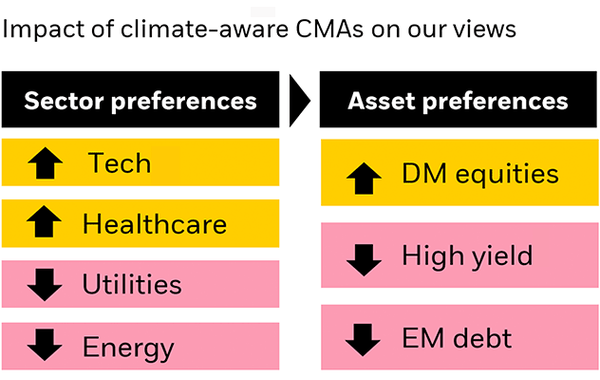
We see technology and healthcare benefiting the most from that perspective, and carbon-intensive sectors such as energy and utilities lagging. This in turn increases our strategic preference for developed market (DM) equities, at the expense of high yield and some emerging market (EM) debt.
Why? The composition of DM equity indexes better aligns with the climate transition, with large weights of technology and healthcare companies, less vulnerability to transition risks and lower carbon intensity. Equities also can better capture potential opportunities of the green transition, as bonds are capped in their capital appreciation. Sectors that face structural challenges due to rising climate awareness, such as energy and utilities, are more prevalent in high yield and EM debt indexes.
Climate risks and opportunities
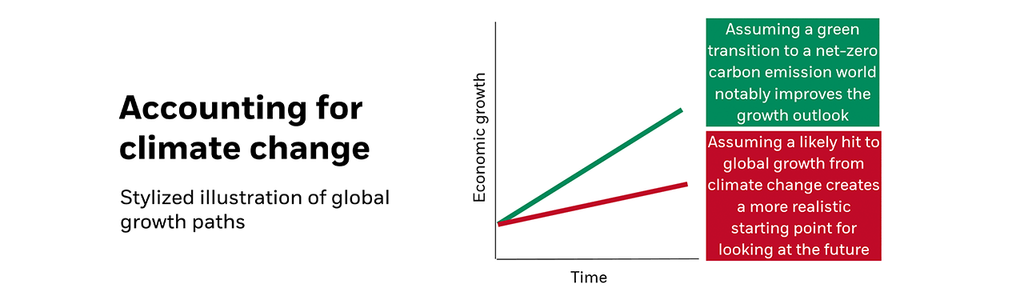
Climate change and efforts to curb it will have major economic outcomes, we believe, not just far into the future but in the next five years. Economic projections that ignore climate change are widely relied upon – yet are based on an unrealistic future scenario, in our view. We instead focus on two scenarios, see the chart below.
The green transition
The two scenarios to compare from this perspective: a transition to a low-carbon economy in which policies to fight climate change are enacted, and a no-climate-action scenario with no actions to limit damages.
A commonly held notion is that tackling climate change has to come at an economic cost. We think that’s wrong. We assume the global economy transitions to a lower carbon path consistent with Paris Agreement goals.
The positive effect of this transition rests on a gradual phasing in of carbon taxes, green infrastructure spending consistent with the IMF’s recommendation, and subsidies on renewable energy. If none of these actions are taken to mitigate climate change, we estimate a cumulative loss in global output of nearly 25% in the next two decades. The stylized Accounting for climate change chart illustrates the potential difference between the two paths.
We focus on the "E" (environmental) of ESG in our updated CMAs. Why? First, there is wide recognition of the importance of climate change on economic and social outcomes. Second, there is consensus on the measurement of an entity’s contribution to climate change: carbon emissions. Carbon emissions have become a widely enough adopted indicator of sustainability for investors to be a driver of repricing at the broad market level.
We see insights into S (social) and G (governance) as key sources of potential returns through security selection, rather than as systematic drivers of returns. We will consider incorporating them in our framework once consensus around their impact and availability of consistent data improve in coming years.
Our investment views
We see returns at a sector level. We believe a sectoral approach to sustainable investing is more appropriate than a regional one. Likely beneficiaries include technology and healthcare, we believe, while laggards include energy and utilities.
Our preference for DM equities has become stronger, at the expense of high yield and some EM debt. Why? The composition of DM equity indexes better aligns with the climate transition, with large weights of technology and healthcare companies, less vulnerability to transition risks and lower carbon intensity. Equities also can better capture potential upside, as bonds are capped in their capital appreciation. See the chart.
The climate framework
Our framework outlines how we incorporate the implications of climate change and shifting investor sustainability preferences into expected asset class returns and, ultimately, strategic asset allocation. We see climate change entering the equation through three channels: macro, repricing and fundamentals.

Getting into the macro
We believe macro variables will be different in a world that is transitioning to a sustainable future. Such changes mean sustainability affects everything that goes into forming a view on long-term asset class returns. We see changes in so-called risk premia for all asset classes – the compensation investors require for holding them.
Repricing effects
The price investors are willing to pay for sustainable assets is changing. The BlackRock 2020 Global Sustainability Survey of September 2020 found 425 institutional investors planned to double their sustainable assets under management in the next five years to 37%.
We see this as a tectonic shift toward sustainable assets. Changing investor preferences will spur a climate change-led repricing due to the falling cost of capital for sustainable assets. These assets will generate higher returns than traditional peers as a result, in our view. Investors are just starting to respond to the structural shift, suggesting it is not yet in the price. Once this repricing phase has passed, we believe this channel will eventually no longer be a boon for “greener” assets’ expected returns.
Back to the fundamentals
Climate change and policies to mitigate it will affect profitability across sectors, we believe. This will have knock-on effects on other variables such as credit default and downgrade assumptions.
No one knows yet what a low-carbon world will look like. Climate projections are highly uncertain. This is due to the complexity of modeling the dynamics and myriad dependencies between climate and carbon emissions, economic variables and mitigation policies.
Our framework allows us to systematically monitor key metrics and the evolution of the green transition, and we plan to adapt it accordingly. Our approach explicitly accounts for uncertainty - highly relevant for climate change that will have varying but highly uncertain impacts over time. We believe this approach lends itself well to the structural transformation taking place.
Climate change in companies
Corporate fundamentals
We estimate corporate earnings consistent with our green transition macroeconomic scenario. We first assess the sensitivity of earnings to carbon pricing.
Beyond the carbon cost
We then assess the impact of transition risks – or the financial risks arising from the transition to a low-carbon economy – and physical risks.
Two dimensions
We score sectors on how exposed they are to climate change and whether that exposure represents a risk or opportunity.
Can differ from the carbon price sensitivity
A company can be a high carbon emitter yet still benefit from the green transition. Think of chemical companies that manufacture materials for electric vehicle batteries.

Authors

Philipp Hildebrand
Vice Chairman

Jean Boivin
Head of BlackRock Investment Institute

Jessica Tan
Head of Americas, Global Product Solutions

Carole Crozat
Head of Thematic Research - BlackRock Sustainable Investing

Vivek Paul
Global Head of Portfolio Research – BlackRock Investment Institute