How dividends can contribute to long-term total returns.
History has consistently demonstrated the critical role that dividends – and, in particular, reinvested dividends –play in delivering an attractive total return to investors over time. In this article, we take a look at the constituent parts of an equity investment return and explore why each area is important in building a total return strategy.
Capital at risk. The value of investments and the income from them can fall as well as rise and are not guaranteed. Investors may not get back the amount originally invested.
Stock market returns can be boiled down into three constituent parts – dividend yield, dividend growth and any change in the share price. While it is often the shifts in share prices that capture the headlines, dividend yield and dividend growth have been crucial factors in investors’ long-term returns from the stock market.
Dividend yield
The dividend can be a powerful force for the total return from your investments over time. It represents a tangible return that an investor receives on their investment on a regular basis.
The benefits of a good dividend yield may come through even more strongly over the long-term if an investor reinvests them, using them to buy more of their original investment. This is why the dividend yield component often accounts for the largest slice of overall return.
BlackRock has a range of five investment trusts that target a balance of income and growth. The current yield on each trust can be found by visiting the trust pages below:
Name
BlackRock Energy and Resources Income Trust plc
BlackRock Income and Growth Trust plc
BlackRock Latin American Investment Trust plc
BlackRock American Income Trust plc
BlackRock World Mining Trust plc
Dividend growth
Another important contributor to equity market returns historically has been dividend growth. Equities are growth assets – companies tend to grow their revenues, profits and earnings over time, and this allows them to reward their shareholders with higher dividend payments.
It is important to note that dividend growth is not guaranteed, however. Sometimes companies are forced to cut their dividend or stop them altogether, because their profits or cash flows cannot sustain it. In challenging economic conditions – such as those seen during the global financial crisis or the Covid pandemic – the aggregate level of dividends across the market may decline.1
Nevertheless, history suggests that dividends do rise over time, albeit rarely in a straight line. The reason for this is that companies have what is known as “pricing power”, the ability to raise prices over time. This comes into its own in times of higher inflation and it is one of the main reasons equities have historically sustained growth through inflationary periods such as the 1970s.2
Change in valuation
The third element of an equity market’s return is the change in valuation that occurs over a holding period. This can have a positive or negative influence on overall returns, depending on whether an asset becomes cheaper (which results in a negative contribution to returns) or more expensive (which allows for a positive contribution) over time, and also when an investor buys and sells.
Over shorter time periods, this change in valuation can make a profound difference to an investor’s return. Equities are volatile, and much of the volatility that investors must tolerate is due to swings in sentiment that can have an impact on valuation. Broadly speaking, share prices will tend to rise when economic conditions are benign, but may weaken when there are concerns about future growth.
We know from history that markets can move from one extreme of sentiment to another surprisingly quickly, which is why we regularly see equity markets up or down by more than 10% in a single year. This swing in sentiment and the impact it has on market valuations can dominate the overall market return in that year, and may surpass the influence of dividends in the short-term.
Over longer time periods, however, the influence of these swings in sentiment tends to moderate, allowing the more fundamental contribution from dividend yield and dividend growth to shine through. Hence, the old investment adage, “In the short run, the market is a voting machine but in the long run, it is a weighing machine.”3
The value of compounding
Indeed, the key reason dividends matter more over the long run, is due to what Albert Einstein called the “eighth wonder of the world” – compound interest. Compounding is a good friend of the long-term investor because it does the hard work for you.
The chart below illustrates this effect. Over 40 years, an original investment of £1,000 which delivers a return of 4% per annum increases in value to around £4,800.4 On its own the dividend income from an investment can deliver a handsome long-term total return. But if you combine the income with a bit of growth, the impact of compounding is even more significant. If an investment compounds at 8% for 40 years, it turns £1,000 into nearly £22,000.
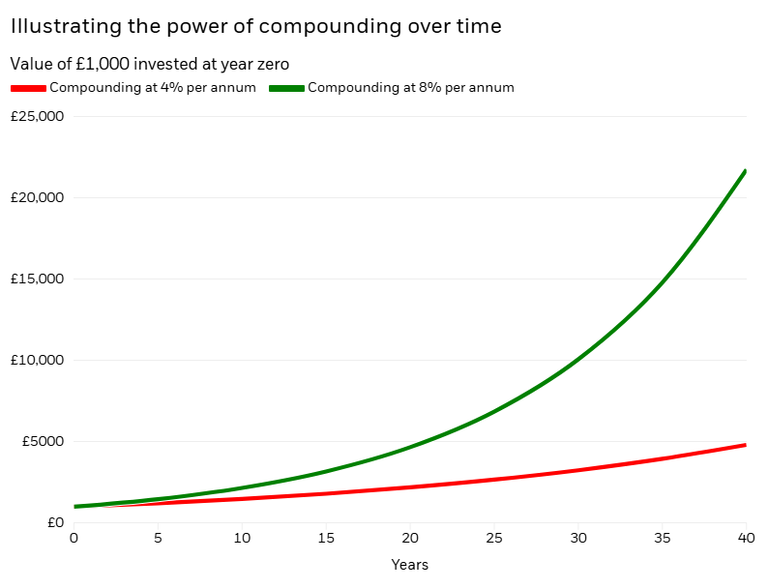
Source: BlackRock. For illustrative purposes only.
Obviously, this is a very long time period and equity returns will not be delivered as smoothly as illustrated.
But it demonstrated how investors can benefit from the significant value of long-term compounding, and the sooner they get started, the better their outcomes may be.
Conclusion
Long term total returns come from a blend of dividends, dividend growth and share price changes. Investors should look at all three elements when building a total return strategy.
Active fund managers are aiming to harness these elements to best effect for their inves