You are now leaving BlackRock’s website

You are leaving BlackRock’s website and entering a third-party website that is not controlled, maintained, or monitored by BlackRock. BlackRock is not responsible for the content or availability of the third-party website. By leaving BlackRock’s website, you will be subject to the third-party website’s terms, policies and/or notices, including those related to privacy and security, as applicable. Please review such policies and notices on the third-party website.

2026 GLOBAL INSURANCE REPORT

Different by Design: Rethinking the Insurance Model
Overhead view of a person standing on a gray textured surface beneath a bright yellow umbrella, alongside the cover title “Different By Design: Rethinking The Insurance Model

BlackRock’s 15th Global Insurance Report examines how insurers are combining internal capabilities and external partnerships across investments, liabilities, capital, technology and distribution—contributing to a more connected industry, but not a uniform one.

Transcript
GIR 2026 Video Script 00:00:00.080 — 00:05:14.000 · Mark Erickson “Hello, I'm Mark Ericsson, Global Insurance Strategist at BlackRock. I'm pleased to introduce the 15th edition of BlackRock's Global Insurance Report. This year, 463 insurance investment professionals participated in our survey. They represent 31 countries and oversee more than $24 trillion in insurance assets. The global Insurance report is one of the industry's longest running surveys. That gives us a valuable perspective on how insurer priorities have changed over time. In this year, we broaden the lens. We looked beyond asset allocation to understand how insurers are thinking about their businesses more broadly. That matters because many of today's most important decisions don't fit neatly into one category. They span assets, liabilities, capital, technology and distribution. Against that backdrop, five themes stood out. The first is a contrast. At a headline level, insurers appear remarkably consistent. But underneath those averages, we see a different story. Strategies are becoming more differentiated. Views vary by company, size, geography, and business model, and those differences are resulting in increasingly distinct portfolio strategies. One reason for that divergence is the liability side of the balance sheet. Different insurance businesses face very different liability challenges, so there isn't one common challenge facing the entire industry. Life insurers are managing one set of pressures. Property and casualty insurers face another. Multi-line, health and reinsurers have still others. And those differences matter. They affect investment strategy, capital requirements and operating priorities. We can see some of that evolution in how insurers are building their portfolios. Private markets are a good example. A decade ago, private markets were primarily an alternative source of yield. Today, they play a much broader role. In 2016, only 16% of insurers planned to increase allocations to illiquid investments. By 2024, more than 90% planned to increase private market allocations. That growth is now becoming more selective. The question is no longer simply whether to invest in private markets. It is where to invest, how to access those investments and how they fit within insurers’ liabilities and capital objectives. And that leads us to a broader change we see across the industry. It isn't just portfolios that are evolving. The way insurers build and access capabilities is changing as well. Historically, insurers often turn to external asset managers for specialist expertise or cost efficiency. Today, those relationships are becoming much broader, and the change extends beyond asset management. Partnerships increasingly span capital, liabilities, technology and distribution. We think of this as a more modular insurance industry. Insurers are deciding what they want to own internally, and where they want to partner externally. The answer is different for every company. Technology is becoming part of that same equation, and nowhere is that more apparent than with artificial intelligence. AI remains the industry's top technology investment priority, but the conversation is changing. For many insurers, the focus is moving from experimentation to implementation. One of the most interesting findings is the perception gap. 73% of C-suite executives report at least one scaled AI use case. That compares with 51% of non C-suite respondents. Across the industry, adoption is most advanced in underwriting, claims and compliance. So the next challenge is implementation. How do insurers embed AI into everyday workflows, and how does it become part of everyday decision making? When we step back, these findings point to a broader evolution of the insurance industry. The industry is becoming more connected, and it is becoming more modular. Decisions about assets, liabilities, capital, technology and distribution can no longer be viewed entirely in isolation. They are becoming part of a broader enterprise strategy. That changes the strategic question. The question is no longer simply whether an insurer can access a particular capability. It is how all of these capabilities fit together, and ultimately, how insurers combine their own strengths with those of external partners. We hope this year's Global Insurance Report provides a useful perspective on that evolution. And once again, we thank everyone who has participated in this year's survey.”

463

Insurance professionals

31

Markets represented

$24T

Insurance AUM represented

15

Years of survey data

Survey overview

BlackRock’s Global Insurance Report has tracked the evolution of insurer priorities for 15 years. This year’s survey broadens the lens beyond asset allocation to examine the increasing interdependence of decisions across assets, liabilities, capital, technology and distribution.

The findings point to a wider range of operating models built around different combinations of internal capabilities and external partners.

The insurance industry has become more modular, but not more uniform.
Source:

BlackRock, as of August 2026..

Five key themes shaping portfolio strategies and operating models

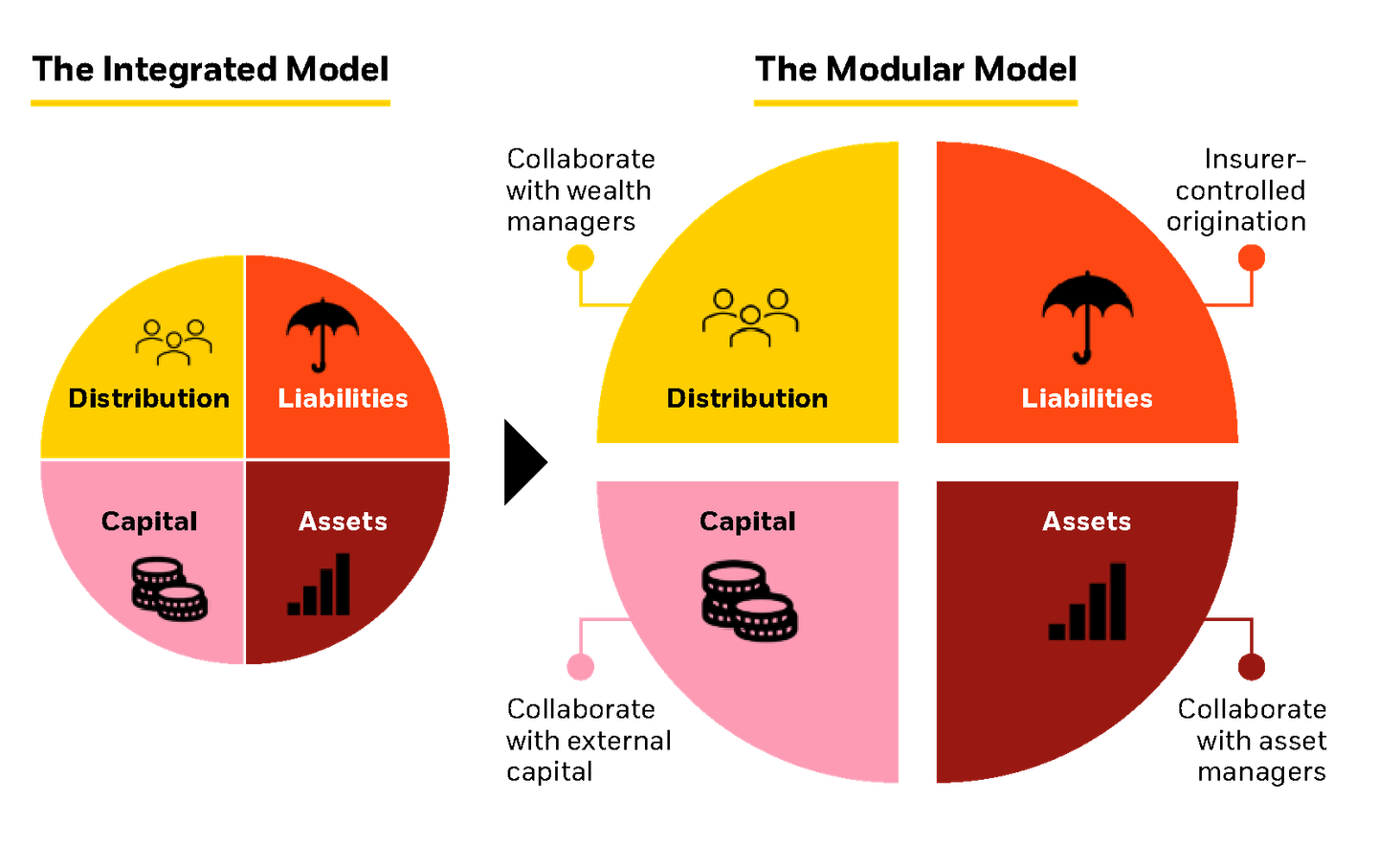
1. Insurers have been transitioning from vertically integrated operating models toward more modular architectures

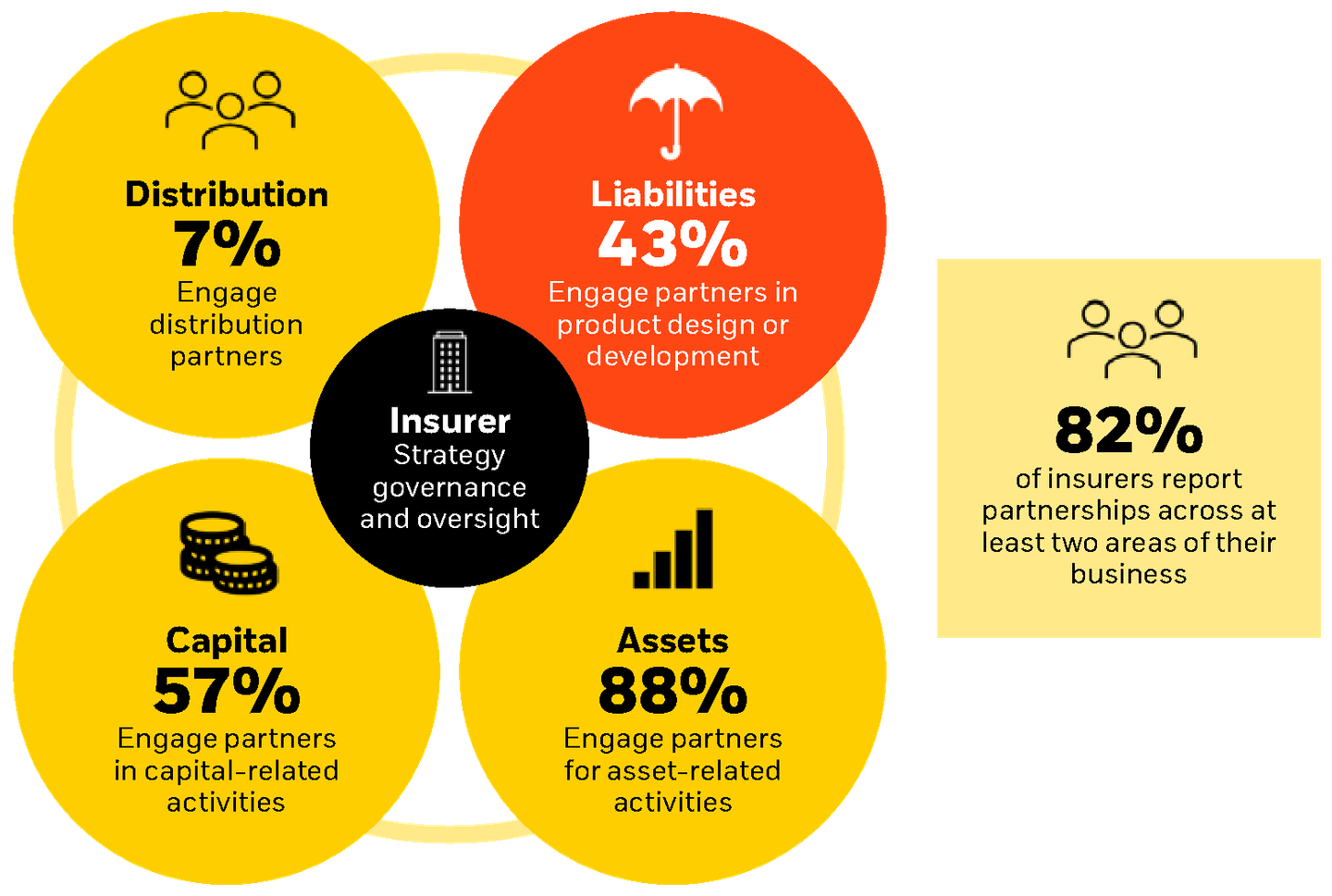
Insurers have increasingly adopted modular operating models, combining internal capabilities with external partners across investments, capital and other core functions, according to our report. Partnerships extend beyond assets to include capital, liabilities and distribution. Insurers have not converged around a single operating model; instead, they are using a wider range of options to align internal and external capabilities with their strategic priorities.

Use of external partners across insurer capabilities
Source:

BlackRock, as of August 2026. For illustrative purposes only.

2. Stable global averages conceal increasingly different strategies

Stable industry averages increasingly mask divergent views and portfolio strategies across regions and insurer segments. 82% of respondents expect to maintain investment risk in 2026, reflecting an industry that has largely adjusted to higher interest rates. Beneath that headline stability, portfolio strategies diverged by firm size, region and economic outlook, shaping portfolio decisions.

Investment risk appetite

Source:

BlackRock, as of August 2026.

Respondents expecting a soft landing

Source:

BlackRock, as of August 2026.

3. Liabilities drive strategy

Liability-specific challenges have been driving different investment priorities, capital needs and operating decisions across business lines. Life and annuity respondents focused on extending liability duration, while property and casualty respondents cite claims severity and inflation. Multiline respondents pointed to increasing complexity; health respondents, to utilization and medical costs; and reinsurers, to tail-event risks.

Top liability profile changes by LOB

Source:

BlackRock. Data as of August 2026.

4. Private markets mature

Over the past decade, private markets have evolved from a source of potential yield into a strategic component of insurers’ investment portfolios. While demand has moderated from a high of 94% in 2025, the reported 76% in 2026 remains one of the highest readings in our survey’s history. In our view, this reflects a shift from broad-based allocation growth toward more selective deployment.

Expected changes to private markets allocations

Source:

BlackRock. Data as of August 2026.

5. AI goes live

Artificial intelligence is moving beyond experimentation toward broader implementation across underwriting, claims, investment and operational workflows. Significant barriers remain, while executives and other respondents view the pace of adoption differently. In our view, closing that gap will require insurers to embed AI more consistently across workflows, decisions and operating models.

AI adoption across insurance workflows

Source:

BlackRock. Data as of August 2026.

2026 Global Insurance Report

Explore the full findings on investment strategy, liabilities, private markets, partnerships and AI.

Contact the team

*Denotes required fields

Read BlackRock's privacy notice